分类: technology

  • Belizean Girls Step Up to Lead in Tech

    Belizean Girls Step Up to Lead in Tech

    A groundbreaking initiative aimed at closing the gender gap in technology is making its fourth annual return to Belize, bringing together a record cohort of young women eager to carve out careers in the digital space. ‘Lead Like a Girl’, which launched as a small grassroots project years ago, has evolved into a nationally recognized movement that continues to expand its reach and impact, empowering growing numbers of teenage girls to explore opportunities in a field historically dominated by men.

    This year alone, 140 female students from 35 high schools across the country are participating in hands-on activities ranging from introductory coding workshops and interactive game development to team-based digital problem-solving challenges. What starts as casual curiosity for many participants is quickly transforming into concrete long-term career ambition, as the program creates a supportive, judgment-free space for young women to test their skills and build confidence in tech-focused work.

    Namrita Balani, Belize’s Director of Science and Technology, noted that the program’s rapid growth in participation over the past four years signals two key shifts: a sharp rise in young women’s inherent interest in technology, and the emergence of a far more robust support ecosystem to nurture that interest. Today, the initiative is backed by a range of stakeholders, from local community groups that provide mentorship to education institutions that offer dedicated scholarships for girls pursuing post-secondary tech degrees.

    Despite this progress, gender disparities persist in Belize’s tech sector. National data confirms that male participation and proficiency in digital skills still outpaces that of women, especially among the 15 to 24-year-old age bracket. This gap makes initiatives like ‘Lead Like a Girl’ all the more critical to encouraging more young women to enter the field, advocates say.

    Speaking to program participants, UNICEF Belize Representative Sajid Ali urged the young attendees to embrace their potential as future leaders in tech, emphasizing that the next great Belizean innovator could already be sitting among them. ‘Someone sitting in this room, she is the next innovator. She’s definitely from Belize. And she could be you,’ Ali told the gathered students.

    For audiences wanting to learn more about the personal experiences of program participants who are already building their tech careers, Belize’s News 5 will air a full feature on the initiative during its 6 PM broadcast this evening.

  • Dominican delegation studies U.S. aviation technology at SUN ’n FUN

    Dominican delegation studies U.S. aviation technology at SUN ’n FUN

    Against the backdrop of the 2026 SUN ‘n FUN Aerospace Expo, a major global gathering for aviation innovation and industry collaboration, a high-level delegation from the Dominican Republic’s Airport Department traveled to Orlando this week to tour the aviation division of the Orange County Sheriff’s Office. The technical visit was spearheaded by Fenris Plácido, a Dominican-born pilot with an established career within the sheriff’s office aviation unit, a role that stands as a prominent example of Dominican aerospace talent succeeding on the international stage.

  • Dubai Completes First Flying Taxi Station

    Dubai Completes First Flying Taxi Station

    In a landmark leap forward for advanced urban mobility, Dubai has officially completed construction on the world’s first purpose-built flying taxi station, with commercial passenger operations on track to launch before the close of 2026. The milestone was announced by Crown Prince Sheikh Hamdan bin Mohammed bin Rashid Al Maktoum during an inspection tour of the new electric vertical take-off and landing (eVTOL) facility, located just a short distance from Dubai International Airport.

    The completed infrastructure is a four-story central hub purpose-built to support the nascent air taxi industry. Designed to accommodate growing passenger demand, the station has an annual capacity of up to 170,000 passenger trips, and will act as the primary base for all of Dubai’s upcoming commercial air taxi services. Authorities have already unveiled plans to develop three additional stations across other key districts of the city in coming phases of the project.

    Commercial flight operations will be run by Joby Aviation, a California-based aerospace company specializing in electric urban air mobility. Under the terms of its agreement with Dubai authorities, Joby has secured exclusive operating rights for the air taxi network for an initial six-year period.

    City officials frame the project as a transformative step forward for urban transportation in Dubai. By rolling out this new zero-emission transit mode, they expect to cut travel times dramatically between the emirate’s key economic, residential, and tourist destinations, while advancing the region’s goals for building faster, more sustainable urban mobility infrastructure that aligns with global carbon reduction targets.

  • Dubai says first flying taxi station completed

    Dubai says first flying taxi station completed

    In a landmark step forward for urban advanced air mobility, Dubai has officially completed construction of the world’s first purpose-built electric vertical take-off and landing (eVTOL) flying taxi station, with commercial passenger services on track to launch by the end of 2025, Gulf emirate officials announced Thursday.

    The completion of the project was marked by a visit from Sheikh Hamdan bin Mohammed, Dubai’s Crown Prince and Deputy Prime Minister of the United Arab Emirates, according to an official statement released by the emirate’s media office. Billed as a one-of-a-kind infrastructure facility globally, the new hub spans four floors across 3,100 square meters near Dubai International Airport. It comes equipped with a two-storey public parking facility, two dedicated takeoff and landing pads for air taxis, and purpose-built high-capacity charging infrastructure tailored for electric eVTOL craft.

    As the central operations hub for Dubai’s upcoming flying taxi network, the completed station is designed to handle up to 170,000 passenger trips annually. Officials added that three additional purpose-built air taxi stations are already in the planning pipeline to expand the network across the emirate in coming years.

    All commercial air taxi flights will be operated by Joby Aviation, a California-based electric aviation company that has secured exclusive six-year operating rights for the service in Dubai.

    Speaking on the occasion of the station’s completion, Sheikh Hamdan emphasized that the new infrastructure represents a critical milestone in Dubai’s push to adopt cutting-edge, sustainable transportation alternatives and future-proof the city’s mobility ecosystem for decades to come. For years, Dubai — the UAE’s most populous urban center — has positioned itself as the leading business and tourism hub of the Middle East, consistently investing in emerging technology to maintain that status.

    The announcement comes against a backdrop of recent regional geopolitical tension: in recent weeks, the Gulf region has seen tit-for-tat attacks launched by Iran against its neighboring Gulf states, carried out in retaliation for the US-Israeli military offensive in Gaza. A two-week ceasefire has now been implemented across the region, easing immediate security concerns.

  • MC Systems pushes cash automation tech to banks, businesses

    MC Systems pushes cash automation tech to banks, businesses

    KINGSTON, Jamaica — As cash-handling operations remain a manual, cost-heavy burden for financial institutions and high-volume cash businesses across Jamaica, regional fintech provider MC Systems is pushing for widespread adoption of a cutting-edge cash automation solution designed to overhaul outdated cash processing workflows.

    The firm, a subsidiary of the Jamaica National Group that serves Caribbean markets with digital and financial technology services, recently rolled out in-person demonstrations of the DN Series 600V Teller Cash Recycler at Kingston’s Courtleigh Hotel. The roadshow targeted a core audience of local banks, remittance service providers, large retail chains and other cash-intensive enterprises that process thousands of physical cash transactions daily.

    Manufactured by global fintech leader Diebold Nixdorf and distributed exclusively in the region by MC Systems, the automated system streamlines end-to-end teller-level deposit and withdrawal processes. It eliminates the need for manual cash counting, manual transaction reconciliation and manual data entry — three of the most time-consuming tasks for frontline cash-handling staff.

    In an interview during the demonstration series, MC Systems Managing Director Dwayne Russell emphasized that the efficiency gains delivered by the technology are accessible far faster than many other business transformation projects. “This is a lever you can pull this quarter,” Russell noted, highlighting the immediate potential to reallocate employee hours away from repetitive administrative work, cut exposure to common cash-handling hazards, and lift overall organizational productivity.

    Unlike many new enterprise systems that require full overhauls of existing infrastructure, the DN Series 600V integrates seamlessly with businesses’ current operational platforms. All transaction data is automatically logged and synced after a single command input, eliminating the risk of human error from duplicate data entry and reducing end-of-shift balancing discrepancies that often cost businesses hours of extra work.

    Beyond cutting down on wasted time, MC Systems positions the recycler as a critical upgrade for cash security. All funds are stored in reinforced, locked vaulted compartments within the device, which drastically reduces how often employees need to physically handle cash. This in turn lowers the risk of internal theft, accidental cash loss, and external robbery. It also reduces businesses’ reliance on third-party cash transportation couriers, cutting additional security risks and associated courier fees.

    The technology leverages Diebold Nixdorf’s existing cash recycling platform, the same infrastructure that powers the company’s global ATM networks. This shared platform allows financial institutions to standardize their equipment, maintenance protocols and staff training across both branch teller operations and ATM channels, eliminating the complexity of managing disconnected systems.

    For long-term strategic cash management, the system supports a shift toward a unified cash model where branches and ATMs operate on the same integrated platform. This reduces redundant cash handling across channels and drives down long-term servicing and inventory costs. It also comes with built-in remote monitoring and predictive maintenance tools that maximize system uptime and minimize unplanned operational disruptions for multi-location businesses.

    To help local businesses test the technology before full deployment, MC Systems has launched an early adopter program that offers customized return-on-investment analysis and tailored pilot deployment plans aligned with each organization’s unique operational needs. The company says the program is designed to help businesses speed up implementation while tracking tangible performance improvements in real time, addressing common barriers to adopting new enterprise technology.

  • Jamaican AI loading

    Jamaican AI loading

    As the global artificial intelligence boom reshapes economies and societies across every continent, the Caribbean is stepping into the creator space rather than remaining just a passive consumer of foreign-developed tech. The region’s latest home-grown innovation, Maestro AI, is currently wrapping up its final testing phase, with ambitious long-term goals that include regional expansion, a public listing on the Jamaica Stock Exchange, and driving broad socio-economic transformation across the Caribbean.

    Maestro AI is developed by Maestro AI Labs, a startup founded just three months ago by veteran Jamaican tech entrepreneur Adrian Dunkley alongside his brother Nicholas Dunkley. Framed as a unique hybrid venture that balances commercial innovation with public impact, the project marks a historic step forward in building a locally rooted AI ecosystem built by Jamaicans, for Jamaicans.

    Unlike many large AI projects that require $5 million to $15 million in upfront investment to build a large language model from scratch, Maestro AI leverages a more cost-efficient, context-focused development strategy. The team adapted pre-existing open AI frameworks, then stripped away unnecessary components and retrained the model using locally sourced Jamaican data vetted for ethical use. This approach allowed the small team to compress what typically takes a full year of development into just three months.

    Importantly, the platform’s core knowledge base was not built using scraped or proprietary third-party data, a key differentiator that aligns with the team’s commitment to ethical AI development. Currently, the founders are actively seeking collaborative partnerships with local content creators and academic and public institutions to responsibly expand the platform’s knowledge base over time. For any user queries that fall outside the scope of its trained knowledge, Maestro AI is designed to respond with full transparency, explicitly stating when it lacks sufficient information to answer, rather than generating unsubstantiated responses.

    Adrian Dunkley, the startup’s chief founder, emphasized that while the project is currently prioritizes social good over short-term profit, it already boasts robust general capabilities ranging from academic essay writing to research support and complex problem solving. Though its reasoning capacity is currently on par with earlier versions of global large language models like ChatGPT, the Maestro AI team has no plans to compete with global tech giants on raw computational power. Instead, their focus is on building practical, context-specific tools that address the unique needs of Caribbean communities.

    Key functionalities currently in development include tools to help ordinary citizens interpret complex local legislation and forecast its impact on daily life, early disease detection support for the regional healthcare sector, and improved hurricane forecasting and disaster preparedness planning tools. The platform also offers customized decision-support resources for individual users and small business owners. This mission builds on Dunkley’s previous venture, StarApple Analytics, which delivered enterprise-focused AI solutions to regional clients. Maestro AI expands that scope to prioritize societal transformation and even life-saving outcomes.

    “Our goal is to be able to predict extreme weather events like hurricanes weeks in advance, giving communities time to prepare and plan,” Dunkley explained in an interview. “Ultimately, we want to give governments and individuals across the Caribbean a personal ‘crystal ball’ for their daily lives and long-term planning.” He added that through better access to contextually relevant information, improved planning capacity, and equitable access to resources, the team envisions Maestro AI helping Caribbean people add an average of 10 years to their life expectancy over time.

    Though rooted in Jamaican context, Maestro AI was built as a modular system that can be easily adapted for other Caribbean nations. As the platform matures, localized versions tailored to the specific laws, cultural norms, and economic priorities of countries including Trinidad and Tobago, Guyana, and other regional markets will be rolled out across the Caribbean.

    The startup has already secured high-profile international backing to advance its development: leading American tech giant Nvidia has joined the project as a partner, providing critical technical training, access to core infrastructure including high-performance GPUs and servers, and support for marketing and capital-raising efforts. The founding team is also currently in active discussions with other global tech leaders including Google and Amazon to explore additional collaboration and support opportunities.

    Despite this international partnership support, Maestro AI remains driven primarily by Jamaican ingenuity. The core development team consists of just three full-time human developers, supported by a network of AI tools, local volunteers, and young Jamaican tech talent – a small, agile group that has delivered extraordinary progress in an accelerated timeline.

    Amid this rapid development, the founding team has placed non-negotiable priority on AI safety and ethical governance. The platform is undergoing extensive rigorous testing to eliminate harmful algorithmic biases and unintended dangerous behaviors. A dedicated red team is currently carrying out active stress testing to probe for security vulnerabilities and test whether the system can be manipulated to generate harmful or unethical output. “If it’s not safe, we won’t release it,” Dunkley confirmed, noting that the team is fully prepared to rebuild the platform from the ground up if critical safety issues are identified.

    As Maestro AI moves closer to public release, early discussions with regional investors are already underway, and long-term plans for an initial public offering (IPO) on the Jamaica Stock Exchange are already in development. The IPO is scheduled to take place after the initial public rollout, and will raise capital to scale operations, expand into new regional markets, and continue refining the platform’s technology. The ultimate goal, the founders say, is to build a home-grown Caribbean tech unicorn that puts regional priorities first.

    For Dunkley, the project is about more than just building a successful tech company: it is a deliberate effort to ensure the Caribbean does not remain solely a consumer of foreign-developed AI technology, but takes its place as an active creator in the global AI ecosystem. By embedding local knowledge, culture, and community priorities into the core of the platform’s design, Maestro AI aims to reflect and advance the region’s unique values and shape its own future in an increasingly digital global economy.

  • SMA reinforces commitment to Caribbean digital resilience and regional collaboration

    SMA reinforces commitment to Caribbean digital resilience and regional collaboration

    KINGSTON, Jamaica — Against a backdrop of growing regional demand for reliable, future-ready digital infrastructure, Jamaica’s top spectrum regulator has doubled down on its pledge to elevate digital resilience across Jamaica and the entire Caribbean basin, stressing that coordinated cross-border action, robust spectrum stewardship, and ongoing technical capacity investments are non-negotiable for long-term progress.

    The Spectrum Management Authority (SMA) laid out this strategic vision at the 31st annual Caribbean Network Operators Group (CaribNOG) Forum, which ran from April 14 to 16, 2026, in Kingston. The gathering brought together hundreds of regional and global digital industry stakeholders, policymakers, and technical experts to tackle pressing questions about the future of Caribbean digital infrastructure, aligning all discussions around the official forum theme: “The Resilient Archipelago: Strengthening the Caribbean’s Digital Core”.

    During a dedicated session focused on elevating women in the Caribbean tech and network operations space, Dr. Maria Myers-Hamilton, SMA’s Managing Director, centered her remarks on a critical, often overlooked truth: building robust, shock-resistant digital ecosystems requires far more than just laying new fiber or upgrading hardware. It requires intentional cross-stakeholder collaboration, visionary proactive leadership, and consistent, long-term investment in developing skilled workforces and strong institutional frameworks.

    “Digital resilience for the Caribbean is never solely a technical challenge,” Dr. Myers-Hamilton explained. “At its heart, it is a test of how we work together as an interconnected region. Our communication networks, our digital systems, and even our shared spectrum environments do not stop at national borders. To strengthen resilience, we must strengthen collaboration first, build up the technical expertise of our teams, and manage our finite spectrum resources in a way that prioritizes long-term sustainability and inclusive economic growth.”

    She went on to reinforce that evidence-based, effective spectrum management stands as the foundational pillar of all efforts to boost regional digital resilience, framing the practice as a strategic catalyst that unlocks universal connectivity, advances public safety outcomes, and drives broad-based economic development across Caribbean island nations.

  • How Online Is the Antigua and Barbuda, the Caribbean?

    How Online Is the Antigua and Barbuda, the Caribbean?

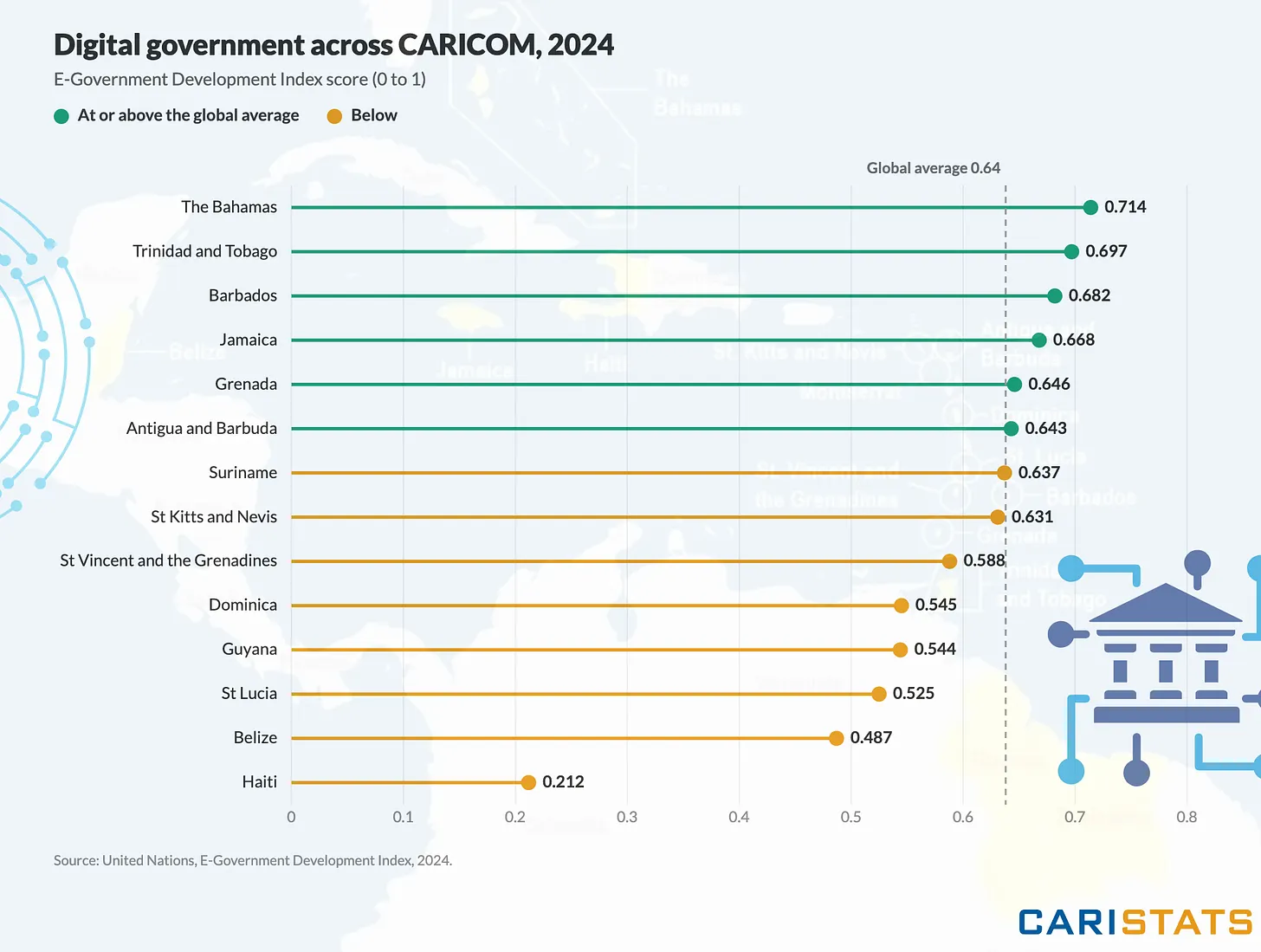
    New 2024 estimates published by the International Telecommunication Union (ITU) have laid bare a dramatic gap in internet adoption rates across member states of the Caribbean Community (CARICOM), with penetration ranging from more than 90% to less than half of the national population.

    According to the ITU’s standardized indicator, which counts any individual that accessed the internet from any location, on any electronic device, at least one time over the previous three months, the Bahamas leads the regional ranking with a 92.5% internet usage rate. At the opposite end of the spectrum sits Haiti, where just 47.9% of the population meet the threshold for measured internet use. For global context, the worldwide average internet usage rate currently stands at 73.6%, meaning the CARICOM region includes both nations that far outpace global standards and those that fall well short.

    While a majority of CARICOM member states fall into a mid-range cluster, with usage rates between 68% and 83%, the data holds several unexpected outcomes that challenge assumptions based on national income classification. Two upper-middle-income economies, Guyana and Belize, posted stronger internet usage results than some wealthier high-income counterparts in the region: Guyana notched an 83.0% penetration rate, and Belize hit 80.0%, compared to 70.4% in Barbados and 72.7% in Antigua and Barbuda—both of which are categorized as high-income economies by the World Bank.

    Regional analysts point to a mix of interconnected factors that drive these divergent outcomes, beyond just national gross domestic product per capita. The affordability of mobile and fixed data, the geographic reach of digital communications infrastructure, the age breakdown of national populations, and the level of competition in domestic telecom markets all play key roles in determining how many people actually go online on a semi-regular basis across the Caribbean.

    This analysis, compiled by regional data initiative CARISTATS, draws on official 2024 figures from the ITU DataHub’s “Individuals using the Internet” dataset. CARISTATS currently offers this public data analysis for free, and encourages readers who value their work to commit to a future subscription; no charges will be applied until the organization formally activates its payment system.

  • Amazon says to buy Globalstar to expand satellite network

    Amazon says to buy Globalstar to expand satellite network

    PARIS, France – E-commerce and technology conglomerate Amazon announced Tuesday a definitive acquisition agreement to acquire U.S. telecommunications satellite operator Globalstar, a move designed to supercharge the expansion of Amazon’s planned space-based internet network and mount a direct competitive challenge to Elon Musk’s market-leading Starlink service.

    Under the terms of the deal, Amazon will offer Globalstar shareholders $90 per share through a combined cash-and-stock transaction, valuing the satellite firm at approximately $9 billion – a valuation first flagged by a Financial Times report earlier this month that fueled widespread market speculation of the impending acquisition.

    Jeff Bezos-founded Amazon has been developing its low-Earth orbit (LEO) satellite internet constellation, branded Project Kuiper, with the core mission of delivering high-speed broadband connectivity to underserved communities and users across every corner of the globe, a goal that has become an increasingly high priority for the tech giant as demand for global connectivity surges.

    “There are billions of customers out there living, travelling and operating in places beyond the reach of existing networks, and we started Project Kuiper to help bridge that divide,” stated Panos Panay, Amazon’s Senior Vice President for Devices and Services, in an official press release announcing the deal.

    The acquisition has already secured backing from roughly 58% of Globalstar’s existing shareholders, with regulatory and procedural approvals expected to push the closing of the transaction to 2027. A key strategic side agreement tied to the acquisition will see Apple – which currently holds a 20% minority stake in Globalstar – transition its existing satellite-based iPhone and Apple Watch services, including its popular Emergency SOS feature, to Amazon’s Project Kuiper network once the constellation is fully operational.

    At present, Project Kuiper has approximately 200 satellites active in low-Earth orbit, a fraction of the size of Starlink’s current deployed network of more than 10,000 satellites that have already cemented the SpaceX-owned service’s dominance in the fast-growing satellite internet market.

    The Globalstar acquisition comes at a moment of intense market anticipation around SpaceX, with widespread speculation that Musk is preparing to launch an initial public offering for the aerospace firm that could raise as much as $75 billion. If achieved, the IPO would become the largest public offering in global history, underscoring the massive commercial stakes in the burgeoning satellite internet industry.

  • Students prepare for robotics world championship in US

    Students prepare for robotics world championship in US

    A cohort of talented secondary school students from across Barbados is set to make history this month, representing the small Caribbean island at the 2026 VEX World Robotics Championship in St. Louis, Missouri, following five months of nonstop work to design and build two fully custom competition robots from the ground up.

    Organized under the banner of the Gears Unboxed 246 Robotics Club, the team draws members from five of Barbados’ top secondary institutions: The St Michael School, Harrison College, Queen’s College, The Lodge School, and the Foundation School. Last week, the young innovators gathered at the Special Education Unit to showcase their months of work to educators, government officials, and program sponsors, demonstrating the core capabilities of their two creations, codenamed *Flying Fish* and *Broken Trident*.

    For the team’s volunteer mentors, this milestone is far more than a simple competition trip—it represents a decades-long push to shift Barbados’ relationship with technology from a net importer of foreign ideas and devices to a global exporter of homegrown innovation. “This is about representing the blue, yellow, and black of our nation,” said Shawn Hoyte, a lead coding and robotics mentor and teacher. “I told these young people from day one: this is not beyond us. We can’t keep relying on other countries to build our technology and create our ideas. These are indigenous innovations, built right here by Barbadian youth. They aren’t just leading the way for our country—they are the tip of the spear.”

    To reach this point, the team has followed a grueling schedule that far outpaces the average school extracurricular. For five months, members have worked from 9 a.m. to 8 p.m. most days, including weekends, to troubleshoot designs, refine code, and test their robots. What makes the achievement even more notable is that most elite international competitors spend a full year preparing for the championship, while the Barbadian team condensed that entire process into half the time.

    Twelve-year-old Paula Bridgeman, a robot builder and driver from Queen’s College, walked audiences through the design of *Flying Fish*, the team’s entry in the championship’s pin-stacking competition, where teams earn points for strategically grouping colored pins. “The autonomous section is where the robot operates entirely on its own, completing all tasks without any human control,” Bridgeman explained. “A single connected pin earns one point, but mixed-color connected clusters give a five-point bonus, so the robot’s positioning and decision-making have to be perfectly calibrated.”

    Fifteen-year-old Tykiari Sergeant, a team member from Harrison College, detailed the steep learning curve the group faced to master advanced engineering concepts they had never studied before, including pneumatics and gear ratio tuning. “Every gear on this robot serves a specific purpose—it’s not just for aesthetics,” Sergeant said. “Adjusting the number of teeth on a gear changes the robot’s speed and torque, so we had to test dozens of combinations to get it right. We went through so many iterations because of stability issues, but after hours of research and trial and error, we finally landed on a design that worked.”

    Joshua Jupiter, 15, from The St Michael School, explained the team’s advanced technical work on autonomous navigation, noting that they implemented a custom Proportional Integral Derivative (PID) control algorithm to let the robot automatically correct its course during the fully autonomous phase of competition. The team’s second robot, *Broken Trident*, built for the VEX V5 division, features a one-of-a-kind S-shaped intake system engineered to collect and score game balls with far greater efficiency than most standard designs.

    The milestone drew praise from top leaders in Barbados’ education sector, with Chief Education Officer Dr. Ramona Archer-Bradshaw in attendance at the demonstration to celebrate the team. Dr. Archer-Bradshaw’s presence was particularly meaningful, as she has been one of the core driving forces behind bringing robotics education to Barbados’ schools for more than a decade. The entire initiative has been made possible by private sponsor support and the volunteer work of teachers who have stepped outside their regular job duties to serve as mentors for the students.

    Looking back, Dr. Archer-Bradshaw recalled the origins of the movement back in 2013, when she was a science tutor at Erdiston Teachers’ Training College with a simple but ambitious dream: to embed coding and robotics into Barbados’ national K-12 curriculum to build critical thinking skills among young people. “This journey didn’t start yesterday, and it didn’t start last year—it started back in 2013, when I believed that coding and robotics could change how our children learn to problem-solve,” she shared.

    The initiative grew out of an early partnership with the Caribbean Science Foundation and prominent Barbadian scientist Cardinal Ward. After completing personal training in robotics drivetrain design and block coding, Dr. Archer-Bradshaw led a nationwide effort to train teachers across Barbados, an effort that has now resulted in more than 300 local educators earning certification in various VEX robotics platforms.

    While qualifying for the world championship represents the highest milestone for the program to date, Dr. Archer-Bradshaw emphasized that the initiative’s true value extends far beyond competition results. “Some people will look at this and say it’s just coding and robotics, but it’s so much more than that,” she explained. “This is a vehicle to teach young people how to think critically, how to solve problems, how to bounce back when you make a mistake, and how to collaborate and communicate with your teammates. Those are skills that will serve them for life, no matter what career they choose.”

    The program expanded dramatically in 2022, when the Ministry of Education Transformation supported the integration of coding into nursery, primary, and secondary school curricula, with education reform leaders spearheading sustainable institutional change. The expansion led to the appointment of a dedicated full-time education officer to oversee the program and ensure its long-term growth. When program coordinator Kenneth Harewood first approached Dr. Archer-Bradshaw last year to request support for sending a team to the world championship, she issued a clear challenge: this could not be a one-off event. The team had to build a pathway for future Barbadian teams to compete in years to come. The team met that challenge, clearing the way for this month’s 2026 trip and establishing a sustainable pipeline for future participation.

    The Gears Unboxed 246 team enters the championship focused on their ultimate goal of bringing home the world title, a win they frame as a history-making moment for Barbados’ education and technology sectors. “These students deserve to be celebrated, because nothing like this has ever been done for Barbados,” Hoyte said. “I love taking on challenges, and even with all the hard work, nothing compares to the pride of watching these young people represent our country on the world stage.”

    Closing out the demonstration, Dr. Archer-Bradshaw credited the initiative’s success to the hundreds of dedicated teachers across the island who have poured extra time into making the program a life-changing opportunity for Barbadian youth. “I’m so happy that the vision and the dream of coding and robotics in our schools has finally come to pass,” she said, as the audience erupted in applause for the departing team.

    The 15-member team includes competitors across two divisions: the VEX IQ team features Virineia Lakuboo (1st form, Harrison College), Joshua Jupiter (3rd form, St Michael School), Paula Bridgeman (2nd form, Queen’s College), and Tykairi Sargeant (4th form, Harrison College). The VEX V5 team includes J’nai Thomas (5th form, Christ Church Foundation), Nathan Whittaker (4th form, Alleyne School), Ashley Chase (5th form, St Michael School), and Tyler Marshall Branker (5th form, Christ Church Foundation).