分类: society

  • A risk to justice system

    A risk to justice system

    As Trinidad and Tobago moves forward with a planned expansion of criminal courts to cut through a massive backlog of pending cases, a top regional security expert is sounding the alarm that crippling staffing constraints at the Office of the Director of Public Prosecutions (ODPP) puts both the nation’s justice system and overall national security at severe risk.

    Details of the staffing crisis first emerged over the weekend, when the Sunday Express reported that the ODPP has formally confirmed it cannot allocate prosecutors to the newly added court seats, despite the judiciary’s push to expand the High Court’s Criminal Division to tackle the growing backlog that has delayed justice for years. In a formal correspondence dated April 30 addressed to Kimberly Prescott, acting Registrar of the Supreme Court, ODPP Director Roger Gaspard, SC, made clear that the office lacks the prosecutorial workforce to support three to four additional High Court judges that were scheduled to begin hearing backlogged cases starting in early May.

    Speaking exclusively to the Express over the weekend, regional security consultant Dr. Garvin Heerah explained that the new court initiative was meant to be a landmark intervention to address rising crime, widespread criminal impunity, long-standing justice delays, and plummeting public trust in the country’s justice institutions. He emphasized that speeding up case prosecution, reducing judicial turnaround times, and strengthening the pathway to successful convictions are non-negotiable steps to rebuild public confidence in the rule of law across the twin-island nation.

    While Heerah commended the Trinidad and Tobago government for taking the critical step of expanding court capacity, he stressed that the operational and human infrastructure supporting the reform effort must also be upgraded to match. “Courts that operate without enough prosecutors, legal researchers, administrative support staff, digital case management systems, coordinated witness support, and dedicated security resources will never deliver on the promised outcomes,” Heerah argued. He added that meaningful justice reform depends on aligned investments in personnel, operational readiness, and strategic resource allocation, not just investments in physical court infrastructure.

    To address the growing gap between prosecutorial demand and available capacity, Heerah has called for urgent, targeted action. His proposed solutions include accelerated recruitment drives for new prosecutorial staff, temporary secondment programs to bring in additional prosecutorial support, targeted hiring for specialized legal roles, investment in improved case preparation protocols, and modernization of outdated operational systems.

    Beyond the immediate staffing crunch, Heerah also raised urgent alarms about operational security gaps for high-stakes cases, including prosecutions involving transnational organized crime, gang violence, public corruption, and intelligence-linked criminal activity. He noted that expanding the volume of court and prosecutorial work will increase the exposure of prosecutors, witnesses, investigators, digital evidence systems, and judicial officers to violent threats, intimidation campaigns, information leaks, and outside interference from criminal networks.

    “Proper Operations Security (OPSEC) protocols have to be built into the reform framework from the very start, not added as an afterthought once risks emerge,” Heerah said. He outlined key security measures that should be implemented immediately, including encrypted secure communication systems, controlled protocols for handling sensitive case documents, enhanced protection for digital evidence, restricted access to sensitive prosecutorial workspaces, improved intelligence coordination with security agencies, regular proactive threat assessments, strengthened support for witness protection programs, and upgraded physical security for both prosecutorial offices and court facilities.

    Heerah concluded that the long-term success of the court expansion initiative will hinge on whether the government grows prosecutorial capacity, personnel numbers, operational systems, and security infrastructure in lockstep with the broader justice reform agenda. “This is a defining moment for criminal justice reform in Trinidad and Tobago,” he said. “If we want to make real, lasting progress in the fight against serious crime, we have to approach this reform with strategic coordination, urgent action, and a focus on long-term sustainability.”

    Gaspard’s letter laid bare just how severe the staffing crisis has become over the past three years. He explained that the crisis has deepened after three deputy Directors of Public Prosecutions and two assistant deputy DPPs were promoted to judicial positions, leaving all deputy DPP roles completely vacant and only half of all assistant DPP posts filled. While recruitment falls under the purview of the Judicial and Legal Service Commission and the Office of the Attorney General, Gaspard noted that new appointments are still pending, and even newly hired prosecutors will require months of extensive training before they are qualified to handle complex serious criminal cases.

    Currently, Gaspard added, prosecutors already assigned outside of the Assize courts carry extremely heavy caseloads across district courts, children’s courts, masters’ courts, and bail courts, with each prosecuting attorney managing more than 70 active matters at any given time. He warned that shuffling already overstretched personnel to the new High Court seats would inevitably erode both the quality and timeliness of prosecutorial work across all other court levels, creating new delays even as the government tries to solve existing backlogs.


  • Government Continuing Repiping Programme as Drought Pressures Water Supply, PM Says

    Government Continuing Repiping Programme as Drought Pressures Water Supply, PM Says

    As Antigua and Barbuda grapples with increasingly severe drought conditions and a century-old crumbling water distribution network, Prime Minister Gaston Browne has confirmed that the administration is pressing forward with a sweeping national initiative to replace outdated pipes and modernize critical water infrastructure. In an interview aired on local radio station Pointe FM, Browne laid out the urgent scope of the project, explaining that large swathes of the country’s underground pipe network have deteriorated so significantly that massive volumes of treated water are lost to leaks before ever reaching residential and commercial consumers.

    “We have systematically been rolling out pipe replacement projects across every region of the country,” Browne stated during the discussion of the ongoing infrastructure drive. The core goals of the program, he emphasized, are to bring the country’s water system into the 21st century and cut down on the crippling non-revenue water loss that has strained supply for years.

    The prime minister tied the country’s mounting water challenges to two interconnected factors: prolonged dry spells that have become far more frequent, and shifting climate patterns that are disrupting rainfall across not just Antigua and Barbuda, but the entire Caribbean basin. “We are actively confronting persistent drought conditions right now,” Browne said, noting that well below average rainfall over recent months has added unprecedented pressure to a system already operating beyond its designed capacity.

    To address immediate supply gaps alongside long-term resilience, the government is also ramping up production at reverse osmosis desalination facilities, which convert saltwater from the surrounding ocean into potable water for domestic use. Browne added that utility managers have implemented a key coordination strategy to avoid unnecessary disruption and waste: all water infrastructure upgrades are being timed to align with planned road repair and reconstruction projects across the country. This integrated approach eliminates the costly and frustrating scenario of resurfacing a road only to dig it up again weeks later to access and replace underground pipes. “There is no logic in completing road repairs, then turning around and digging up fresh pavement to access pipe lines,” Browne explained of the coordinated planning.

    For years, intermittent water supplies and outright shortages have been a top complaint for residents in communities across Antigua and Barbuda, with problems intensifying during seasonal droughts and peak tourist seasons when demand for water surges. According to government statements, the ongoing multi-million dollar investments in desalination expansion, network repiping and utility modernization are designed not just to address current shortages, but to build long-term water security and strengthen the country’s ability to withstand the growing climate impacts that threaten small island developing states across the Caribbean.

  • OPINION: Embracing the Bilingual Antiguan and Barbudan

    OPINION: Embracing the Bilingual Antiguan and Barbudan

    In the sun-drenched archipelago of Antigua and Barbuda, a rich linguistic tapestry has woven itself into the very fabric of national identity – one that blends the country’s official English with the creole language spoken and cherished by generations of locals. This natural bilingual dynamic is not a flaw to be corrected or a barrier to be overcome, as some historical narratives have suggested; it is a remarkable cultural asset that deserves full recognition and celebration across all sectors of national life.

    For much of the modern history of Antigua and Barbuda, dominant discourse has positioned standard English as the only legitimate language of education, government, and professional advancement, often sidelining the locally developed creole as a backward or unrefined form of speech. This subtle stigma created unnecessary divides, pushing many residents to hide their fluency in creole in formal settings, eroding a core part of their cultural heritage in the process. But shifting attitudes over the past two decades have begun to unlock the true value of the island nation’s bilingual tradition, challenging old stereotypes and highlighting the social and cognitive benefits that come with growing up navigating two linguistic worlds.

    Bilingualism, as decades of global linguistic research confirms, delivers measurable cognitive advantages: it boosts problem-solving skills, enhances creative thinking, and improves working memory among people who grow up speaking two languages from early childhood. For Antiguans and Barbudans, this innate cognitive advantage is paired with a deep cultural connection: creole carries the collective memory of the islands, from stories of resistance and resilience passed down through generations to the playful turns of phrase and community inside jokes that bind local societies together. At the same time, fluency in standard English opens global doors, enabling participation in international trade, global education networks, and the thriving tourism industry that forms the backbone of Antigua and Barbuda’s economy.

    Far from being mutually exclusive, these two linguistic traditions complement one another perfectly. There is no need to choose between elevating standard English for formal and global engagement and embracing creole as a core part of national identity. Forward-thinking education policy across the islands has begun to reflect this reality, with more educators supporting bilingual learning approaches that allow students to build fluency in standard English while retaining and celebrating their native creole. This approach not only improves educational outcomes by making students feel more seen and supported in the classroom, it also strengthens national cohesion by honoring the linguistic heritage that makes Antigua and Barbuda unique.

    As Antigua and Barbuda continues to navigate the opportunities and challenges of a globalized world, embracing its natural bilingual identity will be key to balancing global connectivity with local cultural sovereignty. By celebrating both of its linguistic traditions, the nation can equip its people with the skills to succeed on the global stage while preserving the cultural heritage that makes it distinct. Bilingualism is not a burden for Antigua and Barbuda – it is one of its greatest strengths, and one that future generations should be able to embrace fully and without stigma.

  • Official launch in Haiti of the rehabilitation works on the RD205

    Official launch in Haiti of the rehabilitation works on the RD205

    On May 16, 2026, Haitian officials gathered to mark the official kickoff of a major infrastructure overhaul for departmental road RD205, a critical transport artery linking the southern coastal city of Les Cayes to the commune of Torbeck. The launch ceremony was led by Joseph Almathe Pierre Louis, Haiti’s Minister of Public Works, and attended by the country’s tourism minister, agriculture minister, and senior local leaders from both Les Cayes and Torbeck.

    For communities across Haiti’s Greater South region, this launch represents the long-awaited start of a project that promises to transform regional connectivity. Stretching far beyond the initial Les Cayes-Torbeck segment, RD205 functions as a primary strategic corridor that connects 12 separate communities along the southern coast, including Chantal, Arniquet, Saint-Jean-du-Sud, Port-Salut, Coteaux, Chardonnières, Roche-à-Bateau, Port-à-Piment, Les Anglais, and Les Irois.

    For years, the existing roadway has fallen into severe disrepair, creating daily crises for everyone who relies on it. The degraded surface generates thick, suffocating dust that plagues nearby residents and creates hazardous driving conditions, while constant potholes and uneven pavement cause persistent travel disruptions for daily commuters, commercial transporters, and small-scale agricultural producers who depend on the road to get their goods to market. Government planners have framed the rehabilitation project as a urgent intervention to unlock economic opportunity and improve access to services for the entire isolated southern region. In a complementary announcement aligned with the government’s broader connectivity goals, the Ministry of Public Works also revealed that feasibility and planning studies are already underway to extend the full rehabilitation work all the way to Port-Salut.

    The entire project is backed by funding from the World Bank, with engineering plans specifically adapted to address the unique challenges of the region’s wetland terrain and variable tropical climate. After assessing local hydrogeological constraints, technical project teams selected hydraulic concrete as the primary construction material, a choice that delivers long-term durability and resilience against frequent heavy rain and flooding. The completed modern roadway will feature two 3.5-meter-wide travel lanes, graded shoulders ranging from 1 to 1.5 meters along both edges, and a fully upgraded longitudinal drainage system reinforced with dedicated hydraulic crossing structures to improve water runoff and reduce flood-related damage.

    On-site construction is scheduled to begin this week, with an estimated total timeline of 10 months to complete the initial segment. Recognizing that construction activity will inevitably cause temporary travel disruptions for local residents and through traffic, the Ministry of Public Works has issued a public call for patience and understanding from the community. The ministry is also coordinating with the Haitian National Police (PNH) to provide on-site security and manage traffic rerouting during the construction period.

  • Long-delayed Grenadines desalination projects to be fast-tracked

    Long-delayed Grenadines desalination projects to be fast-tracked

    St. Vincent and the Grenadines is currently grappling with an unprecedented severe water shortage that has pushed the country’s smaller Grenadines islands into a state of emergency, prompting the newly sworn-in administration to fast-track a seven-year-stalled desalination initiative that was originally gifted by the Italian government.

    Health Minister Daniel Cummings, who holds oversight over the country’s potable water portfolio, launched sharp criticism at the former Unity Labour Party (ULP) government for the years-long delay of the Bequia desalination plant project. In an interview with NBC Radio this Wednesday, Cummings — who assumed his post in December following the New Democratic Party (NDP)’s victory in the November 25 general election — expressed deep frustration over the stagnant initiative. “It is extremely puzzling that for over seven years, a desalination plant donated by the Italian government for the people of Bequia has never moved past the planning stage. For whatever reason the project never got off the ground, and this is nothing short of a tragedy,” he stated.

    The planned facility, which will include dedicated storage infrastructure and distribution pipelines, is designed to convert treated seawater into safe drinking water for Bequia’s residential community. According to Cummings, the country’s Central Water and Sewerage Authority (CWSA) is now prioritizing the project to advance desalination access across most Grenadine islands, a long-term solution that will help ease chronic water scarcity across the region.

    Right now, the entire archipelago is reeling from a severe extended drought that has forced widespread water rationing even on mainland St. Vincent, which is naturally endowed with rivers, springs, and streams to support its municipal water network. The situation is far grimmer across the Grenadines chain, where rainwater harvesting remains the primary source of drinking and household water for most communities. Cummings labeled the current conditions across the Grenadines a “super critical” crisis, emphasizing that Bequia — the largest Grenadine island located just nine miles from the capital Kingstown — is no exception, despite its proximity to the mainland. The island is currently facing extreme water shortages that have disrupted daily life for residents.

    In the short term, authorities are pulling every lever to stabilize water supplies across the affected islands, leveraging a patchwork of existing and soon-to-be-activated private and resort-owned desalination facilities to fill gaps. On Union Island, a private desalination plant developed by a local investor has already been completed but has not yet entered operation. Cummings confirmed that ongoing conversations with the developer have put the facility on track to be commissioned in the very near future. Once operational, water from the plant will be transported by tanker to different parts of the island, as no permanent distribution mains have been constructed for the facility. On Canouan, residents have historically depended on excess water from the island’s resort-owned desalination plant, but the facility is currently struggling to meet its own operational demands, meaning it can no longer supply the same volume of water to local communities it once did. The small island of Mayreau has seen a modest reprieve recently after the Mustique Company installed a small-scale desalination plant in the island’s bay, though additional water still needs to be delivered by boat to meet full community demand.

    Looking toward long-term sustainable solutions, Cummings highlighted modern advances in desalination technology paired with solar energy that have transformed the feasibility of these projects compared to a decade ago. New solar-powered desalination systems cut reliance on expensive fossil fuels dramatically, harnessing renewable energy to treat water and pump it into elevated storage facilities. “The technology has improved dramatically on both fronts: modern desalination requires far less energy than it did 10 to 15 years ago, while solar power systems have become cheaper and far more accessible,” Cummings explained. The elevated storage design also guarantees consistent supply: when sunlight is unavailable after dark, gravity feeds stored water to residents, ensuring a continuous supply of high-quality drinking water across all Grenadine islands.

    Cummings reaffirmed that the new administration is prioritizing long-neglected water infrastructure projects across the Grenadines to address both the immediate crisis and future water security risks, with the Bequia desalination project at the top of the government’s implementation list.

  • 73-Year-Old Grandmother Loses Home in Bella Vista Fire

    73-Year-Old Grandmother Loses Home in Bella Vista Fire

    In the pre-dawn hours of a Sunday in Bella Vista village, Toledo, a sudden out-of-control fire has left a multi-generational family homeless and without their small livelihood, though all four residents managed to escape unharmed. The blaze broke out at approximately 4 a.m. on May 17, 2026, completely destroying the family’s residential property and the home-based business they operated out of the building.

    The head of the household, 73-year-old Felicita Ruiz, fled the burning structure alongside three family members: her daughter Zarahi Pineda, Pineda’s 8-year-old daughter, and son-in-law Greville Bonilla. In a stroke of luck, the family also acted quickly enough to pull all of their vehicles out of the property before the fire consumed the entire building, avoiding additional total loss.

    Ruiz, a well-known local vendor who sold household goods and apparel through regular Facebook Live sales, lost every piece of inventory and personal belonging she owned in the fire. Despite the devastating turn of events, relatives say the 73-year-old is maintaining a remarkably positive outlook. “My mother is okay and strong,” Maria Stephanie Mejia, another of Ruiz’s daughters, told local outlet News 5. “We know that God is strengthening us because my mother has a smile on her face.”

    Mejia, who was not at the property when the fire broke out, shared that the displaced family has already been overwhelmed by outreach from the tight-knit Bella Vista community, for which they are deeply grateful. As of the latest update, investigators have not yet determined what caused the fire. Community members and outsiders who wish to donate or offer support to the Ruiz family can reach out to the family through Facebook, by contacting either Felicita Caballero or Zarahi Pineda directly.

  • Over 100 Salt Spring residents trained and employed through support from Project STAR

    Over 100 Salt Spring residents trained and employed through support from Project STAR

    ST JAMES, JAMAICA – A community-centered development initiative is creating tangible new opportunities for hundreds of residents in one of St James’ local neighborhoods, blending skills training, social support and youth engagement to uplift entire families. Project STAR, the multi-faceted community development program, has already equipped more than 140 Salt Spring residents with targeted professional training designed to raise employability in high-demand sectors ranging from hospitality to customer-facing services, according to Kelly Griffith, the project’s lead for training and job placement.

  • Taxi operators await transport minister meeting outcome amid strike threat

    Taxi operators await transport minister meeting outcome amid strike threat

    ST ELIZABETH, Jamaica — Frustration is running high among hundreds of Jamaican taxi operators, who have agreed to pause planned nationwide industrial action only until the outcome of a scheduled Monday meeting with Transport Minister Daryl Vaz, according to Charles Powell, president of the Southern Taxi Association.

    Powell told reporters on the day of the meeting that the minister’s invitation to bring together all island-wide taxi association heads has convinced drivers to hold off on strike plans for the moment. “If he had not extended this invitation to talk, our members would have already walked off the job across every corner of Jamaica,” Powell explained. “Right now, we are simply holding our breath to see what concessions, if any, come out of this discussion.”

    The high-stakes gathering was set to kick off at 10:00 a.m. on May 18, 2026, at the Half-Way-Tree transport hub in St Andrew.

    Powell’s association alone counts roughly 300 drivers, all of whom are deeply discontented with a trio of long-running issues: unaddressed demands for a fare hike, steadily climbing fuel prices, and shockingly poor road infrastructure across southern parishes.

    At the top of the list of grievances is a 16% fare increase approved for operators more than two and a half years ago that has yet to be implemented. Second is the abysmal state of roads across Manchester, Clarendon and St Elizabeth, which Powell says has sent vehicle maintenance costs skyrocketing. He also pushed for greater leniency in government roadside vehicle inspections, arguing that it is unfair to penalize drivers for wear and tear directly caused by crumbling road surfaces.

    “You can’t expect our vehicles to stay in perfect condition when we’re navigating roads pocked with unmaintained manholes and broken pavement that local representatives have ignored for years,” Powell said, calling out specific stretches including the route from Mandeville to Alligator Pond down Spur Tree Hill, and the Santa Cruz to Black River corridor through Holland Bamboo. “The road is so bad that replacement costs for front-end vehicle parts have tripled. Keeping a taxi on the road is more expensive than it’s ever been.”

    Compounding these infrastructure-driven costs, Powell noted, is the relentless rise of global fuel prices, which has eaten away most of drivers’ daily earnings. He estimates that more than 60% of a typical taxi operator’s daily income now goes directly toward covering fuel costs, a burden so heavy that many drivers can no longer afford to keep their vehicles on the road, leaving many taxis parked at garages or stranded mid-route from running out of gas.

    “Operating a taxi is simply no longer financially viable under current conditions,” Powell said. He went on to criticize Minister Vaz for delaying the already approved fare hike, arguing that the government has dragged its feet on the issue for so long that the original adjustment is already outdated. “The government keeps telling us this deal is still on the table, but at this point, that table’s got mildew growing all over it. It’s been so long that we’re already due for another round of fare negotiations just to keep up with rising costs.”

  • WATCH: Residents block roads in Granville as situation escalates

    WATCH: Residents block roads in Granville as situation escalates

    In the tight-knit community of Granville, St James, Jamaica, simmering public anger boiled over into civil unrest on Sunday, after 43-year-old community resident Latoya Bulgin was fatally shot by an on-duty officer from the Jamaica Constabulary Force (JCF) during an alleged confrontation. According to official accounts and verified surveillance footage, Bulgin was behind the wheel of a Toyota Voxy, transporting a group of fellow residents to a planned community protest, when the encounter unfolded in the town’s central square. She was rushed to a local hospital for emergency care after the shooting, but medical staff were unable to save her, and she was pronounced dead shortly after arrival.

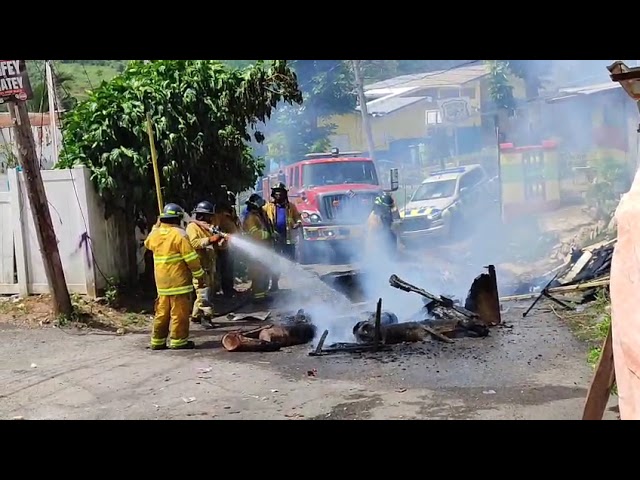
    Within hours of the news of her death spreading, furious residents took to the streets to block key intersections across Granville. Protesters repurposed discarded household appliances, fallen tree trunks, and other debris to build solid barricades across major throughfares, and set large open fires at several blockage sites to signal their outrage over the killing. The unrest has disrupted normal daily life across the community, cutting off access to local businesses, schools, and emergency services for many residents.

    In response to the blockade, a joint team of JCF officers and Jamaica Fire Brigade personnel has been deployed to the area to clear the blocked roadways and restore traffic flow. A heavy, visible police presence remains in Granville as authorities work to de-escalate tensions. In an immediate administrative move, the Police High Command has placed the officer involved in the shooting on interim interdiction, pending the outcome of official investigations. Two independent oversight bodies—the Independent Commission of Investigations (Indecom), and the Inspectorate and Professional Standards Oversight Bureau (IPROB)—have launched parallel probes into the incident to determine whether the use of lethal force was justified, and whether any misconduct occurred.

  • Taxi association boss calls strike notice ‘premature’

    Taxi association boss calls strike notice ‘premature’

    Amid circulating social media speculation of an imminent taxi fare protest set to launch Monday morning, the top leader of Jamaica’s St James Taxi Association has pushed back against the claims, labeling the viral announcement as premature and uncoordinated.

    Dion Chance, president of the local association, told local media outlet Observer Online that the unapproved strike notice originated from an individual based in the southern parish of St Elizabeth, not from authorized industry leadership in St James. As of Sunday, the Jamaica Constabulary Force had issued an internal advisory to its personnel alerting them to potential disruptions tied to the rumored strike, which was framed as a push for increased taxi fares.

    Contrary to the viral warning, public transit operations across St James continued to run normally on Monday with no work stoppages reported. Chance emphasized that organized industry action does not happen spontaneously. Any official strike would require advance notification to all association members, exhaustive exploration of all negotiation channels with relevant stakeholders, and deliberate planning to ensure any protest is effective. “Our members know full well that they would receive formal, advance communication before any industrial action. We do not just call a strike overnight,” he explained.

    Chance confirmed that industry leaders are already in the process of addressing fare increase demands, with a scheduled meeting of all taxi association presidents from across Jamaica set for Thursday this week. This gathering follows an initial meeting held last week to discuss the issue. Following Thursday’s discussions, leadership will finalize a formal plan of action based on the meeting’s outcomes, Chance added.