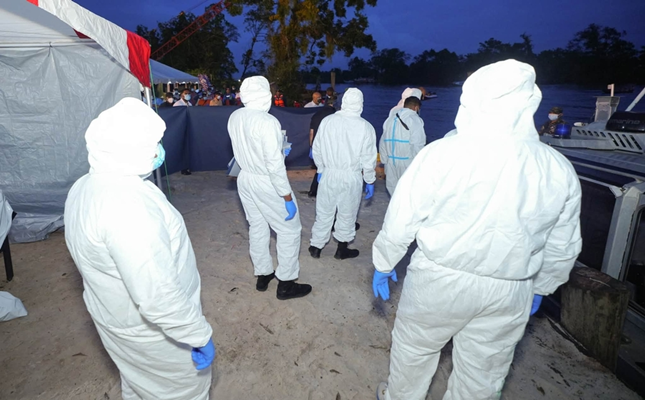
GEORGETOWN, Guyana – A nation gripped by grief entered a new phase of recovery operations this week, after search teams confirmed the location of the capsized passenger ferry MV Barima nearly three days after the vessel sank in the Essequibo River. The tragedy, which unfolded on the evening of July 18, has left at least 27 people dead and more than 80 unaccounted for, with major questions emerging about regulatory oversights that allowed an unsafe, aging vessel to carry passengers far beyond its official capacity.
The MV Barima was traveling from Georgetown to Guyana’s Region One when it capsized amid overloading and unreported passenger numbers. Initial official records listed 113 registered people on board, but ongoing investigations have revealed stark discrepancies between the official manifest and the actual number of people traveling. Authorities now estimate that as many as 180 passengers may have been on the vessel when it overturned – a figure nearly 60% higher than the recorded passenger count. So far, 67 people have been rescued alive from the river, but only 35 of those survivors appear on the official passenger list, deepening confusion over the true scope of the disaster.
Search teams were able to pinpoint the sunken ferry on Monday, thanks to a collaborative effort involving local commercial fishermen, ExxonMobil Guyana, and multiple national response agencies. Local fisherman Haresh Singh, who joined rescue efforts immediately after the capsizing, played a key role in narrowing the search area, while ExxonMobil’s specialized sea and land survey technology helped confirm the wreck’s position on the riverbed close to the site where the vessel’s initial distress signal was sent.
Prime Minister (Ret’d Brigadier) Mark Phillips confirmed the successful location in a statement Monday, crediting the coordinated work of all responding stakeholders for the breakthrough. “Through the aggressive and coordinated efforts of all the responding agencies and stakeholders, the location of the MV Barima was positively confirmed,” Phillips said.
With the wreck located, the operation has officially shifted from an active rescue mission to a full recovery effort, as maritime officials work to extract remaining victims from the sunken vessel and investigators unpack the chain of errors that led to the disaster. Early reporting from local media has already revealed a critical red flag: the 87-year-old ferry had previously been formally condemned by regulators and was not authorized to carry passengers when it sank.
In a key administrative move ahead of the formal inquiry, Guyana’s Ministry of Public Works announced Tuesday that the entire management team responsible for the vessel’s loading, dispatch, and overall oversight has been suspended from their duties. Ministry officials explained the suspension is designed to protect the integrity of the investigation by eliminating any risk of evidence tampering. Investigators have already secured critical surveillance footage from the Kingston Goods Wharf, the ferry’s departure point, which is expected to help investigators reconstruct the final hours before the capsizing.
Public Works Minister Bishop Juan Edghill met with senior leadership of the Transport and Harbours Department this week to formalize the suspensions and map out the next steps for the inquiry. Beyond Guyana’s borders, regional leaders have extended messages of condolence and solidarity to the grieving nation. Among them are St. Kitts and Nevis Prime Minister Dr. Terrance Drew and Nevis Premier Mark Brantley, who shared a public message of support via social media.
“We pray for God’s grace and mercy that all will be found alive and returned safely to their families,” Brantley wrote. “Guyana, we stand with you at this difficult time.”