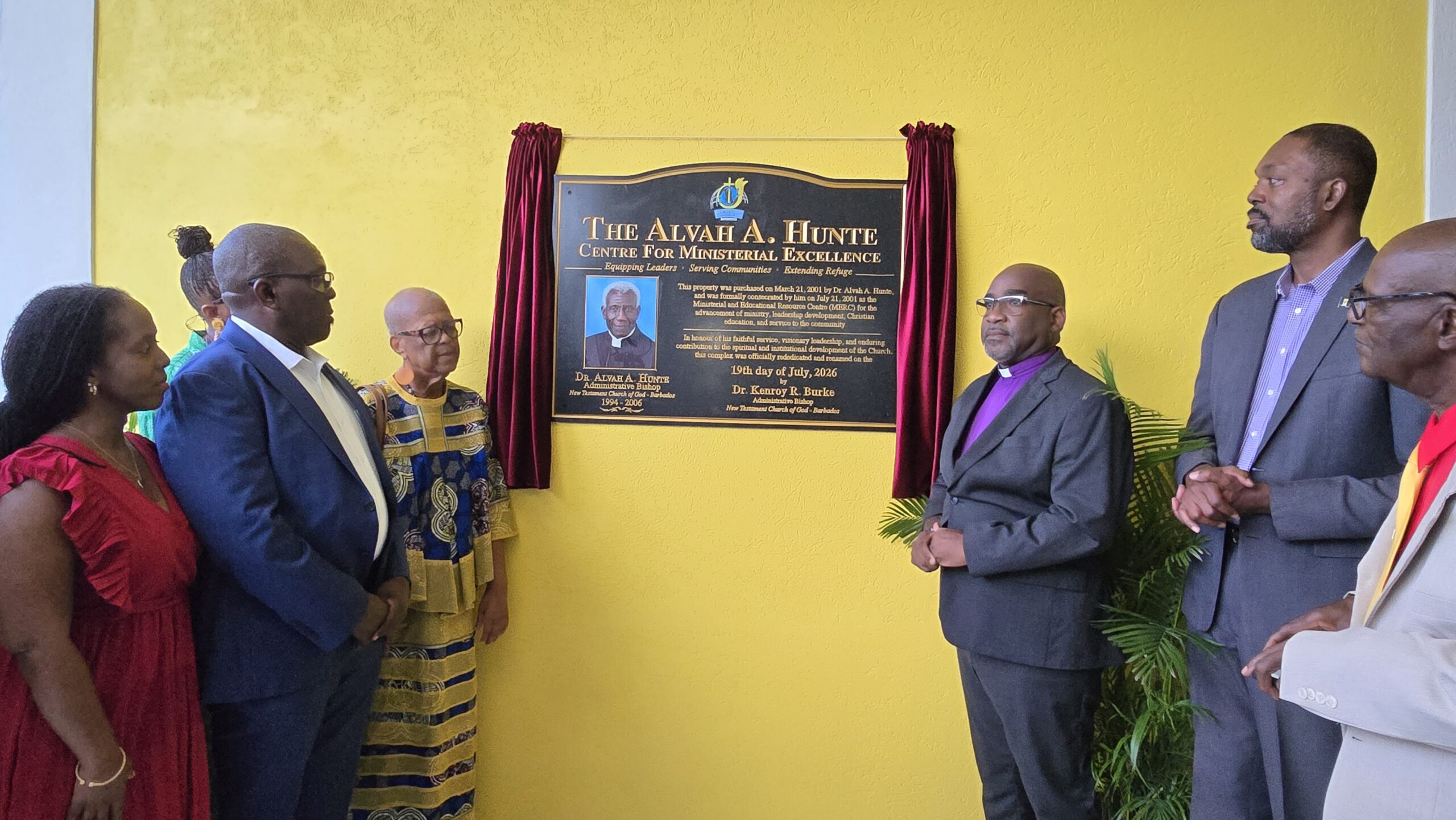
A key religious institution in downtown Bridgetown, Barbados has entered a new chapter of community-focused service, with its headquarters formally renamed the Alvah A. Hunte Centre for Ministerial Excellence during a weekend renaming and rebranding ceremony. The venue, previously the national headquarters of the New Testament Church of God on Fairchild Street, is set to undergo a half-million-dollar infrastructure transformation to expand its mission beyond church administration into a comprehensive community refuge hub for vulnerable residents of the city’s most distressed neighborhoods.
The renaming honors the late Bishop Alvah A. Hunte, who dedicated more than 50 years of his life to leadership within the organization, serving in senior roles including pastor, administrative bishop, and national overseer between 1994 and 2006. Administrative Bishop Dr. Kenroy Burke, the church’s current top leader, opened the event by highlighting Hunte’s far-reaching contributions: strengthening the church’s internal governance structure, cultivating a new generation of ministers and community leaders, expanding access to formal theological education, and embedding a culture of organizational excellence across all church programs.
Burke emphasized that the renaming and transformation align directly with the core values Hunte championed throughout his career. He recalled Hunte’s long-held belief that church properties should exist as functional tools for public service, not static memorials to past leaders. “He understood that buildings are not monuments to the admired, but instruments through which God advances His kingdom and serves His people,” Burke stated. “We do so not merely to remember his accomplishments, but to affirm the values he embodied: faithful leadership, servant-hearted ministry, unwavering integrity. It is our prayer that every person who enters this building will be inspired by that legacy and challenged to continue the work to which he so faithfully devoted his life.”
While the redeveloped facility will retain its existing core functions – housing the church’s national administrative offices, the Barbados campus of Bethel Bible College of the Caribbean, and a public conference space – the major expansion adds a wide range of support services for community members facing crisis. The center of refuge will be a one-stop hub offering targeted support for families in distress, emotionally vulnerable individuals seeking mental health support, and couples working to strengthen their marriages. Planned services include professional and compassionate psychosocial counseling for both individuals and families, parenting training and equipping, free legal aid clinics, health and wellness outreach, educational tutoring, youth mentoring, life skills development, and practical guidance for navigating daily hardships.
For people facing food insecurity or emergency hardship, the center will also distribute food assistance, clothing, and emergency relief, with a focus on long-term stability rather than short-term handouts. Burke explained that the hub will connect vulnerable residents to employment opportunities, helping them restore dignity and achieve sustained life transformation.
The facility’s central location in the heart of Bridgetown, adjacent to the Nelson Street neighborhood, makes it uniquely positioned to serve local communities that have faced generations of systemic challenges including violent crime, persistent poverty, and widespread social vulnerability. Burke framed the project as a tangible demonstration of the church’s commitment to addressing root causes of community distress, rather than only focusing on spiritual outreach. “Located in the heart of Nelson Street, an area that has long faced the challenges of crime, violence, poverty, and social vulnerability, The Alvah A. Hunte Centre for Ministerial Excellence stands as a visible declaration that the Church is committed not only to preaching the Gospel but to transforming lives and communities,” he said. “We fully recognise that Nelson Street and the surrounding communities have faced the painful realities of crime and violence for many years. While the Church is not called to fight crime in the way that law enforcement is, we are called to address the conditions that often give rise to it.”
Adrian Hunte, son of the late Bishop Hunte, echoed that call to action during the ceremony, reflecting on the profound social shifts Barbados has experienced over the past four decades. Noting that many of the island’s social dynamics have changed dramatically since his father began his ministry, Hunte emphasized that the church has an enduring responsibility to reach marginalized people in need. He added that his father’s greatest passion throughout his career was street outreach, prison ministry, and direct support to vulnerable populations, making the new community-focused mission a fitting tribute to his legacy.
Barbados’ Minister of Labour, Social Security and Third Sector Colin Jordan, who attended the ceremony, praised the project as a strategically vital investment for the city. He described the center’s elevated central location as symbolic, framing it as a “lighthouse” that can lift up vulnerable residents across the community. “I believe that you are here because you are expected to shine a light from this place,” Jordan said. “It is difficult for others to see if you are shining a light from in a valley, but when you are in an elevated space, your light is expected to be seen… You’re located in an elevated spot; you’re also located in the middle of the city and God expects you to do what is necessary to interact, to touch, and to lift people from where they are to where God wants them to be.”
Jordan also reaffirmed the Barbadian government’s commitment to partnering with faith-based organizations to address pressing social challenges, noting that government and civic action alone cannot solve complex issues like poverty and violent crime. Effective, sustained progress requires deep collaboration with faith communities that have long-standing trust and roots in distressed neighborhoods, he added.
To fund the initial infrastructure phase of the transformation, Burke confirmed to Barbados TODAY that the New Testament Church of God has submitted a grant application for $500,000 through the national Faith-based Organisations Special Fund Grant Facility, an annual government program that allocates $5 million total to support community projects led by faith groups. Burke noted that the $500,000 covers only the core infrastructure upgrades required to repurpose the building, and additional funding will be needed to fully outfit the center for its expanded outreach programs. Jordan confirmed that the church’s proposal is currently undergoing assessment alongside more than 20 other project applications submitted through this year’s funding round.