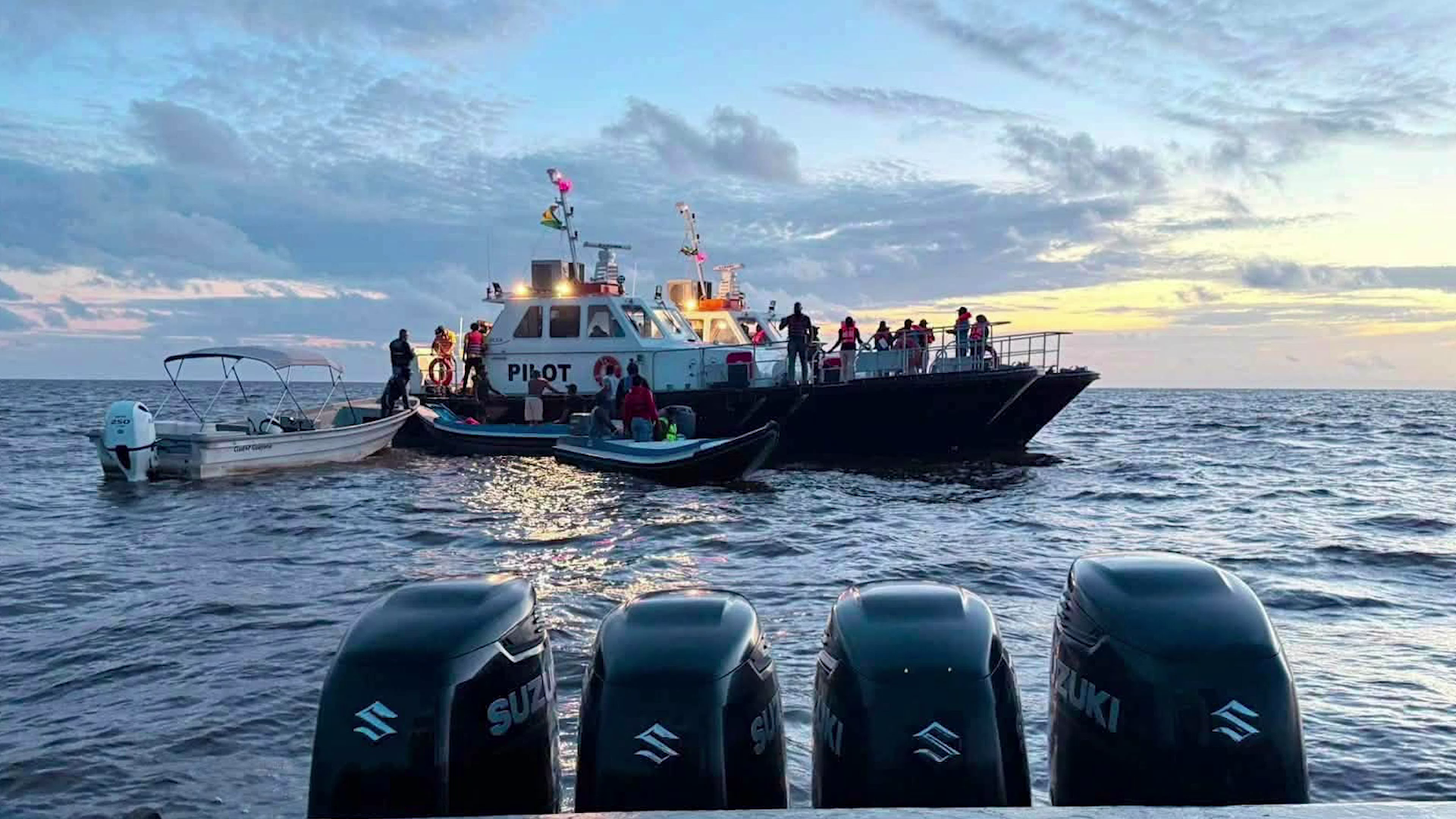
On a fateful Saturday night in late July 2026, a 40-meter passenger ferry MV Barima capsized off the coast of Guyana after being struck by extreme, powerful waves that flooded its hull, triggering one of the deadliest maritime tragedies in the Caribbean region in recent years. Initial reports confirmed that more than 130 passengers, crew members, and cargo including multiple vehicles were on board when the vessel departed from the capital Georgetown, bound for the remote Port Kaituma. As of Monday afternoon, rescue teams have only pulled 60 survivors from the choppy waters, leaving dozens unaccounted for amid a continuing desperate search and recovery operation.
Survivor accounts have painted a harrowing picture of chaos and loss as the vessel rapidly keeled over. Helana Moonsammy, one of the first rescued survivors, described being torn from her seven grandchildren amid the churning waters. Only four of her grandchildren have been found alive so far. “I tried to grab my baby but a box pinned down my hand. All that I could do was fight for my life,” Moonsammy recalled in the immediate aftermath of the disaster. “I saw a square box and another woman fighting for her life, so I told her to come hold on. Seven of my family are gone, five girls and two boys.” Another survivor, Wayne Kitts, lost his partner and daughter in the sinking, recalling that the disaster struck without warning while most passengers were asleep: “All of a sudden we heard the boat capsize to one side, and I don’t even know if shifting cargo made it lean over faster. Both of my people are gone.”
As search operations stretched into their third day, authorities confirmed that the wreckage of the MV Barima was located on Monday afternoon, but critical questions about the disaster’s root causes have already emerged. Investigators have uncovered major discrepancies between the official passenger manifest and the actual number of people on board, with unconfirmed reports pointing to severe overcrowding on the vessel. In response to these early red flags, the Guyanese government has suspended the entire senior management team of the Transport and Harbours Department, the government agency responsible for overseeing the MV Barima’s operations. Public Works Minister Bishop Juan Edghill stated that the administrative suspension is intended to protect the integrity of the ongoing investigation, which is currently probing potential safety rule breaches, systemic operational failures, and even possible criminal misconduct related to the ferry’s operation.
Gale Miller Garnett, Belize’s High Commissioner to Guyana, noted that the tragedy has resonated across the entire Caribbean Community (CARICOM), a bloc of regional nations bound by deep social and historical ties. “As time passes, you realize it is no longer a search and rescue mission – we have moved into a search and recovery phase,” Garnett said. “This is a tragedy that hits home for all of us, because these are our own Caribbean people. Belize and Guyana have shared connections for decades, and this loss is felt across every CARICOM nation.”
In a formal statement, the Government of Belize has extended its deepest condolences to the families of the deceased and those still waiting for word on missing loved ones, and offered prayers for the recovery effort. Regional support has already begun to mobilize: Trinidad and Tobago has deployed a coast guard team and a fixed-wing aircraft to assist with search operations, as Guyanese authorities lacked the advanced deep-water equipment needed to locate the sunken vessel in its initial days. Private sector organizations across Guyana have also joined the response, forming a public-private partnership to coordinate resources and support affected families.
As the investigation continues, the disaster has reignited longstanding calls for stronger maritime safety regulations across the Caribbean, where small passenger ferries are a critical transportation link between mainland and remote coastal communities. Officials have emphasized that they will leave no stone unturned in holding responsible parties accountable for the tragedy.