分类: society

  • WIOC Advises Public of Emergency Response Exercise This Week

    WIOC Advises Public of Emergency Response Exercise This Week

    West Indies Oil Company Ltd. (WIOC) has issued an advance public notification to communities located in proximity to its operations, alerting local residents to a planned large-scale emergency response exercise that will be held across two days in May 2026. The drill, scheduled for May 21 and 22, will see active participation from multiple local emergency response agencies, bringing coordinated emergency training to the site.

    In its public announcement, WIOC has pre-emptively addressed potential public concern, noting that area residents should expect to observe a range of unusual activity during the exercise period. This includes an increased presence of uniformed emergency personnel, a higher volume of response vehicles moving through the area, temporary activation of alarm systems, and controlled test smoke that will be visible on site.

    The company emphasized clearly that there is no actual emergency unfolding, and local residents have no reason for panic or alarm in response to the activity. WIOC explained that regular, full-scale drills of this type are a critical component of maintaining operational safety, allowing response teams to refine protocols, test coordination between agency partners, and boost overall preparedness. These training activities ultimately serve to protect three key groups: WIOC’s on-site staff, the members of neighboring communities who live near the facility, and the surrounding natural environment.

    In closing, WIOC expressed its gratitude to the local public for their anticipated cooperation and understanding as the company carries out this important safety initiative.

  • STATEMENT: World Bee Day

    STATEMENT: World Bee Day

    On the annual observance of World Bee Day 2026, Kevin James, President of Dominica’s National Beekeepers Cooperative Society Ltd., released a statement marking the occasion under this year’s global theme: “Bee together for people and the planet – A partnership that sustains us all.”

    The statement opens by emphasizing that World Bee Day centers all pollinator species, not just domesticated honey bees. From dense native forests to small-scale family farms and residential communities across Dominica, bees and other pollinators deliver irreplaceable daily contributions to global biodiversity, stable food production, and the long-term resilience of entire ecosystems. Their survival is intrinsically tied to the health of undamaged natural habitats, a connection that underscores the urgent need for widespread environmental stewardship, climate-conscious sustainable farming practices, and greater public education around the critical role pollinators play in every person’s daily life.

    For Dominica specifically, this World Bee Day also serves as a moment to assess the steady growth of the country’s domestic beekeeping sector. In ongoing cross-sector collaboration with the Ministry of Agriculture, Ministry of Environment, independent beekeepers, commercial smallholder farmers, regional agricultural bodies, and other key stakeholders, the cooperative has driven measurable progress toward strengthening and modernizing the local industry.

    One of the most notable advances has come in the ongoing effort to formalize official national honey quality standards. This work is foundational to raising the overall quality of locally produced honey, safeguarding the authenticity of Dominican honey against diluted or adulterated imports, and building greater trust between consumers and local producers. These standardization efforts also create a more supportive market for the fast-growing community of value-added producers in the country, who have launched a range of innovative bee-based goods including handcrafted beeswax products, herb-infused honey lines, natural cosmetics, and other specialty items. These products expand the sector’s economic footprint and open new income streams for small-scale producers across the island.

    The statement also praises the recent passage of the Food Safety Bill by Dominica’s Parliament, framing the legislation as a transformative milestone for food safety and consumer protection across the country. The new law will directly address the longstanding challenge of adulterated honey entering local markets, enforce greater accountability and transparency across the domestic food supply chain, and shield both consumers and hardworking legitimate beekeepers who adhere to strict production standards.

    James expressed strong confidence in the future of Dominica’s beekeeping sector, noting that a growing number of young people are entering the industry, public awareness of pollinator protection is steadily rising, and national stakeholders are increasingly recognizing the multifaceted value that bees bring to agricultural productivity, biodiversity conservation, environmental sustainability, and overall national economic development.

    Closing the statement on World Bee Day, James called on all members of the public to continue taking action to protect pollinator populations, preserve intact natural habitats that support bee colonies, and actively choose to support local Dominican beekeepers. Together, these collective efforts will build a more resilient, sustainable future for both the sector and the island as a whole. He ended by extending official wishes for a meaningful World Bee Day to all observers.

  • Firm urges overhaul of road-building methods amid traffic, climate pressures

    Firm urges overhaul of road-building methods amid traffic, climate pressures

    As climate change drives rising regional temperatures and growing vehicle traffic steadily increases load pressure on Barbados’ public road network, aging infrastructure is facing unprecedented strain that is shortening roadway lifespans and increasing maintenance costs. At a two-day industry seminar hosted this week at the Savannah Beach Club Hotel, a leading local construction industry executive is calling for urgent adoption of more durable paving materials and updated engineering standards to reverse this trend and build a longer-lasting transportation network.

    Errol Lynch, Managing Director of Barbados-based Asphalt Processors Inc., told gathered attendees that outdated road-building approaches relying on traditional asphalt are no longer sufficient to withstand the dual pressures of shifting climate conditions and heavier modern vehicle fleets. The event, which brought together civil engineers, paving contractors, government transportation officials, and regional industry stakeholders, was convened to showcase the company’s new polymer-modified asphalt binder and build support for updated road specifications across the Caribbean.

    “ We have to embrace change and keep advancing the spectrum of what we can do, utilizing tools that will carry us from one level of infrastructure resilience to the next,” Lynch said in his opening address to the seminar.

    The innovative material Asphalt Processors aims to introduce to Barbados’ roads blends standard base asphalt with synthetic rubber polymer additives, creating a more flexible, load-tolerant pavement that can recover its shape after repeated heavy use far better than conventional products. Lynch compared the enhanced material to “60-70 grade asphalt on steroids”, explaining that the formulation can be adjusted to match local roadway conditions: for high-traffic routes carrying heavy freight loads, the compound can be stiffened to better absorb consistent pressure without permanent deformation.

    Unlike traditional asphalt, which has very limited elastic recovery and cracks or deforms permanently after a short period of flexing under load, the polymer additive allows the pavement to flex under vehicle weight invisibly and return to its original shape once the load passes – a property that extends roadway lifespan by years, Lynch explained. The material has already been deployed successfully at Grantley Adams International Airport’s runway, where it has withstood heavy aircraft loads and extreme tropical conditions without major issues, though none of these advanced asphalt products are currently in use on the island’s public road network.

    Lynch emphasized that the company is not calling for an immediate full overhaul of Barbados’ entire road network. Instead, it is pushing for policymakers to update material specifications to allow gradual adoption of the advanced product, starting with high-traffic, high-wear routes. “We’re not asking the powers that be to change the whole structure of the road network in one full swoop,” he said. “We’re taking things step by step, assessing current conditions and modifying our approach to fit the needs of each roadway.”

    Beyond Barbados, Asphalt Processors has plans to roll out the technology across the entire Caribbean region, as nearly all small island developing states in the area face the same combination of rising temperatures, increasing traffic, and rapidly deteriorating road infrastructure. “Like Barbados, the other Caribbean islands are faced with the same problems,” Lynch noted. “We are hoping to roll this out to the entire Caribbean.”

    The seminar featured keynote remarks from Dr. Geoffrey Rowe, an American asphalt and paving engineer who outlined the evolution of asphalt testing and modern performance-based road engineering. Among the advances highlighted were computerized testing systems that can accurately simulate a full decade of wear from traffic and weather conditions in a controlled lab setting, replacing outdated manual testing processes that have been in use for decades. Lynch explained that modern testing protocols first age asphalt samples in a rolling thin film oven, then place them in a pressure aging vessel to replicate 10 years of real-world working conditions – and Asphalt Processors already has this full testing equipment on hand, waiting to be used beyond the airport project.

    Looking forward, Lynch stressed that the next generation of civil engineers will play a critical role in designing climate-resilient road networks across the Caribbean that can withstand rising temperatures and growing traffic demand. “If outside is getting hotter, and the loads are increasing, you build a stiffer pavement to resist the temperature and the loads that you’re placing on it,” he said. Building on this week’s discussions, the seminar is set to conclude Wednesday with focused sessions on pavement performance in tropical climates, updated regional specifications, and new high-performance materials for road network improvement across the region.

  • Haynesville stabbing leaves one man dead after dispute

    Haynesville stabbing leaves one man dead after dispute

    A deadly stabbing incident has shaken the community of Haynesville, St James, after a Tuesday afternoon dispute between two local men turned violent, leaving one fatally wounded and prompting law enforcement to issue a public appeal for information that could aid the ongoing investigation.

    Acting Inspector Ryan Brathwaite, the Public Affairs and Communications Officer for the Barbados Police Service, confirmed details of the event to reporters on the scene, noting that emergency authorities were first alerted to the tragedy shortly before 3 p.m. on May 19, 2026. A anonymous caller placed the initial report to police operations control, alerting dispatchers that a man had been stabbed in the Haynesville area and appeared to have already died.

    Within minutes of receiving the call, multiple police units and emergency ambulance personnel were deployed to the location to respond. When first responders arrived, they found the male victim already unresponsive. A local medical practitioner was summoned to the site to conduct an official assessment, and the victim was pronounced dead at the scene shortly after the doctor’s arrival.

    Early findings from the ongoing investigation confirm that the fatal attack originated from a verbal altercation that escalated into violence between the two men. Brathwaite explained that the disagreement ended with one man suffering a life-threatening stab wound that killed him before emergency services could intervene.

    As investigators work to build a full timeline of the incident, law enforcement officials confirmed that one person of interest is currently cooperating with the probe to help answer outstanding questions. Despite this progress, police are still urging any member of the public who may have witnessed the altercation, or who holds any information that could advance the case, to come forward with details.

    Witnesses and tipsters can contact the Holetown Police Station directly at 419-1700, or reach the national police emergency line 24/7 at 211 to submit information confidentially.

  • “Nobody called us”: Activist presses officials over remand of Haitian migrants

    “Nobody called us”: Activist presses officials over remand of Haitian migrants

    On a Monday focused on advancing Saint Lucia’s new Draft National Gender-sensitive Migration Policy, prominent local activist Catherine Sealys, head of advocacy organization Raise Your Voice Saint Lucia, confronted a panel of senior government and law enforcement representatives with hard questions over the recent remand of 28 Haitian migrants to the island nation’s maximum-security Bordelais Correctional Facility.

    Sealys has spent months speaking out against what she identifies as systemic, race-based inconsistencies in how Saint Lucia authorities handle different groups of vulnerable migrants. In a pre-briefing social media post, she laid out a stark pattern of unequal treatment: local government agencies including immigration, law enforcement, social services and the Ministry of Home Affairs regularly reach out to her organization for support when undocumented, trafficked or otherwise at-risk migrants are white. But when the vulnerable migrants in question are Black Haitians, Sealys says no outreach to civil society partners ever happens.

    During the open panel discussion, she doubled down on this accusation, noting: “We are inundated every day from immigration, from home affairs, from major crimes, from everybody – ‘Can you help this person, can you help this person?’ – but when 28 Haitians landed here, nobody called us.”

    Law enforcement officials have confirmed that all adult members of the group of Haitian migrants who arrived in Saint Lucia were charged with illegal entry to the country and ordered remanded to custody at Bordelais. Minors who were part of the migrant group were separated from their parents and are not being held in prison, with police confirming the children are in stable condition, declining to share further details on the case.

    Responding to Sealys’ questioning during the panel was Southern Division Immigration Supervisor Inspector Ken Charlery, one of the government stakeholders who helped shape the draft migration policy. Charlery acknowledged that he shared many of Sealys’ concerns about gaps in current migration management, but emphasized that his team acted strictly within the bounds of existing Saint Lucian law when handling the Haitian group.

    “At this time, we’re guided by the Immigration Act and therefore, when we are faced with situations relating to migrants, that is the legislation that guides our operation,” Charlery explained. “The act does make provisions that if there’s an investigation and there’s need to deem an individual a prohibited migrant, there is provision for them to be housed at a police station or the prison. That is what we currently have in our legislation.”

    Sealys also used the high-profile briefing to draw attention to a longstanding gap in Saint Lucia’s migration framework: the small Caribbean nation is not a signatory to the 1951 UN Refugee Convention or its 1967 Protocol, meaning it has no formal, standardized process for assessing refugee status for people fleeing instability in neighboring countries like Haiti. This absence of clear humanitarian protocols leaves vulnerable migrants in legal limbo, she argued, highlighting the urgent need for a updated, compassionate national migration policy that centers humanitarian needs.

    Aiasha Jn Baptiste, Legal Officer at the Ministry of External Affairs, responded to Sealys’ intervention by confirming that policymakers are already working to address gaps in the country’s migration and refugee framework. She noted that accession to the Refugee Convention is under active consideration, particularly in light of the case of the 28 Haitian migrants, and thanked Sealys for elevating the issue.

    Julian Dubois, Saint Lucia’s Ambassador for Diaspora Affairs, echoed that sentiment, saying the controversy underscored the critical need for the new gender-sensitive migration policy, which requires coordinated buy-in from all government agencies and a whole-of-government approach to be effective. “It brings to the fore the importance of what we’re doing now, you know, the necessity for this policy with buy-in from all agencies and a whole-of-government approach. So hopefully, all agencies could keep their hands on deck and realise that it’s a sad situation,” Dubois said.

    Once public consultation is complete, the Draft National Gender-sensitive Migration Policy will be submitted to the Saint Lucian Cabinet for a final vote on its adoption and implementation timeline.

  • National Youth Council speaks out on school incident

    National Youth Council speaks out on school incident

    A disturbing incident of alleged physical assault by a teacher against a student has sparked widespread scrutiny of Saint Lucia’s education system, with the country’s National Youth Council (SLNYC) issuing a forceful condemnation and pushing for systemic changes to protect student welfare.

    The case, which first broke in local media last week, quickly captured national public attention over allegations that a educator hurled an object at a student, leaving the child with visible facial injuries. In response to growing public outcry, the Department of Education confirmed Friday that a formal investigation into the incident had been launched, and that initial stakeholder meetings with all parties involved had already been held.

    In an official written statement, the SLNYC made clear its position: it expressed deep concern and unreserved condemnation of the reported attack, noting that the alleged behavior constitutes a severe violation of the fundamental duty of care that all education staff owe to students under their supervision. The youth advocacy organization reaffirmed its core commitment to upholding safe, supportive learning environments where both students and educators can work without fear of harm, and acknowledged the critical, multifaceted role that teachers play in shaping young people beyond academic instruction.

    Even as the council recognized teachers’ contributions, it stressed that any form of physical aggression from an education professional is completely unacceptable. Such incidents, the SLNYC argued, erode the hard-won public trust that parents, students and the broader community place in national educational institutions. The organization also voiced frustration over what it says is a lack of urgency and accountability from education ministry officials, adding that responses to student safety incidents must be transparent, decisive, and centered entirely on upholding the rights and dignity of the child.

    The SLNYC has laid out a series of clear demands to address the incident and prevent similar harm in the future. First, the council is calling for a full, independent, and transparent investigation into the assault allegation, alongside immediate protective measures for all parties involved including the accused teacher, the injured student and other affected individuals. Second, it pushes for clear accountability, including appropriate disciplinary action if the allegations are substantiated, a public roadmap from the ministry outlining steps to prevent future attacks, and updated policies plus enhanced training for teachers focused on constructive student engagement, evidence-based conflict resolution, and child protection protocols. Finally, the organization is urging authorities to provide comprehensive, ongoing support to the injured student and their family, covering medical treatment, mental health counseling, and social support throughout the investigation and recovery process.

    The SLNYC closed its statement by reaffirming its longstanding mission to advocate for the rights, safety and well-being of all young people across Saint Lucia, emphasizing that incidents of this nature can never be downplayed or dismissed. The nation’s education system, it noted, must model the values of respect, care, and accountability that it aims to teach the country’s youth.

    On Monday, Education Minister Kenson Casimir publicly addressed the incident, echoing the SLNYC’s priority on student safety. Speaking both as a minister and a parent, Casimir stressed that students are the education system’s primary stakeholders, and that schools must be guaranteed safe spaces for all children. He noted that when parents drop their children off at school, they deserve full confidence that their child’s physical and mental well-being will be prioritized by everyone entrusted with their care.

    The minister added that teachers represent the next most critical group of stakeholders, and that he expects the highest standard of professional responsibility from all educators. As adults in positions of trust, Casimir said, teachers must maintain emotional readiness and responsible conduct at all times when working with children. Reaffirming his commitment to due process, the minister noted that the ministry has established formal legal protocols for addressing school conflicts and misconduct allegations, and that these processes are already being followed in this case. The investigation is currently underway, he confirmed, and the ministry will await a final ruling from the Public Service Commission before determining next steps.


  • Aayana Evanson Graduates with Master’s Degree in Computer Science from NYU

    Aayana Evanson Graduates with Master’s Degree in Computer Science from NYU

    A new milestone has been reached by Antiguan tech scholar Aayana Evanson, who has officially graduated with a Master of Science degree in Computer Science from one of the world’s leading academic institutions, New York University (NYU).

    This impressive capstone to Evanson’s graduate studies is the product of years of consistent hard work, relentless academic commitment, and intentional investment in expanding her professional expertise in the rapidly evolving technology sector. Throughout her graduate program, Evanson centered her research and practical training on software development, building an extensive technical skill set that includes proficiency in widely used programming languages and development tools: Pascal, C++, Python, Pygame, and Javascript, along with hands-on experience working with the Unreal Engine game development platform, to name just a few of her core competencies.

    Evanson’s achievement marks another step forward in a long record of academic excellence that stretches back across her educational career. Before enrolling at NYU for her graduate studies, she completed her undergraduate education at St. John’s University, where she earned a bachelor’s degree in computer science with cum laude honors. Prior to that, she completed her associate degree at Monroe College, graduating summa cum laude — the highest academic distinction available at the institution. Evanson’s secondary education was rooted in her home region, where she attended two respected local institutions: Antigua Girls High School (AGHS) and Sunnyside Tutorial School.

    As Evanson crosses this new academic threshold, her loved ones are joining in celebrating the hard work and dedication that brought her to this moment. She is the daughter of Dean and Gwendolyn Evanson, and her entire network of family and friends have shared in the pride of this significant career and academic accomplishment.

  • Applications Open for CFCCU Ruth O. Limerick Scholarship Fund

    Applications Open for CFCCU Ruth O. Limerick Scholarship Fund

    Antigua and Barbuda’s Community First Co-operative Credit Union Ltd. (CFCCU) has launched a transformative new scholarship initiative to support its members as they work toward completing their undergraduate degrees. Named the Ruth O. Limerick Scholarship Fund, the program marks the latest extension of the financial cooperative’s decades-long dedication to advancing local education.

    Three eligible final-year bachelor’s students will be selected to receive the one-time grant of 6,000 Eastern Caribbean dollars each, funding earmarked specifically to offset tuition fees, textbooks, housing, and other study-related costs that often create barriers for students nearing graduation.

    Rooted in the credit union’s origins, the scholarship holds special institutional meaning. “As a Credit Union started by teachers, education is very important to us,” the organization emphasized in its official announcement. This founding identity has shaped CFCCU’s community-focused priorities, with educational access emerging as a core pillar of its public commitment.

    To qualify for the 2025 award, applicants must meet a clear set of eligibility requirements. Candidates must be legal citizens of Antigua and Barbuda, hold active membership with CFCCU, and be enrolled in their final year of an accredited bachelor’s degree program at a recognized institution. Applications for study outside the Caribbean region will only be approved if the desired degree program is not offered at any local or regional accredited university.

    The selection process will evaluate candidates across multiple metrics to ensure awards go to students who demonstrate both need and merit. Reviewers will assess each applicant’s past academic performance, demonstrated financial need, clearly outlined educational and long-term career goals, personal character, and record of engagement in extracurricular or community service activities.

    Interested eligible students have until Friday, June 12, to submit their complete applications for consideration. CFCCU’s initiative represents a meaningful investment in the next generation of Antigua and Barbuda’s professionals, addressing the financial gaps that too often force promising students to interrupt their academic journeys.

  • Police: Samaroo shooting file to move to DPP

    Police: Samaroo shooting file to move to DPP

    Months after a fatal police shooting left one man dead and his partner permanently disabled in Trinidad and Tobago, law enforcement authorities have confirmed the long-awaited forensic analysis into the incident is finally complete, clearing the way for the case file to be sent to the country’s top prosecutorial official for next steps.

    The deadly encounter dates back to January 20, when 31-year-old Joshua Samaroo and his common-law wife Kaia Sealy were shot multiple times at a street intersection in St. Augustine, following a high-speed chase that began when the couple reportedly attempted to evade a police stop in Maloney. According to initial police accounts, officers attempted to pull the pair over, but Samaroo sped off, triggering the pursuit that ended when the couple’s vehicle crashed into a roadside drain. At that point, officers opened fire on the car.

    Surveillance footage that emerged publicly after the shooting contradicted key parts of the official narrative, showing Samaroo with his hands raised outside the vehicle moments before officers fired. Both Samaroo and Sealy were hit multiple times and rushed to the Eric Williams Medical Sciences Complex in Mt Hope, where Samaroo was pronounced dead on arrival. Sealy survived the attack but suffered life-altering injuries: she is now partially paralyzed and has lost the ability to walk.

    The incident sparked immediate outrage among Samaroo’s relatives and Sealy’s friends, who launched sustained public protests demanding accountability. Demonstrators called for the resignation of Police Commissioner Allister Guevarro and pushed for criminal charges to be filed against the officers involved in the shooting. While protest crowds shrank in the months following the incident, demonstrations continued nonethelss, as organizers pressed authorities to move forward with the investigation.

    Back in March, Guevarro had announced that the probe was nearly finished, with only a single outstanding document delaying the submission of the full case file. On Wednesday, police issued a formal statement confirming that the forensic report, the final outstanding document, had been received from the Forensic Science Centre located in Federation Park. As part of standard investigative procedure, multiple pieces of evidence from the shooting scene had been submitted to the center for forensic testing, and investigators had held up progress on the case while waiting for the results of that analysis.

    “Now that the forensic report is in hand, investigating officers will next submit the full case file to the Office of the Director of Public Prosecutions for review,” the police statement noted. “Once reviewed, the DPP will issue formal guidance on what legal steps will be taken moving forward.”

  • Brunswijk zet strijd tegen bondsvoorzitter Hellings voort met hoger beroep

    Brunswijk zet strijd tegen bondsvoorzitter Hellings voort met hoger beroep

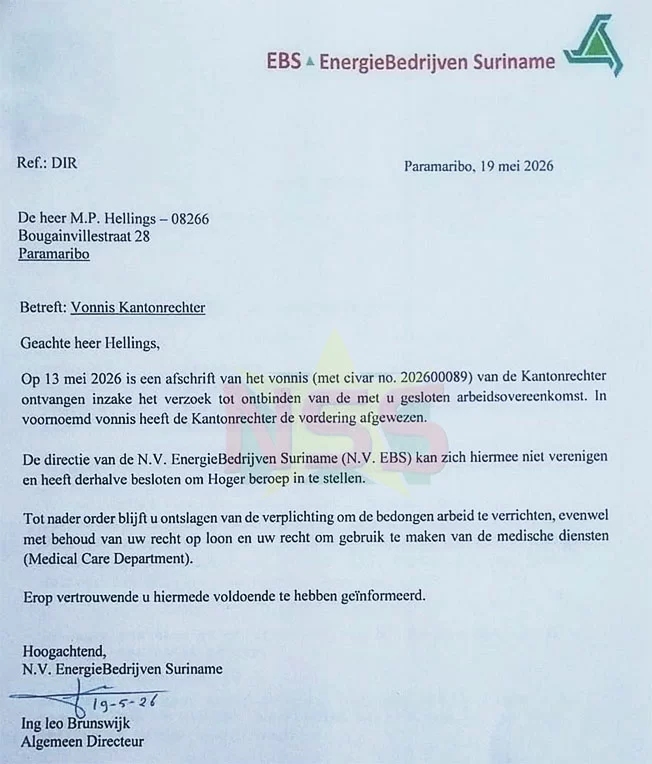
    A long-running high-profile labor conflict at Suriname’s state-owned energy utility Energiebedrijven Suriname (EBS) has entered a new phase, after EBS General Director Leo Brunswijk launched an appeal against a lower court ruling that favored Marciano Hellings, chair of the EBS employees’ union. The formal notice of appeal was officially served to Hellings on Tuesday, court documents confirm. In the notification, Brunswijk states that EBS leadership rejects the cantonal court’s earlier decision, which dismissed the utility’s request to terminate Hellings’ employment contract.

    Per the terms outlined in the appeal notice, Hellings will remain temporarily relieved of his work duties while retaining full access to his regular salary and all medical benefits through the duration of the appellate process. The contentious dispute between EBS executive leadership and the union chair first emerged in July of the previous year, and has since grown into one of the most widely discussed labor controversies at any state-owned enterprise in Suriname. Prior to the cantonal court’s ruling, EBS had already lost previous procedural challenges brought before the Labor Inspectorate, marking the second consecutive setback for the utility in the conflict.

    When contacted for comment by local outlet Starnieuws, Hellings responded calmly to the news of the appeal, saying he had fully anticipated the move from EBS leadership. “This doesn’t keep me up at night,” the union leader told reporters. He added that it had been clear for months that EBS intended to push the case to appellate court regardless of the lower court outcome.

    Hellings also echoed a observation the cantonal judge made in the initial ruling: the conflict has primarily been driven by a single individual within EBS’s executive leadership. The union chair expressed full confidence in the appellate process, saying he expects the lower court’s ruling will be upheld. “I am convinced that when this case is heard on appeal, we will get the same outcome,” he said.

    In additional comments, Hellings pointed out that the prolonged legal battle has already incurred substantial public costs, including fees for attorneys, court procedures and process servers. “The lawyer gets paid again, the process server gets paid, and all of that comes at the expense of state-owned NV EBS,” he noted.