分类: society

  • Tropical Weather Outlook: Friday, 29 May 2026 (8 am)

    Tropical Weather Outlook: Friday, 29 May 2026 (8 am)

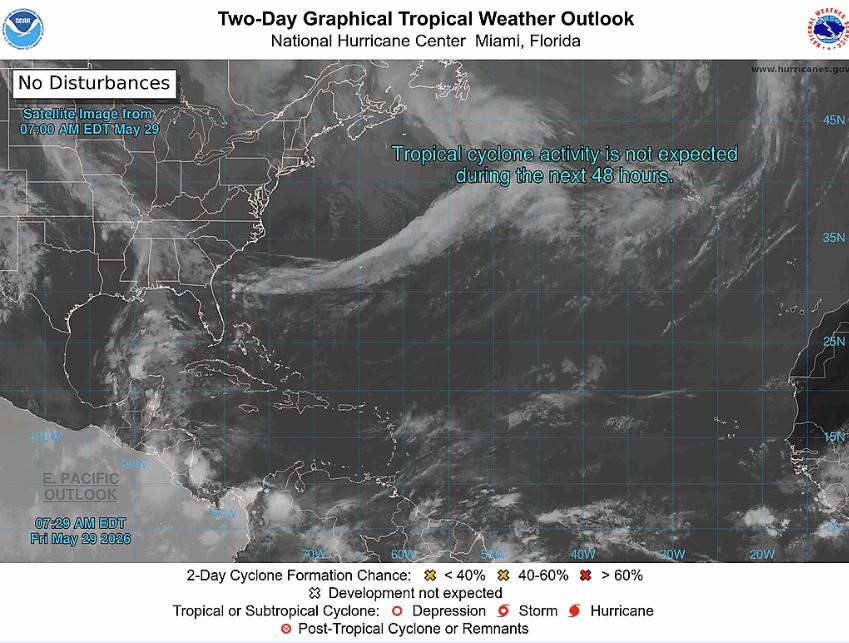
    Meteorological authorities from the Meteorological Services, MBIA, in partnership with the Grenada Airports Authority (GAA), have issued an official update on tropical weather activity across the Tropical North Atlantic Ocean, Caribbean Sea, and Gulf of Mexico. The forecast highlights a developing tropical wave marked for monitoring within the zone of special interest spanning 10 – 20 °N latitude and 40 – 65 °W longitude.

    The system, a broad tropical wave, currently sits with its central axis along 51°W, positioned south of 15°N. As of the latest advisory, the disturbance sits roughly 628 nautical miles east of the Lesser Antilles island chain, tracking steadily westward at a forward speed of between 15 and 20 knots. Following current trajectory models, the wave is on track to reach the island of Grenada between Saturday evening and early Sunday morning. Forecasts predict the system will bring increased cloud cover and scattered to widespread showers across the island during that window.

    Beyond this monitored disturbance, forecasters confirm that no additional tropical cyclone development is anticipated across the entire monitoring basin over the next 48 hours. The next official advisory update on the tropical wave’s progress is scheduled for release at 2 pm local time.

    This public weather advisory is issued by the combined Meteorological Services, MBIA and Grenada Airports Authority, with distribution via NOW Grenada. NOW Grenada notes it assumes no responsibility for contributor content included in public advisories, and invites users to report any suspected content violations through official platform channels.

  • A Force to Be Reckoned With: Carty and Willock Join Forces for Employees

    A Force to Be Reckoned With: Carty and Willock Join Forces for Employees

    Workers across Antigua and Barbuda now have access to a powerful new ally in the fight against workplace injustice, as two seasoned veterans of industrial relations and employment advocacy have joined forces to defend employees facing unfair treatment at the hands of employers.

    The new partnership brings together Anderson Carty, a widely respected figure in industrial relations, and Javonson Willock, an experienced employment and human resources consultant – both of whom bring first-hand, hard-won knowledge of the toll drawn-out workplace disputes can take on individual workers. Carty first made his name in legal circles with a landmark unfair dismissal case that began when he was fired from his role while out on vacation. His fight for justice wound its way through every tier of the national legal system, from the Industrial Court to the Court of Appeal, and ultimately reached the Privy Council. Today, his case remains a cornerstone of legal and policy discussions around exemplary damage awards in unfair dismissal proceedings across the region.

    Willock, too, brings personal experience of systemic workplace injustice to the new partnership. He has long spoken openly about his own six-year battle against unfair employment action, which began when he was pressured to resign over unproven misconduct allegations. At the time, he was repeatedly denied access to the evidence the allegations were based on, despite multiple formal requests. What followed was years of legal wrangling, which ultimately ended with multiple court rulings ruling in his favor. That experience, Willock says, gave him an unfiltered look at the gap in support for ordinary workers navigating disciplinary claims, unfair pressure and formal workplace investigations.

    In a recent statement, Willock emphasized that their shared personal experiences navigating high-stakes workplace disputes have given both men unique insight into the multi-layered burden these conflicts place on employees. Beyond the legal costs, workers face crippling emotional stress and long-term professional damage that often goes unrecognized by institutions and employers alike. “It is because of those experiences that we have chosen to combine forces to advocate on behalf of employees who believe they have been treated unjustly,” Willock explained.

    While the pair prioritize amicable, out-of-court resolutions whenever possible to reduce the strain on workers, they have made clear they will not shy away from vigorous legal action when employers refuse to adhere to basic labour standards. “The requirements of the Labour Code and good Industrial Relations practice are not optional,” Willock noted, adding that the pair intends to hold employers fully accountable when they show blatant disregard for established labour protections.

    Industry observers note that the new partnership marks a shift toward more assertive, worker-centered advocacy in key areas of workplace conflict, including unfair dismissal, disciplinary disputes, workplace victimization, and systemic breaches of labour law. For workers in Antigua and Barbuda who have previously felt overwhelmed, intimidated, or out-resourced when confronting employers on their own, the collaboration fills a critical gap in available advocacy and representation services, expanding access to justice for marginalized and disadvantaged workers across the country.

  • Former ace athlete Sweet-I dies 16 years after paralysing gunshot injury

    Former ace athlete Sweet-I dies 16 years after paralysing gunshot injury

    In a heartbreaking loss for communities across St. Vincent and the Grenadines, Sweet-I Robertson, a woman who turned a life-altering act of senseless gun violence into a story of relentless resilience and academic triumph, passed away Monday night following a sudden short illness. She was 33 years old.

    Robertson’s journey of struggle and success began in October 2010, when the 15-year-old star athlete and fifth-form student at Petit Bordel Secondary School was struck by a stray bullet outside her school’s campus in Petit Bordel. The bullet hit her neck, leaving her permanently paralyzed from the waist down. The tragedy did not end with her injury: in 2013, Shelton Hooper, the man convicted of wounding her, was sentenced to five years in prison. Hooper and his two co-accused relatives also received 12-year sentences for a separate attempted murder, and Hooper faced additional prison time on firearms charges. In a remarkable show of grace just days after her 21st birthday in 2014, Robertson told local outlet iWitness News that she had fully forgiven the men responsible for her injury, noting that holding onto resentment had no place in her new life. “You can’t hold a grudge forever,” she said at the time.

    Against all odds, Robertson refused to let her paralysis define her future. Just a year after the shooting, in 2011, she sat for the CXC O’Level examinations and passed four out of five subjects, earning the highest possible Grade 1 in mathematics. She went on to pursue higher education, graduating from St. Vincent and the Grenadines Community College in 2017 — crossing the graduation stage in her wheelchair, pushed by her older sister Racquel, an educator, to accept her certificate.

    With support from Island Scholars Inc., a United States-based educational charity, Robertson continued her studies at the University of the West Indies. In July 2023, she reached a historic milestone, completing her degree program and graduating with a first-class honours Bachelor of Science in psychology. She had been preparing to launch an online counselling service to support others facing adversity when her health declined unexpectedly, leading to her death.

    Local leaders and institutions stepped in to support Robertson in the years after her injury. Then-Prime Minister Ralph Gonsalves took a personal interest in her case after reading news reports of her assailants’ sentencing. Gonsalves, who used Robertson’s story to draw attention to the unregulated arms trade plaguing Caribbean communities, told a 2013 regional workshop for the UN Arms Trade Treaty that her experience was a “symbol of the creeping scourge of arms and ammunition into the most remote corners of our Caribbean civilisation”. In 2013, Gonsalves’ government arranged for Robertson to receive three months of rehabilitative treatment in Cuba, where she regained full control of her upper body, which had been left with only limited mobility in one hand before therapy. While doctors confirmed the lower half of her body was irreparably damaged, the treatment vastly improved her quality of life and restored her self-confidence. In 2014, the administration donated a custom-built, mortgage-free home to Robertson in Fitz Hughes, a gesture she said lifted a huge financial and emotional burden from her family.

    Robertson’s death marks the second time in recent months that a promising young Caribbean athlete has died from complications of violence committed near their school. In March, 17-year-old top athlete Alia Mc Dowall died at Milton Cato Memorial Hospital, more than a year after she was stabbed in the throat outside Central Leeward Secondary School, where she was a student. The alleged attacker, 17-year-old Bethel High School student Doriel Duncan, has been charged with wounding with intent, granted EC$15,000 bail, and the case remains ongoing in the courts.

  • Bolans Spectator Stand Nearing Completion, MP says

    Bolans Spectator Stand Nearing Completion, MP says

    After months of planning and construction work, the long-planned spectator stand project in Bolans is edging closer to being finished, according to Dwayne George, the Member of Parliament for St. Mary’s South. In a recent statement highlighting the milestone, George framed the infrastructure development as a transformative initiative that local residents have waited years to see come to fruition.

    George extended formal gratitude to key stakeholders that helped turn the community project into a tangible reality, specifically naming Antigua’s Ministry of Works, Minister of Works Maria Browne, and the national government for their coordination, funding, and on-the-ground support throughout the construction process. He shared that even ahead of its official opening, the new facility has already drawn enthusiastic feedback from Bolans residents, who have expressed excitement over the new public space.

    Once fully completed, the spectator stand will offer a vastly more comfortable, accessible gathering area for multiple generations of community members, including local families, young people, and long-term Bolans residents. Beyond hosting spectators for local sporting matches, the space is also designed to accommodate a wide range of other community activities, from public gatherings to local events.

    For George, the near-completion of the stand is more than just a new infrastructure addition: it stands as clear proof of ongoing progress, intentional development, and sustained public investment in both Bolans village and the entire St. Mary’s South constituency, marking a key win for the local area.

  • Governor General Pays Emotional Tribute to Sir Aziz Hadeed, “A Remarkable Son of the Soil”

    Governor General Pays Emotional Tribute to Sir Aziz Hadeed, “A Remarkable Son of the Soil”

    The death of Sir Aziz Fares Hadeed KCMG, CBE has been announced by the Governor-General of Antigua and Barbuda, The Right Honourable Sir Rodney Williams, in an official statement of condolence released alongside Her Excellency Lady Williams.

    Described by the nation’s highest representative as a loss felt across every corner of Antigua and Barbuda, Sir Aziz leaves behind a legacy that stretches across business, public life, and philanthropy. Governor-General Williams framed the passing not just as a national loss, but a profound personal one, noting that the bonds between the Hadeed and Williams families have endured across multiple generations. Tracing their connection back to the era of their late parents, the long-standing relationship between the two families is rooted in unwavering friendship, reciprocal respect, unshakable loyalty, and deep affection.

    For Governor-General Williams personally, Sir Aziz was more than a prominent public figure—he was a beloved brother and cherished confidant, a close relationship shared equally by Lady Williams and the entire Williams family. Over decades of connection, the two men walked side by side through both official national service and the quiet, joyful moments of private friendship and family gathering, building a wealth of lasting memories that the Governor-General says he will hold dear.

    Only a short time before his passing, Governor-General Williams had the distinct honor of honoring Sir Aziz during his knighthood celebration, where he reflected publicly on the extraordinary lifetime of leadership, service, and friendship that defined the icon’s life. Now, that legacy remains as a touchstone for a nation mourning his departure.

    Sir Aziz’s impact extended far beyond his own business achievements, shaping the business sector, the national education system, and local communities across Antigua and Barbuda. Every corner of national life that benefited from his vision, generous spirit, and compassionate action now feels the deep void left by his passing. Even amid the widespread grief of his loss, however, Governor-General Williams emphasizes gratitude for a life lived with extraordinary purpose—one whose legacy will continue to shape Antigua and Barbuda for generations to come.

    A core principle guided Sir Aziz’s life and work: that genuine success comes hand in hand with responsibility to lift up others. Throughout his decades of public and private life, he proved that prosperity gains its greatest meaning when it creates opportunity for entire communities. He did not only build successful business enterprises; he built hope, self-determination, and pathways to advancement for thousands of people across the nation.

    On behalf of himself and Lady Williams, Governor-General Williams extended his deepest sympathies to Lady Hadeed, the entire extended Hadeed family, and all who grieve Sir Aziz’s passing. He encouraged the mourning family to find comfort in the towering legacy Sir Aziz leaves behind, in the widespread respect and gratitude of a nation that benefited immeasurably from his work, and in the countless lives he touched through his kindness, integrity, and unwavering commitment to public good.

    The statement closes with a final prayer: May the soul of Sir Aziz Fares Hadeed rest in eternal peace, and may perpetual light shine upon him.

  • Father calls for justice

    Father calls for justice

    A young Trinidadian sanitation worker, expecting his first child later this year, has lost his life in a fatal work accident that has left his family shattered and calling for full accountability from authorities. Deshawn Joseph, just 20 years old, was killed on Tuesday evening while carrying out his routine garbage collection route in Kelly Village, Caroni, when the garbage truck he was working with reversed and crushed him at the scene.

    The tragedy unfolded shortly before 7:15 p.m. According to initial accounts from law enforcement, the 43-year-old truck driver was attempting to maneuver around a parked vehicle on the left side of Ramnath Street when he backed into the roadway, and was unable to see Joseph behind the truck. Surveillance footage of the incident, which has since spread widely across local social media platforms, captures the final moments: Joseph had stepped off the moving truck to reach a discarded garbage bag when the vehicle struck him. He died instantly at the site of the accident.

    In an exclusive interview with local outlet the Express, Joseph’s grieving father, DeShawn Blackburn, spoke publicly just hours after formally identifying his son’s remains at the Federation Park Forensic Science Centre, from the family’s shared home in Springvale Village, Claxton Bay. Blackburn said he had been informed of a verbal altercation between Joseph and the truck driver earlier that same day, when the driver arrived to pick Joseph up for the night shift. He emphasized that his son was a hardworking, responsible young man who had dedicated two years to his role with the sanitation company, and that the accident could have been avoided if the driver had exercised greater caution.

    Joseph’s twin sister, Shenice Joseph, shared that the young worker had been extra motivated in recent months, picking up additional shifts and saving every extra dollar to prepare for the arrival of his first child with his girlfriend, who is currently four months pregnant. “He was very excited and was organising to buy stuff for the baby. He would call and tell us everything that was going on,” she told the Express. Shenice traveled to the mainland from Tobago, where she and the siblings’ mother Alicia Kathyann Joseph reside, to make arrangements; Alicia is expected to arrive in Trinidad the evening following the accident to join the rest of the family in mourning.

    Local authorities have confirmed that a formal investigation into the incident is already underway, as colleagues, friends and relatives mourn the sudden loss of the young worker. Blackburn said his family has no demands beyond a full, transparent accounting of what led to his son’s death. “We are just awaiting answers and hope investigators will determine exactly what transpired moments before the fatal collision,” he stated.

    Trinidad Prime Minister Kamla Persad-Bissessar has also publicly extended her condolences to the Joseph family in an official social media statement released the day after the tragedy. “It was truly heartbreaking that a young man went out to earn an honest living to care for his family and never returned home,” she wrote, noting that Joseph left behind a grieving family and an unborn child. “May his soul rest in eternal peace, and may God grant strength, comfort and healing to his loved ones during this painful time of grief.”

  • Officer ‘inadvertently’ fired gun

    Officer ‘inadvertently’ fired gun

    A routine traffic stop in the Trinidad and Tobago town of Arima spiraled into a chaotic confrontation last Friday that left one police officer injured and sparked multiple official probes into an accidental gun discharge, law enforcement authorities have confirmed. The incident, which unfolded steps from the Arima Magistrates’ Court along Sorzano Street, involved a couple from Diego Martin who now face criminal charges following the clash.

    According to official statements from the Trinidad and Tobago Police Service (TTPS), the encounter began when patrol officers from the Arima Traffic Department spotted a heavily tinted Toyota Hilux parked illegally in a designated No Parking Zone. Katrianna Rezende, 38, who was behind the wheel at the time, was first issued a fixed-penalty notice for violating the country’s motor vehicle window tint regulations, which mandate minimum levels of visible light transmittance for windshields and vehicle windows.

    After issuing the ticket, officers ordered Rezende to move the vehicle out of the restricted parking area, an instruction she openly refused. When law enforcement then requested to see her driving documentation, she again declined to comply. As tensions rose, Rezende started the vehicle and attempted to drive away, allegedly striking one of the responding officers in the process. The officer, who reported a painful burning sensation to her right foot, believed her life was in immediate danger from the moving vehicle and drew her service weapon, holding it pointed toward the ground.

    As Rezende reversed the vehicle, the officer attempted to return the gun to its holster. In that movement, her finger accidentally made contact with the trigger, firing a single round off from the weapon, the TTPS confirmed. The entire incident was captured on body-worn camera footage belonging to an estate constable with the Trinidad and Tobago Electricity Commission, adding a key piece of evidence for ongoing probes.

    In remarks to reporters during a Wednesday news conference at the Port of Spain Police Administration Building, Deputy Police Commissioner Curt Simon confirmed that TTPS leadership has launched a full internal investigation into the encounter. “The executive is aware. Yesterday (Wednesday) I spoke with Snr Supt Maynard Wilson, who is in charge of that division, and an investigation has commenced to look into that matter,” Simon said.

    Independent oversight is also underway: David West, head of the Police Complaints Authority, confirmed to local media outlet *Express* that the authority has launched its own parallel probe and assigned a dedicated investigator to the case.

    Following the confrontation, both Katrianna Rezende and her 39-year-old husband Manuel Rezende were taken into custody and charged with multiple criminal offenses. Katrianna faces counts of disorderly behaviour, resisting arrest, dangerous driving, careless driving, and assaulting a police officer, while Manuel was charged with disorderly behaviour and use of obscene language. All charges were filed by officers assigned to the Arima Traffic Unit.

    The pair made their initial court appearances this week. Katrianna Rezende appeared before Master Lisa Singh-Phillip in the Arima High Court on Wednesday, where she entered not guilty pleas to all charges brought against her. She was granted bail with a total value of TT$140,000: $80,000 with a surety for the assault on a police officer charge, and an additional $60,000 for the remaining offenses. As a condition of her bail, she is required to sign in at the Four Roads Police Station once per month between the hours of 6 a.m. and 8 p.m. Her case has been adjourned for further proceedings on June 24.

    Manuel Rezende appeared separately before Magistrate Ali in the Arima Magistrates’ Court, where he was granted TT$30,000 bail. His next court date is scheduled for November 30.

    Speaking to *Express* about the incident, Acting Superintendent Ishmael Pitt, president of the Police Social and Welfare Association, noted that while the TTPS puts all its officers through rigorous weapons handling training, accidental discharge events can still occur even for well-trained personnel. Pitt explained that standard protocol following such an incident requires a full investigation before any remedial action is taken, and common outcomes include recommending the involved officer complete a refresher course on safe weapons handling.

    “Where an accident has occurred, re-training and other forms of remedial action would be the usual protocol,” Pitt said.

  • Column: Wat taal vertelt over Suriname

    Column: Wat taal vertelt over Suriname

    Suriname’s living, breathing language is offering a revealing window into how the nation navigates its colonial past, blends diverse cultural identities, and reshapes meaning for a modern, multiethnic society, writer Wilfred Leeuwin argues in a new commentary.

    The conversation starts with a recent observation: a radio advertisement for Suribet, a local gambling platform, aired in Sranan, Suriname’s widely spoken Creole language, carrying the line: “Soso bigisma e teri, gi pikin-nengre Suribet ne seri.” Directly translated, the phrase uses the term “pikin nengre” to reference minors, stating that Suribet only sells to adults. What caught Leeuwin’s attention was not the responsible gambling messaging, but the history carried by that specific phrase.

    Historically, “pikin nengre” originates from the colonial and slavery era, with a literal meaning of “little black child” that carries unmistakeable racist connotations tied to Suriname’s exploitative past. Today, however, the term has shifted dramatically in everyday Surinamese speech: in the advertisement, it is not used as an ethnic label at all, but as a general reference to all children and minors, regardless of their ethnicity or skin color.

    This shift is not driven by dictionary updates or academic linguistic theory, Leeuwin notes. It is organic language evolution, shaped by daily use among ordinary people. Popular platforms from advertising and street slang to music, radio, and social media often reshape language far faster than formal regulatory bodies can.

    Language is a living entity, after all. It shifts alongside new generations, cultural exchange, broader societal change, and the evolving ways people connect with one another. Terms that were once widely accepted can become hurtful and offensive over time, while other words lose their original sharp negative connotations and expand to take on new, broader meanings. Sometimes, the original historical meaning fades entirely from collective public memory.

    At the same time, these linguistic shifts reflect how societies process and engage with their own history. Some terms shed their harmful baggage, while others pick up negative connotations they never originally carried. Leeuwin offers another well-known example to illustrate this dynamic: the Dutch phrase “indianenverhalen”, which today is commonly used to dismiss claims as nonsense, exaggerated fantasy, or untrustworthy tales. But the phrase’s origins are very different.

    As far as linguistic research records, the term originally referenced the rich oral storytelling tradition of Indigenous communities, where elders gathered around campfires to pass down tales of creation, nature, culture, spiritual figures like the great Manitou, traditional wisdom, warnings, and spiritual experiences to younger generations. These stories were never “nonsense” — they were a core pillar of cultural transmission and communal identity. Yet over time, the phrase gained the dismissive negative connotation it carries today. This shift says less about Indigenous culture itself, Leeuwin argues, and more about how broader societies have historically marginalized less powerful, underrecognized cultural groups.

    Language is far more than just a tool for communication, he emphasizes. It carries the weight of history, pain, humor, prejudice, identity, and existing power dynamics. Words change because societies change: sometimes terms evolve as a society grows more inclusive, and sometimes old harmful stereotypes persist unconsciously in everyday speech.

    These evolving linguistic blends also highlight what makes Suriname uniquely diverse, Leeuwin notes. He shares a recent personal encounter that drove this point home: a few weeks before writing the commentary, he heard a customer speaking Sranan with a distinct Aucaan accent at a building supply store. Assuming the speaker was an inland resident with African roots, he was surprised to learn the man was a young Hindustani Surinamese. Striking up a conversation, Leeuwin learned the man had spent part of his childhood in Suriname’s interior and had friends from every major ethnic group in the country. Though he identifies as Hindu, he does not feel culturally boxed in by his background.

    That encounter reinforced a truth about Suriname that language makes plain: different cultural and linguistic traditions blend into one another constantly and naturally, a dynamic that is rare in many other parts of the world. In many nations, language, culture, and ethnicity remain strictly segregated. In Suriname, those boundaries are constantly overlapping. A Hindustani young man speaks Aucaan and Sranan. A Javanese Surinamese person regularly uses Creole phrases. Maroon youth switch seamlessly between Dutch, Sranan, and English in daily conversation. This is not a loss of individual or cultural identity — it is a source of extraordinary cultural richness.

    Leeuwin argues that this is where Suriname’s true national strength lies: in the everyday reality where people adopt one another’s language, humor, customs, and expressions, without losing their own core identity. This is natural nation-building at its most organic, because language tells a more honest story of a country than any official government report or policy document ever could.

    In Suriname’s overlapping languages and evolving terms, you can hear the full scope of the nation’s history: the trauma of slavery and colonialism, the waves of migration, the constant cultural blending, street culture, religious diversity, and widespread communal solidarity. You can also hear a society actively working to let go of old harmful meanings and co-create new, inclusive shared meanings together.

    That is what makes language evolution far more than just a linguistic process — it is a cultural and societal project. And perhaps that is Suriname’s most beautiful strength: that all of its languages, accents, expressions, and meanings continue to mix, shift, evolve, and thrive side by side.

  • Nevis Department of Gender Affairs participates in Menstrual Hygiene Day 2026 activities

    Nevis Department of Gender Affairs participates in Menstrual Hygiene Day 2026 activities

    As the world observes 2026 Menstrual Hygiene Day on May 28, local stakeholders in Nevis are stepping up to advance global efforts to destigmatize menstruation and expand equitable access to menstrual health resources. Coordinated globally by non-profit advocacy group WASH United, this year’s campaign carries the unifying theme “Together for a Period-Friendly World”, calling for cross-sector collaboration from governments, community groups, schools, workplaces and individuals to normalize menstruation and eliminate the shame that still surrounds it globally.

    A truly period-friendly world is defined as a space where women and girls can manage their menstrual cycles safely, confidently and with full dignity, with menstruation recognized as a critical issue tied to public health, educational equity and broader gender equality. The global campaign has outlined five core priority areas for communities and nations to advance this goal: cultivating an open social environment where menstruation can be discussed freely without shame or stigma; delivering evidence-based period education to all children from an early age, regardless of gender; expanding access to affordable, safe and effective menstrual products; ensuring public and private facilities offer clean, accessible period-friendly restrooms for menstrual management; and strengthening clinical menstrual health services, including access to trained providers, diagnosis, treatment and support for menstrual health conditions.

    In Nevis, local partners have been working to turn these global goals into local action since 2023. The Nevis Department of Gender Affairs has partnered with Lake Health and Wellbeing, the Advancement of Children Foundation, UNICEF Eastern Caribbean and the Nevis Ministry of Education to roll out a community-focused Menstrual Health Education Programme, adapted from a training framework developed by WASH United. Trained educators deliver targeted sessions in local schools and community spaces, designed to provide clear, accurate information about menstruation to both girls and boys. The initiative targets three key gaps: widespread stigma, pervasive misinformation and low public awareness, with dual goals: preparing girls for the transition of puberty, and helping boys build empathy and understanding to become supportive allies to women and girls in their communities.

    “Menstrual health is not just a women’s issue; it is a public health, education and human dignity issue,” explained Saros Hendrickson, Director of the Nevis Department of Gender Affairs. “Creating a period-friendly world requires all of us to challenge stigma, improve education and ensure that women and girls have the support and resources they need to manage their menstrual health safely and confidently. We are proud to partner on this important initiative and remain committed to supporting women and girls throughout Nevis and St. Kitts.”

    Abi Begho, Programme Director at Lake Health and Wellbeing, echoed this commitment, noting that ongoing local programming aims to break down barriers to open conversation among young people. “Through our Menstrual Health Education Programme, we are working to ensure that young people receive accurate information about menstruation and feel comfortable speaking up about menstrual health issues. Menstrual Hygiene Day provides an important opportunity for all sectors of society to come together to create lasting change,” Begho said.

    To mark this year’s Menstrual Hygiene Day, the Nevis Department of Gender Affairs and Lake Health and Wellbeing have organized a series of public outreach activities. The centerpiece is a public webinar titled “Supporting Women and Girls’ Menstrual Health at Home, at Work, in School and in the Community”, which will bring together cross-sector stakeholders to share practical, actionable steps to improve menstrual health support across all areas of daily life. Throughout the rest of May, the two organizations will also host educational discussions on local radio and run targeted awareness campaigns across social media platforms to reach broader audiences.

    Local residents are encouraged to engage with the scheduled activities, join the national conversation, and contribute to collective efforts to build a more inclusive, period-friendly world for all in Nevis.

  • Police mounting search for missing Chinese national

    Police mounting search for missing Chinese national

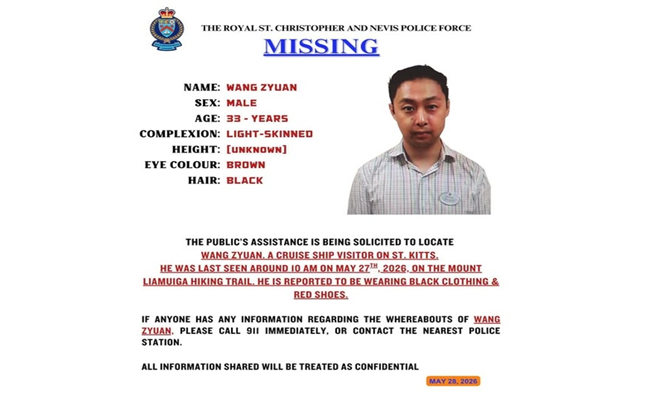
    BASSETERRE, St. Kitts – A large-scale coordinated search operation is ongoing across the rugged Mt. Liamuiga mountain range after a 33-year-old Chinese national went missing during a solo hiking trip, local law enforcement confirmed Friday.

    The Royal St. Christopher and Nevis Police Force (RSCNPF) is leading the effort, with joint support from the St. Kitts-Nevis Defence Force, the Fire and Rescue Department, and the National Emergency Management Agency (NEMA) to locate the missing hiker, identified as Wang Zyuan, born August 29, 1992.

    According to official police records, Wang was last spotted on the mountain’s hiking trail around 10 a.m. local time on Wednesday, May 27, 2026. He had set out on the hike unaccompanied, with no professional guide, and was wearing black outerwear paired with red athletic shoes when he was last seen.

    Roughly four hours after he was first noted on the trail, Wang placed an emergency call to 911 to report he had become disoriented and lost in the mountain wilderness. But shortly after that initial distress call, all communication with Wang cut off, leaving search teams with no updated information on his location or condition.

    A combined search and rescue deployment was assembled within hours of the lost contact, with crews working through the evening of May 27 to cover accessible sections of the range. Search operations were suspended overnight as a safety precaution for crews, and resumed at dawn on Thursday, May 28. Search teams advanced across steep hillsides all the way to the mountain’s crater area on Thursday, but failed to turn up any trace of the missing hiker.

    Operations were again paused for the night of May 28, with plans to restart search efforts on the morning of May 29. Investigators have obtained cell tower location data from local network providers, which authorities say will help narrow search zones and direct rescue teams to high-priority areas to maximize the chances of locating Wang.

    In addition to deploying official emergency resources, local authorities have put out a public call for civilian volunteers to join the search effort, to expand the coverage of teams across the large, rugged mountain range.

    Mt. Liamuiga has a history of similar incidents: over recent years, multiple hikers have been reported missing after straying into unmarked or difficult sections of the range, though most of those individuals were eventually located and rescued by emergency response teams.