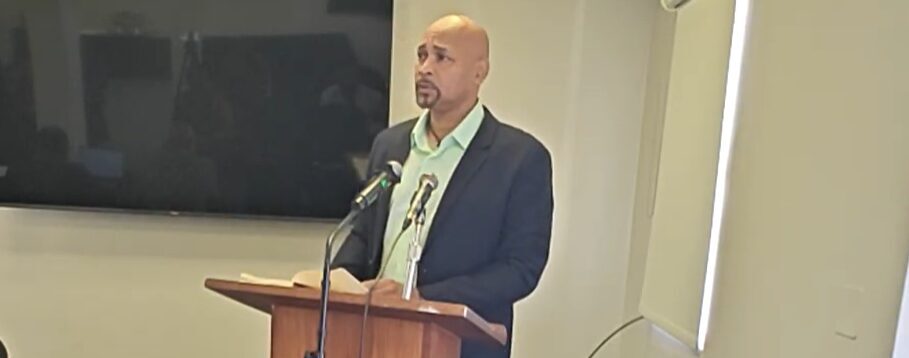
Jeremy Enriquez, a prominent social activist, has filed a second Freedom of Information Act (FOIA) request targeting the allocation of the Constituency Development Fund. Despite facing legal challenges with his initial request, Enriquez remains steadfast in his mission to promote transparency and accountability within the government. His latest submission, directed to the Office of the Prime Minister, seeks detailed information on how funds are distributed across electoral divisions, how they are utilized, and the mechanisms in place to ensure accountability. Enriquez emphasized that these requests are not frivolous but are aimed at holding the government to its promise of good governance, as outlined in their political manifesto. He stressed that secrecy breeds corruption and called for a shift away from this culture. This move comes amidst growing public scrutiny over government spending and the need for greater fiscal transparency.
分类: politics
-

Dominican Republic reaffirms support for Guatemala’s democracy and urges OAS action
The Dominican Republic has reiterated its unwavering support for Guatemala’s democratic process and President-elect Bernardo Arévalo, following the August 2023 elections, which were widely acknowledged as free and fair by international observers. In a virtual address to the Permanent Council of the Organization of American States (OAS), Dominican Foreign Minister Roberto Álvarez condemned recent efforts to undermine the presidential and vice-presidential mandates in Guatemala through dubious legal tactics. Álvarez underscored that such maneuvers not only infringe upon the sovereignty of the Guatemalan people but also contravene the democratic principles outlined in the Inter-American Democratic Charter. He echoed President Luis Abinader’s stance that no governmental authority has the right to override the electorate’s will, emphasizing that the Dominican Republic would refuse to recognize any de facto government arising from a violation of constitutional order. Álvarez called on the OAS and the global community to take decisive action to safeguard democratic institutions in Guatemala and across the Americas, leveraging all available mechanisms within the OAS framework and the Inter-American Democratic Charter.
-

UN Human Rights head: US attacks on boats illegal
The United Nations High Commissioner for Human Rights, Volker Türk, has strongly criticized the United States for its airstrikes on boats in the Caribbean and Pacific, which are allegedly linked to drug trafficking. Türk asserts that these actions violate international human rights law. In a statement released on October 31, Türk revealed that over 60 people have been killed in these attacks since early September, with no justification under international law. He emphasized that these operations, framed by the US as part of anti-drug and counter-terrorism efforts, fall under international humanitarian law but still fail to meet the stringent requirements for the use of lethal force as outlined in international human rights law. Türk called for immediate, independent, and transparent investigations into these incidents. He acknowledged the complexities of combating drug trafficking but urged the US to adhere to international legal standards, including relevant counter-narcotics treaties. Türk advocated for the use of established law enforcement methods, such as intercepting boats and detaining suspects under criminal law, rather than resorting to lethal force. The US has not named any other countries involved in these operations, but reports suggest that the US is also considering strikes on Venezuelan military bases. The Trump administration has labeled Venezuelan President Nicolás Maduro a narco-terrorist, a claim Maduro denies, accusing the US of attempting to orchestrate a regime change. Maduro has called for peace, stating that Venezuela will defend itself against any external threats.
-

Don’t lecture to us, Maduro
In a bold and unflinching open letter to Venezuelan President Nicolás Maduro, Curtis A. Obrady of Arima, Trinidad and Tobago (TT), delivers a scathing critique of the Venezuelan leader’s regime. The letter accuses Maduro of transforming Venezuela into a ‘living hell,’ forcing millions to flee due to hunger, fear, and oppression. Obrady highlights the irony of Maduro’s government, which silences dissent and imprisons journalists, now attempting to lecture TT on humanity and deportations. He emphasizes that TT has shown compassion by welcoming Venezuelan refugees, providing them with safety and dignity, but asserts that this compassion does not equate to weakness. The letter concludes with a strong defense of TT’s sovereignty and Prime Minister Kamla Persad-Bissessar’s leadership, urging Maduro to address his own human rights abuses before criticizing others.
-

Sturge declines to confirm whether Defence Force on high alert
In a tense exchange during the House of Representatives’ Urgent Questions segment on October 31, Minister of Defence Wayne Sturge refused to confirm whether Trinidad and Tobago Defence Force personnel had been ordered to return to their bases. The question was posed by Opposition Chief Whip Marvin Gonzales, who sought clarity on the matter ahead of the debate on extending the state of emergency. Sturge cited Standing Order 27 (g), which allows ministers to withhold information if its disclosure is deemed contrary to the public interest. Despite the minister’s evasive response, an internal message revealed that all military personnel were instructed to report to their respective bases by 6 pm on October 31. The directive also extended to officers on pre-retirement leave, sick leave, or vacation, who were ordered to remain on standby and prepare for potential confinement. The message emphasized the seriousness of the situation, stating, ‘This is not a drill.’ The developments have raised questions about the government’s preparedness and the implications of the ongoing state of emergency.
-

Historical context behind Trinidad and Tobago’s engagement with US, Venezuela
Prime Minister Kamla Persad-Bissessar’s position on Trinidad and Tobago’s (TT) involvement in regional security, particularly concerning the escalating tensions with Venezuela, has sparked considerable debate. Critics have labeled her approach as overly aligned with the United States or even “far-fetched.” However, a closer examination reveals that her stance is neither unprecedented nor unreasonable. It is deeply rooted in an 80-year history of strategic cooperation with the US, shared security interests, and a pragmatic assessment of contemporary challenges.
TT’s relationship with the US dates back to the Second World War, when the 1940 Destroyers for Bases Agreement led to the establishment of a US naval base in Chaguaramas and the construction of critical infrastructure, including the Churchill-Roosevelt Highway. These developments not only bolstered the Allied war effort but also laid the groundwork for TT’s modern road network. Although the US presence in Chaguaramas ended in 1963, the two nations have maintained a cooperative partnership through various agreements, such as the Customs Mutual Administrative Agreement and the Caribbean Basin Security Initiative. These frameworks have facilitated information-sharing, law enforcement collaboration, and maritime security, which are vital in combating transnational crime, narcotics, and arms trafficking.
Against this backdrop, Prime Minister Persad-Bissessar’s concerns about Venezuela’s security developments are well-founded. Recent US legal actions against Venezuelan officials, including former intelligence chief Hugo “El Pollo” Carvajal and President Nicolás Maduro, highlight the gravity of the situation. TT is not insulated from the repercussions of Venezuelan instability, as evidenced by the infiltration of the Tren de Aragua gang, now designated a terrorist organization under TT’s Anti-Terrorism Act. This poses a direct threat to national security, border management, and social stability.
When the Prime Minister asserts that any incursion into TT’s territorial waters will be met with force, she is not echoing US rhetoric but reaffirming TT’s sovereignty and right to self-defense. Her engagement with the US on surveillance, intelligence, and counter-narcotics cooperation aligns with the long-standing strategic partnership between the two nations. This pragmatic approach is aimed at safeguarding TT’s people and borders.
However, this cooperation must be balanced with transparency. TT must ensure that its territory is never used as a staging ground for foreign military operations without full sovereign consent. Diplomatic efforts should continue to prioritize peace, dialogue, and regional stability through organizations like Caricom, while simultaneously strengthening TT’s readiness to defend its frontiers.
In essence, TT’s current engagement with the US is neither subservience nor a novelty. It is a continuation of a historical partnership shaped by shared interests, geography, and the need for security in a volatile region. Prime Minister Persad-Bissessar’s approach is not “far-fetched” but a rational extension of TT’s historical trajectory and its responsibility to protect the republic.
-

Senator: Alcohol, beverage sectors pivotal to Trinidad and Tobago
Independent Senator Francis Lewis has raised concerns over the projected $1 billion in revenue from increased excise duties on rum, beer, and tobacco products, as outlined by Finance Minister Davendranath Tancoo. Speaking during a Senate debate on October 29, Lewis challenged the assumption that consumption of these products would remain unaffected by price changes, a concept known as price inelasticity. He cited a historical example from the ‘beer wars,’ where a 33% price drop led to a 45% surge in sales, arguing that the market is more elastic than policymakers assume. Lewis, who has consulted for local alcohol manufacturers, warned against rapid tax hikes, emphasizing the potential harm to businesses still recovering from the COVID-19 pandemic. He highlighted the sector’s significance, noting it employs approximately 100,000 people, with small bars and rum shops heavily reliant on alcohol sales. Lewis also expressed concerns about the lack of consultation with industry stakeholders, suggesting that sudden tax increases could create uncertainty and hurt revenue. Despite his objections, the Senate approved the government’s proposals to raise excise rates on alcohol and tobacco products.
-

House to debate SoE extension on October 31
Members of Parliament (MPs) in Trinidad and Tobago are set to convene on October 31 to deliberate on the government’s proposal for a second extension of the state of emergency (SoE). The decision, which requires only a simple majority in the House of Representatives, appears to be a foregone conclusion, as both government and opposition MPs have remained tight-lipped in their responses to media inquiries. The motion does not necessitate approval from the Senate, where independent benches hold moderating influence. The issue was expected to be addressed during a post-Cabinet briefing on October 30 at the Diplomatic Centre in St. Ann’s. Opposition Leader Pennelope Beckles, when contacted via WhatsApp, indicated that her MPs would caucus that afternoon to discuss the matter. The SoE was initially declared on July 18 following a public statement by Commissioner of Police Allister Guevarro, who warned of criminal gangs targeting public figures in politics and criminal justice. The House previously extended the SoE by three months on July 28, and MPs will now decide whether to grant another three-month extension. The Trinidad and Tobago Constitution outlines the procedure for extending the SoE, with the first two extensions requiring only a simple majority. However, any third extension would demand a special majority in the House and Senate approval. Attorney General John Jeremie’s motion will argue that the extension is ‘necessary and expedient.’ Meanwhile, government MPs have not responded to media inquiries, leaving reporters to await clarification at the post-Cabinet briefing. During the briefing, officials highlighted measurable decreases in crime as justification for the extension, while dismissing any connection to US-Venezuela tensions.
-

Finance Secretary: THA aims to curb expenditure in 2026
The Tobago House of Assembly (THA) has called on its divisions to limit their expenditures for the fiscal year 2026. This directive was announced by THA Secretary of Finance, Trade, and Economy, Petal Ann Roberts, during a media briefing following a post-budget retreat held at the Mt Irvine Bay Hotel on October 29. The retreat, chaired by THA Chief Secretary Farley Augustine, focused on the fiscal 2026 budget allocations and the assembly’s five percent share of the national budget. Discussions included last year’s achievements and challenges, as well as future policies and actions. Roberts emphasized the retreat’s inclusive nature, with inputs from all secretaries, assistant secretaries, and administrators on their achievements, strategies, and cost-saving measures. The THA has received a total of $2.96 billion, including allocations for Cepep and URP programs, which are crucial for Tobago’s development. The strategy discussed aims to constrain expenditures to fiscal 2025 levels, with a shift of approximately $300 million from recurrent to development, bringing the revised development allocation to $501 million. Six priority areas were identified: tourism, agriculture, digital transformation, human capital development, investment in micro, small, and medium enterprises, and infrastructure. Health, education, and community development were also highlighted as critical areas. Roberts will present a revised budget detailing the projects, their impact, and costs at an upcoming house sitting. Augustine confirmed that a full re-prioritization will be provided within two weeks from October 29.
-

‘Stop overlooking residents in Abaco’
The political discourse in North Abaco remains heavily influenced by ongoing infrastructure challenges and public dissatisfaction, as newly ratified Free National Movement (FNM) candidate Terrece Bootle-Laing steps into the electoral race. Bootle-Laing, a long-time resident of Abaco, has vowed to amplify the voices of constituents who feel neglected by current leadership. She has highlighted critical issues such as deteriorating roads, the stalled reconstruction of Treasure Cay International Airport and Cooperstown Clinic, and unmaintained verges—problems that have persisted since Hurricane Dorian devastated the island in 2019. Bootle-Laing emphasized that residents often feel their concerns are only addressed after significant public outcry, with many believing their voices are inadequately represented in Parliament. The incumbent, Progressive Liberal Party (PLP) MP Kirk Cornish, has announced his intention to seek renomination despite a controversial tenure. Cornish was acquitted of rape and assault charges in 2024 and faced backlash in 2023 for self-proclaiming the title ‘Prime Minister of Abaco,’ for which he later apologized. During her campaign, Bootle-Laing has engaged with residents who have raised issues ranging from the proliferation of shanty towns and inadequate street lighting to sea wall erosion in the cays. If elected, she plans to prioritize infrastructure repair and youth empowerment initiatives.