
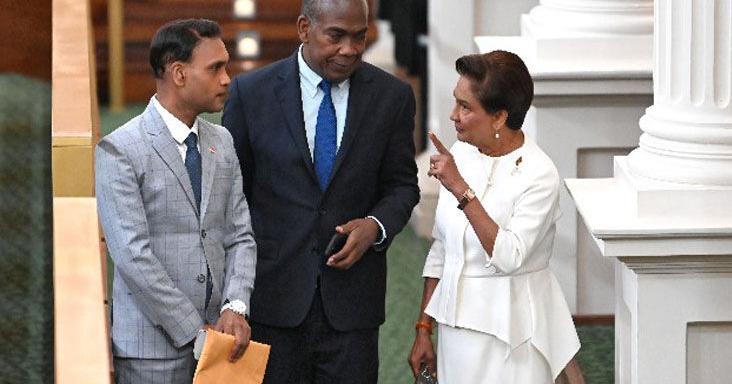
More than four weeks after former Opposition Senator Janelle John-Bates formally submitted her resignation to Opposition Leader Pennelope Beckles, a successor has finally taken her seat on Trinidad and Tobago’s Opposition Senate bench. At the opening of Tuesday’s Senate sitting, attorney Dr. Margaret Satya Rose was officially sworn in as the new People’s National Movement (PNM) senator, capping a weeks-long period of political speculation over the vacancy.\n\nBeckles opened the new chapter by publicly acknowledging John-Bates’ past service to the party and the nation, while doubling down on the PNM’s controversial decision to keep another high-profile senator, Faris Al-Rawi, in his position. Speaking to reporters after the Senate adjourned at the Red House in Port of Spain, the Opposition Leader expressed full confidence in Rose’s capabilities, highlighting her deep specialized experience in public procurement as a major asset to the opposition bench.\n\nThe leadership shake-up traces back to a public controversy that erupted in April, when it was revealed that John-Bates, while sitting on the parliamentary Public Administration and Appropriations Committee (PAAC), assisted former health minister Terrence Deyalsingh in editing a statement he was set to submit to the committee during an enquiry into public health pharmaceutical acquisitions. Al-Rawi was also linked to the preparation of the statement, though he noted he was serving as Deyalsingh’s personal attorney in the matter.\nGovernment senator David Nakhid subsequently referred both John-Bates and Al-Rawi to Parliament’s Privileges Committee for alleged rule violations. However, no investigation ever launched, as the procedural lapsed when the First Session of the 13th Republican Parliament dissolved on May 22. Even so, John-Bates was removed from her roles on the PAAC and the Joint Select Committee on National Security, and she submitted her Senate resignation on May 1.\nFor weeks following the resignation, Beckles faced mounting criticism from the governing party and scrutiny from political analysts over her refusal to immediately confirm John-Bates’ departure and name a replacement. Addressing that backlash on the day of Rose’s swearing-in, Beckles pushed back, arguing that the party needed time to handle the sensitive personnel matter through proper procedures. She emphasized that John-Bates is a young politician, and that mistakes do not need to spell the end of a public servant’s career, adding that the door remains open for her future political service. Responding to widespread calls for Al-Rawi to also step down, Beckles clarified that Al-Rawi was never a member of the PAAC, the committee where the controversy originated, justifying the decision to keep him in place.\n\nBeckles lavished praise on Rose, highlighting what she called the new senator’s “rich and outstanding record of professional achievement, public service and academic excellence.” She noted that Rose’s specialized expertise in governance, accountability and legislative scrutiny will meaningfully strengthen the Opposition’s work in the Senate. \”I am confident that she will serve the people of Trinidad and Tobago with distinction, integrity and commitment,\” Beckles said in her official welcome statement.\nRose is not only a practicing attorney but also an accomplished public policy researcher and educator, with globally recognized expertise in public procurement, governance, commercial law and anti-corruption frameworks. In an official release, the PNM described her as a respected leading professional whose career spans both the legal and public policy sectors. She holds a Doctor of Policy Research and Practice from the University of Bath in the United Kingdom, and has previously advised national governments, public institutions, and major international organizations on procurement governance, regulatory compliance, and public sector reform. She has also served as counsel in multiple high-profile public commissions of enquiry and significant legal cases, including appearances before the Judicial Committee of the Privy Council, the region’s highest appellate court.\n\nFor her part, John-Bates issued a measured statement following the swearing-in, thanking the PNM and Beckles for the chance to serve the nation. She extended well wishes to the Opposition Leader, saying, \”I wish [Beckles] strength and God’s guidance as she continues, in these difficult times, to defend our democracy and the rule of law.\” She also offered sincere congratulations to Rose on her new appointment.\nA civil lawyer by training, John-Bates said she has spent the past weeks reflecting deeply on the controversy and the core responsibilities that come with public office. \”I remain committed to serving the people of Trinidad and Tobago in any capacity that I am asked to by the Opposition Leader in the future,\” she said.\nBeckles echoed that collaborative tone in her official remarks, reaffirming her gratitude for John-Bates’ service over the past year. \”I wish to place on record my gratitude to former Senator Mrs Janelle John-Bates for her commitment and her contribution as an Opposition Senator over the past year. We will all continue to work together to restore good governance to Trinidad and Tobago,\” she said.
分类: politics
-
Govt seeks $2.93b wage boost
Addressing the opening of the 13th Republican Parliament’s second session yesterday, Prime Minister Kamla Persad-Bissessar unveiled a major government funding request alongside a sweeping update on the country’s economic recovery, job creation progress, and upcoming legislative priorities.
At the core of the administration’s immediate parliamentary business is a request for an additional TT$2.93 billion in supplementary funding for the 2025/2026 fiscal year. Of this total, $2.83 billion is earmarked as recurrent expenditure to cover newly negotiated wage increases for more than 62,000 public sector workers across multiple unions and government agencies. The Prime Minister detailed the breakdown of workers set to benefit: 18,000 from the Public Services Association (PSA), 20,000 from the National Union of Government and Federated Workers (NUGFW), 15,000 teachers, 6,000 Trinidad and Tobago Defence Force members, 1,300 from the Amalgamated Workers Union, 900 contract workers, and 850 from the West Indies Group of University Teachers (WIGUT). Persad-Bissessar emphasized that the government has committed to securing the necessary funds to honor the wage agreements, noting she felt “very proud and humbled” to deliver long-awaited salary adjustments to tens of thousands of public employees.
The timeline for parliamentary consideration of the funding request is already set: the 2026 Finance Bill, which gives legal effect to measures outlined in the 2025/2026 national budget, will be tabled in the House of Representatives next Wednesday, June 10 at 10:30 a.m. The Standing Finance Committee will convene on June 12 at 1:30 p.m., followed by full debate on the Supplementary Appropriation Bill—dubbed the mid-year budget review—on June 15. The original 2025/2026 budget, presented by Finance Minister Davendranath Tancoo last October, projected total planned expenditure of $59.232 billion, based on benchmark prices of US$73.25 per barrel of oil and US$4.35 per mmbtu of natural gas. The budget projected total revenue of $55.367 billion, resulting in an initial projected fiscal deficit of $3.865 billion.
Beyond the wage funding request, Persad-Bissessar highlighted the current administration’s progress in reversing economic stagnation left by the previous People’s National Movement (PNM) government. She claimed the PNM’s 10-year term left the country in a precarious fiscal position, with national debt nearly doubling from $75.4 billion in 2015 to $144.7 billion in 2015. She added that economic output contracted by 20%, foreign exchange reserves were cut in half, and billions of dollars were withdrawn from the country’s national savings funds over the PNM’s tenure.
In contrast, the Prime Minister asserted that the current administration has turned the tide in just one year in office, pointing to both domestic economic gains and renewed international credibility. Domestically, official data from the Central Statistical Office shows 8,000 new jobs were created in the final quarter of 2025 alone, with youth unemployment dropping sharply from 12.2% to 7.7%. Between April 2025 and April 2026, the government delivered 14,080 new jobs across 18 cabinet ministries. Upcoming infrastructure and industrial projects are projected to add thousands more: proposed housing developments will create over 4,000 new positions, the first phase of the government’s Blueprint Revitalisation Plan will generate another 4,000 jobs, and a planned 500-acre expansion of the Plipdeco industrial estate at Point Lisas—paired with three upcoming projects (two in metals manufacturing, one in food production)—will expand employment in the industrial sector. The government is also advancing development of a 256-acre Special Economic Zone in Picton, near the University of the West Indies South Campus, dedicated to hosting data center operations.
On the international stage, Persad-Bissessar highlighted three key wins that signal restored confidence in Trinidad and Tobago’s economy and governance: the country’s recent election to a two-year term on the United Nations Security Council, the World Bank’s decision to open a permanent World Bank Group office in Port of Spain—one of the most significant votes of confidence in the country’s economy in recent decades—and the European Union’s decision to remove Trinidad and Tobago from its tax blacklist, a move that reaffirms the country’s status as a credible, responsible, and competitive investment destination. The administration also recently completed a successful US$1 billion sovereign bond issuance, which was oversubscribed 2.5 times by 140 global investors, demonstrating strong international demand for Trinidad and Tobago’s debt.
The Prime Minister also outlined the government’s ongoing support for vulnerable populations, noting that over the past year, more than 117,000 elderly citizens received $3.8 billion in public pensions, 25,602 people living with disabilities received $520.3 million in disability grants, 13,869 low-income vulnerable households received $216 million in direct financial support, 12,614 food-insecure citizens received $75.7 million in food assistance, and 2,808 people affected by disasters received support through 1,232 individual disaster relief grants.
For Tobago, Persad-Bissessar reminded lawmakers that the island received its largest-ever central government allocation in the 2025/2026 budget, totaling $3.724 billion, which accounts for 6.3% of the entire national budget. She added that the central government will partner with the Tobago House of Assembly to advance long-overdue legislative and administrative reforms, including fixing long-standing structural anomalies in the THA Act.
Looking ahead to the second session of Parliament, the Prime Minister laid out a broad legislative agenda that addresses a wide range of policy priorities. Key bills scheduled for debate include legislation to establish a dedicated medical malpractice court, implement a national no-fault compensation system, create regulatory frameworks for cannabis and advance agricultural diversification, amend the Education Act to modernize the country’s education system, develop a national Parental Responsibility framework to address school violence, raise the minimum age limit for legal consumption of marijuana and alcohol and for participation in gambling, enact a new Victims’ Rights Act, establish the position of Chancellor for the Judiciary, amend the Firearms Act to strengthen gun regulation, create legislation to regulate gated residential communities, implement new social media regulations to protect children under 12 years of age, and reform local government processes for construction and building approvals to cut red tape.
As she concluded her address, Persad-Bissessar struck an optimistic tone, updating a promise she made in April that “better days were coming.” “I now say, Mr Speaker, better days are here and they will continue to get brighter,” she said.
-
Finance Bill proposes tax relief, tougher penalties
A sweeping new piece of fiscal and regulatory legislation that will reshape multiple sectors of Trinidad and Tobago’s economy and legal framework is set for parliamentary debate next week, after Finance Minister Davendranath Tancoco formally introduced the 2026 Finance Bill to the House of Representatives this week.
Spanning 31 clauses and requiring amendments to more than 30 existing laws, the bill integrates a diverse set of policy priorities aligned with the current government’s core goals, spanning tax reform, pension adjustments, energy sector investment stimulation, and a nationwide crackdown on regulatory and criminal non-compliance.
One of the bill’s most impactful tax reforms centers on retirement security for local residents: it proposes full elimination of income taxes on earnings generated by government-approved pension fund plans and deferred annuity plans. To support property owners and stimulate the rental market, the legislation also introduces a new tax credit for individuals and businesses subject to the Landlord Business Surcharge, allowing claimants to offset the full surcharge amount against their annual income tax obligation, up to their total tax liability.
To incentivize philanthropic giving, the bill also outlines new tax deduction rules for contributions to government-authorized public funds established under the Exchequer and Audit Act. Individual donors can claim deductions equal to up to 20% of their annual income or $20,000, whichever is lower, while corporate donors are eligible for deductions capped at 15% of chargeable profits or $100,000.
A key economic stimulus measure targets the country’s critical energy sector, designed to unlock new investment in underdeveloped marginal marine gas fields. Eligible fields — defined as offshore assets with total reserves of 300 billion cubic feet or less and an internal rate of return below 15% — will qualify for a reduced 8% royalty rate and a generous 130% enhanced capital allowance on qualifying capital expenditures spread over a five-year period.
The bill also delivers long-awaited pension reform for the country’s protective services, including prison officers, police officers and firefighters. Under the new provisions, retiring officers who served continuously in a higher-ranking position for at least one year before reaching compulsory retirement will have their final pensions and gratuities calculated based on the salary of that higher office.
Administrative modernization is another core focus of the legislation, with a series of reforms proposed for the Registrar General’s Department. These changes include expanding mandatory electronic filing of official documents, requiring standardized identification and supporting records for all submissions, and creating a new voluntary process for companies to apply to be struck off the corporate register.
In line with the government’s public commitment to reducing crime and strengthening regulatory enforcement, the bill includes sweeping increases to fines and criminal penalties across a wide range of offences, alongside targeted regulatory updates. A notable new provision adds a nationwide ban on the importation of any goods produced through forced labour, aligning local trade rules with global ethical standards.
Reforms to gaming and liquor regulations expand the maximum number of permitted amusement machines on certain licensed premises from 20 to 33, introduce a quarterly gaming tax structure, and raise penalties for regulatory breaches. A new offence for exceeding the permitted number of gaming machines carries a $25,000 fine, up to one year of imprisonment, and potential revocation of the premises’ liquor licence.
The steepest penalty increases are applied to tobacco-related offences under the Tobacco Control Act. First offences will now carry fines as high as $150,000, while serious offences tried in the High Court can result in fines up to $600,000 and three years of imprisonment. These enhanced sanctions apply to violations including selling tobacco products to minors, illegal public display of tobacco products, and other breaches of public health regulations.
Other notable penalty hikes include a $150,000 maximum fine for illegal timber removal under the Forests Act, a matching $150,000 fine for unlicensed sawmill operations under the Sawmills Act, and a $150,000 maximum fine for offences under the Conservation of Wild Life Act. Additional increases apply to violations across areas including animal health, shipping, motor launches, pesticide and toxic chemical regulation, and spirits manufacturing.
-
Imbert: More fines in Finance Bill
Trinidad and Tobago’s 2026 Finance Bill has sparked fierce political pushback, with opposition lawmakers warning that broad-based penalty increases across multiple industries and regulatory frameworks will impose new, burdensome costs on ordinary citizens, small business owners, and industry operators nationwide.
Speaking at a press briefing held Tuesday at the Red House (Trinidad and Tobago’s Parliament building) in Port of Spain, opposition MP and former finance minister Colm Imbert publicly outlined details of the 31-clause bill, confirming that the opposition had received official advance notice of the legislative text. Imbert revealed that more than half of the bill’s provisions target existing penalties across a wide range of national laws, with hikes ranging from a 50 percent jump to a staggering 400 percent increase for select offenses.
One of the most controversial adjustments falls to minor, unprescribed offenses under the Motor Launches Act, the legislation governing small commercial vessels including local party boats. The baseline penalty for these unspecified violations is set to jump from TT$2,000 to TT$7,500 — a 275 percent increase that Imbert argues will punish small operators for trivial, accidental oversights.
“What is the basis for this extreme jump? How do you justify moving from $2,000 to $7,500 for an offense that isn’t even clearly defined?” Imbert questioned, noting the penalty hike directly contradicts the current administration’s earlier campaign pledges to reduce burdensome fines and regulatory penalties for citizens and businesses.
Beyond the Motor Launches Act, Imbert pointed to sweeping penalty increases across more than eight additional pieces of legislation, including the Gambling and Betting Act, Forest Act, Sawmills Act, Conservation of Wildlife Act, Animal Importation Act, Registration of Clubs Act, Pharmacy Board regulations, and the Pesticides Act. He emphasized that every proposed adjustment carries a minimum 50 percent penalty increase, calling the cumulative measure a deliberate pattern of punitive cost hikes that targets everyday Trinbagonians.
“This is what the government is doing right now: every week, it’s new fines, new increases, new costs, all to punish ordinary people,” Imbert said. “It was critical that we bring this to the public’s attention so people understand exactly what they’re facing.”
Imbert also doubled down on criticism of the administration’s troubled new Landlord Business Surcharge policy, arguing that repeated extensions to the mandatory landlord registration deadline are clear proof of the policy’s fundamental flaws and the government’s administrative incompetence.
When the policy was first introduced in December, Imbert predicted the government would be forced to extend the original registration deadline due to unworkable structural flaws. He has now correctly predicted two extensions — pushing the deadline from March 31 to May 30, then again to June 30 — and says a third extension is all but guaranteed.
The policy requires an estimated 100,000 landlords across the country to complete in-person registration and verification interviews with the Inland Revenue Division (IRD), after the agency eliminated the option for document drop-off submissions. Imbert warned that the IRD lacks the operational capacity to process such a large volume of applications in a reasonable timeline, creating massive administrative backlogs that will leave thousands of landlords in regulatory limbo.
“How on earth is the IRD supposed to process 100,000 in-person interviews and registration applications? There simply isn’t the staff or infrastructure to pull this off,” he said.
He also raised serious privacy and public safety concerns about the policy’s requirement for a public, searchable register of landlord and tenant information. Imbert argued that making this personal data publicly accessible constitutes a clear violation of privacy, and exposes property owners to elevated risks of kidnapping, fraud, and other violent and financial crimes.
“Every single piece of legislation this government brings to Parliament is sub-standard and poorly drafted,” Imbert said. “We flag the problems, they spend months revising it, and then they come back to fix the mess they created in the first place.”
-
PM Adds Final Touches to CHOGM 2026 Bottle Cap Mural
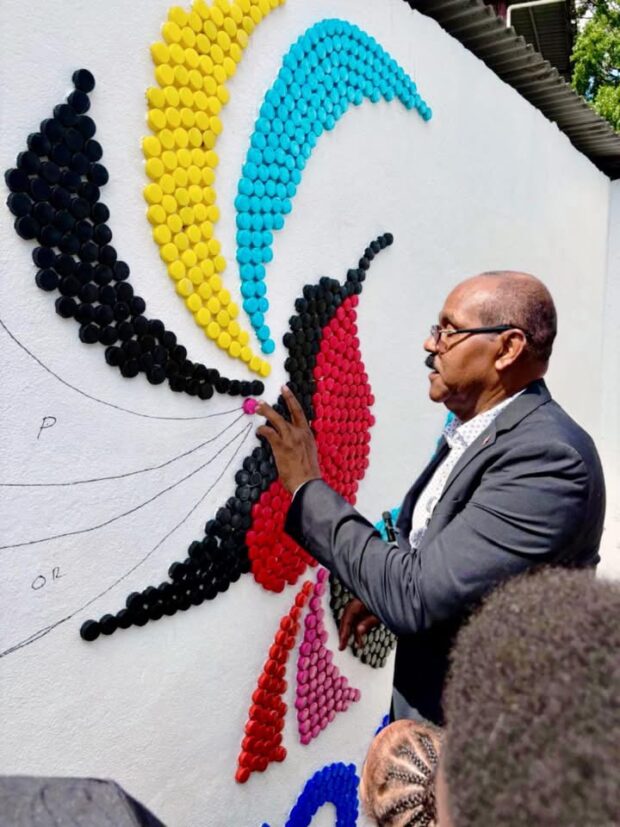
As Antigua and Barbuda moves ahead with preparations to welcome global leaders for the 2026 Commonwealth Heads of Government Meeting, Prime Minister Gaston Browne made a hands-on contribution to a unique community-focused sustainability project this Thursday. The national leader stood alongside young learners from Villa Primary School and key project stakeholders to add pieces of recycled bottle caps to a large-scale public mural, an initiative designed to tie the upcoming major diplomatic summit to local environmental and community action.
The innovative public art project is coordinated by the official CHOGM 2026 Secretariat, with creative direction led by established artistic leaders Calvin Pilgrim and Stacy Russell. Unlike traditional murals that rely on paint and canvas, this work is constructed entirely from repurposed plastic bottle caps, turning everyday waste into a meaningful piece of public art that carries a clear message. The core goals of the project are twofold: to raise global and local awareness of sustainable development practices, and to encourage cross-sector community participation in the lead-up to one of Antigua and Barbuda’s largest international diplomatic events in recent years.
Scheduled to take place from November 1 to November 4, 2026, the upcoming CHOGM will gather heads of state, senior government representatives, and official delegates from all 56 member nations of the Commonwealth. The gathering presents Antigua and Barbuda with a key opportunity to showcase its commitment to global cooperation, climate action, and community-led sustainability on an international stage, with the bottle cap mural serving as a visible, accessible symbol of these priorities ahead of the summit.
-
CABINET NOTES: June 4th 2026
On June 4, 2026, Australia’s federal Cabinet convened for its scheduled quarterly closed-door meeting, where senior government ministers gathered to deliberate on a range of pressing national policy priorities. These high-stakes gatherings serve as the central decision-making forum for the country’s executive branch, where cabinet ministers hash out legislative proposals, coordinate cross-departmental initiatives, and assess emerging national challenges before policies are brought before full Parliament for debate.
While official Cabinet notes are typically kept confidential under the Australian government’s cabinet confidentiality principle to enable open, unfiltered debate among ministers, preliminary off-the-record briefings to major media outlets confirm that the meeting centered on three core policy areas: post-pandemic economic resilience, climate adaptation infrastructure investment, and national health system reform. Ministers reportedly reviewed updated economic data showing persistent inflationary pressures in the housing and energy sectors, and discussed targeted regulatory adjustments to ease cost-of-living burdens for low- and middle-income households.
Another key agenda item was the rollout of the government’s 10-year national renewable energy corridor project, with ministers approving the final allocation of $15 billion in federal funding for transmission network upgrades connecting new wind and solar farms in regional areas to population centers on the east coast. The meeting also included a detailed briefing from the Department of Health on rising demand for aged care services, with ministers advancing draft legislation to increase funding for at-home care packages and raise minimum staffing requirements for residential aged care facilities.
Cabinet is expected to present the finalized versions of these policies to Parliament for its next sitting period, which begins in mid-July 2026. Government sources indicate that the Albanese administration is prioritizing these initiatives to deliver on key election promises ahead of the next federal election scheduled for late 2027.
-
Brandstofprijs kost overheid maandelijks circa SRD 300 miljoen
Suriname’s government is currently allocating roughly 300 million Surinamese Dollars (SRD) each month to cap rising consumer diesel prices, President Jennifer Simons announced during a public press briefing held Friday.
The head of state explained that the policy of artificially holding down fuel prices is a temporary measure, designed to cushion the blow of global crude oil price hikes for local households, transportation service providers, and the country’s domestic production sector. Since March 18, Suriname has enforced fixed maximum prices for common fuels: diesel is capped at 53.27 SRD per liter, while regular unleaded gasoline carries a ceiling price of 48.32 SRD per liter.
Simons pointed to ongoing international conflicts and geopolitical tensions as the core force roiling global energy markets, noting that even though Suriname maintains its own domestic crude oil production, the small nation remains extremely vulnerable to unforeseen shifts on the world energy market.
Crucially, the president issued a clear warning that the government cannot sustain this costly price intervention indefinitely. The future of the policy will remain contingent on two key external factors: the trajectory of international oil prices, and the duration of the current geopolitical frictions that have disrupted global energy supplies.
To address growing concerns over economic stability and rising inflation, Simons confirmed that administration officials are holding continuous consultations with Suriname’s national oil company Staatsolie and the Ministry of Finance. The ongoing coordination is aimed at minimizing spillover risks to the country’s broader economy and curbing upward pressure on consumer prices, according to the president.
-

Who Owns the Land? Indigenous Groups Challenge Government Plan
In southern Belize, a growing coalition of Indigenous communities is ramping up pressure on the national government over a proposed village boundary redrawing initiative that directly threatens long-held ancestral land claims at the center of the years-long Sittee River–Hopkins dispute. What began as a localized conflict has now expanded into a national movement, drawing cross-Indigenous solidarity and global advocacy attention ahead of a potential legal showdown over territorial rights.
The dispute, which has simmered for more than 15 years, has been reignited by the government’s plan to formally redefine village boundaries across the region. For the Garifuna communities at the heart of the conflict, this government-led process amounts to an illegitimate seizure of land that has been governed autonomously by Garifuna people since Belize gained independence in 1981. Wellington Ramos, co-founder of the global Garifuna advocacy group *The Garifuna Nation*, which has recently joined the fight to defend territorial rights, pushed back against the government’s claim to ultimate authority over the land.
“Belize did not become independent until September 21, 1981. That’s a lot of years. We have been living autonomously in our communities since then. So for them to come now and say, ‘Oh, you know what? We own this land, we gonna tell you all what to do,’ that’s not gonna happen,” Ramos said in an interview with local outlet News Five.
The Garifuna campaign has gained critical momentum in recent weeks after the Maya Leaders Alliance, one of the nation’s most prominent Indigenous rights groups, issued a formal declaration of full solidarity with the Garinagu (the plural term for Garifuna people). The alliance has committed to standing alongside Garifuna communities, framing the fight as a shared struggle to enforce Indigenous territorial rights under international law. Joseph Guerrero, co-founder of The Garifuna Nation, called the cross-group support a transformative endorsement, noting that both the Maya and Garifuna have a shared history of fighting for land recognition through international legal systems.
Guerrero pointed to a landmark precedent set by Garifuna communities in Honduras, who successfully won multiple cases against the Honduran government at the Inter-American Commission on Human Rights (IACHR) after the state attempted to title collective Garifuna land to private third parties without the community’s free, prior, and informed consent – a move he says the Belizean government is replicating. He also noted that the Maya in Belize previously faced similar barriers when local courts initially blocked their efforts to access domestic courts to defend their territorial rights, building a shared history of resistance that underpins the current alliance.
“Their support is greatly appreciated by the Garifuna Nation. We do have a relationship with the Maya Leaders Alliance,” Guerrero added.
Not all local village governing bodies have joined the opposition to the government’s boundary plan, however. The Sittee River Village Council has taken a more moderate stance, confirming it is actively cooperating with the government’s commission by turning over all requested maps and documentation to move the boundary process forward. Council leadership has emphasized that their participation in the government-led process is not an attempt to undermine neighboring Garifuna communities, framing the effort as a matter of following formal administrative procedure rather than an act of aggression.
Windell McDougall Jr., chairman of the Sittee River Village Council, said, “They’re our neighbors, our friends, our family, and like I said, we don’t have any issues with our people. We’ll remain friends, family. We have loved ones in neighboring villages you know, it’s just for us, it’s just following the process. The indigenous rights and different stuff they wanna put forward, that’s a different matter. That’s not for to divide us. And that’s a different matter, you know, if any group want to see something like that through. Well, you know, that’s a process for the high courts to take up.”
Council treasurer Kendis Kelly echoed that sentiment, noting that the dispute has been unresolved for 15 years, and the government’s new commission is simply the latest step toward a resolution. He pushed back against claims that the council’s participation is motivated by opposition to Garifuna rights, saying, “It just so happens now that the time has come that the government has appointed a commission now to see the matter forward. But it has nothing to do with the expats fighting against the Garinagus.”
To advance their legal fight, the National Garifuna Council has launched a dedicated Legal Defense Fund to cover advocacy and litigation costs, and has issued a public call for support from Garifuna people at home and abroad, as well as all Belizean citizens who recognize Indigenous territorial rights. For Garifuna communities, the fight over the land is not merely a legal dispute: it is a battle to protect the foundation of their cultural identity and collective self-determination. As pressure builds from both sides of the conflict, the question of how to balance formal administrative due process and long-standing Indigenous ancestral claims remains unresolved, leaving the future of the contested southern Belize lands hanging in the balance. This report was prepared by Britney Gordon for News Five.
-
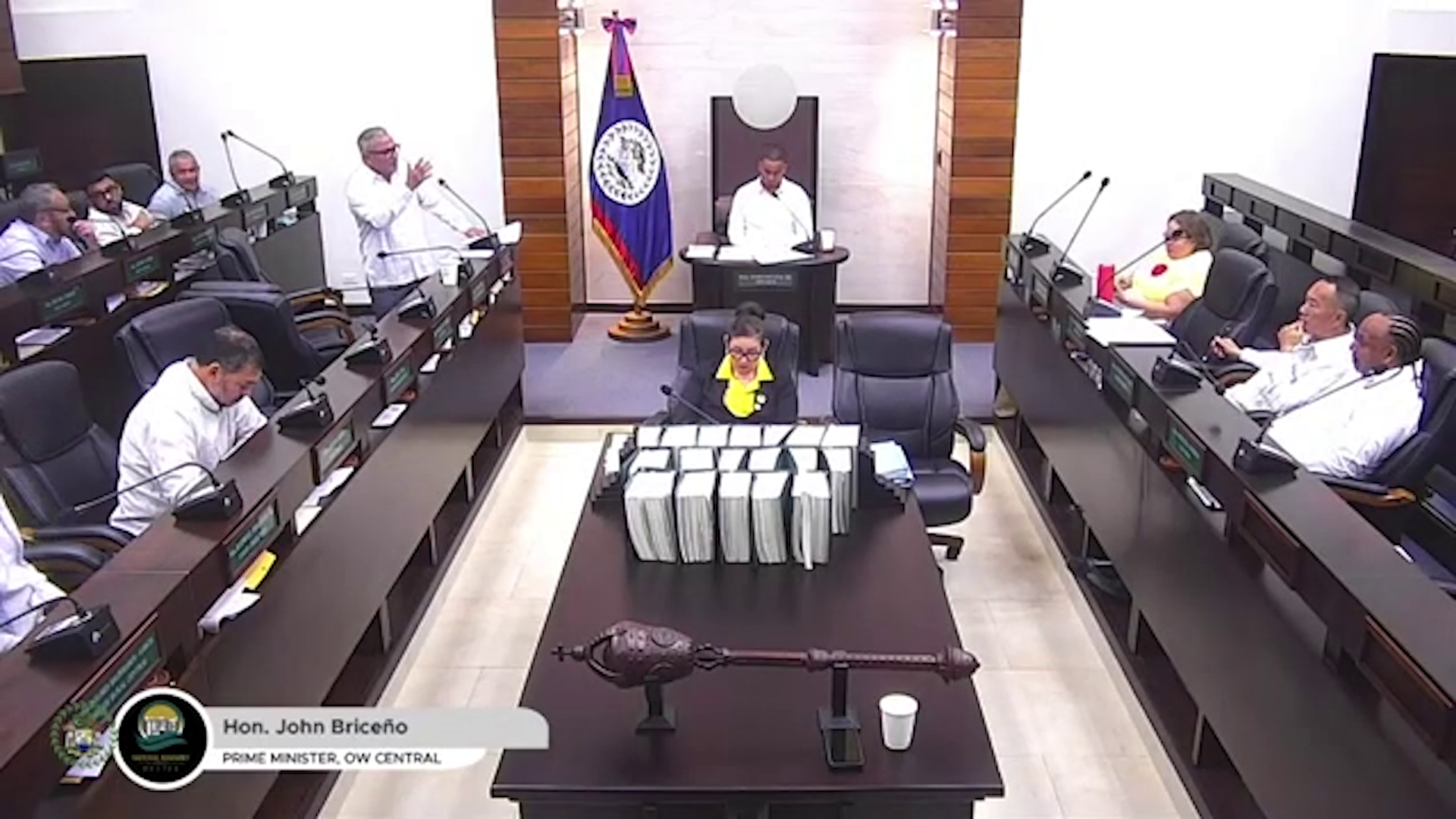
Fuel Prices Ignite Clash in House as Lee Mark Presses PM on Rising Costs
On Thursday, a fiery debate erupted in Belize’s House of Representatives, fueled by skyrocketing fuel prices and their cascading impact on the daily cost of living for ordinary citizens. The confrontation pitted opposition legislator Lee Mark Chang, representative for the Mesopotamia Area, directly against Prime Minister Johnny Briceño’s governing administration, demanding concrete answers for the unrelenting price surge that has pushed up costs for everything from grocery staples to essential public services.
Chang did not limit his criticism to fuel pricing alone. He also launched a close scrutiny of the Briceño administration’s 2026 capital investment budget, questioning whether the proposed $606 million allocation for large-scale infrastructure projects could be reallocated to relieve the mounting financial pressure weighing on households across the country.
Addressing the chamber through the Speaker, Chang laid out his argument bluntly: no one in the country opposes development or improved infrastructure, he said, but national policy must reflect urgent public needs. “Roads alone cannot resolve widespread hardship. We cannot eat asphalt. A family that cannot afford groceries cannot feed their children with pavement. A taxi driver cannot cover their monthly expenses from a ribbon-cutting ceremony. A farmer cannot get their produce to market with government press releases,” Chang stated, emphasizing that every sector of Belize’s economy is tied directly to affordable transportation and fuel costs.
Chang pressed the administration further: amid a nationwide fuel crisis, soaring cost of living, and recent bus strikes that brought the country’s daily operations to a standstill, is large-scale infrastructure spending the right priority at this moment?
In response, Minister of Transport Dr. Louis Zabaneh pushed back, framing the fuel price hike as a global issue driven by geopolitical instability rather than domestic policy failure. He pointed to ongoing conflict in the Strait of Hormuz, near Iran, as a key disruptor that has driven up crude oil prices on global markets, a shock that Belize cannot avoid as an importing nation.
The clash comes shortly after the Belizean government made a commitment to resume regular public notifications of fuel price increases, a move that comes amid growing public frustration over living costs. This report is adapted from a transcribed broadcast of evening television news.
-

Kingmaker Moment? Mahler Weighs in on City Mayoral Race
As the race for Belize City’s mayoral seat enters its pre-convention phase, all political eyes are fixed on Anthony Mahler, the long-serving Pickstock Area Representative, whose endorsement is widely viewed as the deciding factor that could swing the contest to either of the two declared candidates. The ruling People’s United Party (PUP) is set to select its standard-bearer for the upcoming municipal election through an internal party convention, where two young political hopefuls, Eluide Miller and Allan Pollard, have already thrown their hats into the ring.
Political observers across Belize have framed this as Mahler’s ‘kingmaker moment’; his deep roots in city-wide party structures and established base of grassroots support give any candidate he backs a massive early advantage in the race for the nomination. When pressed by reporters this week to reveal which contender he would support, Mahler kept his cards close to his chest, declining to make any public endorsement at this stage.
Mahler did, however, frame the competitive race as a net positive for Belizean democracy, praising the two young candidates for their drive and fresh perspective. “We have two young aspirants who have energy and who are creative. And then we will see where that goes,” he told reporters, adding that he would first consult with his local party executive before reaching a final decision on where the Pickstock delegation will throw its support.
When asked about calls that this cycle is Pollard’s “turn” after he was asked to step aside for another candidate in the 2021 convention, Mahler pushed back against the framing. He noted that the narrative of “waiting your turn” has been used to discourage countless aspiring politicians throughout history, including former US President Barack Obama, who defied early claims he was not ready for national office. “If you really want something you will go for it,” Mahler said. “They said that to me in the past that it is not your time either, go somewhere else or do this. … lets go to a convention and lets see where that ends up.”
While Miller and Pollard are the only two declared candidates so far, rumors are circulating that current Belize City Administrator Candice Pitts is also considering a bid for the PUP nomination. As of this week, Pitts has not issued any public statement confirming or denying whether she plans to enter the race.
This report is adapted from a transcript of a live evening television broadcast, originally published online for Belizean audiences.