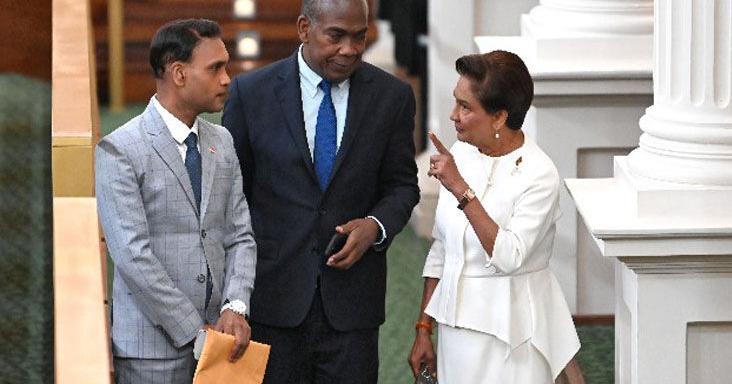
Addressing the opening of the 13th Republican Parliament’s second session yesterday, Prime Minister Kamla Persad-Bissessar unveiled a major government funding request alongside a sweeping update on the country’s economic recovery, job creation progress, and upcoming legislative priorities.
At the core of the administration’s immediate parliamentary business is a request for an additional TT$2.93 billion in supplementary funding for the 2025/2026 fiscal year. Of this total, $2.83 billion is earmarked as recurrent expenditure to cover newly negotiated wage increases for more than 62,000 public sector workers across multiple unions and government agencies. The Prime Minister detailed the breakdown of workers set to benefit: 18,000 from the Public Services Association (PSA), 20,000 from the National Union of Government and Federated Workers (NUGFW), 15,000 teachers, 6,000 Trinidad and Tobago Defence Force members, 1,300 from the Amalgamated Workers Union, 900 contract workers, and 850 from the West Indies Group of University Teachers (WIGUT). Persad-Bissessar emphasized that the government has committed to securing the necessary funds to honor the wage agreements, noting she felt “very proud and humbled” to deliver long-awaited salary adjustments to tens of thousands of public employees.
The timeline for parliamentary consideration of the funding request is already set: the 2026 Finance Bill, which gives legal effect to measures outlined in the 2025/2026 national budget, will be tabled in the House of Representatives next Wednesday, June 10 at 10:30 a.m. The Standing Finance Committee will convene on June 12 at 1:30 p.m., followed by full debate on the Supplementary Appropriation Bill—dubbed the mid-year budget review—on June 15. The original 2025/2026 budget, presented by Finance Minister Davendranath Tancoo last October, projected total planned expenditure of $59.232 billion, based on benchmark prices of US$73.25 per barrel of oil and US$4.35 per mmbtu of natural gas. The budget projected total revenue of $55.367 billion, resulting in an initial projected fiscal deficit of $3.865 billion.
Beyond the wage funding request, Persad-Bissessar highlighted the current administration’s progress in reversing economic stagnation left by the previous People’s National Movement (PNM) government. She claimed the PNM’s 10-year term left the country in a precarious fiscal position, with national debt nearly doubling from $75.4 billion in 2015 to $144.7 billion in 2015. She added that economic output contracted by 20%, foreign exchange reserves were cut in half, and billions of dollars were withdrawn from the country’s national savings funds over the PNM’s tenure.
In contrast, the Prime Minister asserted that the current administration has turned the tide in just one year in office, pointing to both domestic economic gains and renewed international credibility. Domestically, official data from the Central Statistical Office shows 8,000 new jobs were created in the final quarter of 2025 alone, with youth unemployment dropping sharply from 12.2% to 7.7%. Between April 2025 and April 2026, the government delivered 14,080 new jobs across 18 cabinet ministries. Upcoming infrastructure and industrial projects are projected to add thousands more: proposed housing developments will create over 4,000 new positions, the first phase of the government’s Blueprint Revitalisation Plan will generate another 4,000 jobs, and a planned 500-acre expansion of the Plipdeco industrial estate at Point Lisas—paired with three upcoming projects (two in metals manufacturing, one in food production)—will expand employment in the industrial sector. The government is also advancing development of a 256-acre Special Economic Zone in Picton, near the University of the West Indies South Campus, dedicated to hosting data center operations.
On the international stage, Persad-Bissessar highlighted three key wins that signal restored confidence in Trinidad and Tobago’s economy and governance: the country’s recent election to a two-year term on the United Nations Security Council, the World Bank’s decision to open a permanent World Bank Group office in Port of Spain—one of the most significant votes of confidence in the country’s economy in recent decades—and the European Union’s decision to remove Trinidad and Tobago from its tax blacklist, a move that reaffirms the country’s status as a credible, responsible, and competitive investment destination. The administration also recently completed a successful US$1 billion sovereign bond issuance, which was oversubscribed 2.5 times by 140 global investors, demonstrating strong international demand for Trinidad and Tobago’s debt.
The Prime Minister also outlined the government’s ongoing support for vulnerable populations, noting that over the past year, more than 117,000 elderly citizens received $3.8 billion in public pensions, 25,602 people living with disabilities received $520.3 million in disability grants, 13,869 low-income vulnerable households received $216 million in direct financial support, 12,614 food-insecure citizens received $75.7 million in food assistance, and 2,808 people affected by disasters received support through 1,232 individual disaster relief grants.
For Tobago, Persad-Bissessar reminded lawmakers that the island received its largest-ever central government allocation in the 2025/2026 budget, totaling $3.724 billion, which accounts for 6.3% of the entire national budget. She added that the central government will partner with the Tobago House of Assembly to advance long-overdue legislative and administrative reforms, including fixing long-standing structural anomalies in the THA Act.
Looking ahead to the second session of Parliament, the Prime Minister laid out a broad legislative agenda that addresses a wide range of policy priorities. Key bills scheduled for debate include legislation to establish a dedicated medical malpractice court, implement a national no-fault compensation system, create regulatory frameworks for cannabis and advance agricultural diversification, amend the Education Act to modernize the country’s education system, develop a national Parental Responsibility framework to address school violence, raise the minimum age limit for legal consumption of marijuana and alcohol and for participation in gambling, enact a new Victims’ Rights Act, establish the position of Chancellor for the Judiciary, amend the Firearms Act to strengthen gun regulation, create legislation to regulate gated residential communities, implement new social media regulations to protect children under 12 years of age, and reform local government processes for construction and building approvals to cut red tape.
As she concluded her address, Persad-Bissessar struck an optimistic tone, updating a promise she made in April that “better days were coming.” “I now say, Mr Speaker, better days are here and they will continue to get brighter,” she said.