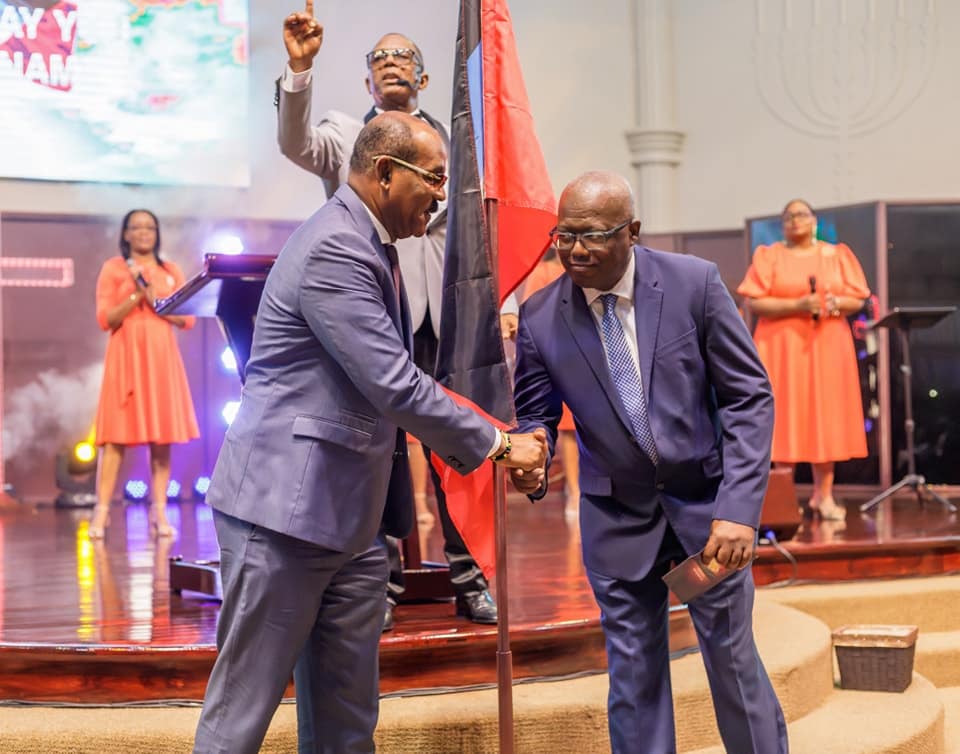
In a compelling address at the launch of the Commonwealth Heads of Government Conference (CHOGM) in Antigua, Prime Minister Gaston Browne of Antigua and Barbuda called for the Caribbean to remain a zone of peace. He expressed deep concerns over the recent military build-up by the United States in the region, ostensibly targeting drug traffickers. Browne warned that such actions could lead to disproportionate suffering for small island states, particularly those within the Organisation of Eastern Caribbean States (OECS), due to their inherent vulnerability. He highlighted the region’s dependence on imports from North America, emphasizing that any disruption in shipping or airlift services could have severe consequences. Drawing parallels to the economic impact of the Russian war on Ukraine, Browne underscored the potential fallout from military actions within the hemisphere. He urged Caribbean nations to unite against any form of military intervention, stressing the importance of defending national interests and promoting peace. Browne also reminded the audience of the shared humanity that binds all people, regardless of race or nationality, and called for a global commitment to justice and equity. His remarks come amid recent US airstrikes on alleged drug trafficking vessels in international waters, which have drawn criticism from the United Nations High Commissioner for Human Rights, Volker Türk.
分类: politics
-

FNM’s Brian Brown tops wealth list in Golden Isles by-election disclosures
In the lead-up to the Golden Isles by-election, financial disclosures published in The Tribune have unveiled the economic profiles of the candidates vying for the parliamentary seat. Brian Berkley Brown, the Free National Movement (FNM) candidate, has emerged as the wealthiest contender, with declared assets surpassing $2.6 million. Brown’s financial statement reveals total assets of $2,627,657, an annual income of $139,000, and liabilities of $235,000, resulting in a net worth of $2.39 million. His portfolio includes $1.7 million in securities and investments, $780,000 in real estate, and $50,000 in personal property.
-

Opposition leader urges greater funding for hurricane relief
Opposition Leader Mark Golding has urged the Jamaican government to allocate at least $50 million to each Member of Parliament (MP) to facilitate clean-up and relief efforts in their constituencies following the devastation caused by Hurricane Melissa. This proposal, if implemented, would require a total government expenditure of $3.15 billion. Golding made the recommendation during a press conference at the Office of the Leader of the Opposition in St Andrew on Monday, emphasizing the urgent need for increased funding to address the widespread damage caused by the hurricane.
-

Iram, COI denies claims he split from party
Central Grand Bahama MP Iram Lewis has firmly refuted allegations of his resignation from the Coalition of Independents (COI), labeling the claims as baseless. In a joint statement, the COI also dismissed the rumors, emphasizing the unity and strength of their team. The statement highlighted that the coalition remains intact and continues to work towards fostering unity and purpose across the Commonwealth of The Bahamas. Lewis, who resigned from the Free National Movement (FNM) in April after anticipating he would not be renominated, has maintained that his decision was driven by a vision to build a better Bahamas rather than political survival. Marjorie Darville, a long-time member of the Central Grand Bahama association, revealed that the FNM had been cautioned about the potential risks of renominating Lewis, with several members advocating for his replacement. Despite the controversy, Lewis expressed hope that even his critics would eventually support his broader vision for the nation.
-

Former US vice president Dick Cheney dies at 84
WASHINGTON, United States — Dick Cheney, the 46th Vice President of the United States, passed away at the age of 84, as confirmed by his family in a statement reported by US media on Tuesday. Cheney, who served under President George W. Bush from 2001 to 2009, succumbed to complications arising from pneumonia, cardiac disease, and vascular conditions.
-

Antigua denies presence of US military on the island
The Antigua and Barbuda Defence Force (ABDF) has categorically refuted claims of unauthorized American military operations on the island, clarifying that the presence of Canadian military personnel is linked to preparations for the Commonwealth Heads of Government Meeting (CHOGM) scheduled for 2026. In an official statement, the ABDF emphasized that there has been no confirmation or authorization of U.S. soldiers conducting surveys or activities in St. John’s or elsewhere on the island. The Canadian officials are engaged in collaborative planning and preparatory exercises to bolster local readiness, coordination, and security for the high-profile international event. The ABDF reaffirmed its dedication to working with regional and international partners to ensure the safety and seamless execution of CHOGM 2026. The public was urged to rely on official ABDF communications and avoid spreading unverified reports. Commonwealth Secretary-General Shirley Botchwey, who arrived in Antigua and Barbuda for planning meetings, expressed enthusiasm for the event, highlighting its potential to foster collaboration and shared prosperity among the 56 member states. During her visit, she is scheduled to meet with Governor General Sir Rodney Williams and Prime Minister Gaston Browne. Antigua and Barbuda’s High Commissioner to the UK, Karen-Mae Hill, underscored the summit’s significance in enhancing trade, investment, and partnerships across the Commonwealth.
-

A migrant exodus
The ongoing Venezuelan crisis continues to cast a shadow over the Caribbean, with Trinidad and Tobago’s migrant policies drawing significant criticism. Under Prime Minister Kamla Persad-Bissessar’s administration, the nation has adopted a ‘TT First’ doctrine, which has led to the dismantling of previous initiatives aimed at assisting Venezuelan migrants. This approach has resulted in the removal of supervision orders for refugees and asylum seekers, with government officials openly discussing ‘mass deportations’ and equating migrants with violent criminals. The administration’s stance was previewed at the UN General Assembly, where Persad-Bissessar argued that illegal immigration poses a threat to small nations like Trinidad and Tobago, leading to long-term disorder, poverty, and cultural antagonism. However, critics argue that the government’s narrative is xenophobic and lacks evidence, as police statistics show that Venezuelans arrested for criminal offenses are minimal compared to the number of legal refugees and asylum seekers. The policy risks damaging the economy, as Venezuelan migrants have been willing to take on jobs that locals often avoid, and threatens social cohesiveness by severing cultural ties with Venezuela. As the world watches, the administration’s actions raise questions about the nation’s commitment to its own history of migration and the pursuit of dreams.
-

PM to address special THA sitting on November 4
Prime Minister Kamla Persad-Bissessar is set to address Tobago’s longstanding quest for autonomy and other critical issues during a special sitting of the Assembly Legislature in Scarborough on November 4. This marks her first official address to the Tobago House of Assembly (THA) since her UNC-led coalition secured victory in the April 28 general election, winning 26 seats against the PNM’s 13 and the Tobago People’s Party’s two. Accompanied by a high-level ministerial delegation, including Attorney General John Jeremie and Finance Minister Davendranath Tancoo, the Prime Minister’s visit underscores her administration’s commitment to national outreach and inter-island collaboration. The visit aims to strengthen governance, enhance service delivery, and accelerate shared development priorities to foster inclusive growth. Persad-Bissessar’s itinerary includes a cultural event at Signal Hill Secondary School, a courtesy call on THA Chief Secretary Farley Augustine, and an address at the Assembly Legislature. Her speech is expected to highlight efforts to expand economic opportunities, improve public administration, and promote national unity. The visit concludes with a reception hosted by the Chief Secretary, bringing together Tobago’s business, cultural, and civic leaders. However, Minority Leader Kelvon Morris has criticized the visit, accusing the Prime Minister of making “empty promises” and planning to expose what he calls the Augustine administration’s failures in a private motion on November 6. Morris’s motion will focus on accountability, urging a Tobago-first approach to governance.
-

US government shutdown ties record for longest in history
The United States government shutdown has now entered its 35th day, matching the record set during Donald Trump’s first presidency. As the impasse continues, the Trump administration has issued stark warnings about potential chaos at airports, particularly during one of the busiest travel periods of the year. The shutdown, which began after Congress failed to approve funding beyond September 30, is on track to become the longest in U.S. history, with no immediate resolution in sight. Approximately 1.4 million federal workers, including air traffic controllers and park wardens, are either furloughed or working without pay. The Transportation Secretary, Sean Duffy, cautioned that the shutdown could lead to mass flight delays, cancellations, and even the closure of certain airspace sections due to staffing shortages. The Thanksgiving holiday, which typically sees a surge in air travel, is expected to exacerbate these issues. Meanwhile, the political standoff remains centered on health care spending, with Democrats demanding an extension of expiring insurance subsidies and Republicans refusing to address the issue until the government reopens. Despite some signs of bipartisan efforts to find a compromise, both sides remain entrenched in their positions. President Trump has remained steadfast, refusing to negotiate and even threatening mass layoffs of federal workers. The shutdown has also jeopardized critical welfare programs, including food assistance for millions of Americans, though the administration has pledged to comply with court orders to continue partial payments.
-

PM wrong – cross-border gas critical
The recent suspension of the Energy Cooperation Framework Agreement between Venezuela and Trinidad and Tobago (TT) has sparked significant concern among citizens and energy experts alike. This agreement, which facilitated the development of shared and cross-border gas fields, was a cornerstone of TT’s energy strategy and economic stability. However, the Prime Minister’s dismissive statement that ‘Trinidad and Tobago doesn’t need Venezuelan gas and never did’ has raised eyebrows and deepened anxieties about the nation’s energy future. TT’s gas production has been in decline since 2011, with current output averaging 2.6 billion standard cubic feet (scf) per day—far below the four billion scf needed to meet industrial and export demands. Projects like Mento, Matapal, and Cypre have provided some relief, but they are insufficient to bridge the gap. Cross-border fields such as Manatee, Dragon, and Manakin-Cocuina were expected to restore production levels by 2028, but their suspension now leaves TT without a viable ‘Plan B.’ The economic implications are dire: without these resources, downstream industries will suffer, government revenues will shrink, and foreign reserves will dwindle. Companies like Nutrien have already halted operations due to gas shortages, and others may follow. While diversification into non-energy sectors is essential, it cannot replace the foreign exchange earnings, tax revenue, and employment that the energy sector provides. The Prime Minister’s cavalier attitude toward this crisis, coupled with deteriorating diplomatic relations with Venezuela, threatens to undo decades of careful diplomacy and economic planning. TT’s short-, medium-, and long-term prosperity remains deeply tied to energy, and ignoring this reality could have catastrophic consequences for the nation’s economy and its people.