分类: politics

  • Noersalim: meer dan 25 corruptiedossiers bij LVV

    Noersalim: meer dan 25 corruptiedossiers bij LVV

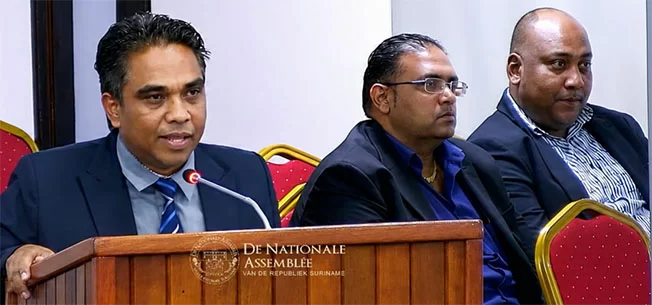
    In a parliamentary address delivered during budget deliberations on June 23, Suriname’s Minister of Agriculture, Livestock and Fisheries (LVV) Mike Noersalim has revealed shocking details of systemic mismanagement and widespread corruption within his ministry, announcing that over 25 potential corruption cases have already been documented for investigation.

    According to Minister Noersalim, when he took office, he inherited a government department grappling with not only deep organizational dysfunction, but also what he describes as deliberate policies that created fertile ground for corrupt activities. Corrupt practices have permeated every level of the ministry, from senior strategic leadership to frontline operational staff, with multiple officials found to have engaged in illicit activities, the minister confirmed.

    To date, formal reports have been filed with law enforcement authorities, relevant individuals have been questioned for investigation, and multiple suspects have been taken into custody, Noersalim said, adding that criminal legal proceedings are already underway against those implicated.

    Beyond the corruption scandal, the minister laid bare the severe operational decay that has crippled the ministry for years. Many core departments are critically understaffed, and basic working infrastructure ranging from temperature-controlled storage facilities and office computing equipment to functional work vehicles is severely lacking. In a striking example of the depth of disarray, Noersalim noted that ministry staff have in the past been forced to pool their own personal money to pay for vehicle fuel just to carry out required field inspections and site visits.

    Minister Noersalim emphasized that comprehensive internal reform is a non-negotiable first step before the LVV can deliver meaningful progress toward rebuilding and revitalizing Suriname’s critical agrarian sector. “You cannot build a functional, effective sector on a corrupted foundation,” he stated.

    The ministry has already launched a full organizational audit and overhaul process, with ongoing work including facility renovations for ministry buildings, upgrades to digital IT infrastructure, fleet and equipment modernization, streamlining of internal work processes, and targeted skills training for existing staff. To prevent future abuses of power and mismanagement, Noersalim highlighted that digital transformation and strengthened internal oversight mechanisms are core priorities of the ongoing reform effort.

  • Guatemala Says U.S. Won’t Be Fighting Gangs on Its Soil

    Guatemala Says U.S. Won’t Be Fighting Gangs on Its Soil

    In a firm rebuke of proposed U.S. military action within its borders, Guatemalan President Bernardo Arévalo has publicly ruled out allowing American troops to conduct anti-gang and counter-narcotics operations on Guatemalan territory.

    Arévalo made the clarification in an interview with Agence France-Presse on the sidelines of the Organization of American States summit held in Panama, confirming that while Guatemala actively seeks and welcomes international collaboration on security issues, its national constitution explicitly prohibits joint military operations with foreign armed forces.

    The president’s statement was issued in direct response to recent remarks by U.S. Defense Secretary Pete Hegseth, who told CBS News that the U.S. was considering launching targeted strikes against transnational criminal gangs and drug trafficking networks in both Guatemala and Ecuador.

    While Arévalo did not challenge the existence of existing bilateral security cooperation between the two nations, he emphasized clear legal and operational boundaries to that partnership. According to the Guatemalan leader, Washington’s involvement is restricted to three core areas: training for local security personnel, tactical planning support for anti-criminal raids, and cross-border intelligence sharing. All armed operations against domestic criminal organizations, he stressed, remain the exclusive responsibility of Guatemala’s own national security forces.

    The exchange comes amid a broader expansion of U.S. military activity across Central and South America under the Trump administration’s renewed anti-drug offensive. Earlier this month, U.S. forces carried out a cross-border raid in Venezuela that resulted in the death of Hector Rusthenford Guerrero Flores, leader of the violent transnational Tren de Aragua gang, who carried a $5 million U.S. bounty on his head. President Trump later publicly shared footage of the operation on his social media platforms.

    Beyond targeted raids on gang leaders, the U.S. has also launched a series of airstrikes against suspected drug smuggling vessels in the Caribbean Sea and Pacific Ocean. Official data from regional security sources indicates that more than 200 people have been killed in these air operations to date.

  • Ramdin opent OAS-vergadering: Samenwerking is geen keuze, maar noodzaak

    Ramdin opent OAS-vergadering: Samenwerking is geen keuze, maar noodzaak

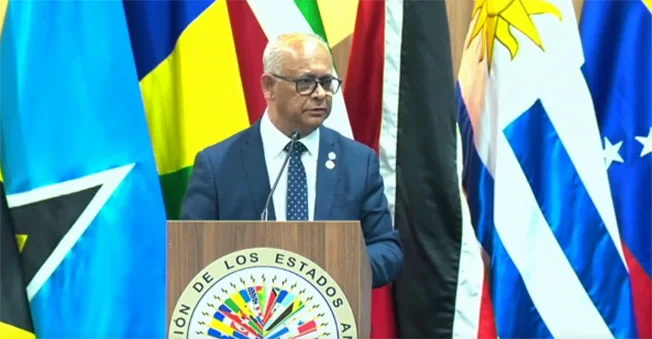
    On Tuesday, at the opening ceremony of the 56th General Assembly of the Organization of American States (OAS) held at Panama City’s Atlapa Convention Center, Secretary-General Albert Ramdin delivered a keynote address urging strengthened cross-regional collaboration to address a growing wave of interconnected challenges across the Western Hemisphere. The Surinamese diplomat emphasized that multilateralism and collective solidarity are not just ideological priorities, but fundamental prerequisites to sustain democracy, expand public security, and drive inclusive economic development across the bloc.

    Ramdin opened his remarks by grounding the gathering in regional history, linking the 2026 assembly to the 1826 Congress of Panama, a landmark event led by Latin American independence leader Simón Bolívar that laid the earliest foundational framework for inter-American cooperation. “What began as a bold vision 200 years ago remains an existential necessity today,” Ramdin stated. “Collaboration is no longer one of many policy options — it is a requirement for our shared survival.”

    The OAS chief outlined a sweeping set of pressing threats facing member nations, ranging from persistent economic uncertainty and widening income and social inequality to intensifying climate-driven natural disasters, rapid disruptive technological shifts, and the expanding reach of transnational organized crime.

    He also used the address to highlight sweeping internal reforms the OAS has implemented in recent years to boost its effectiveness. The organization has cut more than 360 active overlapping mandates down to just 77, all of which are now aligned with a new unified strategic agenda. Work is also ongoing to embed greater operational efficiency, public transparency, and long-term financial sustainability across all OAS bodies.

    On democracy promotion, Ramdin reported that over the past 12 months, the OAS has deployed 16 independent election observation missions across the region, mobilizing nearly 700 monitors to support free and fair electoral processes. At the same time, he reiterated the organization’s deep concern over shrinking democratic space in Cuba, Nicaragua, and Venezuela.

    Ramdin drew urgent attention to the ongoing humanitarian and political crisis in Haiti, where the OAS partners closely with the United Nations and the Caribbean Community (Caricom) to support stabilization efforts. In recent months, Ramdin noted, the OAS has helped distribute more than 600,000 national identity cards to Haitian citizens — a critical step to clear the way for planned democratic elections in the Caribbean nation.

    Public security was another core focus of the address. The OAS has partnered with regional development banks to launch a new observatory focused on tracking and countering transnational organized crime, and recently completed its first joint operational initiative with Interpol targeting the illegal arms trade across the Americas.

    Looking ahead, Ramdin announced the establishment of a new special OAS task force focused on artificial intelligence. The body will be tasked with developing clear regulatory guidelines for the responsible deployment of AI across the OAS secretariat and all its member states. Ramdin reaffirmed the organization’s enduring role as a neutral, trusted platform for inclusive political dialogue and collective action. “The OAS carries a core responsibility to defend democracy, protect the rule of law, and uphold human dignity for all people across the hemisphere,” he said. “But above all, it must bring nations together to collaborate at the moment when they need each other most.”

    The 56th OAS General Assembly will convene over multiple days, bringing together heads of state, foreign ministers, and official delegations from the bloc’s 35 member states to coordinate on shared priorities.

  • ‘Hundreds of Payments’: Formal Corruption Complaint Filed Against Mira

    ‘Hundreds of Payments’: Formal Corruption Complaint Filed Against Mira

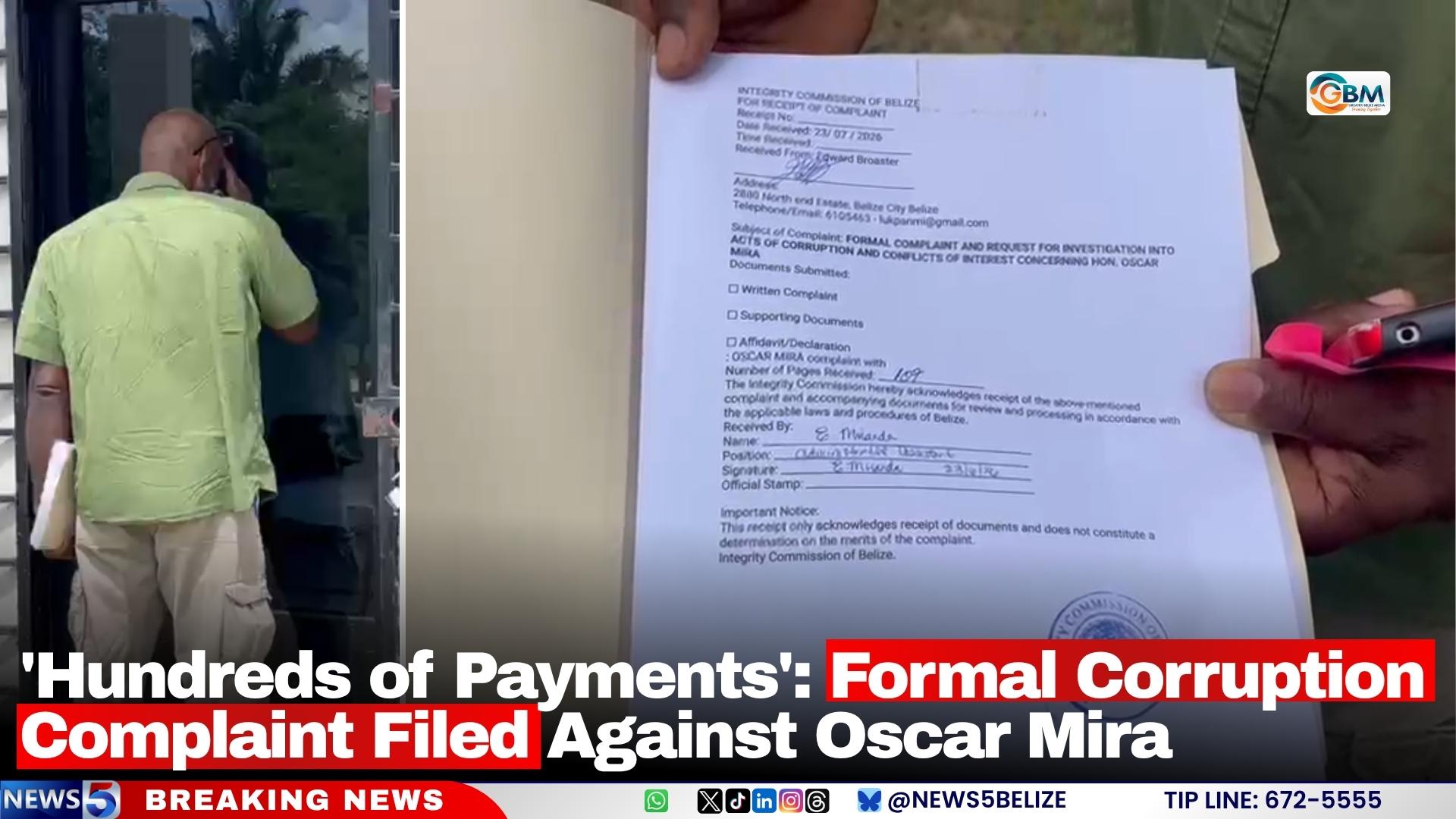
    Political and legal pressure has mounted sharply on Oscar Mira, the Area Representative for Belmopan in Belize, after a formal corruption complaint was submitted to the country’s Integrity Commission on June 23, 2026, calling for a full probe into allegations that he misused his official authority to direct millions of public dollars to family members and their linked business ventures.

    The complaint was brought by Edward Broaster, caretaker for the United Democratic Party (UDP) in Belize Rural Central, filed under Section 34 of Belize’s Prevention of Corruption Act. Broaster’s filing outlines three core accusations against Mira: conflict of interest and unlawful personal gain, failure to disclose private interests tied to government contracts, and abuse of public office to deliver improper financial benefits to close relatives.

    In the complaint, Broaster wrote: “I have reasonable grounds to believe that Hon. Oscar Mira, a ‘person in public life’ under Section 2 of the Act, is in breach of the provisions of this Act.” He anchored his filing in Section 34(1) of the Prevention of Corruption Act, Chapter 105 of Belize’s Substantive Laws.

    At the heart of the allegations are two entities tied directly to Mira’s family: Jenny Mira, the lawmaker’s sister, and MP Farms, a business controlled by his brothers Stanley and Brian Mira. Internal government records pulled from the country’s Smart Stream procurement system include dozens of screenshots showing more than 100 individual payments made to the two vendors between 2020 and 2025, with the majority of funds originating from the Ministry of Defence, a portfolio Mira previously led.

    Documented in the records is a single-day transfer of nearly $400,000 in public funds to MP Farms, while Jenny Mira received thousands of dollars across hundreds of separate smaller payments. Additional funding came from other government agencies including the Ministry of Health, the National Emergency Management Organization (NEMO), and the Belize Coast Guard.

    A particularly troubling detail highlighted in the complaint is the consistent pattern of structuring payments to fall just below the $10,000 threshold that triggers heightened oversight from the national Treasury, a practice widely recognized as a method to avoid regulatory scrutiny. This pattern has already drawn significant criticism from the Belizean public.

    Broaster is calling on the Integrity Commission to launch a complete investigation, cross-reference the claims against Mira’s official sworn asset and income declarations, appoint an independent special investigator, and refer the case to the Director of Public Prosecutions for criminal charges if evidence of unlawful activity is uncovered.

    This latest development comes exactly one week after Opposition Leader Tracy Panton submitted a Freedom of Information (FOI) request seeking the full documentation trail for all contracts connected to Jenny Mira, MP Farms, and four other linked entities dating back to 2020.

    In her statement announcing the FOI request, Panton laid out a series of unanswered public questions: “We want to know to whom were these contracts issued, what was the value, what tenders were publicly advertised, who evaluated the bids, who approved the contracts, were procurement procedures followed, were conflicts of interest declared, were payments structured to avoid scrutiny, were the goods and services actually delivered, and did the Belizean people get value for money?”

    After weeks of public silence, Mira broke his silence on the allegations for the first time on June 17, one day after Panton submitted her FOI request. The lawmaker has denied any personal involvement in procurement decision-making, noting that tender oversight committees fall under the jurisdiction of the Ministry of Finance, and that he has never served on or attempted to influence any of these panels.

    Mira argued: “Tenders are published in the newspaper. Any interested person can apply. They go through a lengthy process. I had no say; I was not part of those committees.” When asked about the pattern of below-threshold structured payments, Mira acknowledged the public’s concern but stopped short of admitting any wrongdoing, stating: “I do not think that anyone wouldn’t be concerned. But was anything illegally done? I do not know. I believe that in every crisis, you learn from it, and I myself am trying to make sure that I learn from this.” Mira also denied having any knowledge of his relatives’ business transactions with the government.

    Last Friday, the Integrity Commission issued a preliminary statement confirming that any member of the public with evidence of corruption can file a formal complaint that will be processed in accordance with Belizean law. Broaster formally submitted the complaint in person at the Integrity Commission’s Belmopan office on June 23, but the filing process was marked by unusual friction. After leaving the commission’s offices, Broaster told local outlet News 5 that commission staff were visibly hesitant to accept the complaint.

    “I never seen jumpier people than that yet, everything they make calls, they didn’t even want to take the complaint,” Broaster said. He also criticized the recent decision to grant Mira a three-month leave of absence, noting that the current Prime Minister has publicly stated zero tolerance for corruption and called for corrupt officials to be imprisoned. “So, giving Oscar Mira a three-month leave, is far cry from what he has been advocating for. I just hope that he will uphold the standards and rhetoric that he has been pushing.”

    Broaster has pushed back against claims that the complaint is a partisan political maneuver, insisting he is acting on behalf of all Belizean residents to protect public funds: “this is not a political move on my part, but rather on behalf of the poor people of Belize, the public purse.”

  • Abinader reaffirms zero-tolerance policy on corruption at all levels

    Abinader reaffirms zero-tolerance policy on corruption at all levels

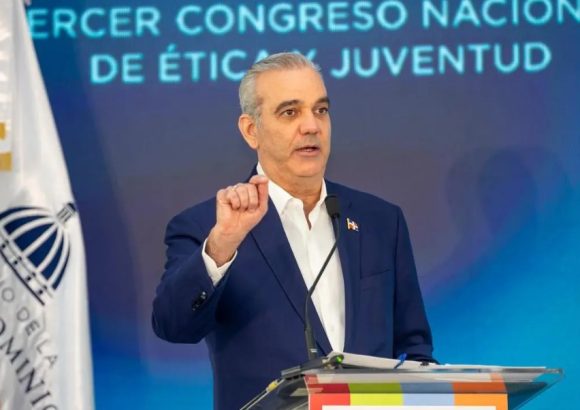
    In a significant push to embed integrity across public life in the Dominican Republic, President Luis Abinader has doubled down on his administration’s pledges to root out corruption and cultivate ethical leadership, speaking to hundreds of young emerging leaders at the Third National Congress of Ethics and Youth held at the Ministry of Defense in Santo Domingo.

    During the gathering, which centered on empowering the next generation to shape transparent governance, Abinader announced a landmark personal commitment: he will step into the role of president of the newly launched National Youth Ethics System. This nationwide initiative is designed to embed core values of honesty, ethical decision-making, and servant leadership among Dominican youth, laying the foundation for more responsible public engagement for years to come. The first gathering of the system is scheduled for next week, with regular monthly sessions planned to coordinate cross-sector efforts and scale the initiative’s reach across every region of the country.

    In his keynote address, the president emphasized that ethical practice cannot remain a rhetorical talking point — it must be integrated into every aspect of daily public and civic life. He issued a direct call to the country’s young people, urging them to step into active roles as guardians of public trust, serve as watchdogs for accountability, and cultivate a new standard of responsible citizenship across the nation. Rejecting the idea that professional status or academic credentials outweigh moral character, Abinader stressed that unwavering ethical conduct is the non-negotiable foundational requirement for anyone seeking to lead or serve the Dominican people.

    The president also used the platform to reiterate his administration’s long-stated zero-tolerance policy toward corruption at every level of government. He made clear that law enforcement and anti-corruption bodies will continue to investigate and prosecute all cases of official wrongdoing, no matter the rank of the individual involved. Broadening the common definition of corrupt acts, Abinader noted that corruption extends far beyond high-profile financial embezzlement schemes. It also encompasses small but corrosive acts including nepotism, influence-peddling, and preferential treatment that erode equal access to public services for all Dominican citizens.

    “We must be relentless in addressing everything from the smallest acts to the most significant ones,” Abinader told the crowd of young leaders. “Our work does not end with prosecutions. We must build a lasting national culture rooted in transparency, equal fairness, and respect for our democratic institutions, and young people are the key to making that vision a reality.”

  • Open Budget Survey 2025 places Dominican Republic second worldwide in transparency

    Open Budget Survey 2025 places Dominican Republic second worldwide in transparency

    In a formal ceremony held in Santo Domingo, the Dominican Republic’s General Directorate of Budget (DIGEPRES) has officially accepted landmark results from the 2025 Open Budget Survey (OBS) that cement the nation’s position as a global leader in government budget transparency. The country earned an impressive score of 82 out of a possible 100 points in the independent assessment, securing second place globally out of 82 participating nations, trailing only Brazil. Within Latin America, Central America, and the Caribbean, the Dominican Republic ranked first overall.

    The final survey outcomes were formally presented to DIGEPRES Director José Rijo Presbot by Juan Castillo, executive director of Fundación Solidaridad. The event drew a cross-section of key stakeholders, including senior government officials, national oversight body representatives, delegates from international organizations, members of civil society groups, and technical teams that support the Dominican Republic’s annual national budget development process.

    Widely recognized as the world’s only independent, comparative, evidence-based global evaluation of public sector budget transparency, the OBS assesses three core pillars of open governance: public access to detailed fiscal data, formal opportunities for citizen engagement in budget planning and oversight, and the strength of monitoring carried out by national legislative bodies and audit institutions. The 2025 iteration of the survey analyzed fiscal data that was publicly available through December 2024 across all participating countries.

    The 2025 report singles out the Dominican Republic as a global standout example of consistent, long-term progress in fiscal transparency. Since the first round of assessments in 2008, the country has surged from a score of roughly 12 points to the 2025 mark of 82, a 70-point improvement that ranks among the largest gains recorded by any nation over the survey’s history. This dramatic progress is attributed to three core drivers: the consistent, timely publication of all critical budget documents, targeted investments that have strengthened DIGEPRES’s institutional capacity, and expanded collaborative partnerships between government bodies and civil society organizations.

    In remarks following the formal acceptance of the results, Director Rijo Presbot framed the high ranking as both a formal recognition of decades of national work and a mandate to continue advancing open budgeting practices. He emphasized that meaningful transparency extends far beyond simply publishing government data; its ultimate goal is to strengthen public trust in state institutions and elevate the quality of national fiscal policy debate. Rijo Presbot also noted that the push for open budgeting aligns directly with the governance agenda of President Luis Abinader’s administration, which prioritizes strengthening government accountability, expanding citizen participation in public affairs, and improving the efficiency of public spending across all sectors.

  • Cartwright reveals $42,900 for violence commission

    Cartwright reveals $42,900 for violence commission

    A long-running dispute over resourcing for the Bahamas’ key anti-domestic violence oversight body has moved into the national Senate, with Social Services Minister Barbara Cartwright moving to quell growing anxiety from women’s rights advocates by confirming dedicated initial funding for the Protection Against Violence Commission. During Wednesday evening’s senate sitting, Cartwright confirmed the government has earmarked $42,900 in initial allocations for the commission, pushing back against claims from leading advocacy groups that the body would be crippled before it could launch its core mandated work without dedicated public resourcing.

    The push for clarification on funding came from Women United, one of the Bahamas’ most prominent women’s advocacy organizations. Group president Lisa Bostwick-Dean recently raised public alarms about the commission’s operating budget, warning that the body’s chair, Marisa Mason-Smith, would face severe operational barriers without guaranteed, dedicated financial backing. In a public statement outlining the group’s concerns, Bostwick-Dean noted the commission carries a broad, critical policy mandate: it is tasked with developing a national anti-violence strategic framework, coordinating cross-sector support for survivors of abuse, overseeing the expansion of emergency shelter capacity, and administering grant certification for community-led anti-violence projects. The advocacy leader called on the national government to publicly disclose exact funding figures to eliminate uncertainty around the commission’s ability to deliver on these responsibilities.

    Cartwright acknowledged the legitimacy of these concerns in her senate address, moving to reassure both the public and advocacy community that sufficient resources have been locked in for the commission. Beyond confirming the initial $42,900 allocation, the minister added that any additional operational funds required by the body will be drawn from the Ministry of Social Services’ 2026/2027 fiscal budget, providing a long-term funding pathway for the commission’s work. She also shared new details on the body’s operational infrastructure, announcing that the commission will be based out of the recently renovated VB Munnings building located on Pit Road in Nassau.

    Cartwright emphasized that the formation of the commission follows the recent passage of the landmark Protection Against Violence Act, meaning the body’s immediate priority will be the full, robust implementation of the new legislation. She told the Senate that the commission’s leadership – including chair Mason-Smith and Vice Chair Pastor Dave Burrows – have already held consistent working sessions with commission members to lay the groundwork for upcoming programming.

    In addition to updates on the commission, the minister outlined progress on a parallel initiative to expand support for survivors of domestic violence: the conversion of two existing ministry-owned properties into new emergency safe houses. Cartwright credited her predecessor, current National Security Minister Myles LaRoda, with launching the renovation project, noting that work is on track to be completed within two to three months. Once open, the new facilities will be able to accommodate up to 24 people fleeing violent or abusive situations.

    Looking ahead, Cartwright confirmed the Ministry of Social Services also plans to expand operational capacity at the Department of Gender and Family Affairs, which works alongside the commission to deliver support to vulnerable populations. The expansion will include hiring additional full-time staff to ensure the department has the personnel needed to meet its public service mandate.

  • Proposal seeks to ban all physical and psychological punishment of minors under Law 136-03

    Proposal seeks to ban all physical and psychological punishment of minors under Law 136-03

    In Santo Domingo, Dominican Republic, the National Council for Children and Adolescents (CONANI) is moving forward with a transformative overhaul of Law 136-03, the cornerstone legislation that governs the country’s minor rights protection system. The centerpiece of the proposed reform is a sweeping, explicit ban on all forms of harm against children and adolescents, including physical discipline, psychological abuse, moral mistreatment, and sexual violence perpetrated against minors.

  • Darializa Ávila Chevalier defeats Adriano Espaillat in New York’s Democratic primary

    Darializa Ávila Chevalier defeats Adriano Espaillat in New York’s Democratic primary

    In a stunning upset that has sent ripples through U.S. Democratic politics, first-time candidate Darializa Ávila Chevalier has claimed victory in the Democratic primary for New York’s 13th Congressional District, edging out long-serving incumbent Congressman Adriano Espaillat by a narrow margin. Latest certified election results show Ávila Chevalier secured 49.4% of the total vote, compared to Espaillat’s 46% — a result that upends expectations for a seat long held by one of the Democratic Party’s established Dominican-American leaders.

    The 13th District, which includes majority-Latino neighborhoods like Washington Heights in Upper Manhattan, is one of the nation’s most high-profile constituencies with a majority Dominican-American population. Espaillat, who has represented the district in Congress since 2017, built a reputation as a respected bridge between local Dominican community interests and national Democratic policy, making his defeat one of the most significant incumbent upsets of the 2024 primary cycle.

    At 32 years old, Ávila Chevalier brings a new profile to the race: a Columbia-educated sociologist, Dominican-American born in Miami to immigrant parents and raised in the heart of Washington Heights. She centered her entire campaign around three core pillars: grassroots community-centered representation, sweeping progressive policy reform, and pushing the Democratic Party to elevate younger, less entrenched political voices. Throughout her campaign, she repeatedly emphasized her dual rootedness in both the Dominican community and the New York district she now will represent, framing her connection to the area as a more authentic match for voters than the incumbent’s long tenure in Washington.

    Ávila Chevalier’s win cements her status as one of the fastest-rising stars within the progressive wing of the Democratic Party, and counts as a high-profile victory for the Democratic Socialists of America movement, which backed her campaign. Beyond the local result, the primary contest encapsulates the growing generational and ideological divides roiling the national Democratic Party: it pitted a decades-long incumbent with deep establishment ties against a young, outsider progressive candidate pushing for systemic change, a dynamic that has played out in dozens of primaries across the country in recent election cycles.

    Notably, even with the competitive race between two candidates with very different political profiles, Dominican representation remained the throughline of the entire contest. Both candidates built their campaigns around their deep ties to the Dominican diaspora in New York, meaning the outcome will not break the long tradition of Dominican-American leadership for the district. Instead, it brings a fresh, progressive voice from the community to the national congressional stage, signaling a shift in the priorities of voters in one of New York’s most politically active districts.

  • Monorath vraagt SRD 521 miljoen extra voor versterking veiligheidsdiensten

    Monorath vraagt SRD 521 miljoen extra voor versterking veiligheidsdiensten

    During 2026 budget deliberations in Suriname’s National Assembly, Minister of Justice and Police Harish Monorath has formally called for a SRD 521 million increase to his ministry’s annual allocation, framing the extra funding as a non-negotiable requirement to strengthen the operational capacity of the country’s security agencies.

    Monorath emphasized that public safety, legal protection, and consistent law enforcement form the foundational pillars of Suriname’s democratic constitutional state. His ministry currently faces mounting, cross-cutting challenges across core portfolios: organized crime reduction, road safety improvement, border security management, and civilian protection, all of which are strained by limited current resources.

    A key pain point laid out by the minister is the extreme imbalance in the ministry’s proposed SRD 5.3 billion baseline 2026 budget, which leaves almost no room for long-term investments in capacity building. Of this total baseline amount, 79% is allocated exclusively to employee wages and salaries, 18% goes to covering routine operational costs, and just 3% remains available to fund policy programs and service development across all security branches.

    “Ninety-seven percent of our entire budget goes to operational running costs. That leaves us with insufficient space to make the critical investments we need to strengthen our corps and services,” Monorath told lawmakers during his budget presentation.

    If approved, the SRD 521 million supplementary budget would be allocated across three key priority areas: SRD 406 million for purchasing new transport vehicles for all security branches, SRD 105 million for firearms and ammunition, and SRD 10 million for new computing infrastructure and expanded digitalization.

    Monorath detailed the critical equipment shortage facing nearly all of the country’s security units. For the Suriname Police Corps alone, an estimated 30 to 40 percent of the current vehicle fleet needs immediate decommissioning due to poor mechanical condition. Other agencies including the national fire department, prison services, and the Security and Assistance Service also face urgent unmet needs for new vehicles and updated operational equipment, he added.

    Beyond equipment gaps, the minister also highlighted persistent structural personnel shortages across the entire security sector. The Suriname Police Corps currently employs roughly 2,700 officers, while the mandated official staffing framework requires a minimum of 3,500 officers, with a long-term target of expanding to approximately 5,000 full-time personnel to meet public demand. To close this staffing gap, the ministry plans to recruit and train around 300 new police officers annually. Other departments, including fire and correctional services, are also targeting workforce expansion and specialized professional training for existing staff.

    Monorath closed by stressing that strategic investments in personnel, equipment, digital infrastructure, and supplies are essential to lifting overall public safety outcomes and boosting the country’s ability to combat criminal activity. He made a direct appeal to the National Assembly to approve the requested budget expansion, noting, “Without these investments, we cannot effectively address the challenges that the ministry currently faces.”