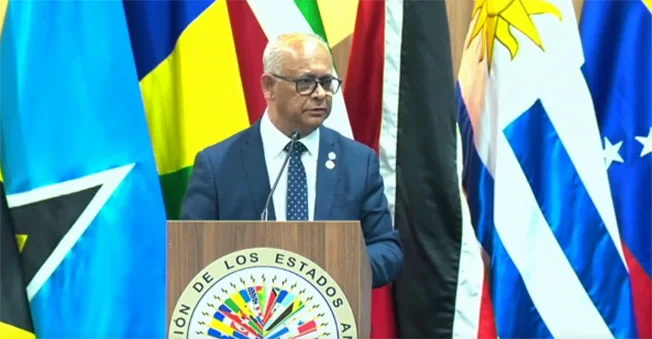
On Tuesday, at the opening ceremony of the 56th General Assembly of the Organization of American States (OAS) held at Panama City’s Atlapa Convention Center, Secretary-General Albert Ramdin delivered a keynote address urging strengthened cross-regional collaboration to address a growing wave of interconnected challenges across the Western Hemisphere. The Surinamese diplomat emphasized that multilateralism and collective solidarity are not just ideological priorities, but fundamental prerequisites to sustain democracy, expand public security, and drive inclusive economic development across the bloc.
Ramdin opened his remarks by grounding the gathering in regional history, linking the 2026 assembly to the 1826 Congress of Panama, a landmark event led by Latin American independence leader Simón Bolívar that laid the earliest foundational framework for inter-American cooperation. “What began as a bold vision 200 years ago remains an existential necessity today,” Ramdin stated. “Collaboration is no longer one of many policy options — it is a requirement for our shared survival.”
The OAS chief outlined a sweeping set of pressing threats facing member nations, ranging from persistent economic uncertainty and widening income and social inequality to intensifying climate-driven natural disasters, rapid disruptive technological shifts, and the expanding reach of transnational organized crime.
He also used the address to highlight sweeping internal reforms the OAS has implemented in recent years to boost its effectiveness. The organization has cut more than 360 active overlapping mandates down to just 77, all of which are now aligned with a new unified strategic agenda. Work is also ongoing to embed greater operational efficiency, public transparency, and long-term financial sustainability across all OAS bodies.
On democracy promotion, Ramdin reported that over the past 12 months, the OAS has deployed 16 independent election observation missions across the region, mobilizing nearly 700 monitors to support free and fair electoral processes. At the same time, he reiterated the organization’s deep concern over shrinking democratic space in Cuba, Nicaragua, and Venezuela.
Ramdin drew urgent attention to the ongoing humanitarian and political crisis in Haiti, where the OAS partners closely with the United Nations and the Caribbean Community (Caricom) to support stabilization efforts. In recent months, Ramdin noted, the OAS has helped distribute more than 600,000 national identity cards to Haitian citizens — a critical step to clear the way for planned democratic elections in the Caribbean nation.
Public security was another core focus of the address. The OAS has partnered with regional development banks to launch a new observatory focused on tracking and countering transnational organized crime, and recently completed its first joint operational initiative with Interpol targeting the illegal arms trade across the Americas.
Looking ahead, Ramdin announced the establishment of a new special OAS task force focused on artificial intelligence. The body will be tasked with developing clear regulatory guidelines for the responsible deployment of AI across the OAS secretariat and all its member states. Ramdin reaffirmed the organization’s enduring role as a neutral, trusted platform for inclusive political dialogue and collective action. “The OAS carries a core responsibility to defend democracy, protect the rule of law, and uphold human dignity for all people across the hemisphere,” he said. “But above all, it must bring nations together to collaborate at the moment when they need each other most.”
The 56th OAS General Assembly will convene over multiple days, bringing together heads of state, foreign ministers, and official delegations from the bloc’s 35 member states to coordinate on shared priorities.