A high-profile legal battle over the pre-trial detention of a 70-year-old woman linked to an alleged assassination plot took a new turn on Friday, as attorneys for Star Sabga pushed to have her constitutional challenge fast-tracked under the same urgent timeline granted to her co-accused, wealthy business couple Dominic and Genevieve Hadeed. Sabga, who is related to the Hadeeds, was taken into custody one day after the couple was detained via Preventative Detention Orders (PDOs) on June 24, and all three are held in connection with the same alleged conspiracy. Just moments after the Court of Appeal concluded an urgent hearing for the Hadeeds on Thursday, Trinidad and Tobago’s Minister of Homeland Security Roger Alexander moved to revoke the PDOs against the couple — but left Sabga’s detention order intact. Representing Sabga, Senior Counsel Douglas Mendes — who also represents the Hadeed couple — argued before High Court Justice Vigel Paul that there was no logical basis to delay Sabga’s constitutional claim now that the Hadeeds have been released from custody. Mendes emphasized that Sabga is being held on substantially the same evidence as the co-accused who were already granted an expedited hearing, noting “The State is saying let us release the co-conspirators but let us take our time with Star Sabga.” He further warned that the window to hear Sabga’s challenge is rapidly closing: the current national State of Emergency (SoE), which authorizes the detention orders, is set to expire in September, and if the case is not heard before the PDO expires on its own, the challenge will become moot. Mendes rejected the State’s argument that the Court of Appeal’s urgency order was tied specifically to Dominic Hadeed’s documented health issues and ongoing detention, stressing that appellate judges framed the entire related matter as one of extreme urgency, with no limiting conditions attached. Fellow senior counsel Rishi Dass added that the recent affidavits filed on Sabga’s behalf only update the court on new developments, including the Hadeeds’ release, and contain no material that would prejudice the State’s position. “They are saying that Star Sabga was in a conspiracy with them. The Hadeeds are now free,” Dass argued, reiterating that the case demands immediate court attention aligned with the appellate court’s direction. However, Gerald Ramdeen, who represents the State, pushed back against the request for an automatic extension of the urgent hearing order. He noted that the Court of Appeal’s direction for an accelerated hearing was specific to the Hadeeds’ separate proceedings, and was granted on the basis that the couple remained in custody at the time and Dominic Hadeed had pressing health concerns. Now that the Hadeeds have been released, Ramdeen argued, the original justification for urgency no longer stands, and Sabga’s case cannot be automatically merged into the existing timeline. Ramdeen also pointed out that no formal application for an expedited hearing had actually been filed with the High Court before Friday’s proceeding, and that the volume of last-minute affidavit evidence from Sabga’s legal team has left the State without adequate time to review the material and prepare a response. In the past week alone, Sabga’s legal team filed a 64-page affidavit Wednesday, a 62-page supplemental affidavit Thursday morning, and notified the State hours before Friday’s hearing that they intended to rely on five additional affidavits from the earlier appellate proceedings. “It is unfortunate and regrettable where someone is detained,” Ramdeen acknowledged, “but each party has to be afforded a certain level of fairness.” He also noted that Sabga, detained since June 25, did not have a constitutional claim filed on her behalf until July 8, questioning the sudden push for extreme urgency after a two-week delay. After hearing arguments from both sides, Justice Paul declined to automatically extend the Court of Appeal’s urgency direction to Sabga’s hybrid constitutional claim and judicial review. The judge ruled that Sabga’s legal team must file a formal written application for an expedited hearing by the following Monday, and adjourned the proceedings to 2 p.m. that same day to hear the application. Paul also agreed to grant the State’s request for additional time to respond to Sabga’s new affidavit evidence, ruling that a short delay of a couple of days was not unreasonable under the circumstances, noting that Sabga had not even reviewed the content of Homeland Security Minister Alexander’s responsive affidavit yet. The judge added that he also needs to obtain a full transcript of Thursday’s Court of Appeal hearing to clarify the exact basis on which appellate justices Eleanor Donaldson-Honeywell and Joan Charles granted the expedited hearing for the Hadeeds. In a nod to procedural fairness, Ramdeen confirmed that the State would arrange special access for Sabga’s legal team to meet with their detained client over the weekend — a break from usual visiting rules that prohibit inmate visits on weekends — so Sabga can review Alexander’s affidavit and prepare a response. The legal team for Sabga includes four senior counsel alongside junior attorneys, while the State is represented by Ramdeen and two additional attorneys.
分类: politics
-
Starnieuws gouddossier 2; Asabina: Regering weet wat misgaat in goudsector, maar grijpt niet in
A senior leader of Suriname’s ruling coalition has exposed deep-rooted systemic failures plaguing the country’s critical gold mining sector, blaming entrenched overlapping political and economic interests for the consistent failure to enforce existing regulations. Ronny Asabina, chairman of the BEP political party, parliamentary faction leader, and a long-time resident of Brokopondo’s Marshallkreek district, made the allegations in an exclusive interview with local outlet Starnieuws, contradicting common narratives that weak regulation stems from insufficient existing laws.
Asabina emphasized that the national government already holds all necessary legal frameworks, data, and authority to bring order to the gold sector – the only missing element is genuine political will to act. Clear agreements on good governance and sector reform were reached within the ruling coalition when it took office, but tangible progress on the ground remains non-existent, he said. “The government knows exactly who holds every concession. The first step is simple: strictly enforce the terms of every active mining permit,” Asabina argued.
The BEP leader called out large-scale illegal subletting of mining concessions as one of the sector’s most pressing flaws. Under current permit rules, subletting is explicitly prohibited, yet the practice has become widespread. Many individuals who qualify for concessions do not engage in actual mining operations; instead, they treat the rights as speculative assets, subletting them to third parties or profiting from selling shares in the concession. Asabina noted that some concession holders do not even know the exact location of their own mining claims.
Alarmingly, this speculative practice extends far beyond professional mining operators, according to Asabina. Professionals from entirely unrelated sectors – including sitting politicians, lawyers, notaries, and even members of the clergy – hold concessions solely to trade them for profit, he claimed.
A further contributing factor to chaos in gold-producing regions is the systematic withdrawal of state presence from mining areas over recent years, Asabina explained. The mining inspection service, which once enforced regulations and oversaw activity in the country’s interior, has effectively ceased to function. As a result, private mining operators and equipment owners are left to provide their own security for staff, machinery, and gold stockpiles – a vacuum that has been filled by private security firms and armed groups that now exercise de facto control over large swathes of mining territory. “The state no longer provides security. Every operator has to figure out how to protect their own assets,” Asabina said. “That is how armed non-state actors gained so much power on the ground.”
Fixing the broken sector will require unprecedented political courage, Asabina stressed, pointing to recent public comments from Natural Resources Minister David Abiamofo, who acknowledged during national budget debates that high-profile figures from nearly all major political parties maintain direct ties to gold industry interests. “That tells you just how deep this problem goes,” Asabina said. “The government must be willing to act without fear or favor, regardless of who is involved. We need a firm, no-nonsense policy to cut through the rot.”
Recent tensions in the Sarakreek gold region serve as a perfect illustration of years of unresolved systemic issues, according to Asabina. He rejected official claims that the unrest stemmed from grassroots discontent among local communities, arguing that far larger political and economic interests were the actual driving force. Ronnie Brunswijk, chairman of coalition partner ABOP and a former vice president, has long been a prominent player in the gold sector, and Asabina says that widespread use of political influence to protect private economic interests has left the government unable to act independently and consistently. This interwoven power structure has eroded legal certainty and led to increasingly frequent violent escalations of concession disputes, he added.
Despite the sector’s many flaws, Asabina acknowledged that small-scale gold mining is one of the foundational pillars of Suriname’s national economy. Along with supporting connected industries including transport, equipment maintenance, supply, and retail, the sector is the second largest employer in the country – trailing only the public sector – providing livelihoods for thousands of Surinamese workers. However, a large share of gold production operates outside the formal economy, costing the state hundreds of millions in lost tax revenue annually.
The damage from unregulated mining extends far beyond lost government income, Asabina warned. The lack of effective governance in gold regions has spawned a cascade of interconnected social crises, including widespread environmental pollution, mass fish die-offs in local waterways, rampant illegal weapons possession, expanded sex work, child labor, rising school dropout rates, drug trafficking, and growing incursion by foreign criminal groups into Suriname’s mining interior. He also questioned the capacity of the country’s security services, noting that major drug seizures and enforcement actions almost always rely on intelligence from foreign partners or third-party tips rather than independent domestic investigative work.
“The problem is not that we don’t know what needs to be fixed – we’ve known for decades,” Asabina concluded. “The problem is that we refuse to do it. We promised the Surinamese people we would reorganize this sector and bring full transparency, and we have not delivered on that promise.”
-

Security : The United States lifts restrictions that limited its cooperation with the FAd’H
After years of blocked bilateral defense collaboration, the United States has cleared a major hurdle to deeper military engagement with Haiti by lifting longstanding restrictions on cooperation with the Armed Forces of Haiti (FAd’H), a development that paves the way for expanded capacity building and professional training for Haitian military personnel.
-

Unions Absent as GOB’s Procurement Scandals Stir Public Concern
For nearly a century, organized labor has been the backbone of grassroots opposition and public advocacy in Belize, turning widespread public anger over government mismanagement into tangible, visible action that has reshaped the nation’s political trajectory. From the 1934 strikes led by Antonio Soberanis and the Labor and Unemployed Association against colonial exploitation, to large-scale mobilizations in the 21st century that forced ruling parties to confront public demands, Belize’s unions have long been the go-to voice for citizen discontent. Today, however, as two high-profile government procurement controversies – the Mira Millions affair and a corruption scandal at the Ministry of Defense – stir growing public anxiety over misuse of public funds, that historic activist muscle has gone surprisingly dormant. This sharp departure from longstanding labor tradition has not gone unnoticed by political observers and ordinary Belizeans alike, prompting questions about what has shifted within the country’s labor movement.
To understand the magnitude of this silence, it is necessary to revisit Belize’s recent history of high-impact union action. In 2005, for example, a proposed national budget that introduced $90 million in new taxes and widespread price hikes brought thousands of unionized workers and citizens into the streets of Belize City. What began as peaceful protest boiled over into mass civil unrest, with tire burnings, clashes with police, and widespread disruption of downtown commerce – a clear demonstration of organized labor’s ability to turn public anger into systemic pressure on the government.
A little over a decade later, in 2016, the Belize National Teachers’ Union (BNTU) cemented that reputation when it launched an 11-day strike after negotiations over promised salary adjustments collapsed. The walkout shut down classrooms across the country and delivered an unambiguous message to policymakers: organized labor remained a political force that could not be ignored. Speaking at the height of the strike, then-BNTU President Luke Palacio emphasized that the action was about more than worker pay, saying, “We need to stand up for our country. We are seeing so many issues affecting our country. We need to deal with those matters.” Former BNTU General Secretary George Frazer echoed that sentiment, adding, “I am glad we are seeing the thousands of teachers and other groups. We want to save our country before it goes ruin.”
Most recently, in 2021, Belize’s labor movement pulled off its longest-ever coordinated action: a 13-day joint strike led by a coalition of unions in response to the government’s emergency austerity measures. Facing ballooning public debt, the ruling administration implemented a mandatory 10% pay cut for public sector workers and teachers, alongside a three-year freeze on salary increments, prompting widespread walkouts and traffic blockades that brought parts of the country to a standstill. “We the people need to demand a change in the government, not to change the government. You change monkey and you get black dog. We want the government to change. We don’t want to change the government,” Darrell Spencer, president of the Nurses Association of Belize, said at the time.
Now, with two separate procurement scandals raising allegations of systemic abuse of government contracting processes, the same labor movement that led those mass actions has yet to organize a single national march or coordinated protest. In interviews with local outlet News Five, multiple union leaders offered explanations for the unexpected silence, pointing to everything from structural gaps to internal organizational delays.
Dean Flowers, president of the Public Service Union (PSU), framed the lack of mass action as a broader reflection of shifting societal attitudes toward government corruption. “My only response is that it’s a reflection of who we are as a society. It seems that we are indifferent to these things that are affecting us. You are right. Every single other union should be in the media, should be speaking out. But more so every citizen should be calling on the radio wave and flooding Facebook with the demand for more accountability where the Mira scandal is concerned. We are doing our part. We have demanded the removal of Oscar Mira from Cabinet, the permanent removal of Oscar Mira from Cabinet.”
Flowers did attend the opposition’s recent “Stand Up for Belize” rally at Battlefield Park, but he was the only PSU member present. Only one other union figure, Senator Glenfield Dennison, also joined the event, bringing total union representation at the well-publicized rally to just two people. When reached for comment, the president of the National Trade Union Congress of Belize declined to speak on the record, saying the body’s General Council had not held its July meeting to discuss a collective position.
BNTU President Nadia Caliz noted that most teachers are currently on summer holiday and traveling, making it impossible to reach a quick internal consensus on how to respond to the scandals. Caliz added that the union is closely monitoring developments and will hold a strategy meeting in August to decide on next steps. Leonora Flowers, president of the Christian Workers Union, similarly said the union must first consult its full membership before taking any public position.
As public concern over the procurement scandals continues to build, the question hanging over Belize’s political landscape remains: will the nation’s powerful labor movement overcome internal logistical hurdles and find common ground to launch a coordinated national push for accountability? Or will the once-vocal activist wing of Belizean civil society continue its historic silence on one of the most pressing corruption controversies in recent memory?
-

Swaso Says Belizeans Deserve Answers on Haitian Children Investigation
Nearly three years after nine Haitian minors were brought into Belize, a former top government oversight official is escalating demands for public clarity around the stalled probe into the children’s circumstances, launching a formal legal push to unearth details about the case’s current status.
Retired Major Gilbert Swaso, who stepped down as Belize’s Ombudsman in December 2025, has submitted an official Freedom of Information Act (FOIA) request to uncover how much progress has been made on the investigation following his departure from the independent oversight post, which remains vacant. Swaso’s new push for answers comes as the country’s Ministry of Immigration has formally joined the probe, which centers on multiple serious allegations: irregularities in the children’s immigration status, unregulated guardianship arrangements, gaps in refugee and social welfare protections, and suspected ties to human trafficking linked to the local nonprofit Beauty Out of Ashes.
In comments included in the original broadcast transcript, Swaso explained that the case reached his office only after a full two years of inaction from other branches of the Belizean government following the initial complaint. International stakeholders, frustrated by the lack of movement, turned the case over to the Ombudsman’s Office in June 2025 for independent review. When his team launched the probe, however, Swaso said key government agencies offered almost no meaningful cooperation. Staff at these agencies refused to share critical information, citing fears of professional retaliation and job loss for speaking up about the case.
Despite the roadblocks, Swaso noted that his independent team made limited progress during his tenure, working within the authority granted to the Ombudsman’s Office under the Ombudsman Act. The investigation had identified critical procedural gaps in how the case was being handled, and the next planned step before Swaso left office was to issue legally binding summonses to compel testimony from uncooperative stakeholders, with contempt charges on the table for those who refused to comply.
Swaso emphasized that with the Ombudsman’s seat empty for more than six months, the public has a right to know whether the probe has advanced at all since he left office, and what measures the government has put in place to guarantee the safety and well-being of the nine vulnerable Haitian children. The FOIA request was first submitted via email Tuesday, with a formal hard copy hand-delivered to government offices Wednesday to ensure it received official processing.
This report is adapted from a transcribed evening television news broadcast, with all quoted statements preserved for accuracy per original transcription standards that include standardized spelling for Kriol language speakers when they appear in the original segment.
-

Appoint Ombudsman Now, Train for Human Rights Later
Seven months have passed since the position of national Ombudsman was left unoccupied, and the last person to hold the role is breaking his silence to push for urgent action from the government. Retired Major Gilbert Swaso, who stepped down from the post months ago, has made clear he has no interest in reclaiming the position — his concern lies solely with the unnecessary delays that have kept the critical office vacant far longer than necessary.
In a recent public statement, Swaso pushed back against the government’s current approach to filling the role, which prioritizes candidates with pre-existing specialized human rights expertise. He argued that this unneeded requirement is unnecessarily complicating the appointment process, pointing to the ongoing institutional transition that is already reshaping the Ombudsman’s Office.
Under current plans, a new National Human Rights Institution will be merged into the Ombudsman’s Office over the coming two and a half to three years. However, Swaso noted that the legislative amendments required to complete this integration have not yet been passed, meaning the existing legal framework for appointing an Ombudsman remains unchanged. He emphasized that the core mandate of the Ombudsman will remain intact during the transition period, and that any required human rights training for the appointed candidate can be delivered after the person takes office.
“To say then that you need someone who has a certificate or knowledge of human rights is making it difficult to appoint an ombudsman under the circumstances, because in my view, they are two separate things,” Swaso explained in his remarks. “The office of the ombudsman should remain as is because this is a consultation process to establish and integrate for the next two and a half to three years. We will be building the institution of the Human Rights Institute within the Office of the Ombudsman. So I believe that however the ombudsman was appointed, as per the law in the past, the act, the act has not changed.”
Swaso warned that clinging to the new human rights qualification requirement risks dragging out the vacancy even further, leaving the country without a key accountability official for months more. The statement comes as stakeholders continue to wait for the government to outline a clear timeline for naming a new Ombudsman, amid growing concerns about the impact of the extended vacancy on governance and public accountability.
-
Proposed Broadcasting Law Draws Fire from Online Creators
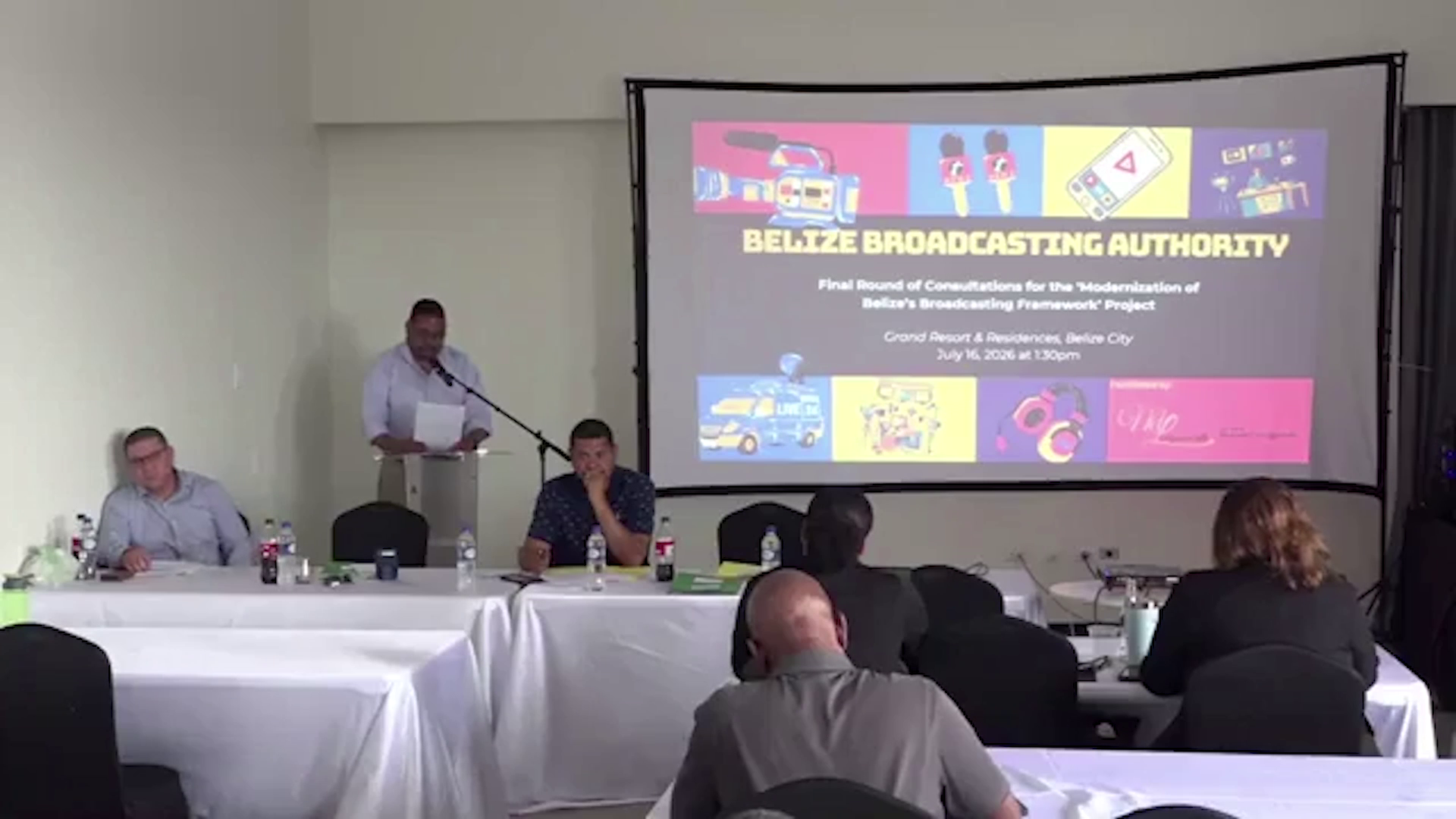
As of July 24, 2026, a controversial draft Broadcasting Bill in Belize that seeks to extend the country’s existing broadcasting regulatory framework to select online media services is facing mounting pushback from digital creators, business owners, and legal stakeholders, who warn that vague language in the legislation could erode freedom of expression and create crippling barriers for small online enterprises.
The Belize Broadcasting Authority (BBA) has framed the bill as a much-needed update to outdated, decades-old broadcasting regulations, emphasizing that the new rules will only apply to entities that operate as formal broadcasters, not average users posting content on major social platforms including Facebook, TikTok and YouTube. But critics argue the draft’s overly broad wording opens the door to arbitrary enforcement and abuse of power, even targeting regular internet users who never intended to operate as full broadcasters.
Prominent Belizean attorney Orson “OJ” Elrington, who is currently representing social media user Sharon Mae Peters in a high-profile defamation case stemming from comments Peters made during a livestream, is one of the most vocal opponents of the current draft. Elrington pointed out that while BBA officials claim ordinary users will not be subject to the law, the text of the legislation is far-reaching enough to include almost any online content creator. The bill grants the BBA broad discretionary power to determine which accounts and services fall under its scope, a structure that Elrington says creates obvious opportunities for targeted enforcement against voices the government or regulators dislike. “Once you have a piece of legislation that has this type of wide discretion over who falls under it and who does not, it opens itself up to abuse and wrongdoing,” Elrington explained. “If they don’t like what you’re saying, nothing stops them from turning around and saying the law applies to you after all.”
Under the current draft, Elrington notes, even small businesses that use standard livestreaming tools to connect with customers would be subject to the law’s licensing requirements. Cristian Silva, founder of Belizean tech firm Silvatech, has joined the growing chorus of critics, stressing that opponents do not oppose all online regulation – they just object to the bill’s poorly structured approach. “Silvatech is not against regulation. Belize should protect copyright, children, public safety, and professional journalism off the bat,” Silva said. “The concern with the draft is that it applies a traditional broadcast permissioning model to ordinary online activity before it defines clear thresholds for who needs a license.”
Silva explained that the bill’s current timeline for licensing approval could derail time-sensitive digital marketing and community content for small businesses across key sectors of Belize’s economy, particularly tourism. For example, if a coastal hotel in San Pedro wants to host a last-minute sponsored livestream to promote an upcoming weekend festival, the draft requires the organizer to wait up to four weeks to receive regulatory approval. That delay would mean losing the marketing opportunity, cutting off potential visitor bookings, wasting pre-produced content, and losing out on tax revenue and local advertising spending that would have supported the local economy. “Essentially, what’s lost there is that content, potential visitors, the production work, GST, and the local ad spend that would’ve been infused into that local economy,” Silva noted.
Elrington added that existing Belizean legislation already addresses harm caused by harmful online content, including the Defamation Act and the Cyber Bullying Act. The new bill’s provisions, which include fines as high as $50,000 BZD, seizure of digital and broadcast equipment, and even authority to block internet access, are unnecessary and disproportionately restrictive, he argued, calling the overly broad regulatory regime inconsistent with democratic principles.
Not all stakeholders oppose the bill, however. Attorney Tiffany Cadle, who is currently suing Peters and two other social media users for defamation over livestream comments, has voiced support for the legislation, arguing it would help hold users with large online platforms accountable for the content they publish. Still, critics are unified in calling for far broader public and stakeholder consultations before the bill moves forward to finalization.
The BBA is currently accepting public feedback on the draft Broadcasting Bill and associated regulations, with written comments open through August 24, 2026. The BBA has not yet issued a formal response to the specific concerns raised by Elrington, Silva and other opponents. This report was compiled from original on-the-ground reporting by Britney Gordon for News Five.
-

CitCo Seeks New Funds for Capital Projects
Eight months out from Belize’s upcoming municipal elections, the Belize City Council has sparked public and political debate with a proposal to issue a $46 million municipal bond, part of which will secure $16 million in fresh financing for critical city-wide infrastructure and capital projects.
Deputy Mayor Eluide Miller has moved quickly to address growing concerns over the timing of the bond initiative, the city’s spending priorities, and its ability to shoulder nearly half a billion Belizean dollars in municipal debt, framing the proposal as a responsible restructuring of existing obligations rather than a reckless new borrowing spree ahead of the election cycle.
Miller, speaking on behalf of the current Bernard Wagner-led administration, emphasized that the council carries a strong fiscal track record that backs its ability to manage the new debt structure. Only $16 million of the total $46 million bond represents new capital for projects, he explained: the remaining $20 million covers existing short-term debt that the council is refinancing into longer-term instruments with maturities of five to ten years, a move designed to ease near-term fiscal pressure and create more flexible repayment terms.
The deputy mayor highlighted that even during two of the most severe shocks to Belize’s economy in recent history—the global COVID-19 pandemic and Hurricane Lisa, which battered the country in 2022—the Belize City Council never missed a single interest or principal payment on its existing outstanding debt. He added that the council has consistently maintained and properly managed required reserve funds, including an interest reserve fund and a sinking fund, to ensure all future debt obligations can be met.
Miller argued that municipal bonds are standard, legitimate financial tools designed explicitly to allow local governments to fund large-scale capital improvements that benefit the public. He also noted that Belize City municipal securities have a long-standing positive reputation in regional financial markets, which currently hold ample liquidity that the council can leverage to advance development in the city. He added that the current administration has also worked to successfully attract both public and private sector investment to Belize City, which he described as one of the most attractive investment offerings in the current market.
Critics and observers, however, have raised questions about the political timing of the bond proposal, which comes just months before voters head to the polls to elect a new municipal council. The timing has led to questions about whether the initiative is aligned with long-term public interests, or if it is a pre-election move designed to fund popular projects ahead of the vote.
This report is adapted from a transcript of a televised evening newscast.
-

No Endorsement from Musa Ahead of PUP Convention
Ahead of the People’s United Party (PUP) upcoming Belize City municipal convention, Caribbean Shores Area Representative Kareem Musa has announced he will remain neutral in the race for the party’s mayoral nomination, framing his non-endorsement stance as a commitment to upholding the democratic spirit of the internal selection process.
Two contenders, Allan Pollard and Eluide Miller, are currently competing to secure the PUP mayoral candidacy ahead of the nationwide municipal elections scheduled for March 2026. While Musa has already publicly thrown his full support behind Kirkland Smith, a career educator from the Caribbean Shores district running for a different position, he says he will not pressure convention delegates to pick one mayoral candidate over the other.
In comments to reporters, Musa emphasized that delegates deserve the autonomy to cast their votes independently, without influence from sitting elected officials. He acknowledged that both Pollard and Miller represent standout young talent within the PUP, pointing to their existing accomplishments in early political careers as proof of their value to the party.
“We in Caribbean Shores will leave it up to the delegates,” Musa said. “This is a democratic process and I will not impress on the delegates, any of them, on who I think that they should vote for.”
Musa, who considers himself a senior member of the PUP, outlined his two core priorities moving forward regardless of the convention’s outcome. Once a winner is selected, he will commit all his efforts to helping the nominee secure victory in the general municipal election to become Belize City’s next mayor. For the candidate who falls short in the nomination race, Musa says he will work to lift up and encourage them, noting that even unsuccessful contenders have significant contributions to make to the party and Belizean politics long into the future.
This report is adapted from a transcribed broadcast evening newscast, originally published ahead of the 2026 municipal nomination cycle.
-

‘He Has Never Lived a Normal Life’: Rodwell Ferguson Speaks on Son’s Arrest
In an emotional first public address Thursday, Stann Creek West Area Representative Rodwell Ferguson opened up about his son Stoney Ferguson’s recent arrest following a violent altercation with law enforcement in Placencia, revealing the decades of severe health challenges that have shaped his son’s daily life.
Stoney Ferguson, 30-something, was taken into police custody on July 18, after authorities say he failed to comply with orders to stop at a routine police checkpoint in the popular coastal town. What began as a traffic stop quickly escalated, according to police reports, resulting in verbal abuse against officers, a short vehicle pursuit through Placencia, and significant damage to a police vehicle.
While Rodwell Ferguson made clear that he in no way defends or condones his son’s alleged actions toward law enforcement, he pushed for the public to understand the context of lifelong health struggles that have left Stoney living with constant chronic pain and volatility. The lawmaker stressed that respect for police is a non-negotiable principle, noting officers were simply carrying out their official duties the night of the confrontation.
“From the day he was born, he has never lived a normal life,” Ferguson told reporters. He explained that Stoney developed severe, life-threatening asthma in infancy, spending the majority of his early childhood years admitted to hospital rather than living at home with his family. The health struggles did not end there: eight years prior to the arrest, Stoney suffered a catastrophic accident after falling from a breadfruit tree, which left him with a broken back.
Due to deeply held religious beliefs, Stoney refused the invasive back surgery that doctors recommended to repair the injury, opting instead to manage the condition through non-invasive pain management. The choice has left him living with unrelenting severe daily pain that often triggers intense irritability, his father explained.
Despite these ongoing obstacles, Ferguson emphasized that his son has worked tirelessly to maintain full independence, supporting himself by selling fresh fruits and vegetables to local residents and visitors in Placencia.
Ferguson acknowledged that his son will face the full legal consequences of his actions during the July 18 incident, but he is asking the public and the justice system to take his long-documented health challenges into consideration as the legal process moves forward.