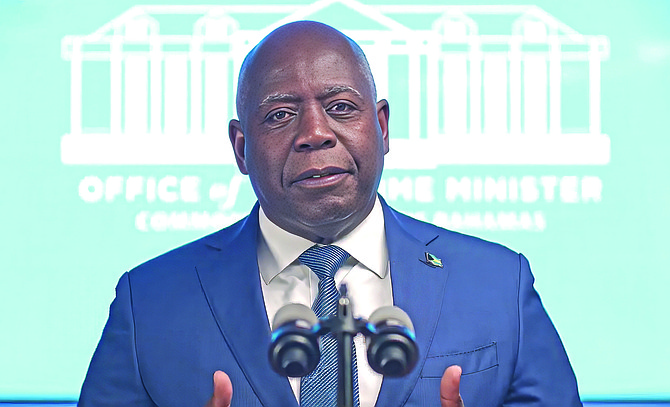
Amid a summer of crippling, widespread power outages that have upended daily life for thousands of Bahamians, Prime Minister Philip “Brave” Davis has delivered a candid national address acknowledging no immediate end to disruptions, while laying out a sweeping multi-year plan to rehabilitate the country’s crumbling electricity system and confronting a growing overtime scandal at state-owned Bahamas Power and Light (BPL).
Weeks of persistent interruptions, capped by a July 30 island-wide blackout across New Providence and five straight days of power cuts in parts of western New Providence, forced Davis to address public anger over unreliable service that has left residents sleeping in cooled cars, discarding tons of spoiled groceries and spending hundreds of dollars on emergency generator fuel. In his remarks, the prime minister refused to offer empty guarantees of restored service overnight. “I am not going to stand here and tell you that every light will stay on tomorrow,” he stated plainly, noting that decades of neglected infrastructure have created a crisis that cannot be resolved overnight.
A core focus of Davis’ address was the explosive overtime controversy that has roiled BPL in recent days, after Tribune reporting revealed three senior employees in BPL’s Fuel and Performance Department collected a combined $601,295 in overtime between May 2025 and April 2026. Two of those workers earned more than $200,000 each in overtime alone, with some monthly overtime checks exceeding $20,000. Davis specifically called out records showing one employee logged 18 hours of work on Christmas Day, followed by 24 straight hours of work for three consecutive days — a total of 90 hours over four days.
Calling the arrangement a blatant abuse of public funds, Davis argued it is impossible for any worker to safely perform critical utility work after working 24 straight hours for three days in a row. “It is not fair to the ratepayer, who funds every dollar. And it is not fair to the honest worker, whose profession is tarnished by it,” he said. The prime minister emphasized that the blame lies with a broken system of management oversight that persisted across multiple previous administrations, not BPL’s frontline workforce. “The overwhelming majority of BPL’s workers are decent, skilled Bahamians who keep our lights on and go out in storms when the rest of us are told to stay inside,” he noted. “This is not about them. This is about a system that permitted this type of abuse.”
New overtime regulations imposed by the administration have already sparked a confrontation with the Bahamas Electrical Workers Union, which has filed a formal trade dispute and instructed members to only work scheduled standard hours until the conflict is resolved. Union president Kyle Wilson has accused the government of using the overtime scandal to distract from its own failures to resolve the electricity crisis, a charge the prime minister implicitly rejected by tying the abuse to longstanding systemic mismanagement.
Turning to the broader power crisis, Davis outlined a clear timeline for restoring generation capacity and upgrading the country’s transmission and distribution network, which he noted has been pushed to breaking point by record heat, surging demand that has broken peak usage records twice this summer, and infrastructure that largely predates Bahamian independence. When his administration took office, more than 60 percent of generation capacity in New Providence and 80 percent in the Family Islands required replacement, Davis said, with BPL carrying more than $500 million in debt, $100 million in unfunded pension obligations, and facing an estimated $500 million in critical upgrades needed to avoid total system collapse. For years, BPL has relied on costly rented generation capacity — costing more than $40 million annually — to patch gaps left by its ageing, failing fleet.
Davis clarified that the July 30 island-wide blackout, which lasted seven hours or more in many communities, was not caused by a generation shortage, but by an underground cable fault that triggered a critical transformer failure at Blue Hills. He explained that underground faults are far more difficult and time-consuming to locate and repair than overhead line issues, noting that crews often have to excavate and trace faults section by section. “It is not an excuse. It is an explanation, because you are entitled to know why – although it does not ease the misery we all felt,” he said.
In the near term, Davis confirmed that the Blue Hills GT2 generator, out of service since spring, is returning to operation alongside a battery storage system designed to ease strain during evening peak demand periods. Two engines at the Clifton Pier generation facility are scheduled to be back online by the end of September, with a Blue Hills turbine undergoing major inspection returning to service in the first quarter of 2026. The administration plans to begin phasing out 40 megawatts of expensive rented generation in January 2026, but only after permanent replacement capacity has been tested and confirmed operational. All failed substation equipment, transformers and switchgear that failed this summer are being fully replaced rather than patched, Davis added, and remote monitoring systems will go live at Clifton Pier by the end of 2025, followed by Blue Hills, allowing crews to diagnose faults faster using real-time data.
Longer-term infrastructure plans include the first phase of a new liquefied natural gas (LNG) generation facility coming online by the end of 2025, which will scale to 190 megawatts of cleaner, lower-cost gas-fired capacity by late 2027. A 40-year-old natural gas pipeline will be replaced, and new combined-cycle generation plants at Blue Hills are scheduled to be commissioned in 2027 and 2028. Davis said the overhaul will eventually cut fuel costs for power generation to a fraction of current levels, but warned that temporary disruptions are still likely as old infrastructure is decommissioned and new systems are connected. “There will be setbacks. There will be equipment failures,” he said.
The Bahamas Grid Company, which manages transmission and distribution for New Providence while BPL handles generation, has already completed a $130 million upgrade that included new steel poles, larger power conductors, protection devices, fiber communications, a looped transmission system and three new high-voltage substations. Those substations reached mechanical completion in July and are now in final testing. Davis said work completed in 2025 has already reduced outage frequency by 45 percent and outage duration by 35 percent compared to historical averages, but acknowledged that those gains have not been felt by all residents amid this summer’s severe disruptions. “Those gains are real. But the outages Bahamians are experiencing now are also real,” he said, noting that the upgrade process remains incomplete and benefits have not been evenly distributed across all communities.
In addition to generation and transmission upgrades, Davis announced plans to reform rules for residential solar systems, working alongside the Utilities Regulation and Competition Authority, BPL, consumer advocates and local solar installers to simplify application processes, set predictable approval timelines, expand access to bi-directional meters, and clarify policies for compensating homeowners for excess power supplied back to the grid. The administration will also accelerate the rollout of advanced smart meters that allow for faster outage detection and give consumers more detailed data on their energy use.
Davis framed the electricity overhaul as the most difficult infrastructure challenge the Bahamas has faced in its 50 years of independence, rejecting the longstanding practice of patching failed equipment and renting temporary generation to simply get through another summer. “We are not here to manage decline. We are not here to defend the status quo,” he said. Acknowledging that Bahamians have already waited far too long for reliable power, he ended with a commitment to leave a vastly improved system for future generations: “What we inherited is not what we will leave behind.”