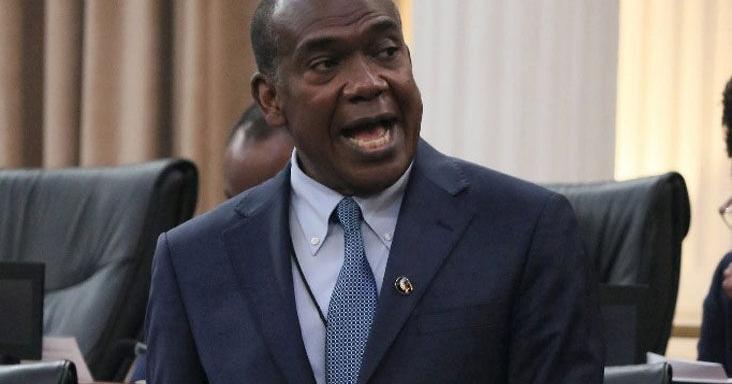
In a dramatic parliamentary address delivered on June 10, 2026, Trinidad and Tobago’s Attorney General John Jeremie has laid bare extraordinary allegations against three high-profile individuals—businessman Dominic Hadeed, 52, his wife Genevieve, 42, and relative Star Sabga, 69—who now face preventive detention orders over claims they conspired to assassinate top government officials. The bombshell revelations came as Jeremie tabled a motion to extend the country’s ongoing state of emergency by three months, pulling back the curtain on a widening crackdown that blurs the line between elite financial power and organized criminal activity.
Jeremie used the parliamentary platform to confirm a sweeping development: the U.S. government has revoked travel visas for multiple members of what he called Trinidad and Tobago’s “1%”, a cohort of wealthy and connected elites he accuses of operating as an organized criminal network. Acknowledging the U.S. intelligence community’s robust surveillance capabilities, he noted that American authorities had made an independent determination that these individuals’ activities warranted barring them from entry to the U.S., a move in which the Trinidad and Tobago government had no hand.
The Attorney General pushed back against the common framing of gang activity as confined to working-class street groups identified by numeric names like Sixx, Seven and Eight. Instead, he argued, the Anti-Gang Act’s broad definition—covering any informal or formal grouping of two or more people engaged in criminal activity—applies equally to the country’s economic elite, who have built decades of unchecked influence. For ten years under the previous People’s National Movement (PNM) administration, Jeremie claimed, these elites thrived, exploiting their connections to secure unlimited access to U.S. dollars, while ordinary citizens are forced to queue for hours at banks to access just $200 in foreign currency for travel. These elite figures, he added, move hundreds of thousands of dollars in foreign exchange through their credit cards on a monthly revolving basis— a privilege out of reach for most Trinidadians.
Jeremie went further, alleging the elite not only funded the PNM but were revered by the party and have effectively taken control of it, with opposition politicians acting as willing pawns for their interests. The revelation of visa revocations, he explained, came unexpectedly: a question from a journalist at Guardian Media Ltd, which Jeremie claimed is owned by the accused group, first piqued his interest. Though he initially ignored the query, he was later contacted directly by multiple elites who confirmed their U.S. visas had been revoked, he said.
Stressing that the Trinidad and Tobago government cannot influence U.S. visa policy, Jeremie made clear that authorities retain full jurisdiction over illegal activity occurring within the country’s borders. “The days when wealth could shield elite criminals from prosecution and law enforcement scrutiny are over,” he warned, arguing that any individual who operates as a gang member—regardless of social standing—will face the same consequences as street-level gang members. “If your designation is within the 1%, or if you are Sixx, Seven or Eight, Teteron (a detention facility) awaits,” he stated.
Directing a specific warning at those who have targeted him and Prime Minister Kamla Persad-Bissessar, Jeremie alleged the group has hidden behind the media outlets it controls to attack the government, and that intelligence indicates they are now planning more direct violent action. “If you target me, as I expect you will, or my Prime Minister, as you have… if, as our intelligence suggests, you have in contemplation more and direct action, the indignity of the cells at Teteron await,” he said.
Jeremie declined to elaborate on additional allegations, including irregular deals over valuable state lands that he claimed the group pursued up until the night of the last general election, noting that the matter is already under active review by the Commissioner of Police. He also accused the former PNM administration of turning a blind eye not only to white-collar gang activity but to the spread of street-level blue-collar gang violence across the country.
Closing his address, Jeremie emphasized equal application of the law: an offense committed by a wealthy member of the 1% is no different than a crime committed by young working-class people in marginalized communities like Morvant and Laventille. While the government has no control over actions taken by its American ally, it will act firmly on evidence of criminal activity gathered by its own law enforcement, he confirmed, declaring that the era of unchecked influence for Trinidad and Tobago’s elite is definitively over.