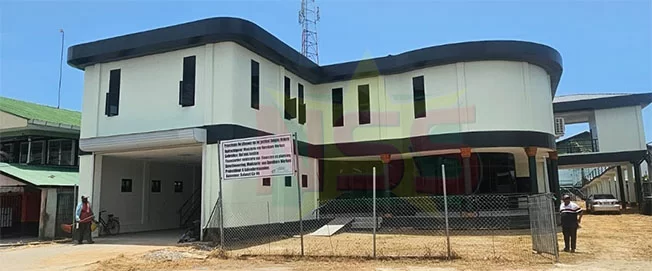
A major infrastructure oversight has emerged at Tobago’s newly constructed ANR Robinson International Airport terminal, with the National Petroleum Company Ltd (NP) confirming that connecting fuel lines from the existing airport site to the new terminal will carry a price tag of $50 million. THA Chief Secretary Farley Augustine recently verified the cost estimate, shedding light on a critical gap in the terminal’s construction: the new building was completed without any on-site fuelling infrastructure at all. In an interview with local media outlet Express, Augustine detailed that discussions with NP several months ago yielded the $50 million projection, adding that the national energy firm is currently debating whether it will absorb the full cost of the project. For Augustine and the Tobago House of Assembly, the project is far more than a basic construction fix: the regional body wants the new terminal to meet modern, efficient, and competitive standards that match or exceed peer airports across the Caribbean and broader global aviation network. The oversight, Augustine explained, is not an unforeseen mistake. He recalled that former THA Infrastructure Secretary Trevor James first flagged the need for integrated fuelling infrastructure back in 2022, when the ruling PNM Cabinet held a gathering in Tobago at the prime minister’s official residence. Despite the early warning, Augustine said, the THA’s input was sidelined, and construction proceeded without including this critical utility. “But of course, as usual, in 2022 the THA was ignored, our thoughts were not considered at the time and the terminal was built without that critical infrastructure there,” Augustine stated. Even with the past disregard for local input, Augustine emphasized that the THA remains committed to collaborating with Trinidad and Tobago’s central government to get the terminal fully and efficiently operational. He framed the airport as a key economic asset for Tobago, rather than just a transit hub for passengers. “Airports in of themselves are potentials for generating income; we have to see the airport as such and not just as a hub for planes to land and pick up people, but as an income-generating facility,” he said. The issue has now gained traction at the national level: Minister of Works and Infrastructure Jearlean John acknowledged the problem in a Monday interview with Express, confirming that the project will require design adjustments to address the fuelling gap. John shared that she shares concerns over the terminal’s current lack of fuelling capacity, and has scheduled a meeting with relevant officials later this week to map out a path forward. The full proposal to resolve the issue will be presented to the national Cabinet for consideration next week.
分类: politics
-

Analysts call for Al-Rawi’s removal
A growing parliamentary controversy in Trinidad and Tobago has two leading political analysts publicly calling for major changes to the People’s National Movement (PNM) opposition bench in the Senate, centered on the fate of veteran Opposition Senator Faris Al-Rawi amid a formal privileges investigation.
The controversy traces back to last Friday, when Senate President Wade Mark launched a Privileges Committee probe into Al-Rawi and first-term Opposition Senator Janelle John-Bates. The investigation was triggered by a motion filed by Government Minister David Nakhid, who accused the pair of improperly assisting former Health Minister Terrence Deyalsingh draft a witness statement for the Public Administration and Appropriations Committee (PAAC), an act that allegedly constitutes interference with parliamentary committee work.
Currently, Al-Rawi himself sits as a member of the Privileges Committee, which is chaired by Mark and also includes Attorney General John Jeremie, Government Senator Darrell Allahar, and Independent Senator Michael Simon de la Bastide, SC. Ahead of Wednesday’s scheduled Senate sitting, local newspaper the Express has confirmed that an announcement replacing Al-Rawi on the investigating committee is expected, a standard procedural step given that the probe centers on his own conduct. If the committee ultimately finds the two senators culpable of misconduct, it will submit a formal finding to the full Senate for a vote. Under current Senate Standing Orders, any suspension handed down has no fixed term, with the length determined entirely by a plenary resolution.
Speaking to the Express, two independent political analysts have laid out stark differing but aligned calls for leadership action from PNM leader Pennelope Beckles, who has so far held off on a final decision regarding the pair’s future on the opposition bench.
Dr. Winford James, a veteran political observer, argued that Al-Rawi, a former Attorney General and Senior Counsel, should be removed permanently from the PNM’s Senate delegation, while John-Bates—whom he described as a political neophyte—should be granted leniency and spared disciplinary action. James framed the ongoing probe as a symptom of growing tit-for-tat polarization between the ruling government and the PNM opposition, which has already levied accusations of bias against House Speaker Jagdeo Singh. He emphasized that as a veteran political and legal figure, Al-Rawi should have recognized the risk his actions posed to John-Bates’ fledgling career. “He has been around a long time and he’s a senior man in the party and in the law. And he should have known better and not imperilled the political career of Ms John-Bates,” James explained. “I’m not saying that she’s guilty or she’s not guilty of some indiscretion. But I think she should be given a second chance because she represents a younger generation in the PNM.” James added that disciplinary action against John-Bates would likely backfire politically for Beckles, while noting that Al-Rawi has already had repeated opportunities in senior political roles. He also pushed back against claims that Beckles’ delay in announcing a decision is a sign of political weakness, framing it instead as a cautious, deliberate approach. Beyond the core controversy, James also highlighted what he called a persistent pattern of sidelining Tobago-based PNM politicians, pointing to the exclusion of Melanie Roberts-Radgman, who was not put forward for a Senate seat by the PNM Tobago Council.
In contrast, Dr. Maukesh Basdeo argued that retaining both Al-Rawi and John-Bates on the opposition bench is an untenable position for the PNM, pointing to documentary evidence that he says proves both are culpable. Basdeo noted that tracked changes embedded in Deyalsingh’s draft witness statement link most edits directly to Al-Rawi, a fact that was revealed during debate on the PAAC report, and that John-Bates has openly admitted her role in the process. Basdeo added that there is already a clear pattern of disruption stemming from the controversy: the Joint Select Committee (JSC) on National Security has already refused to sit with John-Bates as a member, and senior Government Minister Jearlean John publicly stated last week that government representatives will not participate in committee work alongside Al-Rawi. “This sets a clear pattern now that the operations of the committee system in Parliament will be affected by the Leader of the Opposition’s delayed response on dealing with this matter,” Basdeo warned. He echoed the procedural justification for Al-Rawi’s immediate removal from the Privileges Committee, noting that it is only natural for the senator to step aside given that the investigation concerns his own conduct.
-

$350M PAYOUT AT T&TEC
A decades-long industrial dispute has reached a major milestone, as nearly $350 million in long-outstanding cost-of-living allowance (COLA) payments has been released to current and former workers of the Trinidad and Tobago Electricity Commission (T&TEC), Public Utilities Minister Barry Padarath has confirmed. The announcement came during a press interaction at the recent launch of a new solar power system for Angostura Holdings Ltd’s bitters bottling facility in Laventille’s Angostura House.
Padarath explained that the disbursement fulfills a commitment made by the Prime Minister several months prior to resolve backlogged COLA obligations covering the 2015 to 2025 period, noting that the process is currently moving forward as planned. He added that government officials have maintained consistent, open dialogue with the Oilfields Workers’ Trade Union (OWTU), the primary representative body for T&TEC’s workforce, throughout the settlement process.
“Over the last couple of months, we have paid out, I would say, close to $350 million in outstanding payments that were owed to T&TEC workers,” Padarath told reporters.
The minister framed the COLA settlement as a core component of broader government efforts to stabilize industrial relations at the state-owned utility, clear long-standing unpaid obligations, and implement structural restructuring for the organization. Ongoing negotiations are already underway to address bargaining agreements for current and future contract periods, he confirmed, adding that T&TEC’s day-to-day operations remain fully stable amid the changes.
“Morale is high in T&TEC. There are a lot of changes that are happening there, negotiations for the current period, and the outstanding ones will progress in the very near future. There is a good relationship with the OWTU, who is the majority trade union representative for T&TEC,” Padarath said. “We have seen significant improvements with respect to outstanding COLA and settlement of wages and so on. And therefore, we look towards the future.”
Contacted for verification, OWTU Second Vice-President Reesa Ramlogan-Jodha confirmed that disbursements are proceeding under a structured phased plan that includes both active T&TEC employees and former workers, including retirees. The rollout began late last year for current staff, with payments continuing through the early months of 2026, she explained.
“The payment would have been in one or two parts. Each part would have had tranches. So, in December 2025, January and February of 2026, active employees would have received what was outstanding,” Ramlogan-Jodha said.
Following the completion of payments to current staff, focus has now shifted to former employees, with disbursements scheduled for May, June, and July of 2025. By the end of July, all outstanding COLA obligations will be fully settled, she confirmed.
The COLA backlog is a decades-long industrial issue that has stretched back more than 10 years, Ramlogan-Jodha noted, explaining that the OWTU had repeatedly pushed previous T&TEC management teams to resolve the unpaid liability over the years. For much of that period, prior management administrations refused to even acknowledge that the payments were owed, a position that caused major delays in reaching any resolution.
“The then management would not even acknowledge that there was a payment outstanding to workers and former workers who would have fallen within that period. As far as they were concerned, there was nothing owed,” she said.
The turning point came following a change in government administration and a shift in T&TEC’s leadership, which brought a new, more collaborative approach to negotiations, Ramlogan-Jodha added. The new management team has been far more open to finding mutually acceptable solutions to outstanding worker issues.
While the COLA backlog is nearing resolution, it represents only one part of a broader set of outstanding industrial issues between the OWTU and T&TEC. Negotiations over wage agreements for the 2015–2017 and 2018–2020 contract periods are still active, Ramlogan-Jodha noted, adding that the union has formally requested to restart discussions and multiple negotiating sessions have already been held. Though no final deal has been reached, both sides have committed to continuing bilateral talks to find common ground.
For the 2015–2017 period, the Industrial Court previously issued a 0-0-0 wage ruling, which the OWTU appealed; the case is now back before the court. T&TEC has indicated it prefers to resolve both outstanding contract periods through direct negotiation, and if the parties can reach a voluntary agreement, the court case will be resolved accordingly, Ramlogan-Jodha said.
She emphasized that the union remains optimistic about ongoing talks, citing the marked improvement in collaborative relations with the current T&TEC administration. Progress has also been made on other outstanding collective bargaining issues, including field worker placement and overall employment conditions, with incremental advances recorded since the end of last year.
-

Trump: Tijdelijke pauze voor Amerikaanse operatie in Straat van Hormuz
In a significant shift in US policy amid escalating tensions in the Persian Gulf, former President Donald Trump announced Tuesday that Washington is temporarily halting its military operation to escort stranded commercial vessels through the Strait of Hormuz. The pause, he says, is intended to create diplomatic space for finalizing a comprehensive peace agreement between the United States and Iran.
Trump made the announcement via his social media platform Truth Social, noting that the temporary suspension was agreed to “at the request of Pakistan and other nations” following what he called “major progress” in negotiations with Iranian representatives. He clarified that while the existing US blockade on Iranian ports remains fully in effect, the escort mission codenamed Project Freedom will be put on hold to allow negotiators to finalize and sign a formal agreement. As of Wednesday, Tehran has not issued an official public response to Trump’s announcement.
The announcement comes at a moment of rapidly intensifying friction across the Gulf region. In recent days, the US military confirmed it has destroyed multiple Iranian fast attack boats, cruise missiles, and drones. The United Arab Emirates also reported that its air defense systems have intercepted missile and drone attacks launched from Iran for the second consecutive day, while a commercial transiting vessel said it was struck by an unidentified projectile in the strait.
In parallel to the military escalations, Iran has rolled out new shipping regulations for vessels seeking passage through the strait. Under the new framework, ships receive updated transit rules via email from the newly established Persian Gulf Strait Authority. The Islamic Revolutionary Guard Corps (IRGC) also released a revised map expanding Iran’s declared maritime control area, issuing a warning that vessels must only use Iran-designated shipping corridors or face a “decisive response” if they deviate.
In Washington, Secretary of State Marco Rubio confirmed that the US has concluded its offensive military campaign against Iran, codenamed Operation Epic Fury. “We will not open fire unless we are attacked first,” Rubio stated, though he stressed that Iran will still face consequences for its attempts to assert exclusive control over the strategic waterway. “The Strait of Hormuz does not belong to Iran. They have no right to close passage, blow up ships, or lay mines,” he said, adding that allowing Iran to collect tolls for transit would set a dangerous precedent that could be replicated by other countries around the globe.
The Strait of Hormuz is one of the world’s most critical maritime chokepoints, carrying roughly one-fifth of global energy supplies. The waterway has been effectively closed to most commercial traffic since large-scale military operations between the US, Israel, and Iran began on February 28. After a ceasefire took effect in early April, the US imposed its own unilateral blockade to prevent vessels from entering or exiting Iranian ports.
The closure of the strait has already rippled through global markets, disrupting supply chains, pushing up crude oil and fertilizer prices, and stoking widespread fears of a looming global recession and expanded food insecurity.
Speaking to reporters earlier Tuesday, Trump argued that the combination of US military pressure and economic sanctions has forced Tehran to the negotiating table, despite its public rejection of talks with his administration. “Iran wants to make a deal,” Trump said. “What I don’t like is they talk to me with a lot of respect privately, then go on television and say they won’t talk to the president. They’re playing games. But let me be clear: they want a deal. Who wouldn’t? Their military capability has been destroyed, we can do whatever we want.”
Trump, who faces growing political pressure from rising consumer prices ahead of November midterm elections, dismissed Iran’s remaining military capacity as nothing more than the firing of “firecrackers.” When asked what actions from Iran would count as a ceasefire violation, he simply said, “They know what they shouldn’t do.”
Defense Secretary Pete Hegseth, speaking from the Pentagon, added that the recent outbreaks of violence in the strait do not constitute a breach of the four-week-old ceasefire. “US forces do not need to enter Iranian territorial waters. We are not seeking a fight, but Iran cannot block innocent nations and their cargo in international waters,” Hegseth said. “The ceasefire is holding for the moment, but we are monitoring it very closely.”
-

Pawiroredjo en Gajadien uiten scherpe kritiek op ingreep president bij Self Reliance
On Tuesday, two leading parliamentary faction leaders from Suriname — Jerrel Pawiroredjo of the National Party of Suriname (NPS) and Asis Gajadien of the Progressive People’s Party (VHP) — delivered pointed, urgent questions to the national government during a sitting of the National Assembly. The inquiry centers on claims of inappropriate political meddling in the operations of state-linked enterprises and the broader domestic financial sector, triggered by recent actions taken by the Surinamese president targeting the Board of Commissioners of the national insurance firm Self Reliance.
Lawmakers have characterized the president’s move as a deeply troubling development that threatens long-standing principles of good governance and transparent corporate oversight. “Shareholding carries responsibility, not unchecked absolute control,” the parliamentarians emphasized in their questioning. According to unconfirmed reporting from local outlet Starnieuws, the controversial intervention is expected to be reversed in the near term, with all formal correspondence related to the plan also withdrawn.
A leaked letter from the president to Albert Jubitana, president-commissioner of Self Reliance, reveals that acting on behalf of the Surinamese state, which holds shares in the company, the head of state pushed for an emergency general meeting of shareholders to be convened. A key item added to the proposed meeting agenda is the dismissal of multiple sitting members of the Board of Commissioners. The request specifically calls for a full review of the performance of board members, with an eye toward potentially removing several from their posts.
In the correspondence, the president cites Article 23 of Self Reliance’s corporate bylaws, which formally grants shareholders the right to request an extraordinary general meeting. The letter also demands the board turn over internal records on ongoing deliberations and disclose the legal basis for recent decisions the board has made.
Critics of the president’s action have raised serious questions about the appropriate boundaries of shareholder influence, particularly in this case: the Surinamese state does not hold a controlling majority stake in the insurer, instead owning only approximately 40 percent of outstanding shares.
Beyond the insurer itself, concerns have also been raised about potential political pressure on the Central Bank of Suriname. Observers warn that unchecked political influence could erode the central bank’s regulatory independence, creating significant unneeded risks to the overall stability of Suriname’s financial sector. In their inquiry, the parliamentary leaders have demanded the national government provide full transparency around the intervention, as well as a clear, legally sound justification for the president’s actions.
-

Pesticidenschandaal: DNA hekelt falend toezicht en risico voor volksgezondheid
A major political controversy has erupted in Suriname after the European Union rejected two of the country’s key agricultural export shipments in just four days, triggering fierce criticism of the government’s failed food safety regulation from lawmakers in the National Assembly (DNA).
The rejected products, red pepper and yardlong bean, failed EU entry checks due to containing pesticide residues that exceeded the bloc’s strict safety limits. Lawmakers from across the political spectrum have warned that this failure is not just an international trade issue, but an immediate threat to domestic public health, with one senior parliamentarian saying the current broken system is actively poisoning the Surinamese population.
During Wednesday’s public parliamentary session, legislators drew a direct line between the EU rejections and deep, structural flaws in Suriname’s domestic food safety monitoring regime. NDP parliamentarian Jennifer Vreedzaam led the criticism, leveling sharp blame at Agriculture, Livestock and Fisheries (LVV) Minister Mike Noersalim for the government’s inaction on this long-recognized problem.
VHP lawmaker Cherryl Dijksteel emphasized that the incident confirms a fundamental breakdown in the country’s food control infrastructure. “If we cannot stop banned substances from entering the supply chain, detect residue limit breaches, or inspect products before they reach markets, we have to ask: does our current system work at all?” Dijksteel said. She pressed the government to answer a series of urgent, detailed questions about the incident, including whether the responsible exporters have been identified, whether products from the same farms are being retested for domestic sale, and how the country can improve product traceability. “You cannot run effective control if you do not know where a product comes from,” she stressed.
A core unresolved question at the heart of the debate is whether agricultural products are actually tested before they are distributed domestically or exported. If pre-market testing does occur, lawmakers say, the failure to catch the excessive pesticide residues points to major gaps in inspection quality and process. If testing does not occur at all, that indicates a complete failure to deliver the most basic level of consumer protection.
Vreedzaam and VHP colleague Dew Sharman argued that Minister Noersalim and the broader government cannot be allowed to avoid accountability for this failure. Vreedzaam called for immediate corrective action, noting that no recalls have been issued for potentially contaminated products sold domestically. “Nothing has been done. We haven’t seen any products pulled from store shelves, which means contaminated goods are still sitting there for consumers to buy. That can only mean one thing: we are poisoning our own people,” Vreedzaam said.
Dijksteel added that the crisis is entirely avoidable: the problem of unsafe pesticide residues has been recognized as a top priority for years in the strategic plan of the National Institute for Food Safety Suriname (NIVS), and global development programs including the STDF project have already mapped out clear solutions. “We know what the problems are, we already have the solutions worked out, but nothing is being implemented,” she said.
The consequences of this inaction stretch far beyond the two rejected shipments, lawmakers warned. Beyond the immediate damage to Suriname’s reputation as a reliable agricultural exporter, unregulated pesticide residues pose a long-term threat to the health of the domestic population. Dijksteel called the fact that EU inspectors, not local regulators, detected the breaches particularly alarming. “This means our system is failing at its most basic core function: protecting the consumer,” she explained.
Criticism has centered almost entirely on the LVV ministry, which holds formal responsibility for food safety oversight and enforcement. The demand for immediate government intervention has grown louder, with Dijksteel noting the issue has long outgrown the stage of being a simple technical problem. “This is a governance failure. The question is no longer whether there is a problem, it is why nothing has been done to fix it,” she said.
Suriname’s government is now facing widespread pressure to deliver concrete, immediate policy changes: strengthening pesticide use monitoring, closing gaps in food safety inspection, protecting public health, and rebuilding trust with both domestic consumers and international trade partners.