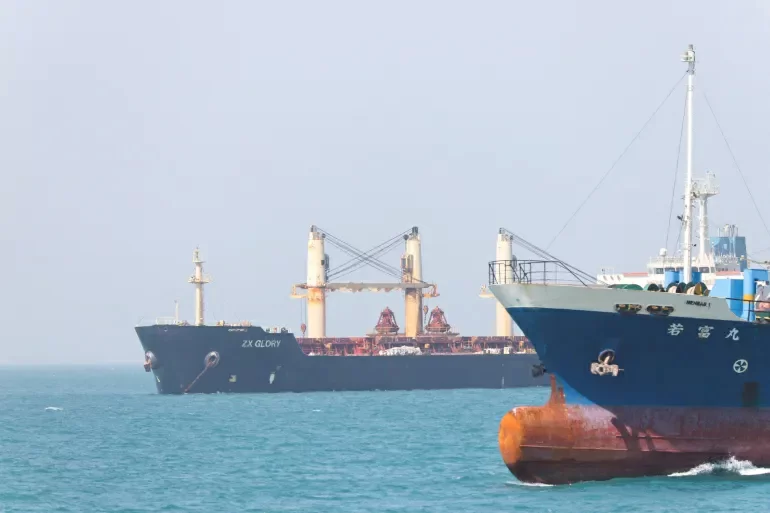
In a significant shift in US policy amid escalating tensions in the Persian Gulf, former President Donald Trump announced Tuesday that Washington is temporarily halting its military operation to escort stranded commercial vessels through the Strait of Hormuz. The pause, he says, is intended to create diplomatic space for finalizing a comprehensive peace agreement between the United States and Iran.
Trump made the announcement via his social media platform Truth Social, noting that the temporary suspension was agreed to “at the request of Pakistan and other nations” following what he called “major progress” in negotiations with Iranian representatives. He clarified that while the existing US blockade on Iranian ports remains fully in effect, the escort mission codenamed Project Freedom will be put on hold to allow negotiators to finalize and sign a formal agreement. As of Wednesday, Tehran has not issued an official public response to Trump’s announcement.
The announcement comes at a moment of rapidly intensifying friction across the Gulf region. In recent days, the US military confirmed it has destroyed multiple Iranian fast attack boats, cruise missiles, and drones. The United Arab Emirates also reported that its air defense systems have intercepted missile and drone attacks launched from Iran for the second consecutive day, while a commercial transiting vessel said it was struck by an unidentified projectile in the strait.
In parallel to the military escalations, Iran has rolled out new shipping regulations for vessels seeking passage through the strait. Under the new framework, ships receive updated transit rules via email from the newly established Persian Gulf Strait Authority. The Islamic Revolutionary Guard Corps (IRGC) also released a revised map expanding Iran’s declared maritime control area, issuing a warning that vessels must only use Iran-designated shipping corridors or face a “decisive response” if they deviate.
In Washington, Secretary of State Marco Rubio confirmed that the US has concluded its offensive military campaign against Iran, codenamed Operation Epic Fury. “We will not open fire unless we are attacked first,” Rubio stated, though he stressed that Iran will still face consequences for its attempts to assert exclusive control over the strategic waterway. “The Strait of Hormuz does not belong to Iran. They have no right to close passage, blow up ships, or lay mines,” he said, adding that allowing Iran to collect tolls for transit would set a dangerous precedent that could be replicated by other countries around the globe.
The Strait of Hormuz is one of the world’s most critical maritime chokepoints, carrying roughly one-fifth of global energy supplies. The waterway has been effectively closed to most commercial traffic since large-scale military operations between the US, Israel, and Iran began on February 28. After a ceasefire took effect in early April, the US imposed its own unilateral blockade to prevent vessels from entering or exiting Iranian ports.
The closure of the strait has already rippled through global markets, disrupting supply chains, pushing up crude oil and fertilizer prices, and stoking widespread fears of a looming global recession and expanded food insecurity.
Speaking to reporters earlier Tuesday, Trump argued that the combination of US military pressure and economic sanctions has forced Tehran to the negotiating table, despite its public rejection of talks with his administration. “Iran wants to make a deal,” Trump said. “What I don’t like is they talk to me with a lot of respect privately, then go on television and say they won’t talk to the president. They’re playing games. But let me be clear: they want a deal. Who wouldn’t? Their military capability has been destroyed, we can do whatever we want.”
Trump, who faces growing political pressure from rising consumer prices ahead of November midterm elections, dismissed Iran’s remaining military capacity as nothing more than the firing of “firecrackers.” When asked what actions from Iran would count as a ceasefire violation, he simply said, “They know what they shouldn’t do.”
Defense Secretary Pete Hegseth, speaking from the Pentagon, added that the recent outbreaks of violence in the strait do not constitute a breach of the four-week-old ceasefire. “US forces do not need to enter Iranian territorial waters. We are not seeking a fight, but Iran cannot block innocent nations and their cargo in international waters,” Hegseth said. “The ceasefire is holding for the moment, but we are monitoring it very closely.”