分类: business

  • FAO official lauds state of Barbados’ fishing industry

    FAO official lauds state of Barbados’ fishing industry

    During an official visit to Barbados this week, Food and Agriculture Organization (FAO) Assistant Director-General Rene Orellana Halkyer has delivered high praise for the well-structured fishing industry of the Caribbean island nation, singling out its integrated cooperative model as a benchmark for inclusive economic development.

    Halkyer made the remarks Tuesday while touring the Bridgetown Fisheries Complex, where he got a first-hand look at how the sector operates across its entire value chain. He emphasized that the coordinated structure connecting working fisherfolk, market vendors, and fishing households across every step of production and distribution stood out as particularly impressive. “We were very surprised because of the way the fishermen, as well as the families of the fisheries, are very well organized,” Halkyer stated, noting that the cooperative framework offers a clear example of how intentional economic organization can unlock meaningful, sustainable income opportunities for small-scale fishing communities.

    The FAO senior official reaffirmed the UN agency’s longstanding commitment to backing public-private collaboration in Barbados’ fishing sector, with the goal of boosting its competitiveness and resilience for future growth. Beyond commending the existing cooperative structure, Halkyer also drew attention to Barbados’ innovative work converting fish waste into valuable commercial products, a development he framed as increasingly urgent amid global market volatility driven by geopolitical instability. With ongoing conflict in the Middle East driving sharp, sustained increases in global fertilizer prices, Halkyer argued that expanded investment in domestic fish-waste fertilizer production is a strategic priority for small island developing states across the region.

    Over recent years, Barbados has poured significant resources into fish silage projects, which process leftover fish byproducts into high-quality animal feed and organic fertilizer. Halkyer emphasized that this circular economy initiative is not just a win for Barbados, but a replicable model that can bring tangible benefits to the entire Caribbean. “We have also visited and been informed about the projects regarding processing and production of fertilizers using fish silage, which is a good example for the rest of the region,” he said. Turning fish waste into fertilizer addresses two pressing challenges at once: it cuts down on industry waste and reduces regional reliance on costly imported fertilizer, which has grown increasingly unaffordable amid the Middle Eastern conflict. “It is very much important to process the waste and to transform it into fertilizers, which is also needed by agriculture and could even be an opportunity for export,” Halkyer explained, adding that scaling up these value-added business models directly improves the long-term livelihood security of fisherfolk and their families.

    Barbados’ top fisheries regulator echoed the call for cross-sector collaboration to keep the industry on a sustainable path. Shelly-Ann Cox, Chief Fisheries Officer of Barbados, underlined that collaborative co-management of fisheries resources is the cornerstone of the sector’s long-term viability. “Co-management of a fishery is very important. Sometimes we see it as a concept, we see academics writing about it, but what we want to do is operationalize this concept,” Cox said. She outlined that the Barbados Fisheries Division maintains regular, ongoing dialogue with fishing cooperatives and a full range of industry stakeholders, from recreational sports fishing operators to large-scale commercial fish processing companies. The shared governance model, Cox explained, is designed to center the needs of the communities that depend on fishing while protecting marine resources for future generations. The ultimate objective, she added, is to deliver equitable, long-term sustainable development for every sub-sector of Barbados’ fishing industry through consistent, inclusive collaboration.
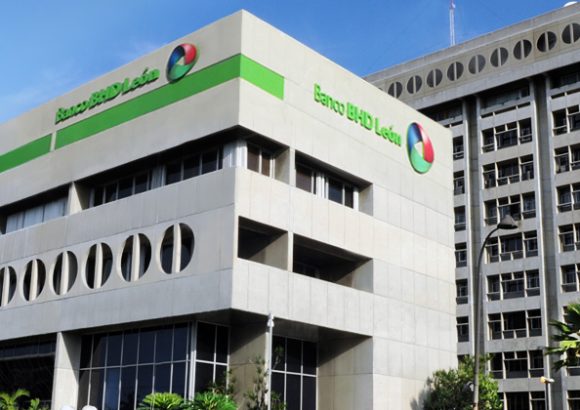

  • Banco BHD reports RD$200 million internal fraud, says customer funds are safe

    Banco BHD reports RD$200 million internal fraud, says customer funds are safe

    A major Dominican financial institution has moved swiftly to contain fallout from a high-value internal fraud scheme, after uncovering unauthorized lending operations worth more than 200 million Dominican pesos (approximately $3.5 million). Banco BHD, one of the country’s leading banking groups, has publicly commended the Dominican Public Prosecutor’s Office and National Police for their rapid, professional response to the incident, which unfolded through a multi-stage investigation starting earlier this year.

    The illicit activity was first detected during a routine internal compliance review launched by the bank in March, according to official statements from the institution. The probe quickly traced the irregular transactions to a current employee, who investigators allege engineered a scheme to create fraudulent credit lines for external third parties. In exchange for processing these unauthorized loans, the employee is accused of receiving personal financial kickbacks. Following the confirmation of wrongdoing, Banco BHD immediately dismissed the employee from their position and moved forward with formal prosecution referral. Multiple external parties that allegedly received the misappropriated funds are also currently the subject of active investigation by law enforcement.

    In April 2026, Banco BHD submitted a formal criminal complaint to the Financial Crimes Investigation Unit of the National District Prosecutor’s Office, officially opening the public legal process. Consistent with regulatory requirements, bank leadership also notified the Superintendency of Banks of the Dominican Republic, the country’s top banking regulator, immediately after discovering the fraud, and has committed to full ongoing cooperation with all government authorities involved in the case.

    In a public statement reassuring stakeholders and customers, Banco BHD emphasized that all financial losses stemming from the scheme have been fully absorbed by the bank’s internal reserves. Institution representatives noted that the total loss amounts to only a minimal share of the bank’s annual net earnings, and stressed that no customer deposits or held funds have been impacted by the fraud. The bank reaffirmed its longstanding zero-tolerance policy for any form of unethical or fraudulent conduct within its operations, and restated its core commitment to maintaining full transparency, strict accountability, and the highest possible standards of corporate governance for all its activities across the Dominican Republic.

  • JetBlue to suspend Newark flights to the Dominican Republic starting July 8

    JetBlue to suspend Newark flights to the Dominican Republic starting July 8

    Low-cost U.S. carrier JetBlue Airways has made a strategic announcement that will reshape its trans-Caribbean route network: starting July 8, 2026, the airline will permanently suspend nonstop services connecting Newark Liberty International Airport to two major Dominican Republic gateways, Las Américas International Airport near the capital Santo Domingo, and Punta Cana International Airport, the country’s top tourist hub. The company cited persistently low profitability on both routes as the core driver behind the decision.

    This route cut is not an isolated adjustment, but rather a key piece of JetBlue’s broader company-wide network restructuring initiative. The overarching goal of this overhaul is to boost overall operational efficiency and reallocate limited resources to high-demand markets that promise stronger long-term financial returns. Contrary to common assumptions that weak travel demand drags down route performance, JetBlue confirmed that both Newark-Dominican Republic routes maintained solid passenger occupancy even as they failed to hit the carrier’s financial targets.

    Industry analysis sheds light on the counterintuitive performance gap: over the most recent 12-month period, the Newark-Punta Cana route alone posted an average load factor of nearly 87%, a figure that actually outpaces JetBlue’s average load factor across its entire global network. This data points to underlying structural pressures rather than low traveler interest as the main causes of poor profitability. Industry observers highlight that steep airport operating costs at Newark Liberty International Airport, combined with cutthroat competitive pressure on routes to popular Caribbean leisure destinations, have eroded margin far more than the airline initially projected.

    JetBlue added that the decision also aligns with ongoing adjustments to address two ongoing industry-wide challenges: persistent aircraft fleet constraints that limit the carrier’s ability to expand or sustain underperforming routes, and broadly elevated operating expenses across major U.S. airport hubs. In an internal memo shared with staff, the airline emphasized that multiple routes operating out of Newark have failed to deliver the level of financial performance required to justify retaining them in the network, framing the adjustment as a necessary step to strengthen the company’s overall financial position going forward.

  • Dominican government prepares to tax Netflix, Airbnb and other digital platforms within 60 days

    Dominican government prepares to tax Netflix, Airbnb and other digital platforms within 60 days

    The Dominican Republic’s General Directorate of Internal Taxes (DGII) is moving forward with a long-discussed plan to level the playing field between international digital service providers and local businesses, announcing it will table a formal proposal to apply the country’s 18% Tax on the Transfer of Industrialized Goods and Services (ITBIS) to foreign platforms operating within its borders within the next two months.

    Major global services including streaming giant Netflix, short-term accommodation marketplace Airbnb, and social media leader Facebook are among the entities that would fall under the new tax rule, DGII Director Pedro Urrutia confirmed during a recent industry gathering hosted by the National Organization of Commercial Enterprises.

    Urrutia emphasized that the core goal of the initiative is to establish uniform tax obligations for all businesses offering services to consumers in the Dominican Republic, eliminating the current competitive advantage that un-taxed foreign digital operators hold over domestic enterprises. Crucially, he added that the affected multinational companies have already signaled they are prepared to comply with the new requirement once a clear legal framework is put in place.

    The proposed tax would apply to a wide range of online transactions carried out by these foreign firms, including paid user subscriptions, short-term rental bookings facilitated through digital platforms, and digital advertising services sold to local clients. Right now, DGII technical teams are conducting a thorough review of the country’s existing Tax Code to determine whether current legislation already grants the agency authority to implement the tax, or if new congressional legislation will be required to move forward.

    This effort marks the resurrection of a 2025 policy attempt that ultimately failed: the original regulation, laid out in Decree 30-25, was later repealed by the Dominican government. Despite that earlier setback, Urrutia made clear the agency remains committed to advancing the policy, noting that foreign digital companies have no logical claim to tax exemption in the country. The DGII intends to finalize formal collection agreements with affected platforms regardless of whether legislative amendments are required, he added.

    Beyond the new digital tax proposal, the DGII is also pursuing broader systemic reform to modernize and simplify the Dominican national tax system. A key focus of these ongoing reforms is an overhaul of the country’s Simplified Tax Regime (RST), with the dual goal of easing compliance burdens for small and medium taxpayers and strengthening the overall competitiveness of the domestic business environment without sacrificing government revenue.

  • JAMAICA BUYS $31-B HURRICANE SHIELD

    JAMAICA BUYS $31-B HURRICANE SHIELD

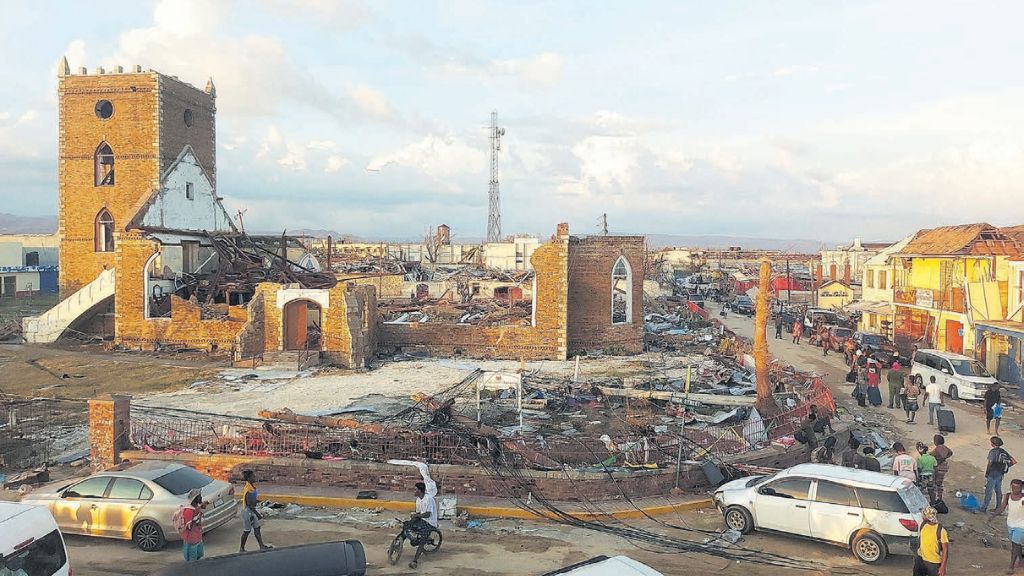
    Just 10 days out from the kickoff of the 2026 Atlantic Hurricane Season, Jamaica has bolstered its financial defenses against catastrophic storm damage by locking in a $200 million expanded hurricane coverage package from global capital markets. This move comes on the heels of 2025’s Hurricane Melissa, which left behind a trail of destruction equal to more than half of the Caribbean nation’s total annual economic output.

    The new transaction replaces Jamaica’s previous three-year $150 million catastrophe bond, a shift that underscores the rising financial threat that severe tropical storms pose to the island’s economy and long-term recovery capacity. The World Bank announced the deal on Monday, noting that overwhelming investor demand allowed the government to increase the coverage size from its initial planned amount. The expansion comes as Jamaica prepares for another forecasted active Atlantic hurricane season, prioritizing protection against rare, high-impact storm events that can upend years of economic progress.

    This latest issuance follows the activation of Jamaica’s prior catastrophe bond after Melissa made landfall in October 2025. The storm met all pre-negotiated trigger parameters tied to its intensity and track, triggering a full payout to the Jamaican government that delivered immediate access to emergency funds during the critical immediate recovery period. This real-world activation served as a full-scale test of Jamaica’s existing disaster financing strategy, proving the instrument’s ability to deliver rapid relief when disaster strikes.

    Post-disaster assessments peg total damage, losses and associated recovery costs from Hurricane Melissa at roughly $12.2 billion, a sum that equals approximately 56.7% of Jamaica’s entire annual gross domestic product. That staggering figure lays bare the massive fiscal and economic vulnerability that climate-driven severe hurricanes create for small island developing states across the Caribbean. The storm damaged critical public infrastructure, coastal tourism assets, agricultural production and public utilities, leaving the government grappling with sustained budget pressure months into the ongoing reconstruction effort.

    Jamaica’s expanded catastrophe bond also highlights a growing global trend: climate-fueled disasters are increasingly becoming a major sovereign balance sheet risk for climate-vulnerable economies. For small islands like Jamaica that face repeated storm impacts, the ability to transfer risk to global capital markets has become a core part of climate resilience planning.

    “Having disaster risk financing in place is a key pillar of our resilience-building framework,” Jamaica’s Finance Minister Fayval Williams said in a statement released through the World Bank. “The catastrophe bond is an important piece ensuring capital market access for Jamaica.”

    The new bond forms a core component of what the World Bank calls Jamaica’s “multi-layered disaster risk financing strategy,” a comprehensive approach that combines parametric catastrophe bond coverage with dedicated budget reserves, contingent government financing agreements and other risk transfer tools. The overarching goal of this framework is to reduce the severe fiscal shock that major hurricanes typically impose on national budgets.

    The World Bank emphasized that Jamaica remains extremely exposed to the financial fallout of hurricane events, warning that severe storms carry lasting consequences for public safety, household livelihoods and broader macroeconomic stability across the island.

    The new bond is issued through the World Bank’s existing “capital at risk” notes program, a mechanism that enables vulnerable nations to shift disaster-related risk off their public balance sheets and onto a broad base of international institutional investors. Under the standard catastrophe bond structure, investors earn regular fixed returns as long as no qualifying triggering disaster occurs. If a major storm meets the payout conditions, however, investors forfeit part or all of their principal, which is redirected to the affected government for emergency recovery.

    This latest transaction will provide Jamaica with continuous hurricane coverage through to 2030, and carries an annual risk margin of 6.75%.

    World Bank Vice-President and Treasurer Jorge Familiar highlighted that the full payout after Hurricane Melissa confirms how well-designed parametric disaster financing instruments can deliver fast, predictable protection when disaster strikes. “The payout following Hurricane Melissa demonstrated once again how countries can prepare for disaster with well-designed parametric instruments that deliver fast and reliable financial protection when it is needed most,” Familiar said.

    The new catastrophe bond will be listed on the Singapore Exchange, with structuring led by global financial firms Aon Securities and Swiss Re Capital Markets.

  • Price hints at Flow 5G roll-out

    Price hints at Flow 5G roll-out

    MONTEGO BAY, St James — Just months after investing $85 million to reconstruct and upgrade its communications network across Jamaica in the wake of Hurricane Melissa, telecom provider Flow Jamaica has deepened its long-term commitment to the country with the official launch of its dedicated business-to-business division, Liberty Business Jamaica. The launch event, held this week in Montego Bay, brought together dozens of local business leaders and government stakeholders, and included major announcements about the company’s upcoming technological expansion and local investment plans.

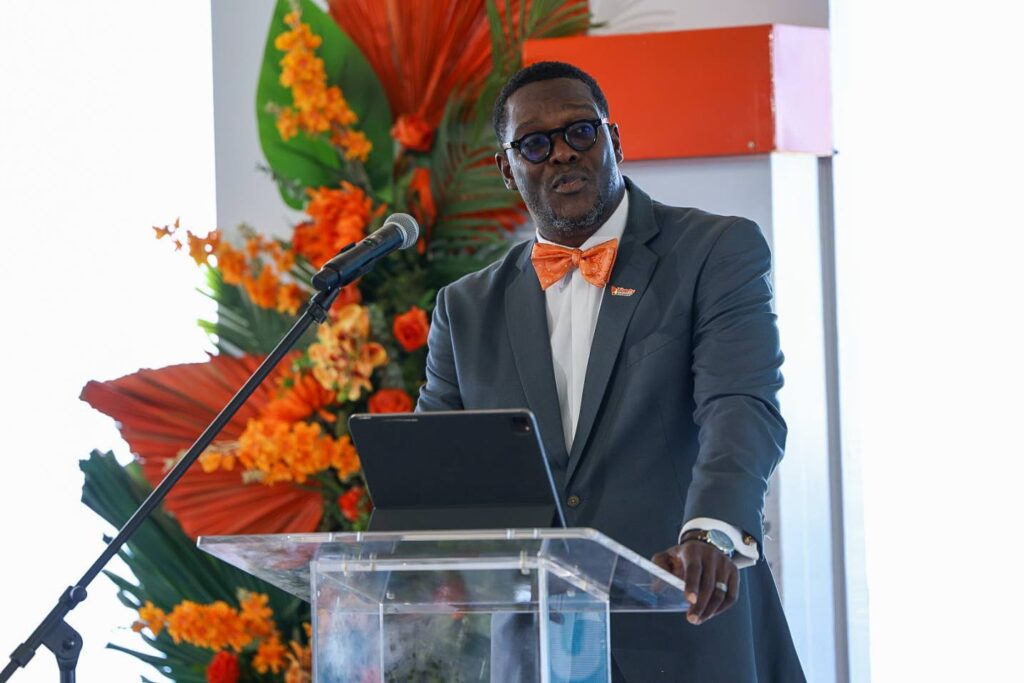
    Stephen Price, vice-president and general manager of both Flow Jamaica and Liberty Business Jamaica, revealed to attendees that the company is in the final stages of preparations for a 5G network rollout, hinting that the official launch could come in just a matter of weeks. Addressing recent temporary mobile service disruptions that some Jamaican customers have experienced, Price explained the interruptions are a side effect of ongoing large-scale infrastructure upgrades. He urged customers who have received notifications to upgrade their SIM cards to complete the swap promptly to get ready for the faster, next-generation connectivity that is on the horizon.

    The upcoming 5G launch aligns with Flow Jamaica’s previously announced goal of completing a full transition to a 100% fibre-optic network across the country by December 2025, a foundational infrastructure upgrade designed to support advanced new technologies including 5G.

    Beyond the 5G announcement, Price officially confirmed plans to open a dedicated Liberty Business Jamaica headquarters in Montego Bay, framing the choice of the western Jamaican city as a deliberate strategic decision. Price noted that Montego Bay is a critical hub for two of Jamaica’s most important economic sectors: tourism and business process outsourcing (BPO), both of which suffered catastrophic damage when Category 5 Hurricane Melissa swept through the island last October.

    In the immediate aftermath of the storm, Price recounted, Liberty Business deployed emergency satellite and mobile connectivity solutions to impacted businesses across western Jamaica, and was the only mobile network provider that maintained operational service in large parts of Montego Bay throughout the crisis. “Some of you had immediate needs that we were able to address right away using satellites and mobile solutions. I’m also proud to say that in the aftermath of the storm we were largely the only mobile network running in Montego Bay,” Price told the gathered stakeholders.

    The $85 million spent on post-Melissa recovery and upgrades marks the latest in a series of large-scale investments by the company, coming on the heels of major recovery spending following Hurricane Beryl in 2024. Price emphasized that despite the significant capital outlay, the investment is critical to supporting Jamaica’s business community and residents. Much of the post-storm recovery work in Montego Bay focused on hardening infrastructure for long-term resilience: crews moved vulnerable aerial transmission lines underground and replaced aging copper network infrastructure with modern fibre-optic cabling.

    Remarkably, Price reported, the majority of Montego Bay’s business community had their connectivity restored within two to three months after the hurricane. As of the launch, 82% of the company’s fixed-network customers across the impacted area have been fully reconnected, with work ongoing to restore service to the remaining 18%, and mobile service is almost entirely back to pre-storm levels. Network traffic has jumped nearly 40% since the storm, a shift Price said reflects Jamaica’s accelerating transition to digital-first services across all sectors. To boost future resilience, multiple mobile cell sites in St James Parish now have permanent satellite backup power and connectivity.

    Price also highlighted the scale of Liberty Business’s regional footprint: the division operates one of the largest digital infrastructure networks across the Caribbean, with roughly 50,000 kilometers of sub-sea fibre-optic cable and more than 17,000 kilometers of terrestrial fibre spanning 30 regional markets. Notably, the company provides wholesale connectivity services to competing telecom providers across the region, and even supplies internet connectivity to Starlink, Elon Musk’s satellite internet firm. The hurricane recovery experience, Price said, reinforced how critical resilient communications infrastructure is to national disaster preparedness and ongoing business continuity.

    “Technology is not abstract. The solutions we provide have a direct impact on livelihoods and national resilience,” Price added.

    Montego Bay Mayor Richard Vernon welcomed the company’s expanded presence and new headquarters, noting that rapid urban growth in the city, driven by an influx of workers to the tourism and BPO sectors, has created increased demand for housing and strained existing public and private infrastructure. Digital tools such as resilient communications networks, smart data management, and digital advisory services, Vernon said, will be critical to supporting sustainable urban planning, improving municipal services, and cementing Montego Bay’s position as Jamaica’s top investment destination. He added that the city is eager to expand its partnership with Liberty Business beyond information and communications technology.

    “In short, this launch is a story of convergence: a company redefining its identity, a city undertaking modernity, and a nation embracing digital transformation. Together, these threads weave a narrative of resilience, opportunity, and progress. So we are not merely hosting a brand launch; we are embracing a partner in this journey to become a safe, vibrant, and digitally empowered city,” Vernon said.

  • First Rock returns to profit but cash strain persists

    First Rock returns to profit but cash strain persists

    Jamaica-based property developer First Rock Real Estate Investments has pulled off a notable return to profitability in 2025, driven by skyrocketing rental revenue and upward property value revaluations, but the firm still faces significant headwinds including negative operating cash flow, ongoing debt restructuring and heavy reliance on luxury residential sales to maintain adequate liquidity.

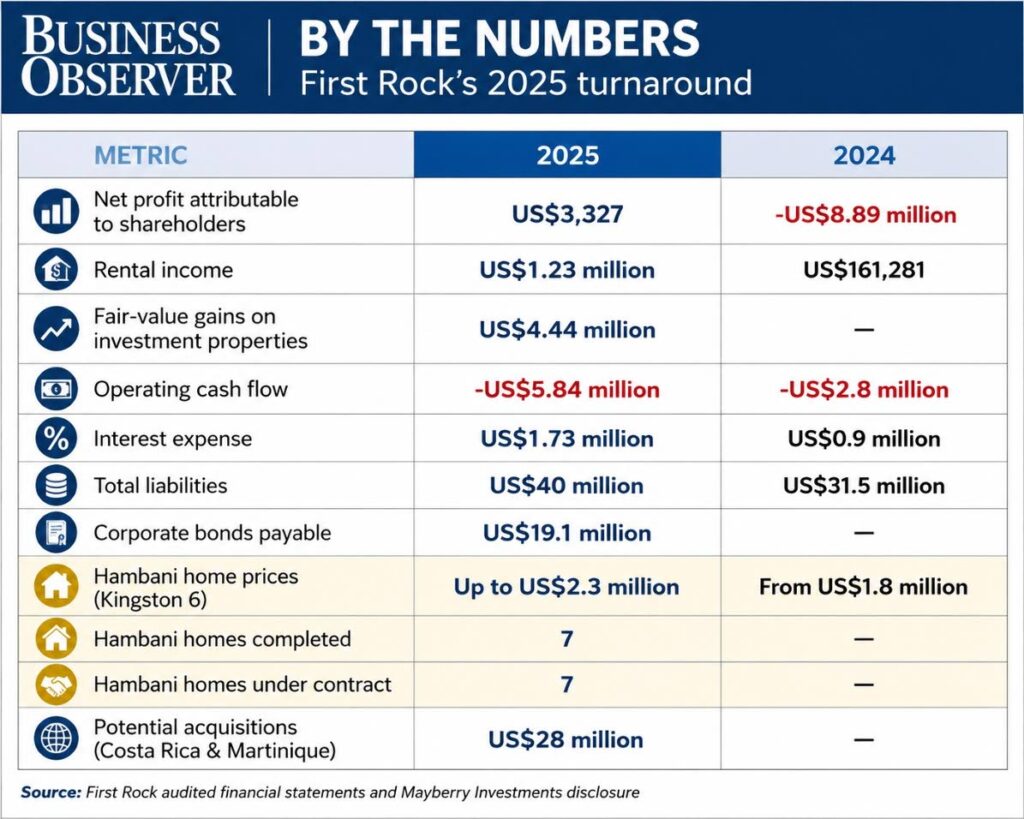
    According to newly released financial results, the company logged a net profit of US$3,327 attributable to shareholders for the 2025 calendar year. This result marks a sharp reversal from the US$8.89 million net loss the firm posted in the prior year. The profit turnaround was fueled by two key factors: a 663% year-over-year surge in rental income, which reached US$1.23 million, and a US$4.44 million gain from upward revaluation of the company’s investment property portfolio. Without the non-cash revaluation boost, however, First Rock would still face material earnings pressure, company filings show.

    The dramatic jump in recurring rental revenue aligns with First Rock’s publicly stated strategic pivot toward stabilizing commercial and income-producing real estate assets, a move designed to cut the firm’s historical reliance on one-off development project sales. Even with this top-line improvement, audited financial statements reveal ongoing strain on the company’s cash position. Operating cash flow registered a negative US$5.84 million for the year, while annual interest expenses nearly doubled to hit US$1.73 million amid a broader high interest rate environment that has pushed up financing costs across the global and local real estate sectors. First Rock remains in active negotiations with creditors to refinance maturing short-term debt and secure additional working capital to fund its ongoing operations.

    At the center of the firm’s near-term cash generation strategy is the near-completed Hambani luxury residential development located in Kingston 6. In a disclosure dated April 30, transaction advisor Mayberry Investments confirmed that seven luxury villas at the development have received practical completion certificates, and all seven are already under contract to buyers. Completed units are priced between US$1.8 million and US$2.3 million, and Mayberry noted that proceeds from sales to date are enough to cover all remaining development costs and leave a surplus of cash to support other corporate obligations.

    First Rock Chief Executive Officer Ryan Reid explained that the company’s current capital structure was intentionally structured to tie debt repayment timelines to development completion and unit sales. “Unit sales are indeed a key part of our repayment strategy, and that’s really by design, which reflects the direct alignment between our development pipeline and our capital structure,” Reid told the Jamaica Observer in written comments.

    A review of the company’s balance sheet shows 15% year-over-year expansion in total assets, which grew to US$65.8 million at the end of 2025. Total liabilities also climbed, rising from US$31.5 million in the prior year to US$40 million in 2025. Outstanding corporate bonds jumped sharply to US$19.1 million, while combined current and non-current long-term loans remained elevated at roughly US$16 million. Audit notes reveal that some of First Rock’s newest financing arrangements carry interest rates as high as 18%, underscoring the steep cost of capital facing heavily leveraged property developers operating in Jamaica’s current high interest rate landscape.

    Reid emphasized that growing recurring rental revenue will be the core driver of improved operating cash flow going forward. “The revaluation gains reflect genuine value creation in our portfolio, but we absolutely understand that cash generation is important, hence the massive movement in our rental income year on year,” Reid told Business Observer. “We expect operating cash flow to further improve meaningfully.”

    Even as the company works through ongoing debt refinancing discussions, First Rock is advancing plans for two regional acquisitions in Costa Rica and Martinique, with a combined transaction value of US$28 million. Reid stressed that the planned purchases are not aggressive expansion into speculative development, but rather a targeted move to accelerate growth in recurring cash flow. “The acquisitions we’re pursuing are not about expansion for its own sake, they are highly selective opportunities that we believe will generate returns faster than greenfield developments would. These are fully tenanted rental income opportunities,” Reid said. “In each case, the entry price, existing entitlements, and near-term development potential mean these assets contribute to cash generation rather than stretching it further.”

    Auditors from Ernst & Young, the firm that signed off on First Rock’s 2025 financial statements, identified investment property valuation as a key audit matter. They noted that investment properties and properties held for sale collectively account for roughly 50% of the company’s total assets as of year end. After years of debt-fueled expansion, First Rock now faces growing pressure to prove that its evolving rental-focused business model can generate sustained, stable cash flow, reducing the firm’s current heavy reliance on non-cash property revaluations and irregular development sales to deliver positive bottom-line results.

  • Seprod sells International Biscuits for $1.71 billion

    Seprod sells International Biscuits for $1.71 billion

    Jamaican manufacturing and distribution conglomerate Seprod Limited has reported a near 100% jump in first-quarter net profit, a surge driven almost entirely by a one-time gain from the strategic divestment of its subsidiary International Biscuits Limited (IBL), even as slowing consumer demand across Jamaica and Trinidad & Tobago dragged down core operating results for multiple group businesses.

    Completed on February 28, the IBL sale forms a core part of Seprod’s long-term strategy to cut group-level debt and streamline its asset portfolio to align with future growth priorities. According to the firm’s first-quarter cash flow disclosures, the disposal generated a net cash inflow of $1.71 billion for the company.

    In its official Q1 report, Seprod framed the divestment as a deliberate strategic move, noting that offloading IBL allowed the group to refocus its resources on core priorities aligned with long-term value creation. Accounting records show the firm logged a $20.62 million loss from discontinued IBL operations for the quarter, paired with a $921.86 million gain on the disposal of the subsidiary. Based on IBL’s reported net assets of $913.96 million as of December 2024, the purchase price from the buyer worked out to roughly $784.20 million above IBL’s net asset valuation.

    For the three-month period ending March 31, Seprod posted a consolidated net profit of $1.65 billion, marking a 95% increase from the $849.92 million recorded in the same period last year. However, the impressive headline growth masks underlying weakness in core operations: excluding the $921.86 million one-time disposal gain, consolidated net profit would have come in at just $730.83 million, down from the prior year’s baseline.

    Overall group revenue slipped 3% year-over-year to $36.42 billion, a decline that Seprod attributes in large part to ongoing disruption to the HORECA (hotels, restaurants, cafés, and catering) channel in the wake of Hurricane Melissa. The downturn is even more pronounced at AS Bryden & Sons Holdings Limited (ASBH), Seprod’s 80% controlled subsidiary, which saw a 6% drop in consolidated revenue to US$141.19 million (equal to $22.13 billion). ASBH’s net profit plummeted from US$3.23 million in the prior-year quarter to just US$67,000 in the latest period.

    Much of ASBH’s profitability decline stems from performance issues at Caribbean Producers (Jamaica) Limited (CPJ), its 79.99% owned subsidiary. CPJ’s revenue fell 28% to US$33.13 million in the quarter, swinging from a prior-year net profit of US$1.81 million to a net loss of US$1.17 million this quarter.

    In its own Q1 report, ASBH outlined a mix of external and internal headwinds driving the weak results: higher alcohol duties in Trinidad & Tobago, softening consumer demand across key product categories, persistent disruptions to Jamaica’s hospitality and tourism sectors following Hurricane Melissa, and elevated overhead costs tied to the group’s ongoing regional expansion and integration projects. The soft operating performance across multiple business units comes as Seprod continues its push to streamline its portfolio, cut debt, and boost efficiency against a backdrop of broadly slowing consumer demand across the Caribbean region.

    Despite the widespread operating headwinds, Seprod’s leadership struck an optimistic tone about the firm’s long-term trajectory, noting that cost containment efforts have so far kept expense growth in check. The group’s gross profit margin dipped only marginally, from 26.73% to 26.64%, even in the face of higher input costs and lower top-line revenue. Overall operating expenses rose just 1% ($90 million) in the quarter, a figure Seprod says reflects active management efforts to control unnecessary spending. Net profit attributable to Seprod shareholders jumped from $548.40 million in the prior-year quarter to $1.67 billion in the latest period.

    Signed by Chairman Paul B Scott and Chief Executive Officer Richard Pandohie, the Q1 report reaffirmed the group’s core strategic priorities: “We remain focused on margin resilience, cash generation, cost optimisation, disciplined growth, and improving return on equity (ROE). These initiatives are foundational to building a more efficient, integrated, and performance-driven organisation.”

    Over the quarter, Seprod’s total consolidated asset base contracted 5% to $137.44 billion, with current assets totaling $75.15 billion. The firm purchased 5.29 million ASBH 6.00 preference shares for US$5.29 million ($812.81 million) during the period, after existing shareholders Ambergate Limited and Fairchild Limited cut their positions in the subsidiary.

    Total group liabilities fell 9% to $86.78 billion, driven by reductions in accounts payable and the current portion of long-term debt, with total consolidated equity coming in at $50.66 billion, $39.94 billion of which is attributable to shareholders. Seprod’s full audited 2025 financial statements are currently delayed, as ASBH has not yet completed its own audited disclosures; ASBH has indicated it expects to submit its completed financials by May 31.

    As of Monday’s market close, Seprod’s share price stood at $82.43, leaving the stock down 2% year-to-date in 2026 with a total market capitalisation of $75.09 billion. The firm has also declared a $0.605 per share dividend, totaling $551.12 million, which will be paid out on June 5 to shareholders recorded on the company’s books as of May 15. While the per-share dividend matches the 2025 payout, the total payment is larger than last year’s $443.80 million, a change driven by a July 2025 share swap that increased Seprod’s stake in ASBH to 80% after the firm issued 177,398,683 new ordinary shares.

  • Saint Lucia to focus on people empowerment on HR Day

    Saint Lucia to focus on people empowerment on HR Day

    Across the globe, human resources professionals form the invisible backbone of resilient, high-performing organizations — and this year, the Association of Human Resource Management Professionals in Saint Lucia (AHRMP) is stepping up to honor their work alongside the international HR community for International HR Day, taking place Wednesday, May 20.

    A yearly global observance, International HR Day was created to shine a spotlight on the critical contributions HR teams make to building workplaces that are productive, resilient, and centered on the needs of employees. Beyond celebrating individual practitioners, the day also spotlights the shifting strategic role of the profession, which has grown from a back-office support function to a core driver of organizational adaptation and long-term growth amid today’s fast-changing business landscape.

    This year’s global theme, “Empower People to Lead Change”, frames the conversation around a core imperative: organizations and their leaders have a responsibility to cultivate work environments where every team member has the tools, support, and encouragement to drive meaningful organizational transformation. The theme prioritizes four key pillars for navigating today’s complex modern workplaces: adaptability, inclusive leadership, employee empowerment, and intentional people-centric practices.

    To mark the 2026 observance, AHRMP is organizing an interactive virtual open to professionals across Saint Lucia and beyond. Aligning with the global theme, the local event carries the subtitle “Empowering People to Lead Change: The HR Imperative in Today’s Workplace.” The webinar is scheduled to run from 12:30 p.m. to 2:00 p.m. local time on May 20, and will bring together a cross-section of stakeholders: practicing HR professionals, C-suite and business leaders, organizational development specialists, and emerging young professionals entering the field.

    During the session, attendees will join in guided discussion exploring core topics including modern leadership strategies, ongoing workplace transformation, the rapidly evolving role of HR in 21st-century organizations, and the diversity and growing strategic value of the HR profession.

    For AHRMP, International HR Day is more than a celebration — it is a critical opportunity to strengthen national conversations around pressing workplace topics: adaptive leadership, healthy organizational culture, workforce readiness for future challenges, and sustainable people practices that drive long-term success.

    AHRMP President Goretti Paul recently shared her perspective on the growing importance of the HR function in today’s volatile business climate, emphasizing that people are the foundation of any successful organization. “Organisations cannot successfully navigate change, build resilience, or sustain growth without placing people at the centre of their strategy,” Paul explained. “HR is no longer operating at the sidelines of business decision-making; it is increasingly at the core of how organisations adapt, lead, and remain future-ready.”

    AHRMP has extended an open invitation to a broad range of stakeholders to participate in the upcoming webinar, including practicing HR professionals, team managers, business leaders, human resources students, and any members of the wider professional community interested in exploring the future of work, leadership development, and people strategy. Pre-registration for the event is currently open to the public via the official AHRMP website at www.ahrmp-slu.org/hrday2026.

    Additional event details, including announcements of featured speakers and the full event agenda, will be published in the coming weeks via AHRMP’s official social media channels. For any questions or further information, interested parties can contact the AHRMP team directly by phone at 758-520-1671, via email at info@ahrmp-slu.org, or by visiting the association’s main website at www.ahrmp-slu.org.

  • Bramble urges diaspora to turn remittances into investment

    Bramble urges diaspora to turn remittances into investment

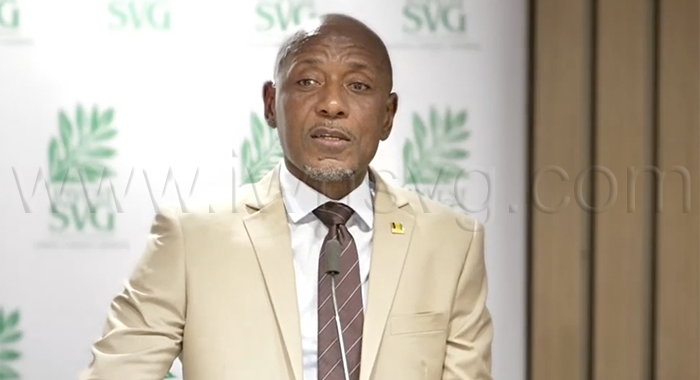
    Against the backdrop of persistent economic challenges, St. Vincent and the Grenadines (SVG) is calling for a fundamental transformation in its long-standing relationship with its global diaspora community. At a recent diaspora outreach gathering hosted by Invest SVG in Toronto, Foreign Affairs and Foreign Investment Minister Dwight Fitzgerald Bramble laid out a bold new vision: moving the relationship “from barrels to businesses” to unlock sustainable, long-term national development. For decades, support from Vincentians living abroad has centered on three core pillars: cash remittances, care packages shipped in barrels, and charitable giving. Bramble was quick to emphasize that this traditional support has been invaluable to SVG’s economy and communities, keeping households afloat, funding student educations, and underpinning local growth. But he argued that this model, while still critical for meeting immediate family needs, is no longer sufficient to lift SVG to the next stage of development.

    Bramble’s call echoed a core theme running through the entire Toronto event: the need to shift from short-term consumption-focused support to long-term productive investment that builds lasting generational wealth. Crucially, the government does not ask diaspora members to stop sending remittances or care packages. Instead, officials want to expand this engagement to complement existing support with investment, industry expertise and global business networks. “While remittances help our families meet immediate needs, we need to think about long‑term investment, which has the power to build lasting generational wealth,” Bramble told attendees.

    Addressing a common misconception held both at home and abroad, Bramble noted that many SVG residents still frame “foreign investment” exclusively as large-scale corporate projects, while many diaspora members underestimate the impact of their individual contributions. He pointed to the power of cumulative small- to mid-sized investments: if just 10 Vincentians based in Canada each invest CA$50,000 back home, the combined impact would already move the needle on national growth. Scaled up across the full diaspora spread across North America, Europe and Asia, that impact would be transformative for the small island nation.

    Under the current New Democratic Party government, this new approach to diaspora engagement has become official policy. Bramble stressed that SVG cannot tackle its deep-seated socioeconomic challenges alone; policymakers cannot restructure and redevelop the national economy in isolation. Instead, the diaspora must be repositioned from an occasional source of donations to a core strategic partner in national development. “At the centre of any approach to development is the recognition that the diaspora is not peripheral to development, but central to it,” Bramble said. “This is not about Prime Minister Godwin Friday, this is not about Bramble… this is about us, St. Vincent and the Grenadines.”

    Unlike remittances and care packages, which are largely used for immediate consumption, intentional investment creates tangible, lasting benefits for the SVG economy. Investments generate local jobs, build long-term national assets, and expand the country’s productive economic base. Most importantly, Bramble argued, investment creates opportunities that allow Vincentian families to stay and build their lives in their home country, rather than being forced to migrate abroad for economic opportunity.

    Bramble connected his “from barrels to businesses” framework to specific, high-priority investment gaps that government and agency officials outlined earlier in the meeting. Key sectors open for diaspora investment include tourism, agriculture, affordable housing, agro-processing, the blue economy, and creative industries. Specifically, SVG currently faces unmet demand for additional tourism accommodation — from boutique hotels and villas to short-term Airbnb rentals — as well as increased farm output and value-added processed goods. Bramble noted that these are ideal spaces for diaspora members to convert their traditional informal support into structured, profitable business ventures. For example, many of the diaspora members who currently ship care barrels to family at home could, with government support, transition to owning the productive facilities that create the goods that go into those barrels — instead of shipping items to SVG, they can help build local industries that export goods from SVG to global markets.

    Framing the shift as a redefinition of what it means to engage with home, Bramble told attendees: “Home is not just a place we remember; it is a place we build.” He encouraged every diaspora member to view their existing remittances and care packages as a potential first step toward business ownership and enterprise, urging them to turn their existing love and commitment to their home country into job-creating, wealth-building investment.

    To ensure this new approach is more than just rhetoric, Bramble confirmed that the government is strengthening its institutional framework to support diaspora investment. His ministry, the national investment promotion agency Invest SVG, and the upcoming reconfiguration of SVG’s consulate in Canada are all being aligned to streamline investment facilitation, reduce bureaucratic fragmentation, and improve efficiency for diaspora investors. Bramble, who framed himself as a results-driven leader, told the crowd that failure is not an option for this new initiative, and that a functional support structure is already in place for interested investors. He closed with a direct appeal to the global Vincentian diaspora: “St. Vincent and the Grenadines’ future is dependent on your total commitment to the development of our country. Work with us, please, because we want to work with you. Let’s do this together.”