Fresh tensions have emerged in bilateral trade relations between the United States and the Dominican Republic, as Washington has formally called on Santo Domingo to scrap a controversial new tariff regime for imported rice that the Caribbean nation enacted to shield its domestic agricultural sector and shore up national food security. The demand was tabled during ongoing high-level negotiations over the two countries’ bilateral tariff agenda, which kicked off on September 9. Leading the discussions from the Dominican side was Foreign Minister Víctor “Ito” Bisonó, while the U.S. delegation was headed by Deputy Trade Representative Jeffrey Goettman and Julie Callahan, the chief agricultural negotiator at the Office of the U.S. Trade Representative (USTR). A virtual meeting between the three officials was held earlier this week, as confirmed by an official USTR social media post dated September 11, 2026. Per USTR’s position, rolling back Decree 693-24 is necessary for the Dominican Republic to uphold its market access obligations under the Dominican Republic-Central America Free Trade Agreement (CAFTA-DR), specifically the commitments that grant U.S. rice preferential access to the Dominican market. Enacted by the Dominican government on December 17, 2024, the decree puts in place a two-tiered tariff structure for imported rice: a 20% levy applies to all rice imports brought in within the authorized import quota, and any shipments that exceed the quota face a steep 99% tariff. Dominican officials have stood firmly behind the policy, framing it as a critical measure to protect the country’s local rice production industry and preserve long-term food security. Santo Domingo argues that retaining robust domestic productive capacity is non-negotiable for ensuring a consistent, reliable food supply for its population. The policy did not come out of nowhere: it was preceded by Conassan Resolution No. 07-2024, which formally recommended the government implement special protective measures for rice, classified as a strategically sensitive product, to defend the country’s food sovereignty. The Dominican government has also emphasized the outsize economic importance of domestic rice cultivation, which supports livelihoods across 21 of the country’s provinces where rice is the primary agricultural crop. The U.S. demand to repeal the decree has now pushed the Caribbean nation’s rice import policy to the forefront of ongoing trade negotiations, with the outcome set to shape the future of U.S. rice access to the Dominican market under the terms of CAFTA-DR. Both sides have reiterated a shared commitment to strengthening overall bilateral economic ties through the talks, but the disagreement over rice tariffs remains a major sticking point that threatens to derail progress on other trade agenda items.
分类: business
-

Carl’s Jr. opens first location in the Dominican Republic at Galería 360
U.S.-born fast-food brand Carl’s Jr., known for its signature grilled burgers, has marked a major milestone in its global expansion strategy with the official opening of its first brick-and-mortar location in the Dominican Republic. The new outlet is strategically situated at Galería 360, a popular shopping center in the nation’s capital, Santo Domingo.
The location operates under the chain’s standardized international In-Line concept, a store model crafted to fit seamlessly into modern, high-traffic retail spaces while retaining the iconic visual branding that customers around the world recognize. The design prioritizes contemporary aesthetics, streamlined service layouts to reduce wait times, and spacious, comfortable zones tailored to enhance guest experiences.
Franchise operations in the Dominican Republic are overseen by DATH, a Mexican hospitality firm that already holds a prominent position within Carl’s Jr.’s global franchise network. Ranked as the third-largest Carl’s Jr. franchisee in Mexico, DATH runs more than 450 locations across its home market, where the chain has built a solid, loyal customer base. The company has secured exclusive operating rights for the entire Dominican Republic, making this launch the first step in a planned market entry into the Caribbean region.
Speaking at a pre-opening media presentation at the new restaurant, Mónica Cabrera Pérez, DATH’s chief executive officer for both Mexico and the Dominican Republic, emphasized the brand’s commitment to upholding the global quality standards that define Carl’s Jr. “We’ve come here committed to offering an excellent experience, meeting Carl’s Jr.’s international standards, based on the quality of our products, friendly service, and an atmosphere designed for the enjoyment of our guests,” Cabrera Pérez stated.
The official grand opening ceremony for the Galería 360 location was held on September 10, kicking off the brand’s official operations in the new market. For Carl’s Jr., this expansion opens up a new untapped consumer market in the Caribbean, while DATH looks to replicate its successful Mexican business model in the Dominican tourism and local dining sectors.
-

Dominican Agriculture Ministry and cassava sector agree on measures to boost production
In a collaborative working meeting convened by Dominican Republic’s Ministry of Agriculture, key stakeholders across the entire bitter cassava and casabe production chain have finalized a set of targeted measures designed to scale up domestic output, standardize planting practices, and enhance market access, all while protecting grower profit margins and maintaining consistent consumer supply.
The roundtable discussion was chaired by Agriculture Minister Francisco Oliverio Espaillat, and brought together a cross-section of participants: independent bitter cassava producers, industry associations, processing operators, marketing firms, as well as elected senators and provincial government representatives from the major growing regions of Dajabón and Santiago Rodríguez.
In opening remarks to the gathering, Minister Espaillat underscored the critical importance of striking a careful balance between total production volume and existing consumer market demand. This balance, he explained, is key to avoiding two costly outcomes: widespread oversupply that drives down prices and erodes producer income, and unexpected shortages that push up costs for everyday consumers. “We cannot allow either an abundance that destroys producers, or a scarcity that affects consumers. It’s a balance,” Espaillat stated.
Among the core commitments reached during the meeting, stakeholders agreed to implement coordinated, data-driven production planning, establish consistent monitoring of planting cycles across growing regions, and reinforce existing market stabilization mechanisms to reduce price volatility for bitter cassava sales.
Current cultivation data shared at the meeting puts total planted bitter cassava acreage across Dajabón and Santiago Rodríguez at more than 40,000 tareas, equal to roughly 14,000 acres, with crops currently in varying stages of development. Pedro González Toribio, general secretary of the national Cassava Producers Association, shared that new plantations are also being established in Santiago, Cotuí, and Montecristi, a clear sign of the crop’s expanding footprint and its untapped potential as a reliable source of raw material for casabe and other value-added food products.
Participants also flagged two key structural barriers to sector growth: limited access to affordable financing and gaps in access to modern farming equipment. In response, the Ministry of Agriculture has pledged to deliver expanded technical assistance to producers, and to back industry-led efforts to raise overall output per acre while cutting input and production costs.
Moving forward, producer organizations will hold internal discussions to review the agreed proposals and build a unified consensus position to present back to the ministry. A second follow-up meeting is scheduled to take place in the coming weeks, where stakeholders will review progress on initial commitments and advance the joint action plan for the sector.
-
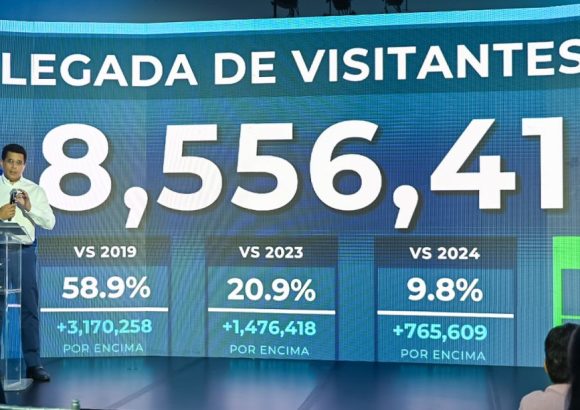
Dominican Republic welcomes record 8.5 million visitors through August 2026
SANTO DOMINGO – The Dominican Republic’s tourism sector has hit a historic milestone, posting a record number of international visitor arrivals through the first eight months of 2026, according to official data released by Tourism Minister David Collado. Between January and August, the Caribbean destination welcomed 8,556,415 total visitors, marking a 6.9% year-over-year increase compared to the same period in 2025.
Breaking down the overall arrivals figures, 6,610,258 tourists entered the country via air travel, while 1,946,157 arrived on cruise ships. When compared to pre-pandemic levels from 2019, the current eight-month total reflects a dramatic 58.9% jump, signaling that the Dominican Republic’s tourism industry has not only fully recovered from global travel disruptions but is now outperforming pre-crisis levels by a substantial margin. Even against 2024 figures, the 2026 count shows a healthy 9.8% expansion, confirming consistent, long-term growth momentum for the sector.
The upward trend held strong in the final month of the reporting period as well: August 2026 alone drew 856,858 total visitors. This represents a 6.2% year-over-year increase over August 2025, a 5.4% rise from August 2024, and a 52.3% gain compared to the same month in 2019. A closer look at August’s breakdown shows outsized growth in cruise travel: air arrivals hit 725,560 for a modest 2.6% annual gain, while cruise passenger arrivals surged 31.9% year-over-year to reach 131,298.
The United States continues to anchor the Dominican Republic’s source market, accounting for 44% of all tourist arrivals in August. Rounding out the top source markets are Canada at 9%, Colombia at 8%, Argentina at 5%, Spain and the United Kingdom at 4% apiece, and Puerto Rico and Mexico at 3% each.
On the infrastructure side, the country’s major airports reflect the concentration of tourism activity in key resort regions. Punta Cana International Airport, the primary gateway to the country’s most popular eastern beach destinations, handled 49% of all incoming air tourist traffic. It was followed by Las Américas International Airport near Santo Domingo with 29% and Cibao International Airport in the country’s northern region with 14%. Puerto Plata and Higüero airports each captured 3% of traffic, while La Romana and Samaná airports accounted for 1% each.
Beyond raw arrival numbers, industry metrics point to strong visitor satisfaction and healthy hospitality performance. Average hotel occupancy across the country hit 68% in August, and the average visitor satisfaction rating came in at 4.3 out of a possible 5 points. Most notably, survey data from the Ministry of Tourism shows that 90% of recent visitors stated they would plan a return trip to the Dominican Republic, and 60% said they would actively recommend the Caribbean destination to friends, family, and social contacts. This high level of visitor loyalty bodes well for sustained future growth as the country works to build on its record 2026 results.
-

BHTA reports strong first-half performance
Against a backdrop of shifting global travel trends and geopolitical uncertainty, Barbados’ key tourism industry has posted strong overall results for the first half of 2024, industry leaders have confirmed. The Barbados Hotel and Tourism Association (BHTA) unveiled the sector’s solid financial performance and landmark development progress during its third quarterly stakeholder meeting, held recently at the scenic Graeme Hall Nature Sanctuary.
While the industry faced a mild headwind in the form of a 3% year-over-year drop in visitor occupancy – a decline BHTA Chief Executive Officer Ryan Forde attributed to simmering global geopolitical tensions that have disrupted international travel patterns – key performance metrics tell a far more positive story. Both Average Daily Rate (ADR) and Revenue Per Available Room (RevPAR), two of the hospitality industry’s most critical financial indicators, recorded measurable increases over the 2023 first half period, underscoring the sector’s ability to maintain strong revenue even amid slight dips in bookings.
Beyond solid financial results, the first half of the year has also brought transformative infrastructural growth to Barbados’ tourism landscape. Three major new hospitality offerings have opened their doors to visitors, joining the island’s expanding accommodation portfolio: the upscale Royalton Vessence Barbados resort, the casual Blue Monkey Hotel & Beach Club, and the completed Marriott Collection, a network of seven distinct properties that broadens the international brand’s footprint on the island.
In his address to members and stakeholders, Forde also pushed back against growing public criticism of the island’s tourism industry, highlighting the BHTA’s successful advocacy work that has secured critical policy concessions for two key hospitality-linked sectors: standalone restaurants and local car rental operators. Forde emphasized that these won concessions deliver widespread benefits across businesses of all sizes, stretching from large multinational resort operations to small, community-run rum shops that are a core part of Barbadian cultural and economic life.
“When individuals speak from a place of limited information and speak negatively about tourism and hospitality, we implore them to speak not from emotion but from evidence,” Forde told attendees. Moving forward, the BHTA has outlined clear strategic priorities to strengthen the sector further: the association plans to deepen its collaborative partnerships with multiple government ministries to elevate the profile of Barbados’ national cultural festivals and upgrade the country’s tourism data collection systems to support more informed planning and decision-making.
-
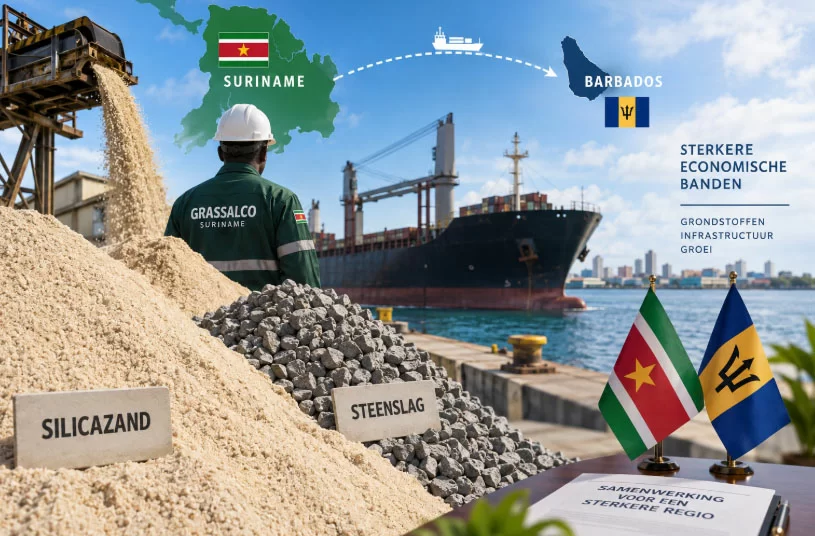
Barbados kijkt naar Suriname voor import bouwmaterialen
As the Caribbean nation of Barbados ramps up its push for large-scale infrastructure development, it is actively exploring opportunities to import key construction materials – silica sand and crushed stone aggregate – from neighboring CARICOM member Suriname, according to recent high-level diplomatic talks held this week. The push for imports comes as Barbados’ own domestic reserves of these critical building materials have declined significantly, creating a supply gap that needs to be filled to support the government’s accelerated infrastructure agenda.
Senior Minister Kerrie Symmonds of Barbados confirmed the country’s interest in Friday’s discussions, which were held at the Lloyd Erskine Sandiford Centre with Surinamese officials and a delegation from N.V. Grassalco, Suriname’s state-owned mining enterprise. “Historically, we have relied heavily on our domestic deposits to meet our needs for silica sand and aggregate, but those reserves have dropped off dramatically in recent years,” Symmonds explained during the talks. “That means we now have to source a large share of our required construction materials from international suppliers, and Suriname stands out as a natural, strategic partner.”
As a fellow member of the Caribbean Community (CARICOM), Suriname, located on the South American mainland, holds abundant untapped natural resources that can deliver tangible economic benefits to Barbados at a competitive advantage over non-regional suppliers. The ongoing discussions with Grassalco are also part of a broader initiative to revitalize bilateral economic cooperation between the two nations, which was disrupted by the COVID-19 pandemic after the signing of the landmark Brokopondo Agreement in 2018.
The Brokopondo Agreement outlines cooperation frameworks across multiple key sectors, including maritime and air connectivity, tourism development, agriculture and food security, trade and investment, natural resource development, and renewable energy. “Now that the worst of the COVID-19 pandemic is behind us, we are working to restart implementation of the critical commitments laid out in the Brokopondo Agreement,” Symmonds noted. Beyond construction materials, Barbados has also signaled interest in exploring collaborative opportunities in Suriname’s growing oil and gas sector, as well as joint renewable energy projects.
Symmonds emphasized that the longstanding positive political and diplomatic ties between the two CARICOM nations should now be translated into concrete, mutually beneficial economic outcomes. For Grassalco, which was founded in 1971 and specializes in the exploration and extraction of mineral resources including gold and natural stone, a new trade agreement with Barbados could open the door to expanded regional market access for Suriname’s mineral products. If negotiations progress successfully, this partnership could mark the first step for Suriname to establish itself as a leading regional supplier of construction raw materials across the Caribbean bloc.
-
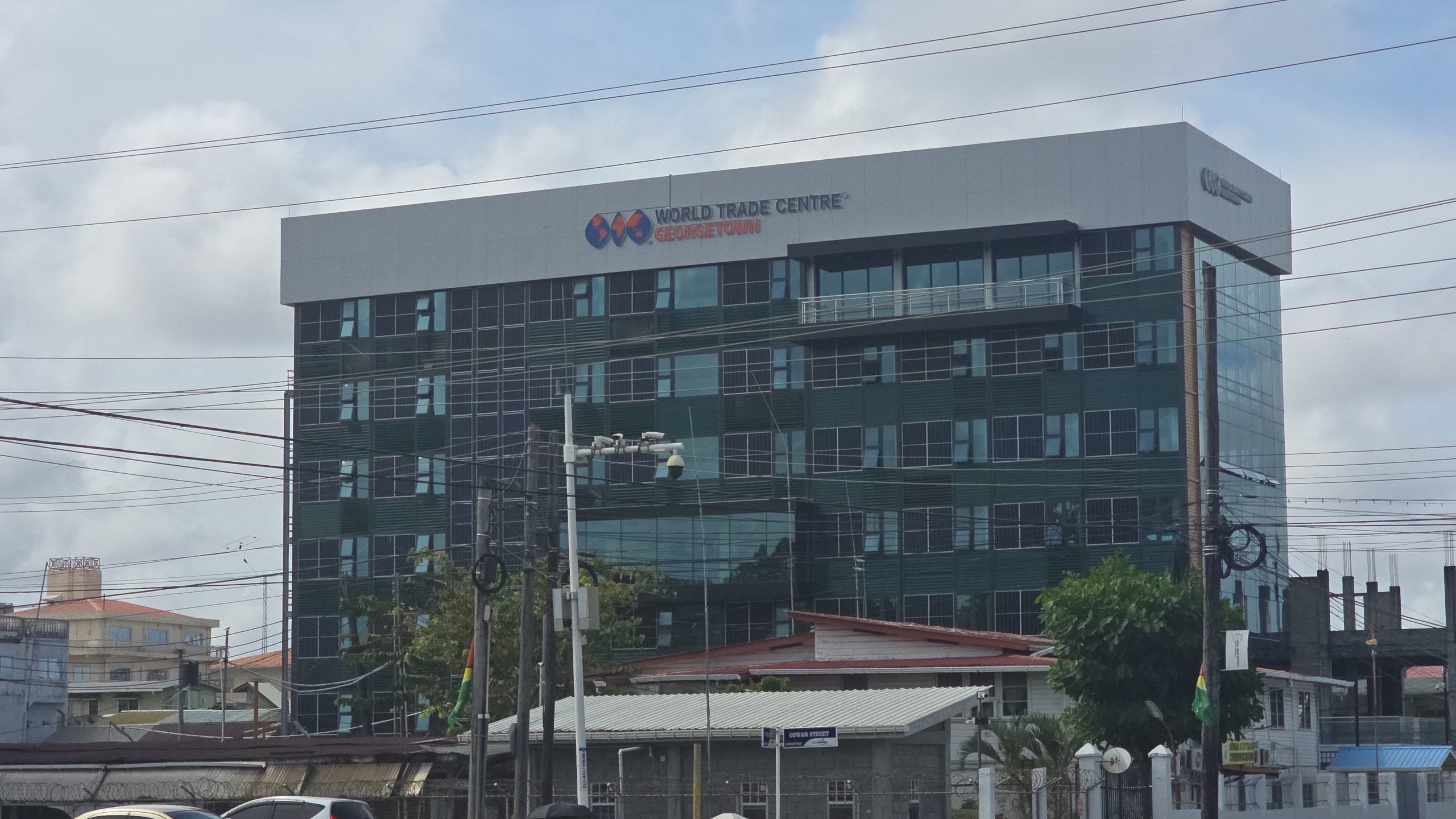
WTCG’s major global trade confab to examine trade implications of Artificial Intelligence
Georgetown’s World Trade Centre (WTCG) has announced that its upcoming annual International Trade and Investment Conference, scheduled for October 19 to 23 in Guyana, will dedicate a flagship session to examining how artificial intelligence reshapes competitiveness and growth for small, open developing economies. The announcement was made publicly by WTCG on Saturday, following preliminary stakeholder discussions held earlier this month.
The special session, titled “AI, Trade and the Future Competitiveness of Small Economies,” is designed to cut through widespread industry hype surrounding generative and advanced AI, and deliver practical, context-specific analysis for local and regional stakeholders. Unlike broad global AI dialogues that often overlook the unique needs of small developing nations, the session will directly explore what AI adoption means for on-the-ground actors across Guyana and the wider Caribbean: from small-scale export producers and domestic manufacturers to family-owned agricultural operations, regional financial institutions and cross-border logistics providers.
Ahead of the main conference, WTCG organized a closed-door informal roundtable to map out key risks and opportunities for CARICOM member states, including Guyana, which is currently experiencing one of the fastest economic growth rates in the Western Hemisphere. Attendees reached a clear consensus: while the risks posed by unregulated AI are tangible, small developing economies cannot afford to slow or resist AI integration. Instead, they argue that countries like Guyana should accelerate responsible AI adoption, while simultaneously investing in critical safeguards: robust cybersecurity infrastructure, risk management frameworks, and institutional capacity to govern emerging AI tools.
WTCG Executive Director Wesley Kirton, who is currently preparing to represent the organization at the Food and Beverage Show of Americas opening Monday at Miami Beach Convention Center, outlined three core risk categories identified during the roundtable discussion. These include immediate malicious misuse of AI tools by bad actors, widespread structural economic disruption that could displace existing labor and industries, and the long-term risk of losing human oversight over highly advanced autonomous AI systems. Citing the 2026 Global AI Safety Report, which highlights the growing emergence of fully autonomous AI agents that can operate without any human input, roundtable participants acknowledged that these risks cannot be ignored.
Despite these concerns, the majority of attendees agreed that AI offers transformative cost-saving benefits that can help small economies overcome longstanding structural disadvantages in global trade. For example, AI tools can dramatically streamline routine trade processes from market research and competitor analysis to tariff calculation, export documentation preparation and consumer demand forecasting. These efficiency gains cut overhead costs for small and medium-sized enterprises that often lack the resources of large multinational corporations, leveling the playing field for small producers looking to access global markets.
Following the roundtable, a dedicated working group has been convened to develop a comprehensive policy paper, titled “AI and the Future of Guyana and CARICOM: Threat, Opportunity or Both?”, which will be presented as a foundational discussion document at October’s main conference. Kirton emphasized that Guyana’s ongoing rapid economic transformation creates a unique window of opportunity to embed AI into growing sectors, allowing the country to leapfrog traditional development barriers that have held back many small developing economies for decades.
-

Guyana verdiende ruim US$2,5 miljard aan olie in 2025
Guyana, one of South America’s fastest-emerging oil producers, has released its 2025 annual report for the Natural Resource Fund (NRF) — the sovereign wealth vehicle that holds all of the country’s oil and gas sector revenue — revealing key figures that shed light on how the nation manages its newly found natural resource wealth.
Last year, total inflows into the NRF reached $2.509 billion from the country’s offshore oil operations, representing a modest 2.3% decline from the 2024 total inflow of $2.568 billion. The vast majority of this 2025 revenue came from profit oil — the share of crude output that Guyana claims as part of its production sharing agreements with international oil companies. According to prior data published by Minister of Finance Ashni Singh, profit oil contributed roughly $2.1 billion to the fund in 2025. Royalty payments added another $330.7 million, while a $15 million signing bonus from a new production contract was also deposited into the sovereign fund.
The most striking takeaway from the annual report is that Guyana’s government withdrew nearly as much capital from the NRF as was deposited over the course of the year. Total withdrawals hit $2.463 billion, a more than 55% jump from the $1.586 billion pulled from the fund in 2024. This 2025 withdrawal amount aligns almost exactly with the annual approved budget ceiling of $2.464 billion, meaning the government utilized nearly 100% of its permitted withdrawal allocation for the year. Disbursements were spread evenly across 2025: two $400 million transfers to Guyana’s Consolidated Fund were made in February and April, followed by multiple $200 million installments, with a final $463 million withdrawal processed in late December.
Under Guyana’s existing national legislation, all funds withdrawn from the NRF are transferred to the country’s Consolidated Fund, where they are earmarked for national development priorities and economic growth-driving investments that benefit the broader public. This framework was designed to ensure that oil revenue is directed toward long-term national progress rather than accumulated solely as reserve capital.
Guyana first launched commercial crude production from its massive offshore Stabroek Block in December 2019. Over the subsequent six years, production has expanded rapidly as multiple floating production, storage and offloading (FPSO) vessels were brought online. By the end of 2025, four FPSOs — the Liza Destiny, Liza Unity, Prosperity, and One Guyana — were operating at the Stabroek Block, supporting ongoing output growth.
Looking ahead, Guyana’s government projects that total oil revenue will grow in 2026. Forecasts call for around $2.4 billion in profit oil earnings and $375.3 million in royalty payments next year, alongside an additional $17 million in signing bonuses from a new exploration agreement for Block S7. Despite the large-scale withdrawals in 2025, the NRF still holds more than $3 billion in reserve capital, with an end-of-year 2025 balance sitting at approximately $3.25 billion.
In just a few years, substantial oil reserves and consistent revenue growth have transformed Guyana into one of the fastest-growing oil producers in the Western Hemisphere, with far-reaching implications for the country’s economic trajectory and regional standing.
-
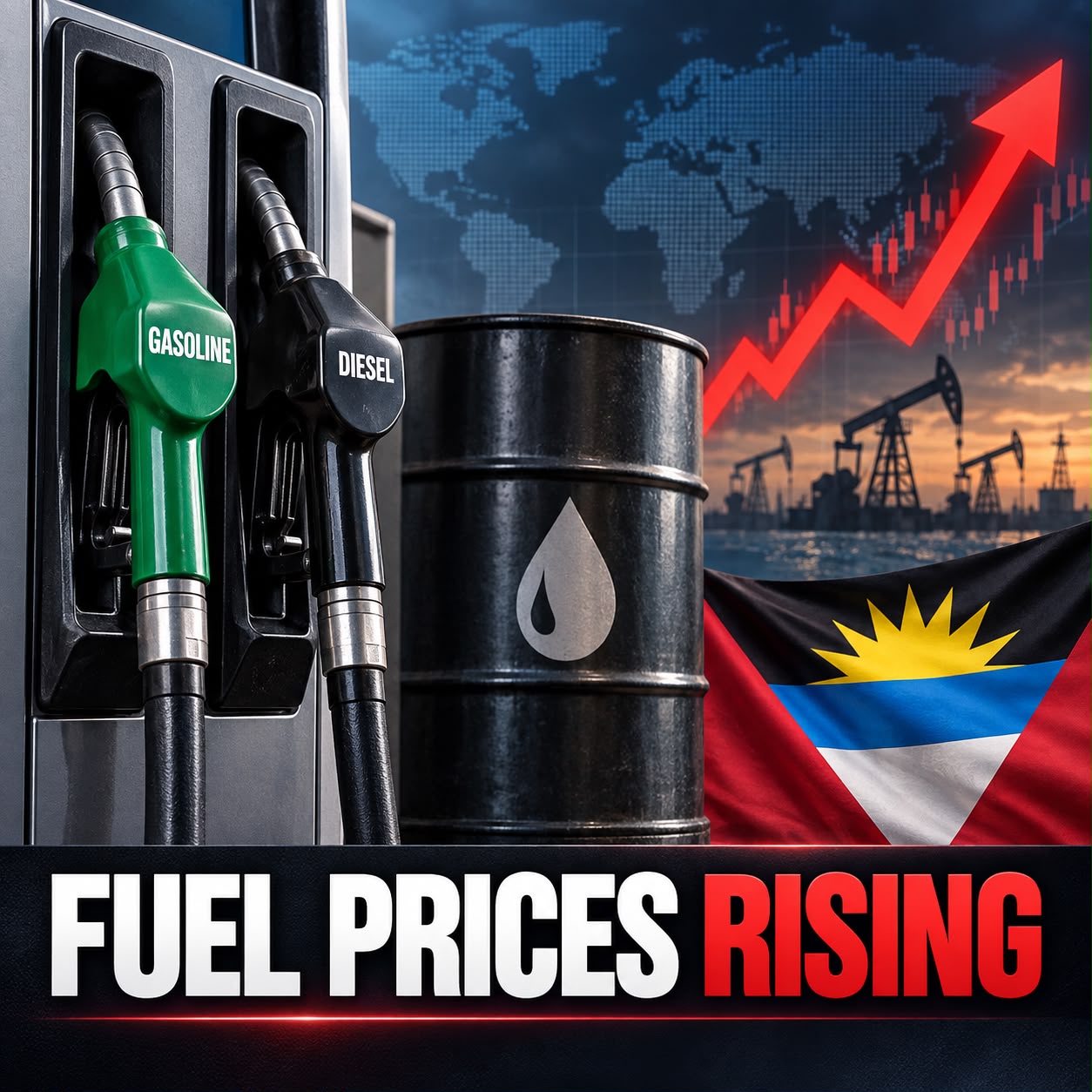
LISTEN: PM Warns Another Fuel Price Increase Could Follow as Global Oil Tops US$100
The twin-island Caribbean nation of Antigua and Barbuda is bracing for another round of increases to retail gasoline and diesel prices, Prime Minister Gaston Browne has confirmed, as sustained volatility in global oil markets keeps benchmark prices firmly above the $100 per barrel threshold. Browne made the announcement during an appearance on the local *Browne and Browne Show* this past Saturday, spelling out the unavoidable implications for consumers across the country.
The prime minister’s warning arrives on the heels of a dramatic weekly rally in global crude prices, driven by escalating geopolitical tensions in the Middle East and growing fears of widespread supply disruptions that have already stretched global energy inventories thin. Data from leading international newswire Reuters confirms that Brent crude, the global benchmark for oil pricing, closed at $104.61 per barrel this past Friday. Meanwhile, U.S. West Texas Intermediate crude settled just above the psychologically important $100 mark at $100.05 per barrel. Over the course of the week, both benchmarks recorded gains of more than 8% — a surge that aligns directly with Browne’s assessment that current trading prices hover around $105 per barrel.
The sharpest single-day jump came on Thursday, when Brent climbed as high as $107.63 per barrel. That intraday peak followed fresh attacks on commercial shipping routes in the Middle East, which amplified already heightened concerns over interruptions to global energy supplies that have remained tight for months amid ongoing production cuts and geopolitical constraints. Reuters data shows both crude benchmarks rose more than 6% during that single trading day alone.
In his address, Browne emphasized that the government of Antigua and Barbuda has no ability to influence or offset the movements of the global crude market. Beyond direct increases at fuel pumps, he warned, higher energy costs will send ripple effects through every corner of the domestic economy. As the prime minister noted, oil is a foundational input for nearly all manufacturing, transportation and industrial activity, meaning higher crude prices will quickly drive up costs for freight delivery, construction materials and a broad range of everyday consumer goods. “Everything that is manufactured is supported by oil. There’s a knock-on effect. Everything increases,” Browne explained.
At this stage, the prime minister has not released details on the size of the upcoming fuel price adjustment, nor has he confirmed a specific date when the revised pump prices will go into effect for motorists and businesses across Antigua and Barbuda.
-

Jet Blue’s Financial Troubles Behind Regional Flight Cuts, Antigua PM Says
When low-cost carrier JetBlue announced its withdrawal from Antigua and Barbuda, speculation quickly emerged that local policy or government missteps had driven the airline’s departure. But Antigua and Barbuda Prime Minister Gaston Browne has pushed back against those claims, framing the exit as one piece of a much larger corporate restructuring driven by deep financial headwinds hitting the airline across the Caribbean and South America.
Speaking during an appearance on the *Browne and Browne Show* this past Saturday, Browne emphasized that the decision to cut the Antigua and Barbuda route was not driven by any factors unique to the twin-island nation. “It wasn’t an Antigua-specific issue,” he told listeners, outlining the cascading financial challenges that have forced JetBlue to scale back its footprint across the region.
Per Browne’s assessment, JetBlue’s aggressive past expansion strategy has become unsustainable, after the airline posted cumulative losses totaling hundreds of millions of dollars. To right-size its operations, the carrier has pulled out of multiple destinations across the Caribbean and South America as part of its broader corporate restructuring plan.
Two major recent setbacks have amplified JetBlue’s financial strain, Browne noted. First, the airline’s high-profile attempt to acquire fellow low-cost carrier Spirit Airlines was blocked by U.S. regulators, eliminating a key pillar of JetBlue’s long-term growth strategy. Compounding that failure, a proposed commercial arrangement between JetBlue and industry giant American Airlines also collapsed, removing another opportunity for the airline to stabilize its revenue and cut operational costs.
Browne also addressed the gap in competitive conditions across the region, pointing out that many competing Caribbean tourism destinations offer direct subsidies to JetBlue to keep unprofitable routes running. Unlike those jurisdictions, Antigua and Barbuda does not provide public subsidies to the airline to maintain its service. The prime minister’s comments clear up widespread local confusion over the route exit, framing it as a consequence of corporate financial stress rather than any failure of local policy.