
Six months into open conflict between the United States and Iran, Washington has doubled down on a two-pronged strategy of military strikes and financial isolation, aiming to push Tehran’s leadership to the negotiating table by crippling Iran’s access to the global economy. This latest escalation of tensions comes alongside expanded U.S. military operations targeting key Iranian assets, including missile launch sites and critical strategic infrastructure. In a press briefing at the White House Wednesday, U.S. President Donald Trump told reporters that American forces hold operational superiority over Iran, claiming recent U.S. airstrikes have successfully disabled Iranian radar systems and destroyed a wide range of key military infrastructure. “We hit them last night because they took a shot at us in Jordan, and we knocked all of them down,” Trump stated. In parallel to military action, the Trump administration is ramping up targeted pressure on Iran’s Islamic Revolutionary Guard Corps (IRGC), which U.S. officials identify as a core pillar of Iran’s military and national security apparatus. The broader economic pressure campaign includes sweeping new sanctions on Iranian entities and formal appeals to U.S. allies, global commercial banks, and other international financial bodies to sever all existing business ties with Tehran. The push for coordinated international action took center stage this week at the G20 finance ministers and central bank governors’ meeting held in Asheville, North Carolina. During the gathering, U.S. Treasury Secretary Scott Bessent lobbied for global collective action to cut Iran off from international capital markets and secure unimpeded navigation through the Strait of Hormuz, the strategically vital chokepoint through which nearly a fifth of global oil supplies pass daily. Bessent told attendees that even China, Iran’s largest long-standing economic partner, has publicly agreed that freedom of maritime trade through the Strait must be preserved. China has maintained robust economic ties with Iran for decades, particularly in the energy sector, and remains the top buyer of Iranian crude oil. Bessent argued that Beijing holds unique leverage to help de-escalate the conflict, noting that China can contribute through intelligence sharing, economic monitoring, and diplomatic engagement with entities that back the Iranian government. “What I can tell you is that many of our allies came forward and said we will do whatever is necessary because they understand that Iran is in an economic death throes,” Bessent said. He framed the U.S.-led economic campaign as analogous to severing a snake’s head, asserting that once Iran’s remaining productive economic capacity is sufficiently weakened, the country’s ruling leadership will have no choice but to enter negotiations. The Treasury chief also pushed back against claims that China’s continued crude purchases undermine U.S. pressure efforts. He explained that Iran currently holds some 30 million barrels of crude stored on tankers at sea, and that most Chinese purchases of Iranian oil are settled in Chinese yuan rather than globally traded hard currencies such as the U.S. dollar. In response, Washington is specifically targeting the cross-border financial channels that allow yuan earned from oil sales to be converted into other currencies and moved through regional financial systems, he said. Recent U.S. sanctions targeting global financial institutions, including a Dubai-based bank, are part of this strategy to block Iran from accessing U.S. dollars and other reserve currencies. “When that money cannot be converted to dollars, then the regime will starve,” Bessent said. While the pressure campaign is targeted at Iran, its economic ripple effects are being felt across the globe. Resumed hostilities between the two powers have already pushed international crude prices sharply higher, stoking widespread concerns over rising fuel costs and spillover impacts on consumers, businesses, and small import-dependent economies. For small island nations including St. Kitts and Nevis and other Caribbean states, spiking global energy prices translate almost immediately to higher transportation costs, more expensive electricity, and increased operating expenses across all sectors of the economy. Both the federal government in Basseterre and the Nevis Island Administration have been struggling to manage the economic fallout of these rising energy costs. Nevis Premier Mark Brantley recently acknowledged growing public discontent over surging electricity bills as the conflict enters its sixth month. Starting in June 2026, local authorities reintroduced a fuel surcharge to residential electricity customers, though the administration capped the charge 10 cents below the standard residential rate of 79 cents per kilowatt hour. Brantley noted that public reaction to the policy has been split, but admitted that the vast majority of households are already feeling the financial strain of higher electricity costs. As Washington continues to ramp up economic pressure on Tehran, the consequences of the six-month conflict extend far beyond the Middle East battlefield, leaving energy-importing nations and ordinary consumers across the globe to absorb a growing share of the economic cost.
作者: admin
-
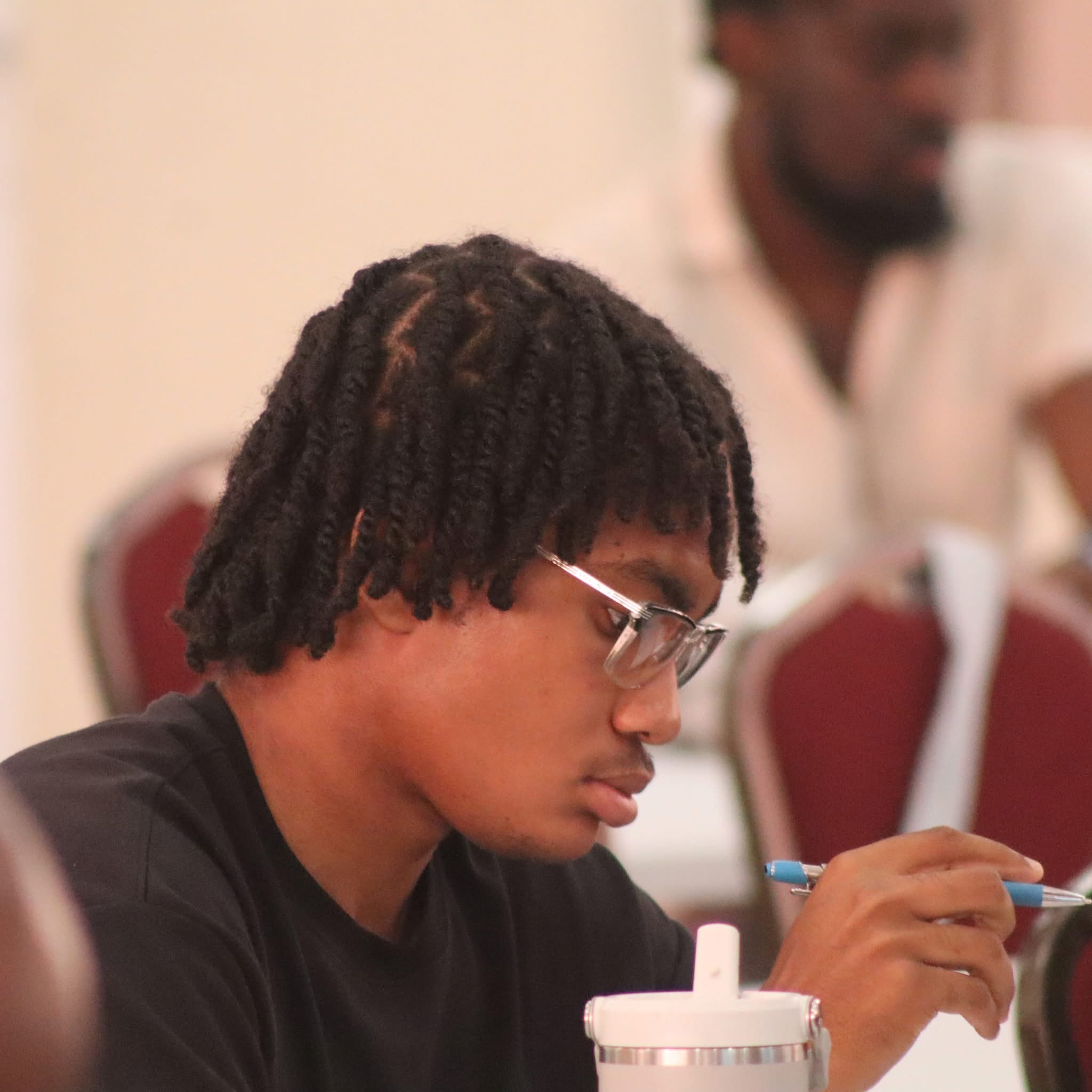
UWI Five Islands Welcomes Historic First Cohort of Law Students
The University of the West Indies (UWI) Five Islands Campus has reached a transformative milestone in its institutional growth, welcoming its very first incoming class of Bachelor of Laws (LLB) students to its Antigua-based facility. This groundbreaking program kicked off formal instruction this week, aligning with the start of Semester I for the 2026/2027 academic year, which follows UWI’s official academic calendar that sets September 1 as the standard start date for all teaching activities.
In a public statement highlighting this landmark moment, campus leadership confirmed that the pioneering cohort draws students from across three Eastern Caribbean nations: Antigua and Barbuda, Dominica, and St. Kitts and Nevis. For regional students seeking a quality legal education, the launch eliminates the need to relocate to other UWI campuses across the Caribbean to pursue an accredited law degree, expanding access to professional legal training for emerging scholars across the subregion.
Campus officials framed the launch of the program as more than just a new academic offering, calling it “the beginning of a legacy” for the young campus. For these inaugural students, the four-year course of study will dive deep into global and regional law, legal systems, and practical legal skills, building a foundational knowledge base that will prepare graduates for a wide range of careers in the legal field, from judicial work and public advocacy to private practice and public policy.
The first cohort is scheduled to complete their degree requirements and cross the graduation stage in 2029. The addition of the LLB program represents one of the most significant expansions of academic programming in the Five Islands Campus’s history, bringing a high-demand professional degree to the Antigua campus for the first time. The program was originally greenlit for a September 2026 launch, a timeline that campus administration has stayed on track to meet despite planning and coordination requirements.
To maintain the high academic standards that UWI is known for across the Caribbean, the program operates through a formal partnership with UWI Mona, one of the university system’s most established campuses with a long-respected law program. Under the pre-approved partnership structure, UWI Mona takes responsibility for curriculum design, ongoing quality assurance, and overall academic governance of the LLB program, while the Five Islands Campus manages all day-to-day operations, including instruction, student support services, and campus logistics for enrolled students.
-
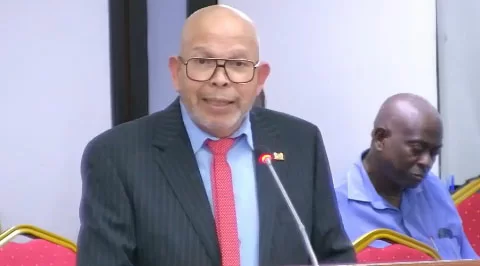
1.000 laptops nodig, 100 nieuwe lokalen pas eind jaar klaar
As the start of the 2024 academic year approaches on October 1, Suriname’s Ministry of Education, Science and Culture is moving forward with urgent infrastructure and digital upgrades to address long-standing systemic gaps in the country’s education sector, Minister Dirk Currie has confirmed in an address to the National Assembly.
Decades of accumulated underinvestment have left the nation’s schools grappling with two critical challenges: a lack of digital learning tools and a widespread shortage of usable classroom space. Currie outlined the ministry’s ongoing mitigation efforts while warning the public that not all issues will be resolved in time for the first day of classes, given the scale of the problems the department inherited.
One of the ministry’s top priorities is expanding access to digital learning resources. An initial needs assessment conducted earlier this year identified 400 additional computers as necessary for general secondary education, but a follow-up review that included vocational education programs pushed the total requirement to 1,000 laptops. The new figure reflects widespread gaps across all education sectors: Currie noted that some schools report having no functional computing devices at all, while others only have a small number of outdated units, and many lack qualified teachers to lead ICT instruction even when equipment is available.
The push for digital transformation also serves a second purpose: partially offsetting national shortages of specialized subject teachers. The ministry is already rebroadcasting pre-recorded educational content via Gov.tv and its official YouTube channel, and development is underway on a full remote learning platform that can deliver live digital instruction to understaffed schools. A separate digital learning pilot program is being planned for rural and interior regions of the country, with Currie confirming he has held discussions with local stakeholders to identify eligible regions and schools. Reliable broadband access is a core requirement for the pilot, and the minister named Starlink as a potential technical solution, though he acknowledged that existing national regulations may create barriers to its immediate deployment.
Alongside digital upgrades, the ministry is rushing to address a severe shortage of classroom space across the country. Currently, 76 new classrooms are under construction with support from private sector partners: some have already been completed, while others remain in active building or final finishing phases. Separate renovation projects are also ongoing at 35 schools distributed across all regions of Suriname. Looking ahead, the ministry has plans to construct an additional 100 new permanent classrooms, though Currie confirmed that not all of these will be ready in time for the October 1 school start. The department has set a final completion deadline of December for all new builds.
To minimize disruption to student learning before all new classrooms come online, Currie announced a series of temporary flexible use policies. The ministry will eliminate rigid separation between general education and vocational education classroom spaces, requiring schools to utilize every available square meter to accommodate students. If needed, temporary bus transport will be provided to move students between undercapacity schools and nearby campuses with available space.
A key priority for the minister is ending the widespread practice of students only attending school three days per week due to space shortages. Currie emphasized that if any such temporary scheduling adjustments are necessary this year, they will only remain in place until December, when the bulk of new classroom construction is scheduled to be finished.
Closing his address to the National Assembly, Currie sought to temper public expectations for the start of the school year. He acknowledged that the 2024 academic year will start off better than the 2023 term, but noted that decades of structural backlogs cannot be fully resolved in just a few months of targeted work. The ministry’s ongoing investments are designed to deliver long-term, sustainable improvement to Suriname’s education system rather than quick fixes, he added.
-
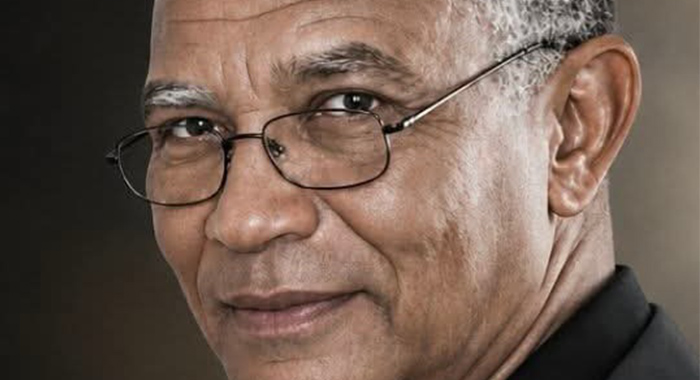
Tribute to the late Mr. Lennox John
Across Kingstown, Saint Vincent and the Grenadines, communities are gathering this week to honor the life and enduring legacy of Lennox John, a beloved local leader who touched countless lives through three distinct, impactful lifelong vocations. Written by Terry Haynes, a founding member of the Bishop’s College Steel Orchestra, this tribute reflects on a man whose quiet commitment to lifting up others shaped generations of residents across the island nation.
John’s life was defined by service across three core pillars of community life: faith, national sports, and education. As a deacon at St. George’s Cathedral in Kingstown, he carried out his duties with steady humility and unwavering religious conviction, supporting congregants through every stage of life. At a national level, he stepped into the role of president of the Saint Vincent and the Grenadines Cricket Association, pouring hundreds of hours of voluntary work into a sport that serves as a unifying force across the country’s diverse communities. For Haynes and thousands of other former pupils, however, John’s most lasting impact came as principal of Bishop’s College Kingstown, where he nurtured young talent and opened doors that many students never would have accessed on their own.
One of John’s most lasting contributions to the school is the Bishop’s College Steel Orchestra, an institution that would never have come to fruition without his relentless support. When a small group of students first proposed the idea of a school steel band, John did not merely sign off on the project—he championed it at every turn. When the group had no instruments to play, John tracked down donated equipment and secured resources to get the band off the ground. When the packed academic schedule left no room for regular practice, he rearranged school timetables to carve out dedicated time for the ensemble. When the band hit financial walls and struggled to fund travel to off-island competitions, John fundraised, coordinated transport, and never stopped encouraging the young musicians to push forward. What started as a risky, untested idea grew into one of the school’s most beloved core programs, a central part of Bishop’s College identity that has represented the institution at events across the country for decades.
This combination of relentless problem-solving and wholehearted support marked every part of John’s work, from the cathedral to the cricket pitch to the school’s hallways. As a principal, he prioritized student success above all else, working tirelessly to ensure every pupil had the resources and opportunities needed to complete their secondary education and build a foundation for future success. He had a unique ability to spot untapped potential in young people, often recognizing what students could achieve long before they believed in themselves. He made it his personal mission to send every graduate out into the world with the skills, confidence, and tools they needed to build meaningful lives.
For the steel orchestra specifically, John’s support never wavered throughout his tenure. No matter the event—from high-profile national competitions to small school assemblies, rain or shine—John was always in the audience to cheer on the students. He might sit front row to watch a new soloist perform, or slip into the back row for a casual assembly set, but he was always present, always nodding along to the rhythm, and always visibly proud of the work his students had put in.
Haynes notes that holding just one of John’s three major roles would be enough to fill a lifetime of meaningful service, but John excelled in all three, carrying out every duty with radical integrity, steady discipline, and a quiet, deep love for the people of his community. Through his example, he taught everyone around him that true leadership is not about holding impressive titles or garnering public attention—it is about showing up consistently, lifting others up, and creating space for people around you to succeed.On behalf of the Bishop’s College community and the steel orchestra, Haynes extended deepest condolences to John’s family, the congregation of St. George’s Cathedral, the national cricket community, and the thousands of Bishop’s College graduates whose lives and trajectories were shaped by John’s guidance. Haynes emphasized that while the community has lost a transformative leader, John’s legacy will never fade. It lives on in every graduate who achieved their academic goals with his support, every cricketer who got the chance to compete under his leadership of the association, and every note that the Bishop’s College Steel Orchestra plays for generations to come.
Closing the tribute, Haynes expressed the community’s enduring gratitude: “Thank you for seeing us. Thank you for believing in us. Thank you for building things that outlast us. May your soul rest in peace, and may your light continue to guide us. We will keep the beat going, sir.”
-

H2O Lions register ‘surge’ in medals, personal best times
One of the region’s emerging competitive swimming programs, the H2O Lions Swim Club, has turned in an impressive performance at the 2024 SVG Gallagher National Swim Championships, held from August 27 to 30 at the Shrewsbury Aquatic Centre. The club’s young athletes not only secured a top-three finish in the team standings but also posted a dramatic jump in total medals across all age divisions, marking a major milestone for the program.
Over four days of tightly contested racing against some of the country’s top swimming talent, every H2O Lions competitor walked away with a new personal best time, with a large number of the club’s athletes earning spots on the championship podium. The performance highlighted the depth of skill and steady progress the club has fostered among its rising young competitors.
Standout individual results from the event underscore the promise of the club’s youth development pipeline: In the boys’ 9–10 age group, Calique Grant captured a bronze medal, while 11–12 age category competitor Ezron Quashie took home top honors in the 800m freestyle event, clinching the gold.
In a statement released after the competition, club leadership attributed the strong team showing to more than just improved speed and refined technique. The surge in medals and faster personal bests, the organization noted, also reflects clear growth in on-race confidence and strategic tactical awareness among all participating swimmers.
The club’s coaching duo, Josel Williams and Elise Quashie, emphasized that the program’s core mission extends far beyond racking up championship titles or team rankings. The club’s primary focus remains on holistic development, building every member both as a competitive swimmer and as a well-rounded individual.
“Our goal from the start has been to develop athletes who are stronger, smarter, and more confident both in and out of the pool,” the coaching pair explained. “When we center individual progress — focusing on perfecting core skills like starts, turns, and pacing, while also building mental toughness — strong team results come naturally. This championship performance proved that our approach is delivering real results. We are building a culture where every single swimmer has the opportunity to improve, regardless of their starting skill level.”
Currently, the H2O Lions Swim Club conducts regular training sessions at Questelles Beach. Local community members and aspiring swimmers can reach the organization directly by phone at 784-432-8701 for more information on membership and training schedules. To follow more local sports coverage from the region, readers can subscribe to the iWitness News WhatsApp Channel.
-
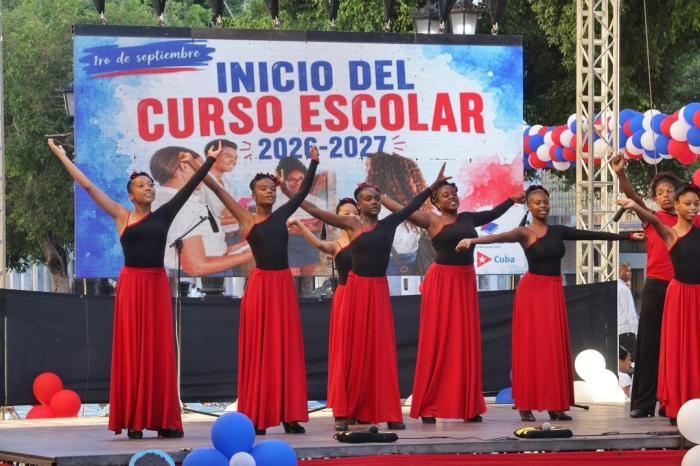
Díaz-Canel: “As long as there are classrooms with students and schools with teachers in Cuba, there is a nation, there is a homeland, there is a Revolution, and there is socialism”
On September 2, 2026, Cuba held its national opening ceremony for the 2026-2027 academic year at the historic Paseo del Prado in Old Havana, a location deeply tied to the island nation’s educational legacy — the very spot where teacher Mendive once taught the iconic Cuban independence leader José Martí. Speaking after the ceremony, Miguel Díaz-Canel Bermúdez, First Secretary of the Central Committee of the Communist Party of Cuba and President of the Republic, framed the opening of the new school term as an act of national resistance against external pressure, while outlining three core takeaways from this milestone.
Against the backdrop of intensified U.S. economic blockade and energy restrictions that have created widespread logistical challenges across the country, Díaz-Canel emphasized that opening classrooms to students across the nation is itself a victory. This year’s school launch coincides with the centennial of the birth of Fidel Castro, founding father of modern revolutionary Cuba, adding historic weight to the occasion.
“As long as there are classrooms with students and schools with teachers in Cuba, there is a nation, there is a homeland, there is a Revolution, and there is socialism,” Díaz-Canel told reporters. He described opening the school year in current conditions as an enormous shared responsibility for all Cubans, noting that the successful launch defies efforts by the blockade to undermine the country’s social fabric.
“It means having started the school year in the middle of a complex situation that we cannot deny, neither to our teachers, nor to our students, nor to our children, nor to our adolescents,” the president said. “This beginning is also to show the capacity of a country, a nation, a Revolution, where the passion for knowledge and love for the Homeland are imposed on all restrictions, imposed on that genocidal policy of blockade that seeks to drag a country into barbarism.” He added that opening the term despite hardship is a deliberate act of resistance against colonial interference, proving that the Cuban people’s commitment to learning outweighs any adversity.
Díaz-Canel went on to credit the successful opening to widespread collective effort across all sectors of Cuban society. In the months leading up to the term, he explained, education leaders, government agencies at the local, provincial and national levels, families and community groups all joined forces to upgrade school infrastructure and prepare learning environments despite resource shortages. When Díaz-Canel tasked education leaders with developing a viable academic plan amid the energy and economic blockade, he said, they delivered an innovative, creative proposal in just two weeks — a result he said could only come from deep commitment to revolutionary ideals.
“It is worthwhile to express our gratitude and recognition to all our teachers, all our professors, all our institutions, parents, families, and communities for what they have accomplished,” the president stated.
The third core point Díaz-Canel highlighted is the ongoing challenge of delivering high-quality education amid national transformation. Beyond simply opening classrooms, the country’s priority this year is raising educational standards, with every classroom designated a “workshop for solutions” to overcome emerging challenges. He called this year’s term a difficult but dignified undertaking, framing it as a reaffirmation of Cuba’s commitment to protecting education as a fundamental social right.
“This start of the school year is an embrace of optimism and an expression of the Revolution’s and the country’s determination to continue defending such a sublime and paradigmatic social achievement as the nation itself,” Díaz-Canel said. “It is about giving our children, our grandchildren, our youth the right to an education; and it is also about giving them the right to dream and allowing us to share those dreams.”
The president also extended targeted calls to key groups involved in the school year. He acknowledged the economic hardships that Cuban teachers face, noting that salaries do not yet match the enormous effort educators put into their work, but emphasized that teachers are the backbone of the country’s cultural resilience. “Our teachers, our professors, our teaching staff, are above all builders of the resilience that distinguishes us as a nation and that distinguishes us as a people,” he said, calling on educators to bring innovation and dedication to supporting vulnerable students.
To students, Díaz-Canel emphasized that the entire country’s collective effort to open schools is for their benefit, and urged them not to use resource shortages as an excuse to disengage from learning. “On the contrary: dedicate yourselves passionately to your studies, dedicate yourselves passionately to learning, and let that also be part of your contribution to this daily effort and to the great effort that the entire country has made so that the school year could begin today,” he said. He also called on families to partner with schools, noting that successful education requires shared commitment from both household and school communities.
The opening ceremony, which opened with a tribute to Fidel Castro, featured performances from child, adolescent and young adult artists, drawing emotional responses from attendees in a reminder of what the nation is working to protect. The event was also attended by Cuban Prime Minister Manuel Marrero Cruz, other party and government leaders, and representatives of youth and student organizations.
Speaking at the ceremony, Education Minister Naima Ariatne Trujillo Barreto noted that the bell signaling the start of the 2026-2027 term is no ordinary bell. “It is the heartbeat of a nation that decides, once again, to invest in its future. It is the sound of resistance, of tenderness, and of hope. It is heard with the strength of those of us who know that educating is the noblest and most just thing we can do,” Trujillo said.
She reaffirmed that access to free education in Cuba is non-negotiable, noting that while the country continues to work toward better infrastructure, materials and uniforms, the value of Cuban education is measured not by physical resources but by its commitment to leaving no student behind. “Even if one resource is lacking, there will be an abundance of creativity, solidarity, and love from our teachers,” Trujillo said.
Trujillo tied this year’s effort back to the 1961 Cuban Literacy Campaign, a landmark initiative that eradicated illiteracy across the island 65 years earlier, noting that while current challenges are different, the same spirit of determination remains. She added that this year’s academic calendar is designed with flexible, localized decision-making to adapt to varying conditions across different regions and communities, with the core goal of making daily learning sustainable for all students. Closing her remarks, Trujillo thanked teachers for their heroic preparation work, called for continued family partnership, and noted that students’ curiosity and joy of learning are the core motivation for all the effort put into opening the term.
-
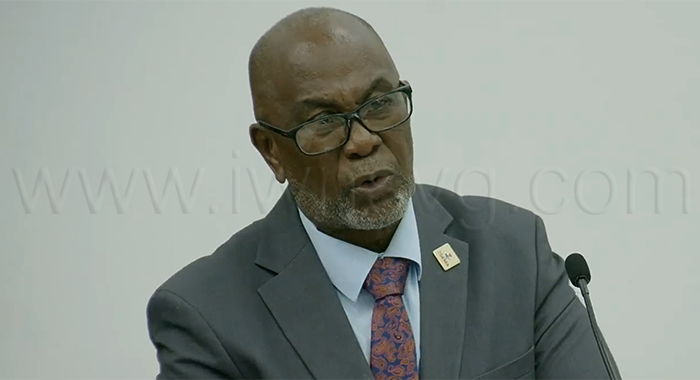
Leacock turns Gonsalves’ ‘hook in the gill’ comment on opposition
In a striking parliamentary address that blends rhetorical flair with blunt policy candor, Deputy Prime Minister and National Security Minister St. Clair Leacock of St. Vincent and the Grenadines (SVG) has reworked one of the most recognizable metaphors from opposition leader Ralph Gonsalves, framing the new Godwin Friday administration’s work as a gradual effort to extract a debt “hook from the gill” of the nation while tackling rising gun violence and severe fiscal scarcity.
Leacock made the remarks while responding to a question posed by opposition senator Carlos James, leaning into the familiar phrasing to reframe SVG’s current economic and security realities for the legislative body. He reminded lawmakers that the original metaphor, coined by Gonsalves before the current administration took office, spoke of placing a hook in the gill of the incoming government. Drawing on SVG’s deep cultural connection to fishing, Leacock unpacked the literal meaning of the phrase: a hook set in a fish’s gill is intended to capture or kill the catch. Today, he argued, that same metaphor describes the difficult position the new government inherited.
For years, Leacock told parliament, successive administrations turned to borrowing as a default to fund policy priorities, leaving SVG with a legacy of structural debt and stretched public finances. The “hook in the gill” that now constrains the current administration is the overlapping weight of fiscal stress and urgent social pressure, which limits the scope of action for any government, regardless of political agenda. “Everything that we want to do in St. Vincent [in] the last few years… the options are that we either borrow… or we try to reconstruct our circumstances so that we mitigate [against] further debt,” Leacock said. “If you don’t have money, what do you do? Most of us would advocate that we work harder and smarter, and that we strive to cut and contrive and live within our means.”
Where the original metaphor cast the opposition as the fisherman setting the trap, Leacock reframed the current government’s role: instead of setting the hook, the administration is working slowly to pull it out, one careful step at a time. Rejecting dramatic, sudden policy shifts that could “kill the fish” — meaning destabilize core state institutions — Leacock emphasized a gradual approach to fixing the structural weaknesses left by the previous Unity Labour Party administration. This measured strategy extends to the national security portfolio, which Leacock oversees, where the government is pursuing a “do more with less” approach to address widespread public concern over gun violence and homicides.
Leacock outlined a series of targeted upgrades to SVG’s police force, noting that many facilities were in dire condition, describing some stations as ramshackle and mould-infested. To address these gaps, the government has relocated officers from the most unsafe facilities and added new patrol vehicles to high-need districts including Calliaqua, Marriaqua and Bequia. It has also redirected investment to targeted capacity building: additional recruits are being assigned to specialized units, a new police drone program is being rolled out with overseas training for operators, and the government is leaning into regional security partnerships including the Regional Security System (RSS) and CARICOM IMPACS to track suspicious vessels and aircraft and build intelligence to crack down on illegal firearms trafficking.
Acknowledging that public anxiety over violent crime is running high, Leacock also pushed back against what he warns is an overblown narrative of widespread lawlessness, which he says could harm SVG’s vital tourism and foreign investment sectors. He pointed to recent large-scale public events, including the annual Carnival and international cricket matches, that concluded without any major violent incidents, noting that by regional standards, SVG remains a safe nation.
Leacock made clear that the current fiscal and security pressures were not created by the new administration, but that fixing the challenges is its core responsibility. “We are not for a minute proceeding like the proverbial ostrich,” he said. “We know that this country is under pressure, but we didn’t put it so; we met it so, and we are getting it right, and we are fixing it.”
Calling on Vincentians to place trust in his administration, Leacock reaffirmed the government’s commitment to building a more professional, accountable police force, strengthening border security to disrupt weapons smuggling, and addressing the root social and economic drivers of violent crime. He added that while current police leadership assesses the security situation remains manageable, the administration would not hesitate to request direct intervention from the RSS if conditions worsen in vulnerable communities.
In the end, Leacock’s reframing of the iconic metaphor casts the current government not as an outside actor trapping the state, but as a steward working to free the nation from the constraints it inherited, while working to keep SVG’s waters safe and stable for all citizens.
-
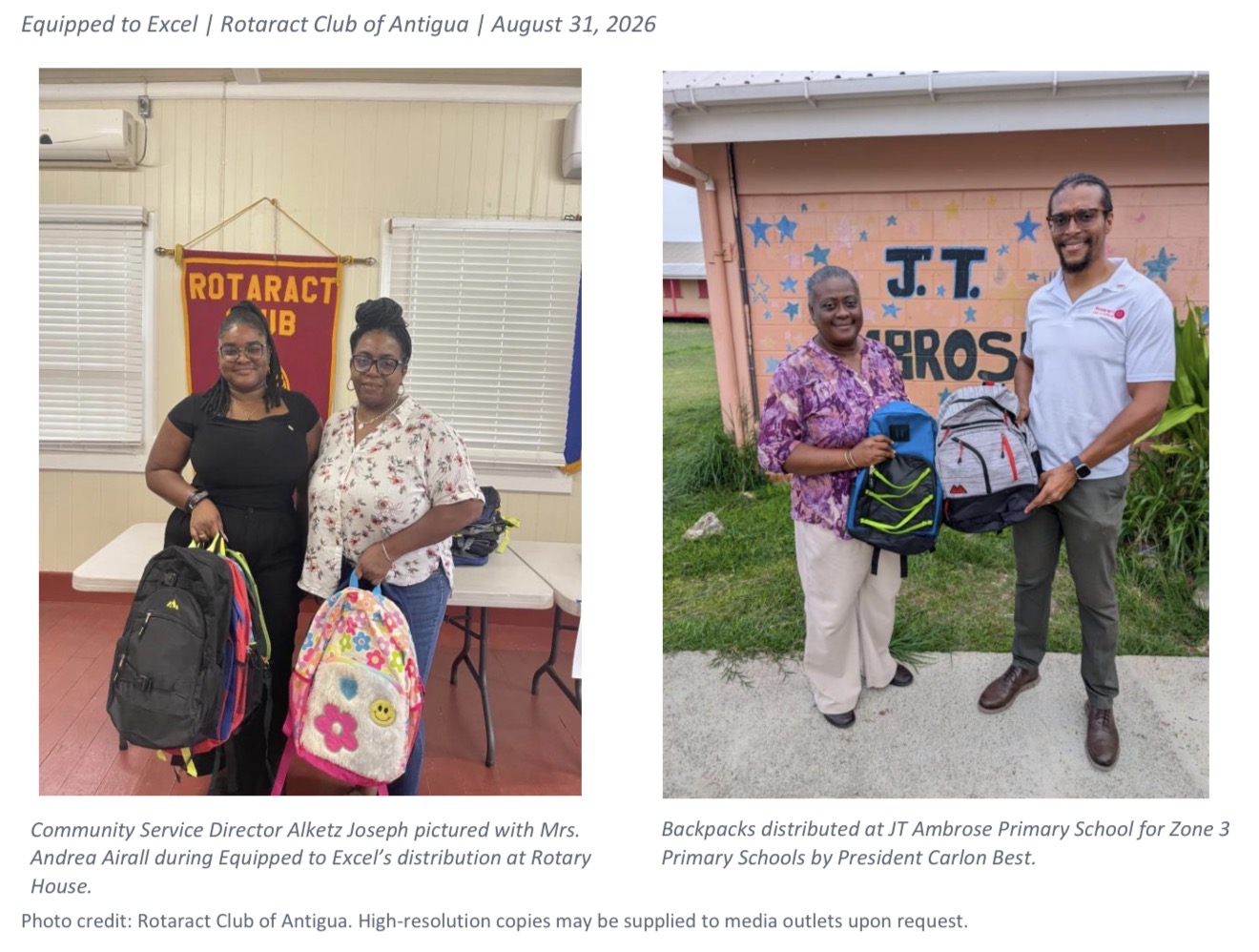
Rotaract Club of Antigua’s Equipped to Excel Project Supported 209 Students Across 16 Primary Schools
As the 2026 academic year approached, a youth-led service organization in Antigua turned a targeted community support plan into tangible change for hundreds of school-aged children, beating their own outreach goals to deliver critical learning tools to families facing financial strain.
The Rotaract Club of Antigua wrapped up its 2026 *Equipped to Excel* Back-to-School Initiative on August 31, a project designed to ease the heavy financial burden many households shoulder when preparing children for a new school term. By distributing pre-packed backpacks stuffed with essential supplies across 16 primary schools in both Antigua and Barbuda, the organization ensured no student would start the year lacking the basic tools they need to thrive in the classroom.
What started as a goal to support 200 primary school students ultimately grew to reach 209 children, thanks to generous donations from local corporate and community sponsors, as well as coordinated support from Antigua and Barbuda’s Ministry of Education. Education Officer Andrea Airall played a central role in the project’s success, coordinating directly with school administrations across different education districts to identify families with the greatest economic need, ensuring donations reached those who would benefit most rather than being distributed broadly.
Each supply package given to students included a durable backpack alongside core classroom items: exercise books, pencils, erasers, pencil sharpeners, rulers, pencil cases, and organizational folders. These seemingly small items can add up to a significant expense for low-income families, and having them provided for free removes a major source of stress ahead of the first day of class.
“Our children are the bedrock of our nation’s future, and every single one of them deserves a fair shot at academic success, no matter what their family’s financial situation looks like,” said Alketz Joseph, Director of Community Service for the Rotaract Club of Antigua. “Through the Equipped to Excel initiative, we were able to change the trajectory of the new school year for 209 kids, sending them back to class with confidence and all the tools they need to excel. This project is a reflection of the shared commitment Rotaract and our sponsors have to lifting up our community and investing in the next generation.”
The organization extended sincere thanks to all partners who made the initiative possible, including corporate sponsors Marshall & Co., Fleetwave, Stargate Imports, CCAA Consultancy, community supporter Mr. Anthony Astaphan, and local children’s nonprofit Happy Kids Antigua. Additional recognition went to Andrea Airall, the Ministry of Education, participating school leaders, club volunteers, and every individual supporter who contributed time or resources to the project.
*Equipped to Excel* is part of the Rotaract Club of Antigua’s 2026-2027 official service plan, developed under the organization’s presidential theme “Leading with Heart, Serving with Purpose.” The initiative reinforces the club’s longstanding core commitments to expanding educational access, supporting youth development, and creating measurable, positive change for local communities.
The 16 primary schools that received supplies through the initiative are: Five Islands Primary School, Pares Primary School, J.T. Ambrose Primary School, Old Road Primary School, Willikies Primary School, Mary E. Pigott Primary School, Jennings Primary School, Liberta Primary School, T.N. Kirnon Primary School, S.R. Olivia David Primary School, Buckleys Primary School, Pigotts Primary School, Golden Grove Primary School, Freemans Village Primary School, Potters Primary School, and Bendals Primary School.
The Rotaract Club of Antigua is a youth-led service organization affiliated with Rotary International District 7030. Its mission centers on developing young leaders, fostering collaborative community fellowship, and improving local quality of life through sustainable, partnership-driven projects focused on the most pressing needs across Antigua and Barbuda.
-

WATCH: Robbery at Brownies Bakery in Herberts
A brazen daytime robbery has shaken the small community of Herberts, after two unidentified suspects stormed the popular local Brownies Bakery and made off with an undisclosed sum of cash on Wednesday morning.
Witnesses at the scene told local media that the men, both wearing dark hooded clothing and face coverings to conceal their identities, entered the store shortly after it opened for business at 7 a.m. One suspect allegedly brandished a knife, threatening the bakery’s two on-duty employees while the other emptied the cash register. No customers were present inside the establishment at the time of the incident.
Neither of the staff members suffered physical injuries, though police confirmed both were left shaken by the encounter and have received counseling support following the robbery. The suspects fled the scene in a waiting dark-colored sedan, according to preliminary witness descriptions.
Local law enforcement has launched a full investigation into the robbery, asking any members of the public who were driving through the area between 6:45 a.m. and 7:15 a.m. and have dashcam footage, or anyone with other information about the incident, to come forward to assist with the inquiry. Business owners in the Herberts area have also been advised to review their security protocols in the wake of the theft.
Brownies Bakery, a long-time local fixture known for its homemade baked goods, closed for the remainder of the day to allow staff to recover and for police to process the crime scene. It has since resumed normal operations, with the bakery’s ownership releasing a short statement thanking the community for the outpouring of support it has received after the incident.
-

Basdeo: A battle cry to her party tied to succession
A leading Caribbean political analyst has unpacked the combative language used by Trinidad and Tobago Prime Minister Kamla Persad-Bissessar in a recent Independence Day address to her United National Congress (UNC) party, framing the rhetoric as a deliberate battle cry tied to long-running internal leadership succession discussions. Dr. Maukesh Basdeo shared his reading of the controversial remarks during an interview with TV6’s Morning Edition, breaking down the layered messaging in Persad-Bissessar’s two separate addresses delivered on Monday: one directed to the broader national population of Trinidad and Tobago, and a second, more fiery communication to the UNC party base.
In her message to UNC members, Persad-Bissessar struck an uncompromising tone, declaring that the party requires “steeliness and savagery” to defend its collective interests. She told supporters that there was no middle ground in internal and political struggles, stating bluntly: “It’s either peace or total war, nothing in between.” She also warned that the party’s top leadership must “never fall into the hands of weak men and women,” arguing that diplomacy alone is insufficient to protect the party’s core membership and values, and urging members to “do not crawl on your belly for anyone.”
Basdeo’s analysis connects this aggressive rhetoric to well-documented internal friction within the UNC. The party has faced growing internal dissent in its ranks, and open discussion of leadership succession has been ongoing for months ahead of the scheduled April 2025 general election. Basdeo argues that Persad-Bissessar’s core goal with the speech was to emphasize that overcoming these existing internal challenges requires unwavering party unity — a prerequisite, he says, for the UNC to secure victory at the polls next year. Beyond unity, Basdeo contends the speech also lays clear groundwork for formal succession planning within the party. By framing the next UNC leader as needing to be a strong, uncompromising figure who can hold the fractious party together, Persad-Bissessar is setting a clear benchmark for whoever succeeds her in the top role.
The analyst also addressed growing criticism from the opposition People’s National Movement (PNM), which has raised questions about the appropriateness of a sitting prime minister using such militaristic language in a partisan political address. Basdeo noted that it is inherently difficult to separate the dual roles of prime minister and political party leader when the same person holds both positions, a dynamic that creates unavoidable overlap between national and partisan messaging.
Basdeo also analyzed Persad-Bissessar’s broader national Independence Day message, marking 64 years of Trinidad and Tobago’s independence from colonial rule. In that address, the prime minister urged the nation to move past blaming ongoing social and economic challenges on its colonial history, and instead take full ownership of all policy decisions made in the decades since independence. Basdeo echoed that framing, noting that the country’s current major social and political groups all emerged from the colonial experience, making it long past time for the nation to take full responsibility for shaping its own future.