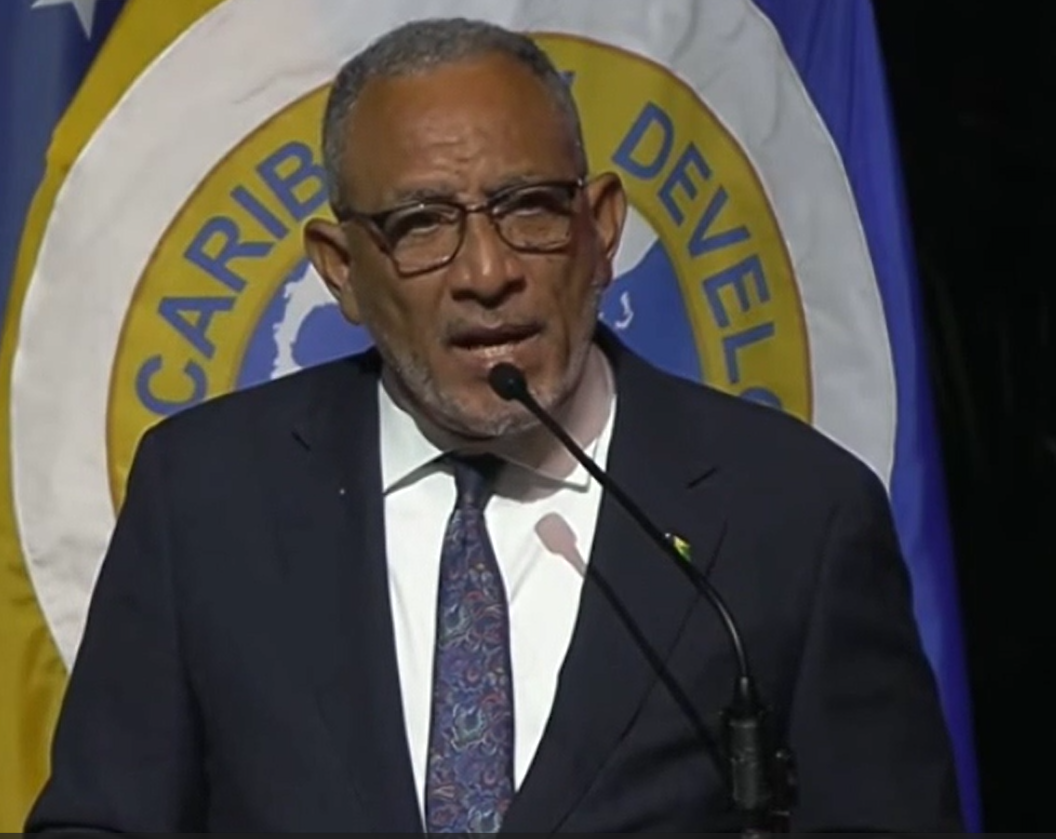
In a high-stakes address delivered on behalf of the Caribbean Development Bank’s (CDB) borrowing member nations in Nassau, Prime Minister Dr. Godwin Friday of St. Vincent and the Grenadines has issued a urgent, impassioned call for coordinated regional action and sweeping global financial reform to confront the overlapping crises of extreme climate vulnerability and unsustainable sovereign debt that threaten the Caribbean’s future.
Addressing a gathering of senior regional leaders that included Bahamas Prime Minister Philip Davis, CDB President Daniel Best and central bank governors from across the region, Dr. Friday spoke against the backdrop of the conference theme “Forging the Caribbean’s Future: Strategic Solutions for Uncertain Times”. He opened by framing the region’s current challenge as a navigation through turbulent global shifts, noting that long-standing geopolitical alliances are strained and widely accepted global norms are being challenged without clear, reassuring resolutions for small island nations.
Dr. Friday pulled back the curtain on the severe economic constraints strangling Caribbean economies, laying bare the region’s chronic debt crisis. Nine of the CDB’s borrowing member nations carry central government debt-to-GDP ratios that exceed the 60 percent prudential threshold, he revealed, and in his own country of St. Vincent and the Grenadines, that figure surges past 113 percent. This crippling debt load, he emphasized, severely erodes governments’ capacity to fund critical public investments that would drive inclusive growth and shield the most vulnerable communities from cascading global price shocks—including spiking fuel costs, rising shipping expenses and a shrinking global aid landscape.
Beyond the debt crisis, Dr. Friday drew urgent attention to the catastrophic funding gap holding back the region’s efforts to build climate resilience. While Caribbean nations require an estimated $14 billion annually to implement comprehensive climate adaptation, mitigation and response measures, the region currently mobilizes less than 10 percent of that total. “It is therefore imperative that our development partners become more adaptive, more responsive, and willing to provide highly concessional financing and dedicated resources for loss and damage that will not worsen a bad debt situation,” he argued.
Despite the systemic barriers the region faces, Dr. Friday offered measured praise for the CDB’s long-standing role as a critical pillar of regional development. He highlighted tangible, impactful projects supported by CDB investment in St. Vincent and the Grenadines, including the modernization of Kingstown’s port, nationwide school improvement initiatives, and expanded rural road infrastructure that have strengthened the country’s ability to withstand climate shocks. When targeted institutional capital is paired with local community expertise, he noted, it delivers transformative change: improving lives, strengthening local communities and building the climate-resilient economic assets the region needs to thrive.
Looking ahead to the immediate challenges on the horizon, Dr. Friday reminded delegates that the Caribbean is entering the 2026 hurricane season still recovering from the devastating damage inflicted by Hurricanes Beryl in 2024 and Melissa in 2025. To build long-term, multi-dimensional resilience across environmental, economic and social systems, he laid out a clear strategic framework for the CDB’s future priorities, centered on aggressive economic diversification.
Dr. Friday urged regional states to pursue emerging growth opportunities, including widespread digitalization of public services, expansion of renewable energy development modeled on the geothermal projects already underway in Dominica and St. Kitts and Nevis, and investment in value-added agro-processing to boost domestic food security and reduce reliance on volatile global import markets.
To turn this ambitious agenda into action, Dr. Friday called for rapid institutional reform within the CDB to address the region’s persistent implementation gap, which has delayed progress on critical initiatives for years. “We must move swiftly to implement the transformative reforms to eliminate friction and drive our institution forward,” he insisted. He closed with a direct appeal to all CDB shareholders and international non-regional partners to fully back the bank’s new strategic direction and provide robust support for the 11th replenishment of the Special Development Fund (SDF 11)—a facility he described as “the lifeblood of concessional financing for the region’s vulnerable members.”
Ultimately, Dr. Friday urged regional and global leaders to make choices that will lay the groundwork for “a stable, inclusive, and thriving Caribbean that is sustainable for generations to come.”