
作者: admin

  • Government Outsources HR Tasks to NeoPeople

    Government Outsources HR Tasks to NeoPeople

    A government-led public service modernization initiative has triggered unexpected debate, centered not on whether the reform will boost administrative efficiency, but on whether sensitive employee data will remain secure after the decision to outsource core human resources tasks to private firm NeoPeople. The project, announced publicly on April 16, 2026, involves moving thousands of confidential personnel records from physical storage facilities to centralized digital systems, a shift that has left thousands of public servants raising urgent questions about access controls and data protection.

    Public Service Minister Henry Charles Usher, who also holds the portfolio for Disaster Risk Management, moved quickly to address growing anxiety among government employees, laying out the rationale for the overhaul and detailing the safeguards the administration has put in place to guard personal information.

    Usher acknowledged that worries over the security of personnel records, performance evaluations and confidential personal files are not new, even under the old system. For years, many government agencies have lacked sufficient on-site storage space for physical records, forcing departments to store sensitive paper files in off-site commercial storage containers, a practice that carried its own set of confidentiality risks. The digitization and outsourcing process, he emphasized, is a core component of the government’s broader push to modernize the underperforming public service.

    “Regardless of whether data management is handled in-house by the Central Information Technology Office (CITO) or outsourced to a third-party provider like NeoPeople, maintaining the confidentiality of public servants’ personal information remains our top priority,” Usher stressed. He added that the government conducted extensive due diligence on NeoPeople before awarding the contract, verifying that the firm has the infrastructure and expertise to secure sensitive government data, and that the administration is confident in the company’s capacity to protect the records.

    Usher also acknowledged the persistent threat of cyberattacks, noting that even major private sector organizations face constant attempted breaches. “Telecom provider BTL previously reported that they block thousands of attempted hacking incidents every day, and the same is true for banks, financial institutions and the Social Security Board,” he said. “We have implemented robust firewalls and ongoing security monitoring, and we will continuously update our protections to ensure they remain at the highest possible standard to guard against emerging threats.”

    This report is a transcribed excerpt from an evening television newscast, with all statements reproduced accurately for online publication.

  • Work Begins on Belize’s Youth Development Policy

    Work Begins on Belize’s Youth Development Policy

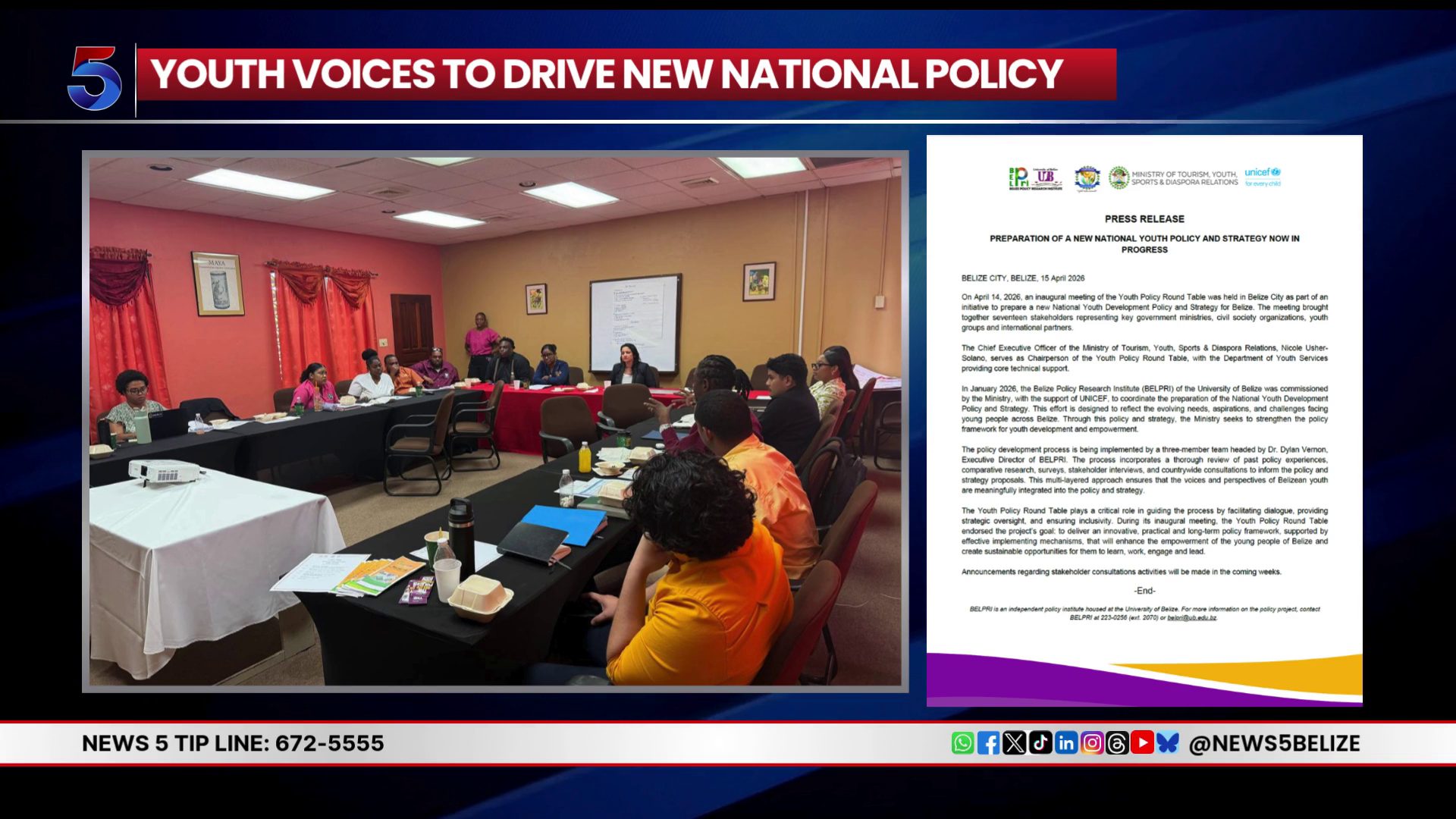
    Nearly three years from now, in 2026, Belize has officially launched the development process of a refreshed National Youth Development Policy and Strategy, a framework designed to more accurately align with the evolving daily realities, long-term aspirations, and pressing challenges that shape the lives of the country’s young population.

    To kick off this multi-stage policy drafting process, 17 stakeholders drawn from four key groups — government bodies, domestic civil society organizations, grassroots youth collectives, and international cooperating partners — gathered in Belize City for the first ever Youth Policy Round Table. This round table has been tasked with guiding and overseeing every step of the policy development effort to ensure accountability and inclusive direction.

    The entire initiative is being led by Belize’s Ministry of Tourism, Youth, Sports and Diaspora Relations, with Nicole Usher-Solano, the Chief Executive Officer of the ministry, serving as chair of the inaugural round table. To ground the policy in rigorous, context-specific research, the ministry has contracted the University of Belize’s Policy Research Institute (BELPRI) to coordinate all drafting work, with technical and financial backing from the United Nations Children’s Fund (UNICEF).

    A research team led by BELPRI Executive Director Dr. Dylan Vernon will carry out a full suite of outreach and data collection activities: from comprehensive background research and national public surveys to one-on-one stakeholder interviews and regional consultation workshops across every district of Belize. The core purpose of this broad engagement strategy is to ensure that the perspectives, needs and priorities of young Belizeans directly shape the final policy framework, rather than the document being designed exclusively by adult policymakers in closed sessions.

    Organizers behind the initiative have emphasized that the end goal is not a superficial, ceremonial policy document. Instead, they aim to deliver a practical, forward-looking roadmap that expands accessible opportunities for Belizean young people to pursue education, build meaningful careers, take on leadership roles in their communities, and contribute tangibly to the country’s long-term national development goals.

  • Hurricane Hunters Visit Belize 46 Days Before Season

    Hurricane Hunters Visit Belize 46 Days Before Season

    Forty-six days before the 2026 Atlantic hurricane season officially kicks off, a unique piece of storm-tracking infrastructure has arrived in Belize as a key stop on the annual Caribbean Hurricane Awareness Tour: the Hurricane Hunters, the specialized flying crews that collect irreplaceable inside-storm data for forecasters across the globe. The rare on-the-ground visit gives Belizean officials, students and ordinary residents an up-close look at the high-stakes work that saves thousands of lives every year, coming at a critical time as the low-lying coastal nation prepares for another year of storm risk in the Atlantic hurricane belt.

    Unlike standard commercial or research aircraft, the Hurricane Hunters’ planes are purpose-built to do what most pilots would avoid at all costs: fly directly into the center of developing and mature hurricanes to gather real-time atmospheric data that satellite technology simply cannot capture. This data is sent directly to the U.S. National Hurricane Center, which partners with local meteorological services across the Caribbean and Central America to generate accurate storm forecasts.

    Jordan Mentzer, a pilot with the Hurricane Hunters, joked that people often call the crew crazy for choosing to fly into deadly storms, but decades of institutional knowledge have turned the risky mission into a carefully regulated, safe operation. “We’ve been doing this for a long time, so guys and gals before me have taught us how to operate as safely as possible, what to avoid, and how to navigate even the most powerful systems,” Mentzer explained. Missions can stretch more than 12 hours, with crews patrolling storms from the Gulf of Mexico to the central Caribbean, regions that regularly bring storm impacts to Belize.

    Robbie Berg, a warning coordination meteorologist with the National Hurricane Center, compared the difference between satellite data and Hurricane Hunter data to judging a steak by its grill marks versus cutting into it to check its doneness. “Satellites can show us the outside of a storm, but we can’t know what’s happening in the core until the Hurricane Hunters cut right into it,” Berg explained. That inside data on air pressure, wind speed, and storm structure feeds into advanced computer forecasting models, allowing forecasters to predict a storm’s path, intensity and size with far greater accuracy over the critical five-day forecast window. The National Hurricane Center coordinates closely with Belize’s meteorological service to issue timely watches and warnings for the country and other Caribbean nations, a process that depends entirely on the data collected by these flights.

    Ronald Gordon, Belize’s chief meteorologist, emphasized just how critical this data is for the nation, which sits squarely in the path of most Atlantic hurricanes that form each year. “The data these crews collect goes straight into our complex computer models, helping us better predict how a hurricane will strengthen and where it will go,” Gordon said. He also used the visit as an opportunity to remind Belize residents that the 2026 hurricane season is just weeks away, and public preparedness should already be underway.

    Beyond improving forecasting and public awareness, the visit carries a second, equally important goal: inspiring the next generation of Belizean STEM professionals. The Caribbean Hurricane Awareness Tour only stops at three countries this year, making Belize’s inclusion a rare honor, according to Minister of Public Service and Disaster Risk Management Henry Charles Usher. “They came from Honduras before this, and they will head to Puerto Rico after,” Usher noted. “This is really about inspiring young Belizeans to pursue careers as scientists, pilots, meteorologists and engineers — that’s exactly what we need moving forward.”

    Local organizers opened tour sign-ups publicly via social media to avoid bias, allowing schools across the country to reserve time slots to visit the aircraft. Dozens of students have already toured the one-of-a-kind flying laboratory, getting a first-hand look at the technology that powers life-saving storm forecasts, and more groups are scheduled to visit throughout the day. Local officials hope the experience sparks long-term interest in meteorology, atmospheric science and aviation among Belize’s youth, building a local workforce that can continue to lead storm preparedness and forecasting for decades to come.

    As the countdown to hurricane season continues, the Hurricane Hunters’ visit serves as a reminder that accurate forecasting and early preparation are the most powerful tools to reduce hurricane risk. Thanks to the work of these brave crews, Belize enters the 2026 season better prepared and more informed than ever before.

  • BIFF Launches Search for Belizean Screenwriting Talent

    BIFF Launches Search for Belizean Screenwriting Talent

    Scheduled for launch in 2026, the Belize International Film Festival (BIFF) has opened an exciting new search to uncover hidden screenwriting talent from the Belizean community, both within the country and among diaspora creators around the globe. The initiative aims to elevate authentic Belizean storytelling that centers the nation’s one-of-a-kind landscapes, rich cultural heritage, and diverse local voices that have long defined life across the country.

    Unlike generic screenwriting competitions that accept all story themes and origins, this search specifically calls for short screenplays rooted in Belizean experience. Creators are invited to craft narratives set against any of the nation’s iconic backdrops – from the rolling, forested slopes of Sleeping Giant near The Banks Resort to the sun-warmed, palm-lined coasts of Jaguar Reef in the seaside village of Hopkins. BIFF organizers emphasize they are open to all genres and bold, original creative visions, encouraging storytellers to take risks and share perspectives that have not often been centered in mainstream film.

    Beyond the opportunity to showcase Belizean creativity to a global audience, the competition comes with tangible rewards to help creators turn their written ideas into finished screen projects. The grand prize winner will receive an immediate cash award of $500 USD, with an additional option for a $500 USD film rights buyout that puts further financial support in the creator’s pocket. As an extra perk to support production, the winner will also receive a complimentary one-night stay at a local resort during their film shoot, removing a small but meaningful barrier for creators working to bring their stories to life on screen.

    This search marks BIFF’s ongoing commitment to nurturing emerging local creative talent and building a sustainable, homegrown film industry in Belize. By investing directly in screenwriters – the foundational creators of any film project – the festival aims to build a pipeline of original Belizean stories that can reach audiences far beyond the nation’s borders.

  • Medical Mission Wraps Up After Serving Hundreds of Belizeans

    Medical Mission Wraps Up After Serving Hundreds of Belizeans

    A four-day free community medical outreach organized by the Seventh-day Adventist Church drew to a close this week in Belize City, after delivering no-cost care to more than 1,300 low-access and underserved Belizean residents, organizers confirmed in closing remarks.

    The initiative, which launched earlier that week at the Belize City Center, brought a team of fully board-certified medical specialists from the United States and other global regions to provide complimentary consultations and care to local residents who often face barriers to accessing high-quality healthcare. Unlike temporary volunteer missions that rely on trainee providers, every clinician participating in this outreach is a practicing, experienced specialist committed to donating their time and covering all personal travel expenses to support the community, church leadership noted.

    Patient turnout far exceeded initial expectations, growing steadily across the event’s four-day run. Dr. Zoraida Powell, health ministry assistant for the Belize Union Seventh-day Adventist, shared that patient numbers climbed from 230 on the first day, to 350 on the second, and reached 420 on the third day. By the final day of the outreach, lead organizers estimated the total number of people served across all services surpassed 1,300.

    For local Belize City residents who accessed care, the impact of the mission was immediately clear. Evonne Longsworth, a Belize City resident and a member of the Adventist community, expressed her surprise and joy at the large turnout for the event, noting that she had long valued the church’s focus on public health messaging. “I know they have a good health message, I am an Adventist. I am so happy they came to Belize and I am amazed by the amount of people that turned out,” Longsworth said. Fellow resident Edward Belizaire echoed that positive feedback, describing the outdoor community-focused care model as unlike any medical outreach he had experienced before.

    Dr. Roger Chene, director of the Amazing Facts Medical Clinic, emphasized that the event was a collaborative success, bringing together the visiting medical team, local public health authorities, and the national Adventist church to serve the community. “Everyone is very excited about the experience here. They had the opportunity to see over one thousand three hundred patients throughout the four days. So it has been a true blessing to be here. The patients are very happy to be here. They are thankful about the services they have received, working with the team, the local ministry of health and the local Seventh-day Adventist,” Chene said.

    Dr. Al Powell, president of the Seventh-day Adventist Church Belize, highlighted the quality of care delivered, stressing that all participating providers are active, board-certified specialists who manage clinical cases daily in their home practices. “We are providing top quality medical doctors, specialist in all the areas. These are board certified in the U.S. and throughout where they serve. So we bring in quality persons that manage this stuff on a daily basis. They are no interns here. They are all persons that are committed and sacrificing time and energy and they are paying their expenses to come on this exploit to build up Belize,” Powell explained.

    Looking ahead, the Seventh-day Adventist Church in Belize has announced plans to turn this successful outreach into a recurring annual event, expanding access to free high-quality care for Belizean residents into the future.

  • Season of Emancipation launches as $4 tn reparations estimate revealed

    Season of Emancipation launches as $4 tn reparations estimate revealed

    Barbados has kicked off its 2026 Season of Emancipation with renewed momentum, centered on newly released economic research that quantifies the cumulative damage of transatlantic chattel slavery on the island at up to 4 trillion Barbadian dollars, or 2 trillion U.S. dollars. For organizers and government officials, this landmark figure brings long-overdue visibility to the intergenerational harm that continues to shape Barbados’s social and economic trajectory today.

    The launch event was held at Golden Grove Plantation in St. Philip, a site of profound historical significance: it was one of the core battlegrounds of the 1816 Bussa Rebellion, a pivotal uprising led by an enslaved African-born man named Bussa that marked a turning point in the fight for abolition in the Caribbean. Unlike most Caribbean nations that mark Emancipation with a single day of celebration on August 1, Barbados’s Season of Emancipation stretches across four months, starting on the anniversary of the 1816 rebellion on April 14 and running through late August. Program advisor Rodney Grant, from the island’s Office of Pan-African Affairs and Heritage, noted that this extended calendar makes Barbados unique across the region, framing the season as a sustained “long journey” of public education and cultural reclamation that centers African diaspora identities long suppressed by colonial rule.

    The centerpiece of this year’s opening ceremony was the official presentation of research commissioned to quantify the economic legacy of slavery, led by American economist Dr. Coleman Bazelon. Dr. Bazelon emphasized that the 3 to 4 trillion Barbadian dollar figure is not a formal financial invoice demanding immediate payment from former colonial powers, but rather a evidence-based starting point for honest national and global dialogue about reparations and reconciliation. “This research is an accounting of the harm that was done,” Dr. Bazelon explained. “A recognition of that harm is the necessary first step toward meaningful reconciliation.” His analysis estimates that more than 792,000 people were enslaved in Barbados over the course of the slave trade, resulting in roughly 25 million years of stolen labor and stolen life that created intergenerational wealth for colonial powers while leaving Barbados with persistent structural inequities. “Enslaving a few hundred people on one plantation is a crime, but enslaving hundreds of thousands over centuries is a crime against humanity,” Dr. Bazelon noted, adding that the large final figure simply reflects the staggering scale of harm inflicted.

    This local research aligns with broader regional efforts to quantify reparations claims. A 2023 report commissioned by the American Society of International Law and the University of the West Indies estimated that total reparations for stolen labor and lost life across all Caribbean and American slaveholding territories would amount to 110 trillion U.S. dollars as of 2020, equal to roughly 2.8 million U.S. dollars per enslaved person. Dr. Bazelon’s study, carried out in partnership with the U.S.-based economic consultancy Brattle Group, is designed to build a formal legal and economic framework to support Barbados’s reparations advocacy.
    Trevor Prescod, Barbados’s Minister for Pan-African Affairs and Heritage, used the launch to call for radical transparency about the island’s colonial past and its ongoing impacts. “You can’t erase history,” Prescod said, outlining his mandate to deliver Afrocentric redress for the systemic inequities created during slavery. He acknowledged that conversations around reparations often spark heated debate across the island, but urged residents and global stakeholders alike to engage with the uncomfortable truths of the past. “We must have these hard conversations that we sometimes are very uncomfortable about,” he said. “The Pan-Africanist movement has always been in the forefront of the struggle for the various steps of the mind.”

    Prescod also highlighted upcoming cultural and historic preservation projects tied to the 2026 season, including the exploration and formal recognition of a cave at Bayley’s Plantation—another key 1816 rebellion site where Bussa served as an enslaved ranger—believed to have sheltered enslaved rebels during the uprising. The full 2026 Season of Emancipation calendar includes a full slate of events spanning four months: April 28 marks National Heroes Day; May 25 is Africa Day, with focused African heritage education programs in primary and secondary schools; the entire month of June is designated Heritage Month, with the unveiling of a bust of Cuffee (a symbolic anti-colonial figure) on June 12, after the artefact spent a year submerged off the coast of Speightstown. July and August will integrate events with the popular annual Crop Over Festival, with July 26 designated a Day of National Significance, August 1 marking official Emancipation Day, August 17 hosting a homage to civil rights leader Marcus Garvey focused on Black economic empowerment, August 23 marked as the National Day for the Remembrance of the Slave Trade, and August 27 reserved to celebrate the legacy of Barbadian activist Jackie Opel. Organizers have invited all Barbadians to participate in the season through both in-person community events and digital outreach platforms.

  • EMPRO businesswomen drive economic growth and job creation in Dominican Republic

    EMPRO businesswomen drive economic growth and job creation in Dominican Republic

    Six months after its completion, an independent assessment has confirmed that the Empresarias Progresando (EMPRO) initiative, a women-focused business development program run by INCAE Business School in the Dominican Republic, has driven remarkable, measurable growth for female-led small and medium enterprises across the country.

    The highly competitive program selected just 49 participants out of more than 500 total applicants. Its structured curriculum combines multi-phase targeted business training with a full week of immersive in-person instruction hosted at INCAE’s campus in Costa Rica, equipping participating entrepreneurs with the skills, networks, and strategies needed to scale their operations. Early impact data collected after six months shows these investments have translated to extraordinary improvements across four core pillars of business success: revenue growth, job creation, digital transformation, and expanded access to capital.

    Economic outcomes for participants far outpace baseline expectations for typical small business development programs. Average monthly sales for participating women-owned businesses nearly tripled compared to pre-program levels, while total employment across the cohort jumped by 80 percent. In total, the program has supported the creation of approximately 450 new full and part-time jobs across the Dominican Republic, expanding local livelihoods beyond the 49 participating entrepreneurs themselves. Beyond revenue and headcount gains, 82 percent of program graduates launched new business opportunities, most through the development of original products and services that opened untapped customer markets.

    A key focus of the EMPRO initiative is closing gaps in digital and financial inclusion for women entrepreneurs, and results in these areas are equally compelling. At the start of the program, 22 percent of participants did not integrate any digital tools into their daily business operations; by the program’s conclusion, every entrepreneur had adopted digital tools for tasks ranging from sales tracking to customer outreach, positioning their businesses for long-term competitiveness in an increasingly digital economy. On the financing side, 69 percent of participants secured new capital to scale their operations, with nearly half of those loans coming through traditional banking channels, most from program partner Banco BHD. A large majority of participants also overhauled their internal financial management practices, a shift that program organizers say signals stronger operational capacity and sustainable long-term growth potential for the cohort.

    The EMPRO program is a collaborative public-private initiative, backed by funding and strategic support from three partner organizations: the Mastercard Center for Inclusive Growth, the PriceSmart Foundation, and Banco BHD. Program leaders say the strong results of the six-month evaluation make a clear case for scaling targeted investments in female entrepreneurship as a core driver of national economic competitiveness and inclusive, sustainable development across emerging markets.

  • Morocco signs an agreement with Haiti in the field of air transport

    Morocco signs an agreement with Haiti in the field of air transport

    In a diplomatic move set to reshape regional and international air connectivity, Morocco sealed three bilateral air transport agreements with the Cooperative Republic of Guyana, the Republic of Haiti, and the Republic of Mauritius on April 16, 2026. The signing ceremony took place in Marrakech, on the sidelines of the ongoing Global Symposium on Implementation Support (GISS 2026), with Morocco’s Minister of Transport and Logistics Abdessamad Kayouh leading the kingdom’s delegation for the negotiations and formal signing.

    Each of the three new agreements is centered on expanding bilateral air service operations between Morocco and its respective partner nation. The core goal of the pacts is to put in place a modern, fair regulatory framework that aligns fully with global civil aviation standards set by international aviation bodies. Key provisions laid out in the agreements cover multiple critical areas of air transport operations: rules for the designation of multiple airlines to operate routes between the signatory countries, guidelines for setting weekly flight frequencies, and stringent protocols to uphold civil aviation safety and security across all operations.

    Beyond regulatory alignment, the agreements open new doors for deepened collaboration between the national and private airlines of all participating countries. In particular, they create clear pathways for the development of joint commercial partnerships and technical knowledge-sharing initiatives. Industry analysts expect these new linkages will drive tangible improvements in cross-regional air connectivity, streamlining the movement of both passenger traffic and cargo shipments between Morocco, the Caribbean nations of Guyana and Haiti, and the Indian Ocean island nation of Mauritius.

    This round of agreement signings is not an isolated diplomatic step, but rather a direct implementation of the broader connectivity strategy laid out under the policy of His Majesty King Mohammed VI. The strategy prioritizes strengthening Morocco’s air transport links with partners across the globe, with a long-term vision of cementing the kingdom’s position as a leading regional aviation hub that connects the African continent to Europe, the Americas, Asia, and Oceania.

  • Abinader inaugurates Renacer Plant, Caribbean’s first food-grade recycled PET facility

    Abinader inaugurates Renacer Plant, Caribbean’s first food-grade recycled PET facility

    SAN PEDRO DE MACORÍS — Dominican Republic President Luis Abinader has formally opened the Renacer Plant, a ground-breaking industrial facility that claims the title of the first food-grade recycled PET resin production plant in the entire Caribbean region.

    Nested within the Quisqueya Free Zone in San Pedro de Macorís, the landmark project is the product of a strategic partnership between two local firms, Diesco and Invema. Designed to convert millions of post-consumer plastic bottles into food-safe reusable raw material, the launch marks a transformative leap forward for the Dominican Republic’s transition to a circular economy.

    Backed by a total investment of more than 3 billion Dominican pesos, the facility boasts an annual processing capacity of over 124 million plastic bottles. Beyond its industrial output, the plant is projected to create more than 500 direct job positions and support up to 5,000 indirect employment opportunities across the country’s recycling and supply chains.

    Government officials have outlined multiple economic and environmental benefits tied to the initiative. By strengthening the entire domestic recycling value chain, the plant cuts the Dominican Republic’s reliance on imported virgin PET resin, while unlocking new export opportunities for the high-quality recycled output it produces. Environmental gains are equally significant: the facility will prevent thousands of tons of carbon dioxide emissions annually by keeping plastic waste out of landfills and ecosystems, and reducing the carbon footprint associated with producing new plastic.

    Both public officials and private sector leaders point to the Renacer Plant as a powerful testament to rising investor confidence in the Dominican Republic’s economic and regulatory landscape. The project also stands as a model of successful public-private collaboration, blending government support for sustainable industrial development with private sector innovation and investment.

    In addition to its core industrial and economic impacts, the facility is designed to drive long-term community development in the San Pedro de Macorís region. It will host vocational training programs for local workers, operate an on-site medical dispensary for community use, and open an educational recycling museum to raise public awareness about circular economy practices. These complementary initiatives are expected to cement San Pedro de Macorís’ position as a regional hub for sustainable industrial innovation across the Caribbean.

  • Abinader announces fuel prices will remain unchanged this week

    Abinader announces fuel prices will remain unchanged this week

    In the Dominican Republic’s capital of Santo Domingo, President Luis Abinader has unveiled a series of coordinated government measures designed to shield consumers from the ripple effects of global economic turbulence, with a particular focus on stabilizing costs for hydrocarbon-linked essential goods.

    As an immediate, tangible step to ease household financial strain, Abinader confirmed that retail fuel prices will hold steady at their current levels for the coming week. To build long-term, collaborative solutions, the administration has already convened initial roundtable discussions with leaders from the country’s core productive sectors, and plans to continue these negotiations on a regular basis going forward. The next scheduled negotiating session is set to take place in approximately two weeks.

    The overarching objective of these multi-stakeholder talks is to avoid passing the full weight of spiking international commodity costs onto end consumers, with a deliberate policy priority on protecting low-income and vulnerable communities that are most sensitive to price swings. Beyond the general working groups, Dominican officials are also preparing targeted one-on-one consultations with individual sectors that have already recorded unplanned price increases, with the aim of co-developing customized price control mechanisms that work for both businesses and consumers.

    The opening round of talks brought together leadership from all of the country’s most influential private sector and business organizations, including the National Council of Private Enterprise (CONEP), the Association of Industries of the Dominican Republic (AIRD), the National Organization of Commercial Entrepreneurs (ONEC), the National Union of Economic Supermarkets (UNASE), and the Agricultural Business Board (JAD). The ongoing collaboration between government and private enterprise comes amid persistent upward pressure on global oil markets, which has created cascading challenges for maintaining stable prices across food, consumer goods, and essential services in small open economies like the Dominican Republic.