
Health authorities in Antigua have issued a pressing public appeal for voluntary blood donations to support Tehvorney Jeffers, a patient currently battling critical illness in the Intensive Care Unit (ICU) at the island nation’s leading public hospital, Sir Lester Bird Medical Centre. Unlike many targeted blood drives that seek out specific rare blood types, organizers of this appeal are welcoming donors of all blood groups to step forward, as any healthy donation can help expand the hospital’s blood supply and meet Jeffers’ ongoing transfusion needs throughout his intensive care treatment. Sir Lester Bird Medical Centre, the primary public healthcare facility for Antigua, hosts a fully operational Adult Intensive Care Unit and manages all of the island’s in-hospital blood processing, matching, and transfusion services. Hospital representatives emphasized that timely community donations are the only reliable source of blood for emergency cases like Jeffers’, as the facility does not maintain a large surplus stock for unexpected critical care needs. The appeal has been amplified across local community networks, urging any eligible member of the public in good health who is able to donate to contact the hospital’s blood services department as soon as possible to contribute to Jeffers’ life-saving treatment.
作者: admin
-

Maximus, Branch shine in PM Cup openers
The opening round of the 202X Prime Minister’s Cup Group B fixtures delivered two compelling matches on a rain-soaked Tuesday night, with standout individual performances carrying both Ivy Rovers and Brittons Hill United to convincing wins over their respective opponents.
At the Friendship Playing Field in St Michael, Jarad Maximus emerged as the undisputed star of the night, netting a hat-trick to anchor Ivy Rovers to a dominant 4-1 triumph over Pinelands. The striker got his side’s campaign off to a flying start just 10 minutes in, converting a clinical penalty to put Ivy Rovers in front. The lead doubled 18 minutes later, when Jamario Nichols finished a well-crafted team attack inside the 18-yard box, capitalizing on excellent build-up play from Rovers’ right wing that split Pinelands’ defensive shape.
Maximus notched his second of the night before halftime, capping a dynamic first-half display that would ultimately earn him Player-of-the-Match honors. The wet, slippery pitch and persistent heavy rain created difficult conditions that challenged Pinelands’ backline throughout the second half, and it was this defensive disorganization that allowed Riviera Cottle to stretch Rovers’ advantage to 3-0 in the second period. Pinelands managed a late consolation in the 88th minute, when Lamar Scantlebury got on the end of a long clearance over the top of Rovers’ defense and nodded home past the goalkeeper. But any hopes of a late comeback were snuffed out in the fourth minute of stoppage time, when a Pinelands defensive mistake left Maximus unmarked in space. He slotted home calmly to complete his hat-trick, securing a three-goal winning margin for Ivy Rovers.
Speaking to reporters after the final whistle, Maximus said he had come into the match prepared for the physical test of tournament football. “I knew it would be a physical game, so I just listened to the coach, did what I had to do and finished the ball,” he said. “Moving forward you can expect more from me – taking on players and trying to help my teammates to raise their level as well. I know how it feels to go all the way to the final, so I believe that my team can go far and we’re going to try our best.”
In the late-night second fixture of the evening, substitute Jalen Branch delivered a moment of magic, scoring two late goals to carry Brittons Hill United to a 2-0 shutout win over St Andrew Lions. A large contingent of Brittons Hill fans braved steady heavy showers to cheer on their side, and they were rewarded in the 73rd minute when Branch broke the game’s deadlock. T’shane Lorde produced a brilliant piece of skill to create space down the left wing before delivering a pinpoint cross into the six-yard box, where Branch was waiting to tap home from close range.
With St Andrew Lions pushing forward aggressively in stoppage time, throwing bodies forward to find an equalizer, they left their defensive line exposed high up the pitch. Branch took advantage in the 91st minute, shaking off the marking of two Lions center backs before hitting a perfectly judged lob from distance that sailed over the out-of-position goalkeeper and into the back of the net. The goal secured all three points for Brittons Hill.
A delighted Branch noted after the match that he prides himself on being able to make an immediate impact off the bench. “I just need five minutes and I can give the team something for sure,” he said. “In the build up to the competition I did a lot of physical work with the coaches trying to get fit, but I am still not 100 per cent there. I think we can go all the way to the finals again like we did before. I was not in the team back then, but now I am here to help.”
-

Cabinet Rejects Several NTUCB Demands, Offers Alternatives
On September 16, 2026, Belize’s Cabinet issued an official response to 11 policy and governance demands tabled by the National Trade Union Congress of Belize (NTUCB), rejecting several key proposals while laying out structured timelines for ongoing negotiations and incremental policy progress on other union priorities.
Among the most high-profile demands put forward by the NTUCB was the removal of Belize Telemedia Limited (BTL) Chairman Markhelm Lizarraga and all government-appointed BTL board members. Cabinet officials have flatly turned down this request, noting that there is no legal grounding under Belize’s existing company law to justify the dismissals. The government further pushed back on the union’s rationale, pointing out that BTL posted record-breaking profits in its most recent financial cycle, and the termination of the proposed Speednet acquisition does not constitute a reasonable or legal cause to remove the board.
Two other BTL-related proposals from the union were also rejected: the creation of a new tripartite governance structure for the telecommunications provider, and a full restructuring of the Public Utilities Commission (PUC). Cabinet explained that union representation on BTL’s oversight is already secured through a seat on the Belize Social Security Board, while the PUC’s status as an independent autonomous body means restructuring is not justified under current governance frameworks.
On the NTUCB’s request for a dedicated liaison embedded within the Office of the Prime Minister, Cabinet offered a compromise: it welcomed deeper collaboration with the Joint Unions Negotiating Team (JUNT) and has proposed holding formal quarterly consultation meetings with NTUCB leadership moving forward.
Cabinet confirmed measurable progress on several reform priorities the union has pushed for. The final draft of the long-awaited Protected Disclosures Bill has already been circulated to both the NTUCB and the Belize Chamber of Commerce and Industry for stakeholder review, with a formal consultation meeting scheduled for October 22. Work on new campaign finance legislation is also underway: drafting is complete enough that the bill is on track to be submitted to Cabinet for official review by December 8, 2026.
Additionally, the government is moving forward with establishing the Civil Recovery Authority Unit (CARU) within the Financial Intelligence Unit, a body mandated under the 2023 Civil Asset Recovery and Unexplained Wealth Act to target illicitly obtained assets. Progress is also being made on filling the long-vacant Ombudsman post: the Ombudsman Reports Committee is expected to submit candidate nominations soon, before a final appointment resolution is introduced to the Senate for approval.
One demand that was firmly rejected was the NTUCB’s call to withdraw the 2026 Revenue Authority Bill. Cabinet reaffirmed the government’s commitment to launching a semi-autonomous national revenue authority, but noted that officials will continue working closely with the Public Service Union and Tax Department staff to address workforce concerns during the transition period.
On educator-specific demands raised through the NTUCB, Cabinet has agreed to hold further negotiations around two key issues: additional pay for teacher duties required in August, and a proposed new classroom resource allowance. For the University of Belize, the government highlighted a steady increase in annual public subvention, which has grown from $7.6 million in 2020 to $10 million in 2026. It has also made a formal commitment to raise the subvention by $1 million annually starting in 2027, until the annual allocation reaches $15 million. The government added that the new Financial Assistance Program Policy, launched in June 2026, has already created a standardized, transparent process for grants, scholarships, and stipends, addressing longstanding calls for reform from the University of Belize Faculty and Staff Union (UBFSU).
In closing, Cabinet acknowledged that it could not accommodate every demand put forward by the NTUCB, but emphasized that the government remains fully committed to open consultation and continued productive engagement with the union confederation on shared priorities for Belize.
-

Evicted, Then Fire Destroys His Home
In a devastating turn of events that has left a Belama resident with nothing, 5-year long homeowner Eugene Thompson has lost every possession he owned after an out-of-the-ordinary fire gutted his residence on a Tuesday afternoon in September 2026, just 24 hours after a court ordered him to vacate the property amid a bitter domestic dispute with his ex-girlfriend.
Thompson, who is now completely unhoused with no secure place to sleep or store personal belongings, has publicly stated he believes the blaze was deliberately set, not an accidental incident. The ongoing legal conflict over the property began when Thompson initially sought a court order to evict his ex-girlfriend from the home. In a surprise turn, she countersued through the local court system, and judges ultimately ruled in her favor, ordering Thompson to leave the residence for a 15-day period.
Thompson shared that he attempted to plead his case to the court, explaining he faced extreme hardship and had no alternative housing options, but his claims of distress were dismissed. “The court didn’t believe me, she had the ruling go her way,” Thompson explained. “They served me an eviction notice, I complied, and by 1 p.m. that same afternoon I was out, and my entire home was burned to the ground.”
A neighbor was the first to spot the fire and alerted Thompson, who was not on the property when the blaze broke out. By the time emergency response arrived, the structure was already completely destroyed. Thompson confirmed that not a single one of his personal belongings was salvaged from the wreckage. “Nothing was saved, nothing at all,” he said. “By the time my neighbor called out to alert me, the fire had already taken over the whole house.”
Thompson estimates the total value of his lost property and structural damage at approximately $45,000, a devastating loss that leaves him forced to rebuild his entire life from scratch. With no bedding, clothing, or personal items to his name, and nowhere permanent to stay, Thompson is now reaching out to the broader community for any assistance that can be offered. Individuals who are able to provide support can contact Thompson directly at 639-6773. “I just need help right now,” Thompson said. “I have nowhere to live, nowhere to sleep, nothing saved. I lost everything.”
-

New Airport CEO Moves to Elevate Status of Aviation Security Officers
Since taking the helm as the new Chief Executive Officer of V.C. Bird International Airport in Antigua and Barbuda, Kurt Menal has launched a landmark initiative to elevate the professional standing of the facility’s aviation security officers, framing their work as a cornerstone of both seamless airport operations and the country’s broader national security architecture.
In an exclusive interview with local outlet ABS News, Menal underscored his commitment to shifting public and institutional perceptions of these security professionals. For years, frontline security staff at the airport were broadly categorized as generic airport security workers, a grouping that failed to capture the specialized scope and critical importance of their roles. Under Menal’s new framework, these officers have been formally re-designated as specialized aviation security personnel, a change aligned with global industry best practices that more accurately reflects the full breadth of their job requirements.
“What I want to do is to highlight them as a distinct profession, highlight them as a unified body of professionals that literally is responsible, not just for on-site airport security but for the entire nation’s security,” Menal explained in his remarks.
Aviation security personnel at V.C. Bird International Airport carry far-reaching responsibilities that extend far beyond basic access control. They are tasked with protecting millions of annual passengers, hundreds of on-site airport employees, commercial and private aircraft, all airport infrastructure, and restricted security zones that are vulnerable to potential threats. Menal argues that this work must be contextualized within Antigua and Barbuda’s national security strategy, as the airport serves as the country’s primary international gateway for travel, trade, and tourism — one of the small island nation’s most critical economic sectors.
The reclassification and push for greater public recognition marks a deliberate departure from outdated frameworks that reduced these specialized professionals to generic support roles. Menal’s leadership priority is designed to reinforce the professional identity of aviation security staff, boost morale, and strengthen public understanding of the outsized impact their work has on the safety and prosperity of Antigua and Barbuda. This shift, observers note, positions the airport to meet evolving international security standards while better valuing the frontline workers who keep the facility and the nation safe.
-

Dominica unveils programme for 48th independence celebrations
The Commonwealth of Dominica is preparing to mark 48 years of sovereign nationhood with an expansive, multi-week series of cultural, civic, and national events under the unifying theme “Our Journey, Our Legacy, Our Future”, running from mid-September through early November 2026. The full event schedule was officially announced by Honourable Greta Roberts, Minister for Culture, Youth, Sports and Community Development, during a press conference held this Wednesday, where she framed the annual independence observance as more than a celebration — it is a moment for national reflection, cultural celebration, and collective forward planning.
In her remarks to reporters, Roberts emphasized that the 2026 theme was crafted to encapsulate the full arc of Dominica’s national story. “The theme captures the full story of our nation. It calls us to reflect on the journey that has brought us to this point, to preserve the legacy entrusted to us and to work together to create a stronger future for the generations who will follow,” Roberts said.
Celebrations will kick off with two National Days of Prayer and Thanksgiving on September 19 and 20, a faith-focused opening that invites churches and religious organizations across the island to frame their worship services around prayers for the nation’s peace, unity, and long-term prosperity. “Let us begin this season by giving thanks to God for His continued blessings upon Dominica and by praying for peace, unity, protection, wisdom and prosperity for our nation,” the Minister urged attendees and citizens.
The formal opening of official celebrations follows shortly after: the Official Opening Ceremony will be hosted at the State House Conference Centre on September 25, with a public Opening Walk-Through Parade taking place the next day at the iconic Dominica Botanic Gardens. The entire month of October has been designated Patriotism and Heritage Month, a dedicated period packed with cultural activities centered on elevating Dominican Creole identity and national history. Highlights of the month include Had Kweyol Fridays, cultural observances Jounen Panyen and Jounen Chapo Pay, National Emblems Week, Flag Day, a national juried Independence Art Exhibition, History Week, the popular street festival Creole in the Street, and “Market Day with a Difference” that centers local artisans and producers.
Community-led celebration is a core pillar of the 2026 schedule, with every district across the island hosting its own local cultural festivals open to residents and visitors. National Heritage Day will be hosted this year by the village of Paix Bouche on October 18. From October 19 to 22, the immersive Ti Vilaj Kweyol festival will transform the Dominica Botanic Gardens into a living showcase of Dominican heritage, featuring traditional cuisine, folk music, handcrafted goods, Creole language activities, and time-honored cultural practices.
Two of the most anticipated cultural events on the calendar are the National Miss Wob Dwiyet Pageant, scheduled for October 21 at the Massacre Indoor Facility, and the National Madam Wob Dwiyet Pageant, set for October 28 at the same venue, both celebrating the iconic traditional Dominican garment Wob Dwiyet and cultural heritage. The globally recognized World Creole Music Festival will return for its annual run from October 23 to 25 at Windsor Park Sports Stadium, drawing regional and international artists to showcase Creole musical talent. Young Dominicans will take center stage at the National Youth Rally on October 29, highlighting the next generation’s role in shaping the nation’s future.
The final week of October will bring Jounen Kweyol (National Creole Day) and the National Dress Parade on October 30, followed by a Cultural Extravaganza and the annual Eat Fish Day on October 31, which celebrates Dominica’s rich coastal fishing heritage. The celebrations will wrap up in early November with the National Cultural Gala held at the Botanic Gardens on November 1, the formal National Day Observance Ceremony on November 3, and a closing National Day of Community Service on November 4 that grounds the independence anniversary in collective action. This year’s community service day will combine neighborhood beautification projects with targeted small-scale infrastructure improvements across communities island-wide.
Minister Roberts extended an open invitation to all Dominicans, whether residing on the island or living abroad, to join in the celebrations. She encouraged participation through simple, meaningful acts: displaying the national flag, wearing traditional and cultural clothing, attending local events, and intentionally supporting Dominican creatives, small-scale farmers, street vendors, fashion designers, local musicians, and small independent businesses. Closing her remarks, Roberts reaffirmed the core meaning of the anniversary: “Independence is a time to celebrate who we are, remember those whose sacrifices brought us this far, and recommit ourselves to building a peaceful, united and prosperous Dominica,” she said.
-

Tridents knocked out of WCPL at playoff stage
In a rain-disrupted semi-final clash at Kensington Oval on Wednesday, cricket history was made in the Women’s Caribbean Premier League: for the first time since the tournament’s 2022 inception, two-time defending champion Barbados Tridents will not feature in the title decider, after Guyana Amazon Warriors secured a dominant seven-wicket win to knock them out.
Persistent wet weather forced significant alterations to the fixture, delaying the opening toss and trimming the contest to just eight overs per side — a format that turned every single delivery into a high-stakes moment, with no room for slow starts or mid-innings recovery. Sent into bat on a damp pitch by Guyana skipper Chloe Tryon, the Tridents struggled to find consistent rhythm, managing only 69 runs for the loss of four wickets from their allotted overs.
Barbados’ innings was plagued by early setbacks: opener Qiana Joseph retired hurt after scoring just three runs from eight deliveries at the end of the third over, and all-rounder Kiran Navgire fell for a first-ball duck on the first delivery of the fourth over. The most damaging blow came in the sixth over, when Tridents captain and star batter Hayley Matthews was run out for 22 off 14 balls, leaving the lower order with too much work to do in the remaining overs. Maddy Green top-scored for the side with an unbeaten 30 from 16 deliveries, but Guyana’s bowling unit adapted expertly to the tricky wet conditions to keep the target well within reach.
Chasing 70 for a place in the final, the Amazon Warriors faced only one minor early hiccup, losing opener Eboni Brathwaite for two runs in the first over. From there, the chase stayed firmly on track, powered by a match-winning performance from Player of the Match Tazmin Brits. Brits remained unbeaten on 35 off 23 deliveries, cracking three fours and two towering sixes to keep the run rate ticking over, while Shemaine Campbelle contributed a quickfire 22 from 12 balls. The Warriors crossed the finish line at 75 for three, with four deliveries left to spare, booking their spot in Thursday’s championship decider.
They will go head-to-head with Trinbago Knight Riders in the final, a side they already defeated during the group stage of the tournament. Following the upset, Barbados Tridents Chief Operations Officer John Mumby told local outlet Barbados TODAY that the ultra-shortened format created an unlevel playing field that made results hard to predict.
“We were just saying off camera that limited overs (in a T20 game) is always a bit of a lottery. It makes the toss really big and to have lost the toss and then be put into bat on a wet pitch with a wet ball is tricky,” Mumby explained. “I think we did pretty well [to set a 70-run victory target], but yeah, we came up just a little bit short.”
Despite the disappointing early exit, Mumby praised the passionate local support that turned out for the side on home soil. A small but loud crowd cheered the Tridents through every over, and Mumby noted that public enthusiasm for the franchise has grown dramatically this year. “I think the nation has really gotten behind both the men’s and the women’s teams this year, with huge excitement in Barbados around the Tridents identity and the national colours. All through the game you heard ‘let’s go Tridents,’ which was amazing to hear from the school kids and I think that emphasises everything the franchise has tried to do this year,” he added.
-

Het Pinglu-kanaal: China’s nieuwe toegangspoort tot Zuidoost-Azië
On September 16, 2026, China officially opened the Pinglu Canal, a landmark infrastructure project that marks the country’s first nationally planned and constructed modern river-sea waterway. Stretching 134.2 kilometers across the Guangxi Zhuang Autonomous Region in southern China, the canal directly connects Nanning, the capital of Guangxi, to the Beibu Gulf, creating the closest access to the ocean for China’s landlocked southwestern interior and cutting more than 560 kilometers off the traditional trading route through Guangdong Province.
With a total construction investment of 72.7 billion yuan (approximately 10.75 billion U.S. dollars), the project took just over four years to complete. Engineers overcame significant technical hurdles, most notably a 65-meter elevation difference across the canal’s length—roughly the height of a 20-story building—by building three double-chamber lock complexes to accommodate vessels up to 5,000 deadweight tons. The project set four global engineering records: the strongest shipping capacity among comparable canals worldwide, the fastest lock operation for similar waterways, the largest water level difference for a water-saving lock, and the world’s largest water-saving inland waterway lock. Environmental sustainability was integrated into construction from the start: more than 98% of the 315 million cubic meters of excavated earth and rock was reused, and the canal includes a 480-meter fish passage as well as a dedicated crossing for local terrestrial wildlife such as leopard cats and squirrels.
The Pinglu Canal is a core component of China’s New International Land-Sea Trade Corridor, a strategic initiative linking China’s inland regions to ASEAN and global markets. On opening day, 30 cargo vessels transited the new waterway, and two new shipping routes were launched: the international Nanning-Can Tho (Vietnam) route and the domestic Nanning-Yangpu (Hainan) route. Four additional passenger routes were also opened alongside the cargo lanes, with initial shipments including containers, bulk construction materials, coal, ore, steel, and fertilizer.
Ding Xuexiang, a member of the Standing Committee of the Political Bureau of the Communist Party of China Central Committee and Vice Premier of the State Council, attended the opening ceremony in Qinzhou and emphasized that the completion of the canal creates an opportunity to develop the Beibu Gulf Port into a world-class international trade gateway and expand opening-up in western China. As a critical multi-modal infrastructure hub integrating water transport, rail, and maritime shipping, Ding noted that the Pinglu Canal must leverage its unique advantages in coordinating land-sea connections and linking domestic and international markets to operate as a safe and efficient “golden waterway” between China’s interior and the ocean.
The opening of the canal comes in the first year of China’s 15th Five-Year Plan (2026-2030), a period in which the world’s second-largest economy has prioritized more balanced regional development and expanded high-quality opening-up. For southwest China, a region that has long lagged behind the more prosperous eastern coast and faced high logistics costs for accessing ocean ports, the Pinglu Canal marks a transformative shift. It is projected to cut annual transportation costs by more than 5 billion yuan and reduce overall logistics costs by between 18% and 30% for regional trade.
China-ASEAN trade has grown rapidly in recent years, surpassing 1 trillion U.S. dollars for the first time in 2025. In the first seven months of 2026 alone, bilateral trade reached 744.41 billion U.S. dollars, a 24.7% year-on-year increase that accounts for 21.8% of China’s total foreign trade. Industry analysts note that the value of the Pinglu Canal extends far beyond just reduced shipping distance.
“The real impact lies in how much the canal can cut overall logistics costs, reduce travel time variability, and lower supply chain uncertainty across the entire China-ASEAN trade network,” explained Boonsub Panichakarn, a scholar from the Faculty of Logistics and Digital Supply Chain at Thailand’s Naresuan University. Lu Xinning, vice chairman of the Pinglu Canal project, added that the waterway creates a new direct connection between China’s 1.4-billion-consumer market and ASEAN’s nearly 700 million consumers, with benefits extending beyond just goods trade to encourage cross-border investment and deeper integration of regional supply chains.
Looking ahead, the canal is expected to reshape regional trade flows in the near term, shifting some cargo volume from road and rail to water transport and redirecting traffic from the Pearl River Delta to the Beibu Gulf. Over the long term, lower access costs to ocean trade are projected to attract new investment to southwest China’s interior and reshape the industrial layout along the canal. The Beibu Gulf Port has already seen rapid growth in capacity, with container throughput rising from just 2.28 million TEU in 2017 to around 10 million TEU in 2025. Analysts project that the Pinglu Canal will add an estimated 3.5 million tons of additional cargo throughput in its early years of operation, rising to as much as 150 million tons annually over the long term.
-

Jawahir: Climate change already affecting Saint Lucia’s food, water
For small island developing states across the Eastern Caribbean, climate change is not a distant hypothetical threat—it is a daily reality reshaping core industries and endangering the most vulnerable populations, according to Saint Lucia’s top agriculture official.
At a Wednesday event held at Rodney Bay’s Bay Gardens Hotel, Agriculture, Fisheries, Food Security and Sustainable Development Minister Lisa Jawahir shared how shifting weather patterns have already upended local food systems, delivering stark warnings ahead of the launch of a groundbreaking UNICEF-commissioned climate resilience study. The new analysis, conducted by research firm Meru Labs, spans six Eastern Caribbean nations: Saint Lucia, Barbados, Dominica, Grenada, St Kitts and Nevis, and St Vincent and the Grenadines. It focuses on the understudied impact of climate hazards on children, a group disproportionately affected by rising global temperatures despite contributing the least to emissions.
Jawahir outlined the cascading harms Saint Lucia is already facing: more intense extreme rainfall that triggers devastating flooding, longer and more severe dry spells that drain water reserves, accelerating coastal erosion that erodes critical marine habitat, and steadily climbing average temperatures. These shifts do not stay confined to environmental systems, she emphasized—they ripple through households and communities, hitting low-income families hardest. “When drought reduces agricultural production, the consequence can reach the dinner table of a family already struggling to make ends meet,” Jawahir said. “When water becomes scarce, households must make difficult choices about how that limited resource is being used.” Disruptions to climate-sensitive sectors from farming and fishing to tourism, she added, generate widespread economic pressure that destabilizes home life for generations. “Our vulnerability is therefore not only environmental, it is social, developmental, and intergenerational,” she noted.
The groundbreaking Child-Centered Climate Analysis for Building Resilience paints a sobering picture of current and future risk for children across the region. The study cross-references climate hazard maps with local socioeconomic data to map how climate change impacts children, their schools, local health facilities, and household livelihoods. Right now, more than one-third of all children, schools and health clinics in the six study countries sit in zones exposed to at least three separate climate hazards. Under a high-greenhouse gas emissions scenario that follows current global emission trends, that proportion is projected to jump to more than 90 percent by the middle of this century.
Jawahir explained that the child-centered framework used in the research fills a critical gap, making visible how climate vulnerability overlaps with existing systemic inequities across poverty, education, health care, food and water security, housing, livelihood support and social protection. “Climate resilience, food security, and sustainable development are inseparable,” she stressed. Investing in climate-smart agricultural practices, secure water infrastructure and climate-resilient public systems is not just about protecting national economic sectors—it is about protecting families, communities, and the future of the region’s children, she argued.
The minister stressed that the research’s findings must not remain unused, gathering dust on government shelves. Instead, the data should be leveraged to pinpoint unaddressed gaps in existing resilience efforts, challenge outdated policy assumptions, strengthen national climate planning, and guide targeted investment from both national governments and international development partners. She doubled down on this call during a post-presentation question-and-answer session, noting that governments hold a particular responsibility to vulnerable children to act on the clear evidence the study provides. To turn these findings into tangible protection, Jawahir said, climate action priorities must be embedded in formal government strategies, policies, and annual national budget deliberations. “We need to make sure when there are budget discussions, some of these issues on climate are reflected as something that the Ministry of Finance should see the need to say, you know what, we need to put money now on a yearly basis so that we don’t get our children to that place,” she said.
Using a simple, vivid metaphor to illustrate the urgency of pre-emptive investment, Jawahir compared proactive climate preparation to having an umbrella ready before a storm hits. “So that our children will have umbrellas when the rain starts, not buying the umbrella when it’s raining,” she explained.
Beyond calling for targeted investment and policy change, Jawahir pushed for a shift in how children are positioned in climate action. Too often, she said, children are framed solely as vulnerable groups in need of assistance, but they have a critical role to play as active contributors to resilience building. “Our children must not be viewed only as vulnerable recipients of assistance. They must be recognised as participants, innovators, and partners in building resilience,” Jawahir said. “Their voices absolutely belong in this conversation.”
Closing her remarks, Jawahir reaffirmed Saint Lucia’s commitment to collaborating with regional and international partners to boost climate resilience across the Eastern Caribbean. She emphasized that the new data now demands urgent translation into tangible action. “We must move from evidence to policy, from policy to investment, and from investment to measurable improvements in the lives of our people,” she said.
-
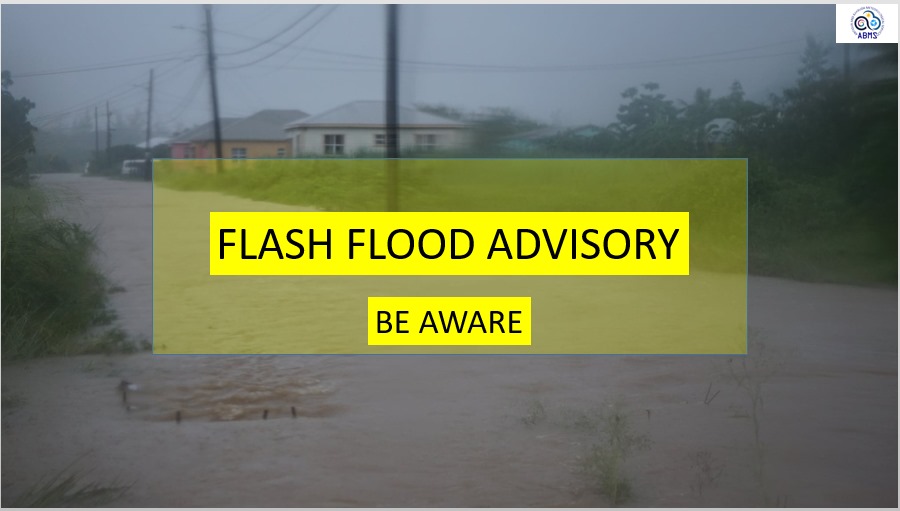
Flash Flood Advisory Issued for Antigua and Barbuda Until 8 p.m.
On the evening of September 16, the national Meteorological Services of Antigua and Barbuda issued an official flash flood advisory that will remain active from 5 p.m. through 8 p.m. local time, putting the island nation on alert for potential low-level flooding across vulnerable geographic zones. Meteorological forecasters attribute the adverse weather conditions to an active tropical wave, which has brought increased atmospheric moisture and instability across the broader Leeward Islands region. These conditions have spawned repeated rounds of intense downpours that are projected to persist through the rest of the evening. According to the official advisory statement, natural watercourses including small streams and creeks, along with urban drainage systems, are at high risk of rising water levels and potential overflow onto public streets and other low-lying, flood-prone areas. While officials have cautioned residents and travelers to remain vigilant, they also noted that any structural or property damage from the expected flooding is forecast to be limited in scope. Traffic and public safety officials have issued clear guidance for motorists navigating the affected regions: all drivers are reminded to practice extra defensive driving, particularly during moderate to heavy rain events that can sharply cut down on road visibility. Most critically, authorities have issued a strong warning against attempting to cross roadways that are already submerged by floodwaters, a common cause of weather-related injuries during flash flood events. The Antigua and Barbuda Meteorological Services confirmed that it will maintain continuous monitoring of evolving weather conditions across the islands, and will issue updated public statements and revised advisories should conditions change unexpectedly. In the meantime, residents are encouraged to stay tuned to local radio and television broadcasts to receive the latest official updates as the event unfolds.