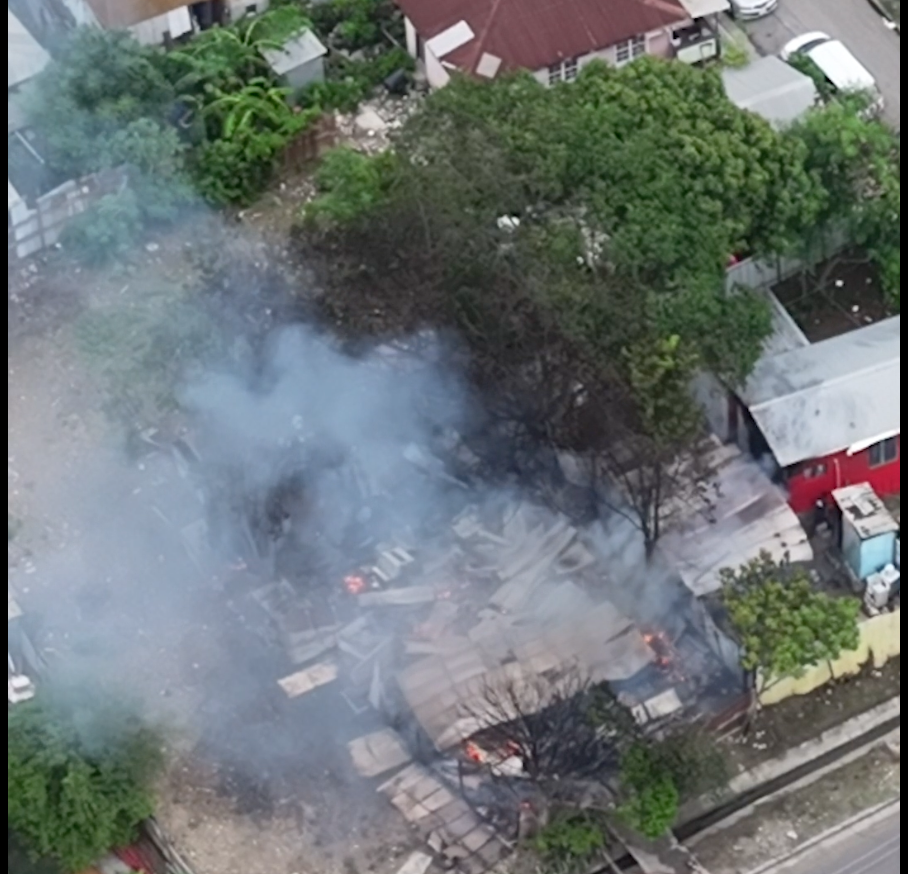
A destructive fire has ripped through a residential neighborhood in the Pointe community, leaving three homes completely destroyed, as local firefighting teams work around the clock to stop the flames from spreading to adjacent properties. On-scene visual footage captures the intensity of the emergency: bright, towering flames engulf the three residential structures, turning the once private homes into gutted frames, while thick, dark plumes of smoke blanket the entire area, obscuring visibility as emergency responders work relentlessly to bring the blaze under control. As firefighting operations continued through the response, displaced and concerned local residents gathered at a safe nearby distance, watching the emergency crews carry out their work and awaiting updates on the fate of their neighborhood. As of the latest update, officials have not yet determined the root cause of the fire, nor have they confirmed any details regarding potential injuries to residents or emergency personnel, or the number of community members that have been displaced from their homes by the destruction. Local authorities have confirmed that the incident is still under active investigation, and a full official public statement outlining further details is still pending as investigative teams work to piece together what led to the blaze.
作者: admin
-

Tourism Billboard or Territorial Message? Belizeans Divided
As Belize prepares to mark its 45th Independence Day, a new advertising campaign across the nation’s largest city, Belize City, has ignited fierce public division, tapping into long-simmering tensions over a decades-old territorial dispute between Belize and neighboring Guatemala.
The campaign, placed by Guatemalan tourism interests, features billboards emblazoned with a warm-sounding invitation: “Guatemala Welcomes You with Open Arms. Come for the landscapes, stay for the people, keep coming back.” Accompanying the text is imagery of rugged mountain terrain that critics are quick to note is not characteristic of Belize’s own geography, stoking immediate suspicion over the campaign’s true intent.
The timing and placement of the advertisements have landed like a bombshell in public discourse, coming as national pride reaches an annual peak ahead of the September 21 independence celebration. Online, many Belizeans have voiced fierce condemnation, framing the billboards as a deliberate incursion into Belizean sovereignty. Critics argue the presence of a Guatemalan tourism campaign on Belizean soil, paired with non-Belizean scenery, carries an unspoken territorial claim that cannot be ignored. “It’s an insult! Hattieville is in Guatemala now,” one Belizean wrote sarcastically online, while another labeled the campaign “a wrong message, a wrong gesture.”
This public anger does not reflect a universal view, however. A significant contingent of Belizeans has pushed back against the outrage, arguing the billboards are nothing more than a straightforward effort at cross-border tourism marketing. Proponents of this interpretation note that thousands of Belizeans cross the border into Guatemala annually for shopping, affordable medical care, and educational opportunities, while many international tourists who travel to Belize also extend their trips to include nearby Guatemalan destinations like Tikal or Antigua. From this perspective, the advertisements are simply targeting travelers already in the region who may be interested in adding a Guatemalan stop to their itinerary.
Top political leaders in Belize have also split along similar lines, deepening the national debate. Prime Minister John Briceño, head of the current ruling government, has aligned with the tourism marketing interpretation, though he acknowledged that the campaign’s current wording and imagery carry an unnecessary risk of misinterpretation. “I think it’s a bit misleading,” Briceño told reporters Tuesday. “I think it’s more from a touristical aspect. Maybe the billboard owners should ask them to, if they could reword it to remove that kind of fear or phobia.” The prime minister was firm in reaffirming Belizean sovereignty, adding clearly, “Belize would never be a part of Guatemala.”
For Opposition Leader Tracy Panton, however, there is no innocent explanation for the campaign. Panton has labeled the billboard initiative a deliberate “political provocation” and argued that the government must respond to it as such, rejecting any framing that reduces the issue to simple tourism marketing.
The controversy arrives at a sensitive moment for the two Central American nations, whose decades-long territorial dispute is currently ongoing before the International Court of Justice (ICJ) in The Hague. Guatemala has long claimed more than half of Belize’s current territory, a dispute that has lingered since the colonial era and only recently moved to the ICJ for a binding resolution. For many Belizeans, the billboard campaign is not just a marketing misstep, but a reminder of the ongoing threat to their nation’s territorial integrity, turning a routine advertisement into a flashpoint for national conversation just days ahead of one of the country’s most important national holidays.
-

Blue Economy, Coastal Management Get $447,000 Equipment Boost
On September 16, 2026, a major equipment handover ceremony held at the Fisheries Compound in Belize City marked a key milestone for the Central American nation’s coastal and marine conservation efforts. Two local government agencies tasked with ocean stewardship — the Ministry of Blue Economy and Marine Conservation (MBEMC) and the Coastal Zone Management Authority and Institute (CZMAI) — took delivery of nearly $447,000 worth of new vehicles and marine gear, funded through the World Bank-supported Belize Blue Cities and Beyond Project.
The full suite of donated infrastructure includes two rugged pickup trucks, a 32-foot Ocean Runner vessel paired with a supporting trailer, a VHF marine radio system, and two high-performance outboard engines. Under the allocation agreement, one pickup truck will go to MBEMC to support its cross-regional policy and field coordination work, while CZMAI will take possession of the second truck and all remaining marine equipment to expand its on-water operations.
According to project planners, the new assets are designed to address critical gaps in the two agencies’ operational capacity. For years, limited transportation and monitoring infrastructure have slowed routine patrols, resource surveys, and conservation project implementation across Belize’s extensive coastal zones. With the upgraded equipment, teams will now be able to conduct more frequent and comprehensive monitoring of vulnerable marine ecosystems, respond more rapidly to illegal activity or ecological threats, and advance ongoing initiatives tied to the sustainable development of Belize’s blue economy.
Belize’s coastal and marine resources are one of the country’s most valuable natural assets, supporting critical industries such as tourism, fisheries, and international trade while hosting globally significant biodiversity including the world’s second-largest barrier reef system. This investment reflects a growing global focus on expanding sustainable ocean management as a core strategy for long-term economic and ecological resilience.
-

Building on a dream: Bonita Bart heads to world-leading architecture school
Long before Bonita Alicia Bart could correctly spell the word “architect”, a childhood passion for designing spaces had already cemented her career path. As she recalls, it was her father who first helped her put letters to the dream that would shape her entire academic and professional journey. Today, decades after that childhood conviction, the young Vieux Fort native is preparing to join one of the world’s most prestigious architecture programs, carrying a mission that extends far beyond her own academic success.
On September 20, Bart will depart the Caribbean island of Saint Lucia for the United Kingdom, taking up the country’s sole Chevening Scholarship spot for the 2026/27 academic year. She will pursue a master’s degree in architectural history at University College London’s globally renowned Bartlett School of Architecture, a milestone that still feels surreal to the young scholar. She first received the life-changing news over a routine lunch break, when a congratulatory email popped up on her phone. “I remember putting the phone down and being like, this can’t be real,” she said of her initial reaction.
Instead of jumping into immediate celebrations, Bart confronted a quiet, common struggle for high achievers: imposter syndrome. For a period, she worked through the internal hurdle of accepting that she had earned the prestigious award through her own hard work and merit. “Sometimes we work hard and we don’t accept when good things happen,” she explained. “So, it was a good personal process for me as well.”
Bart’s award makes her Saint Lucia’s only representative among a small cohort of just five Chevening Scholars from the entire Eastern Caribbean region. Initially, the knowledge that she was the sole recipient from her home country left her feeling isolated, especially after learning just how fierce the global competition for Chevening awards is. But the cross-disciplinary group of Eastern Caribbean scholars, whose fields range from medicine and media to logistics and Bartlett’s own architectural history, quickly formed a tight support network. After meeting in Barbados, the group made a commitment to stick together through the challenges of studying abroad, easing much of Bart’s early anxiety. “So, I’m not too scared anymore,” she said.
Bart’s path to the Bartlett grew from a lifelong passion that first emerged in small, childhood moments. She remembers being fascinated by the annual rearrangement of her family home during the Christmas season, eager to weigh in on where every piece of furniture and decor should go. As she grew older, her knack for drawing helped turn that early instinct for spatial planning into a clear professional goal. It was during her undergraduate studies in Jamaica that her focus narrowed to architectural history and theory, sparking a critical observation that would become the core of her work: many Caribbean people do not recognize the unique cultural value of the architecture that exists in their own communities.
“ We think of it as a big capital A of skyscrapers in Dubai and in the US,” she said. “But we’re not thinking about the bioclimatic approach that people have taken with getting houses. And having houses that fit the Caribbean context and the colours and our own cultural history with it.”
Four years ago, Bart turned that observation into action, launching the Caribtecture Research Project to document and analyze the distinct identity of Caribbean architecture through a combination of written research and visual documentation. Within that broader initiative, she created Luciantecture, a focused project centered specifically on recording and examining Saint Lucia’s unique built heritage. For Bart, studying a historic Saint Lucian building means looking far beyond its physical facade: she explores the cultural and social influences that shaped its design, the communities that built and lived in it, and the irreplaceable character that could be lost if the island modernizes without intentional heritage preservation. Among the elements at particular risk are Saint Lucia’s distinctive French colonial architectural legacies, including traditional fretwork and stonework craftsmanship. While some efforts are underway to pass down the trade skills needed to maintain these features, Bart argues that preservation ultimately requires public buy-in: many locals now favor modern glass and luxury cladding over the island’s traditional architectural character.
Her greatest concern is that rapid unplanned modernization will erase Saint Lucia’s unique cultural identity, turning the island into a generic copy of developed nations rather than celebrating its one-of-a-kind heritage. Beyond the cultural loss, she warns this shift could also harm Saint Lucia’s key tourism sector, which relies on the island’s unique natural and cultural identity to attract visitors.
Preservation is not Bart’s only focus. She also points to climate change as an urgent, growing challenge for Caribbean architecture. Much of Saint Lucia’s housing, infrastructure and economic activity is concentrated along vulnerable coastlines, requiring difficult conversations about sustainable development, adaptive infrastructure and even the managed relocation of at-risk coastal communities. For Bart, these decisions cannot be left only to engineers and developers. Relocating entire communities disrupts intergenerational social ties, livelihoods and cultural patterns that are deeply tied to place, and local people deserve a seat at the table in these decisions. “ The social, political and economic aspect of architecture to me is often ignored,” she said. “And I think we don’t bring the public into that conversation as much as they should be a part of that conversation.”
This focus on the interconnectedness of people, place and power is exactly what drew Bart to the Bartlett School of Architecture’s program. The program’s framework examines both rural and urban spaces through social, economic and political lenses, tracing the historical forces that shaped built environments and exploring the impacts of change. That academic training is exactly what she needs to advance her work with Caribtecture and Luciantecture. When she returns to Saint Lucia after her studies, she plans to expand her research in collaboration with local writers, artists and fellow architects to build a comprehensive, accessible public record of Caribbean architectural history.
For now, though, Bart is wrapping up preparations to leave the only home she has ever known for the busy streets of London and the rigors of postgraduate study. When she departs on September 20, she will step into an experience that will almost certainly reshape her understanding of architecture – and ultimately, change how she sees the Caribbean home she plans to preserve.
-

Antigua and Barbuda Yachting and Marine Association Unveils Action-Packed Event Calendar
Antigua and Barbuda has long held a reputation as one of the world’s top yachting destinations, and that status is set to grow even stronger with the official launch of the 2026-2027 yachting season event calendar from the Antigua and Barbuda Yachting and Marine Association (ABYMA). The newly released schedule delivers the most diverse lineup in the destination’s history, blending elite international competitions, beloved traditional events, and accessible community-focused activities for sailors of all skill levels.
Elite Racing Gets a Strategic Refresh
Following a successful inaugural launch, the Antigua Racing Cup returns for its second edition with a strategically adjusted schedule. Moving to an earlier start in March, the revised timing aligns perfectly with the RORC Caribbean 600, allowing competing yachts to take on back-to-back high-level races without leaving the Caribbean, a change designed to better serve global sailing teams traveling to the region for competition. The season will also feature long-standing fan-favorite cornerstone races that have become staples of the regional yachting circuit, including the iconic RORC Caribbean 600 and the Nelson Series, alongside the highly anticipated returns of the Antigua Yacht Show and the region’s top-tier Sport Fishing Tournament.Balancing Heritage and Innovation
The 2026-2027 calendar honors Antigua and Barbuda’s deep maritime roots while embracing fresh formats to appeal to new generations of sailors. The legendary Antigua Classic Yacht Regatta, a staple for lovers of traditional sailing vessels, retains its spot as a seasonal highlight, while the Antigua Superyacht Challenge will once again draw attention to some of the most spectacular luxury superyachts in the world. After a successful reimagining in its first year, the newly formatted Antigua Sailing Week returns as a streamlined four-day event that explores multiple coastal destinations around the island, capturing the laid-back, authentic joy of sailing that has defined the nation’s maritime culture for decades. For long-distance adventure seekers, three of the world’s most grueling ocean challenges — the World’s Toughest Row, Salty Dawg Rally, and McCintyre 580 Transat — will once again finish in Antigua, offering intrepid sailors some of the most demanding open-ocean routes on the global yachting calendar.Prioritizing Inclusive Community Participation
ABYMA and local yacht clubs have expanded accessible programming to ensure the season welcomes recreational and new sailors alongside elite competitors. Antigua Yacht Club will host the Jol Byerley High Tide Series, a collection of events including the High Tide Race, Boxing Day Barrel, Nelson’s Pursuit, and Sandy Island Race, open to sailors of all experience levels to foster broad participation. On the island’s West Coast, Jolly Harbour Yacht Club is adding an all-new One Design Elite regatta, which will serve as the Caribbean Championship ahead of the popular annual Jolly Harbour Valentines Regatta. Dinghy sailing, a year-round activity for local enthusiasts, will crown national champions at the pinnacle Budget Marine Optimist & ILCA National Championships, scheduled for April, which is expected to draw top young competitors from across the region.Franklyn Braithwaite, President of ABYMA, emphasized the significance of the expanded calendar in cementing Antigua and Barbuda’s global leadership in the yachting industry. “From world-renowned offshore races to community-driven regattas, Antigua and Barbuda is cementing its place at the heart of the international sailing calendar,” Braithwaite said. “We invite sailors, spectators, and families from around the world to join us for an unforgettable year.”
ABYMA also extended its gratitude to Falmouth Harbour Marina, which has provided long-standing support to the association and the annual event calendar initiative for many years. Full event details, schedule information, and registration for the 2026-2027 season are available now on the official ABYMA website at www.abyma.ag.
-

Belize’s Parliament Looks to AI to Modernise Operations
In an early September gathering focused on 21st-century legislative transformation, parliamentary delegations from across the Caribbean, including a team from Belize’s National Assembly, convened at Florida International University for the landmark workshop *Applying AI and Digital Solutions to Modernize Parliamentary Practice*. The event centered on exploring how cutting-edge artificial intelligence and emerging digital tools can reshape core parliamentary functions, bringing Belize one step closer to updating its legislative infrastructure for the digital age.
The workshop’s curriculum delved into multiple high-priority areas for legislative modernization, examining how new technologies can streamline day-to-day legislative operations, overhaul information management systems, and expand equitable public access to government parliamentary records. Attendees did not only engage in theoretical discussion: the program combined policy conversations, hands-on practical training, and cross-border knowledge-sharing sessions to equip participants with actionable takeaways for their home institutions.
Belize’s delegation was led by two representatives from the Office of the Clerk: Acting Deputy Clerk Manuel Grant and Parliamentary Officer I Tiarrah Bedran. Both took an active role in all workshop activities, contributing to peer discussions, participating in guided practical exercises, and exchanging institutional insights with parliamentary leaders from other Caribbean nations.
Grant took on prominent leadership roles during the event, serving as a featured panelist for a focused session on developing shared standards for legislative digitization. During his panel contribution, he outlined key considerations around common data frameworks, cross-system interoperability, and the critical long-term preservation of official parliamentary documents. He also went on to lead a working group that delivered a presentation and facilitated open discussion on the development of fit-for-purpose AI governance policies for legislative bodies.
Beyond policy and standards discussion, the workshop covered a wide range of practical topics critical to digital transformation, including mass document digitization workflows, maintaining high-quality government datasets, mitigating emerging cybersecurity risks, and aligning with global data standard frameworks. A key hands-on component of the program introduced attendees to commercially available generative AI tools widely used today, including ChatGPT, Claude, and Gemini, with training focused on integrating these tools into routine parliamentary work. Organizers emphasized responsible deployment and robust security protocols to protect sensitive government information throughout the session.
Following the workshop, Belize’s National Assembly issued a statement highlighting the long-term value of the institution’s participation. For the Central American nation, the gathering created a critical opportunity to exchange digital transformation experiences with regional peer nations, build internal institutional expertise on AI integration, and identify practical, tested tools that can boost operational efficiency, maintain operational continuity during transitions, and expand transparent public access to parliamentary information across Belize.
-
Overeenkomst LVV basis voor landbouwproject waarbij Mennonieten zijn betrokken
Newly released public contractual documents and a 10-year business plan have cast fresh clarity on the complex structure behind a controversial large-scale agricultural development project in Suriname, confirming that Mennonite farmers who migrated to the country for the initiative do not hold any formal stake in the state land agreement at the heart of the project.
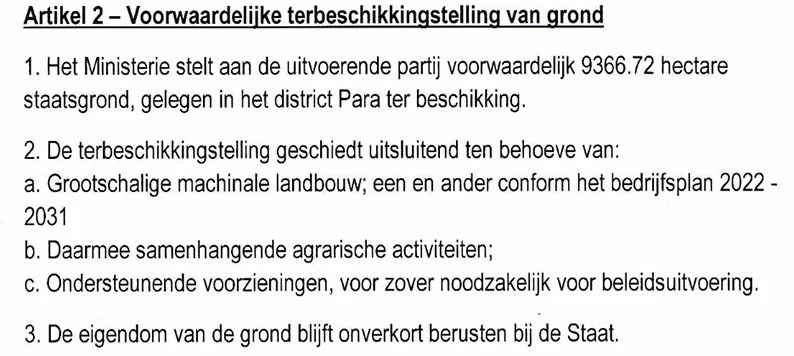
The deal, signed January 13, 2026, between Suriname’s Ministry of Agriculture, Livestock and Fisheries (LVV) and local entity Braganza Marketing Group N.V. — the firm that recruited the Mennonite farmers to work on the project — grants the company conditional use rights to 9,366.72 hectares of state-owned land in Suriname’s Para district for an initial 20-year term. The land remains the formal property of the Surinamese state, and Braganza holds a non-transferable right to use the plot exclusively for large-scale mechanized agriculture and related agribusiness activities. Under the terms of the agreement, Braganza is required to bring at least 10 percent of the total allocated area under cultivation every year to retain its access rights. What makes the arrangement notable is that despite the Mennonite farmers being central to the project’s on-the-ground implementation, their names do not appear anywhere in the formal public contract between LVV and Braganza.
LVV Minister Mike Noersalim had previously stated that his ministry never entered into a separate agreement with the Mennonite community, noting that the ministry’s contract was exclusively with the Surinamese registered firm for the production of commodity crops including soybeans and corn, and that Braganza did not present itself as a representative of the migrating farmers during negotiations. Braganza, however, has publicly confirmed its plan to rely on Mennonite agricultural workers for the project’s two core sites: one group of Mennonites from Belize for the Tibiti site, and a second contingent from Mexico for the Kabalebo site.
During a recent visit to the Tibiti area by members of Suriname’s National Assembly and journalists, Peter Petersen, a Mennonite leader from Belize, explained that his group was recruited to Suriname by Lionel Blokland and Ruud Souverein, two figures connected to Braganza. Petersen said his community sold all of their assets in Belize and shipped heavy farm machinery to Suriname under the expectation that they would be able to operate large-scale farms on the Para district land. His group, he added, expects to use more than 9,000 hectares and has agreed to pay $150 per hectare for access, though details of who receives this payment and what contractual rights the group holds remain unclear.
Braganza’s 2022-2031 business plan, also made public, shows that plans for the Tibiti and Kabalebo sites have been in development for nearly a decade, with the firm explicitly outlining its goal to produce soy and corn across the two concessions. The plan also highlights the project’s international backing, naming Adrian Barbero of Bolivia-based Rural Real Estate Investments Ltd. (RREI) as a lead initiator. According to the document, RREI brings more than 30 years of experience investing in large-scale agriculture and livestock operations across South America, with a track record of developing and acquiring large agricultural concessions across multiple regional countries where “agricultural specialist colonies” operate. While the plan does not explicitly confirm these colonies refer to Mennonite communities, it is now verified that Braganza has specifically recruited Mennonite farmers to carry out on-ground work for its Suriname projects. RREI, alongside Blokland, is listed as a stakeholder in Braganza Marketing Group, with international investors planning to contribute their own capital to develop agriculture, livestock, and dairy projects across the allocated Surinamese land.
The disclosures confirm a clear structural separation: the Surinamese state has granted land access to Braganza, not directly to the Mennonite farmers, who are only involved as contracted workers through the local firm. Crucially, no details of the private agreement between Braganza and the Mennonite community — including terms for land use, per-hectare payments, investment responsibilities, or profit sharing — appear in the public contract with LVV or the released business plan. This lack of transparency raises regulatory questions, as the LVV-Braganza agreement explicitly bans transferring use rights to any third party without the ministry’s prior written approval.
-

Who Gets to Tell Belize’s History? Magical History Tour Reaches Final Stop
As Belize prepares to mark 45 years of full national sovereignty on September 21, 2026, a landmark national history education initiative is drawing to a close this week at its final venue. The Belize @45 Magical History Tour, organized jointly by the National Institute of Culture and History (NICH) and veteran historian and ambassador Assad Shoman, has spent the past several weeks bringing untold and underrepresented stories of Belize’s path to independence to young audiences across every district of the country.
Launched on August 26 in the southern coastal town of Punta Gorda, the eight-stop tour traveled sequentially through Dangriga, San Ignacio, Benque Viejo del Carmen, Belmopan, Belize City, and Orange Walk, before concluding its cross-country journey at the Corozal House of Culture on September 16, 2026. Unlike traditional textbook-centered history lessons, the initiative was designed to facilitate active dialogue rather than one-way instruction. It encouraged participating students from all regions to ask critical questions, share their own community’s historical narratives, and debate the cascading events that have collectively forged Belize’s unique modern national identity.
Beyond student-focused sessions, the tour also hosted open public forums that created space for ordinary residents and local community leaders to exchange divergent perspectives on Belize’s past, drawing clear connections between historical struggles, decisions, and the social and political realities the nation faces today. At its core, the project was built around a central, urgent question: Who gets to write and share Belize’s national story? Organizers argue that centering young people in this conversation is critical, as this generation will not only steward the country’s historical memory for decades to come but also pass that legacy on to future generations of Belizeans. As the country gears up for its official independence day celebrations, the tour has already left a lasting mark by reimagining how national history is taught, discussed, and owned across Belize.
-

Opposition Leader Responds to Prime Minister: “We Cannot Eat 5.1% Growth”
In a direct response to Prime Minister John Briceño’s 2026 State of the Nation Address delivered on September 16, opposition leader Tracy Panton has launched a pointed critique of the incumbent government’s policy framing, arguing that official economic indicators do not align with the daily struggles of ordinary Belizeans. Panton’s address pushed back against Briceño’s opening claim that, at 45 years old, he embodies the nation of Belize, re-centering the identity of the country around working people rather than political leadership.
“He told us to look at him, that at forty-five, he is Belize. Mr Prime Minister, with respect, you are not Belize. Belize is the cane farmer in Orange Walk, the fisherman in Sarteneja, the market vendor trying to make a living, and the mother in Belize City trying to stretch a dollar that simply cannot be anymore,” Panton stated in her opening remarks.
At the core of Panton’s critique is the disconnect between the government’s headline economic data and household financial pressures. Briceño highlighted a 5.1% national economic growth rate, 98% employment, and a stable Belizean dollar as markers of a successful economy — metrics Panton says mean nothing to families struggling to cover basic costs.
“The Prime Minister says the economy is growing at five point one per cent. He says employment is at ninety-eight per cent. He says Belize has a strong dollar. I have a very simple question: Are we feeling it? When you go to the grocery store, are we feeling the five point one per cent growth? When you fill your vehicle with fuel approaching sixteen dollars a gallon, are we feeling it? When we pay our electricity bill, when we pay rent, when we try to put food on the table, an economy cannot simply look good on paper. It has to work for the people,” Panton argued.
Panton also pushed back against government celebration of Belize’s recently reaffirmed B-/B credit rating, noting that the ranking remains deep in speculative grade and offers no tangible relief to struggling households. “We cannot eat five point one per cent growth. We cannot put a credit rating in our gas tanks, and we cannot tell struggling families that the economy is doing wonderfully when our money buys less and less,” she added.
Beyond economic metrics, Panton called out the government’s failure to address the ongoing national electricity crisis. While Briceño offered explanations for spiking utility costs, Panton emphasized that Belizeans do not need excuses — they need immediate action to bring down prices.
She further highlighted that the government’s temporary fix for lost electricity supply from Mexico’s national utility CFE, which cut Belize’s supply to zero earlier this year, only highlights long-term policy failure. The government has filled the gap with a six-month diesel-powered arrangement, while promised solar and battery storage projects first announced in 2023 are not scheduled to come online until 2027. While Panton acknowledged the partial relief of removing GST from residential electricity bills under $200, she noted the policy does nothing to resolve the underlying crisis of unreliable and unaffordable energy that plagues the country.
Turning to national security, Panton addressed the recent September 10 Sarstoon River sovereignty incident, praising the courage of civilian Belizeans who participated in the event but raising critical concerns about the government’s failure to protect national territory. “I salute every Belizean that was present. Their courage was real. Their patriotism was real. But we must not confuse courage with security. What happened on the Sarstoon should trouble us. Belizeans were challenged while travelling in territory that belongs to us. Brave citizens found themselves on the frontline of a sovereignty issue. That cannot become normal,” she said.
Panton called for full resourcing, modern equipment, and clear political backing for the Belize Defence Force, stressing that the nation should never rely solely on civilian courage to defend its sovereignty.
A large portion of Panton’s address focused on issues entirely omitted from the Prime Minister’s State of the Nation address, starting with demands for greater accountability and anti-corruption action. “Where was the serious discussion about corruption and accountability? Where was the response to the questions being raised about unexplained wealth and conduct at senior levels of the public service? While nurses struggle and patients search for medications, Belizeans have every right to demand accountability from those entrusted with public resources. We deserve answers,” she stated.
Panton also highlighted other unaddressed everyday concerns: new village trade taxes that place added burden on small entrepreneurs and street vendors, a persistent school transportation crisis that leaves parents scrambling to get children to class even as the government delays delivery of promised new buses, and plummeting morale among under-resourced police officers. “These are not small matters. They are the everyday realities of Belizeans. And a State of the Nation Address should confront them. Because sometimes what a government chooses not to talk about tells us just as much as what it does,” she noted.
Closing her address, Panton laid out an alternative progressive vision for Belize that centers working people, rejecting the Prime Minister’s framing that he equals the nation. She called for a country where economic growth translates to tangible household gains, public procurement and contracting are fully transparent, corruption allegations are investigated regardless of who is involved, energy is reliable and affordable, the military has the resources to defend national sovereignty, and young Belizeans can build prosperous lives at home.
“I believe we can build a Belize where economic growth reaches the kitchen table, where public money is treated with respect because every dollar earned is earned on the backs of the Belizean people, and where contracts and procurement are transparent. Where allegations of corruption are investigated and wrongdoing has consequences regardless of who is involved. Where families can afford electricity and the government has a real energy security plan. Where our soldiers have the resources they need to defend our sovereignty, and where a young Belizean can work hard, build a home, raise a family, and believe that their best future is right here at home,” Panton said.
She concluded by reaffirming that Belize belongs not to the government or any single political party, but to all its people, who must always be the nation’s first priority. “Mr Prime Minister, this morning you told Belizeans to look at you, that at forty-five, you are Belize. I see it differently. Belize is not one man. Belize is all of us. Our country faces serious challenges. I refuse to believe that those challenges are greater than our people. We can do better. We must do better together. We will do better. Belize does not belong to a government. It does not belong to a political party. Belize belongs to its people. It is the people who must always come first.”
-

Dominica Bar Association reaffirms confidence in CCJ after leaked emails reveal internal contention
A growing regional controversy sparked by the unauthorized leak of confidential internal judicial correspondence has prompted the Dominica Bar Association (DBA) to publicly reaffirm its unwavering confidence in the Caribbean Court of Justice (CCJ), the Caribbean’s apex regional judicial body.
The controversy erupted in August, when private communications between CCJ President Justice Winston Anderson and other sitting judges were leaked to the public. The documents exposed long-simmering internal disagreements over a range of administrative issues, including a proposed revision to the court’s judicial dress code and broader institutional operating practices. Beyond procedural debates, the correspondence included formal allegations questioning Anderson’s management of judicial panel assignments and other core court governance functions. The situation intensified after Jamaica’s Nationwide Radio published remarks attributed to Trinidadian Justice Peter Jamadar, who was quoted describing the court’s internal working environment as “increasingly toxic.”
In response to the allegations, Justice Anderson has issued a formal rejection of all claims, while strongly condemning the breach of court confidentiality that allowed private communications to enter the public sphere. Following the leak, multiple leading regional legal organizations—including the Organization of Eastern Caribbean States (OECS) Bar Association and the Organisation of Commonwealth Caribbean Bar Associations (OCCBA)—have publicly called for full, independent investigations into both the security breach that enabled the leak and the substantive concerns raised in the disclosed correspondence, according to reporting from the Guyana Chronicle.
Against this tense regional backdrop, the DBA released a detailed public statement addressed to the people of Dominica aiming to ease growing public uncertainty about the court’s integrity. In the statement, the association emphasized that internal administrative disagreements among judicial officers do not equate to a systemic failure of the CCJ’s core judicial function, and doubled down on its longstanding support for the regional court.
The DBA acknowledged that the leak and subsequent reporting have naturally sparked concern, skepticism, and uncertainty among the Dominican public and across the Caribbean. It framed the internal friction exposed by the leak as a normal feature of large human institutions, rather than a sign of irreversible structural collapse. “Conflict and disagreement are integral to human institutions. Robust internal debates, far from being a sign of structural failure, are an essential component of growth and, at times, self-correction,” the statement read.
The association also noted that the unauthorized disclosure of uncontextualized confidential communications is deeply regrettable, as it often fuels unsubstantiated speculation and sensationalized media coverage that distorts public understanding. It stressed that despite the administrative disagreements, the CCJ remains fully committed to its core mandate of delivering impartial, independent justice, and that the court’s commitment to the rule of law remains untarnished.
Dominica is one of the founding pioneering nations that acceded to the CCJ’s appellate jurisdiction in fulfillment of regional treaty obligations, and the DBA highlighted the court’s 20-plus year track record of delivering internationally respected jurisprudence across the Caribbean. “A leaked administrative challenge in over twenty years of distinguished operation does not dismantle a legacy built on legal brilliance, accessibility, and uncompromising fairness,” the statement added.
Joining regional legal bodies in calling for accountability, the DBA outlined three core priorities moving forward: first, it backs the OCCBA’s call for thorough investigations into the court’s data security protocols and internal administrative practices to strengthen transparency and prevent future breaches; second, it commits to expanding public legal education initiatives for Dominican citizens to demystify court operations and build long-term public trust; third, it reaffirms the legal community’s role as independent guardians of the court’s transparency and institutional independence.
Concluding the statement, the DBA emphasized that the CCJ is a Caribbean-created institution built on the sovereign will of regional nations. It urged the Dominican public to look past sensationalized media coverage, and reaffirmed that the court remains fully capable, independent, and steadfast in its commitment to serving Caribbean communities.