作者: admin

  • Wereldwijd dieseltekort dreigt tot in 2027 aan te houden

    Wereldwijd dieseltekort dreigt tot in 2027 aan te houden

    The global diesel market is facing a crippling supply deficit that market analysts warn could remain tight well into 2027, driven by cascading geopolitical conflicts and critical disruptions to key refinery operations in major exporting regions. According to inventory data and industry analysis cited by Reuters on Monday, this shortage is already being felt across three major consumption hubs: North America, Europe, and Asia. As a fuel that underpins global commercial activity – powering long-haul freight trucks, agricultural machinery, and a wide range of industrial equipment – diesel’s scarcity carries far-reaching economic ramifications.

    The root of the current crisis lies in the sudden loss of massive volumes of refined fuel exports from two of the world’s largest supply regions: Russia and the Middle East. Tensions around Iran and severe restrictions on commercial shipping transit through the Strait of Hormuz, a critical chokepoint for nearly 20% of global oil trade, have severely curtailed exports from the Persian Gulf region. Parallel to this, repeated attacks on Russian refinery infrastructure and Moscow’s self-imposed export restrictions have further shrunk the pool of diesel available on the global market. Before these cascading disruptions began, the two regions combined made up a substantial share of total global diesel exports.

    The United States is currently experiencing the most acute strain of the shortage. U.S. diesel inventories have dropped to their lowest seasonal level since 1982, and the U.S. Energy Information Administration forecasts that stockpiles will remain depressed through most of 2027. Price impacts have already been significant: as of Monday, the average national retail diesel price hit $6.51 per gallon, a 76% jump compared to the same period one year earlier. With U.S. refineries already operating at roughly 97% of their maximum capacity, there is almost no room to quickly ramp up domestic production to offset the global supply gap.

    Europe is also grappling with historically low diesel stockpiles, and the crisis is compounded by a parallel shortage of jet fuel. Both diesel and jet fuel fall into the same category of middle distillate refined petroleum products, meaning competition for limited refinery output further tightens supplies. In the key Amsterdam-Rotterdam-Antwerpen storage and trading hub, jet fuel inventories have already fallen to their lowest level in seven years.

    The economic impact of the diesel shortage extends far beyond higher prices at fuel pumps for commercial operators. Diesel is an essential input for nearly every sector of the global economy, from moving consumer goods across supply chains to powering farming, mining, construction, and manufacturing operations. Higher fuel costs push up production and distribution expenses across the board, which are ultimately passed through to end consumers, adding renewed upward pressure to global inflation that many central banks have worked aggressively to tame.

    Some near-term relief could come from increased production from other major refining centers, including China, where high refining margins are already incentivizing operators to maximize diesel output. However, industry analysts agree that this additional production will not be enough to fully close the global supply gap in the short term. Any new unplanned refinery outages or further escalation of existing geopolitical conflicts could trigger another sharp spike in global diesel prices.

    A core structural issue exacerbating the crisis is a global lack of refining capacity, not a shortage of crude oil itself. Damaged or idled refinery capacity cannot be replaced quickly, as new facility construction takes years of planning and investment. This means the diesel market can remain tight even when global crude oil supplies are sufficient to meet demand.

    For countries that rely heavily on diesel imports, the crisis marks a shift in how final import prices are determined. No longer is the global crude oil price the only key factor; the availability of refined diesel, its market price, and associated transport costs are now playing an increasingly large role in determining the final cost of imported fuel for import-dependent nations.

  • Government limits special  operations to UNC districts

    Government limits special operations to UNC districts

    A sharp political clash over a sweeping anti-crime policing bill has taken an unexpected turn in Trinidad and Tobago, where Prime Minister Kamla Persad-Bissessar has announced she will limit the implementation of the 2026 Special Operations Bill exclusively to electoral districts controlled by her United National Congress (UNC) party and the island of Tobago. The decision comes in direct response to fierce opposition from the rival People’s National Movement (PNM), whose lawmakers have raised repeated constitutional and civil liberty objections to the legislation, even threatening mass public protests to block its rollout in PNM-held seats.

    In a blunt statement posted to social media over the weekend, Persad-Bissessar said her administration would respect the Opposition’s rejection of the bill, leaning into a forceful retort that frames the PNM’s opposition as a choice to let criminal elements control their constituencies. ‘The PNM-represented constituencies clearly preferred to be controlled by violent criminal gangs and the local drug mafia instead of being protected by law enforcement,’ the prime minister said. She confirmed that special operations would only launch in 26 UNC-held parliamentary constituencies, 70 UNC-controlled local government districts, and the two Tobago People’s Party (TPP) seats, following consultation with Tobago’s Chief Secretary Farley Augustine.

    The political standoff erupted days after the Special Operations Bill passed the House of Representatives in the early hours of Saturday, capping a marathon 13-hour debate that exposed deep divides over the legislation. The bill is scheduled to open its first reading in the Senate this week, and the Opposition has already signaled it will continue to challenge the measure. PNM lawmakers have argued that the bill’s expanded powers for security forces, including the ability to conduct warrantless searches in areas designated as ‘closed areas’, would erode fundamental civil liberties and turn the twin-island nation into a police state.

    Leading the Opposition charge is Port of Spain South MP Keith Scotland, who has vowed to mobilize his constituents in peaceful, legal protest against the bill. Scotland has described the legislation as a ‘sprawling assault’ on constitutional rights, warning that residents of targeted communities would face sweeping restrictions on their personal freedoms. ‘We will first go on our knees and then we’ll rise from our knees, and we’ll be on our heels and toes because we do not agree with this,’ Scotland said ahead of the House vote. Persad-Bissessar has pushed back against this criticism, noting that Scotland and his supporters are fully within their rights to protest within the bounds of the law, adding that her government has no interest in forcing security measures on communities that do not want them. ‘I’m not begging to help anyone who doesn’t want to be helped. If any community prefers to live under violent gangs that’s their choice, I’m not bothered, they can go ahead,’ she said.

    The prime minister also dismissed PNM claims that the legislation would be weaponized to target Opposition strongholds, calling the allegations ‘comical manufactured drama’ rooted in race-baiting and political grifting. She argued that opponents had deliberately misrepresented her government’s intentions, noting that the bill is designed solely to crack down on organized violent crime that has plagued communities across the country for decades. ‘For three decades, law-abiding citizens have been terrorised by violent criminal gangs. Law abiding citizens have been forced to lock themselves behind burglar-proofing, security cameras, tall gates and guard dogs because of the threat of violent home invasions. Mothers and daughters have been raped in their own beds, fathers and sons beaten and our elderly tortured by these violent criminals,’ Persad-Bissessar said, defending the need for enhanced policing measures in government-held areas.

    She doubled down on her position that PNM constituencies retain the democratic right to reject the additional security, arguing that their leaders’ opposition amounts to an endorsement of the status quo of gang violence. ‘The PNM are free to continue to allow their constituencies to be overrun by violent criminal gangs. They are free to allow the local drug mafia financiers to flood their constituencies with deadly drugs which poison their children and destroy their futures. It is their democratic choice to allow themselves to be destroyed from within,’ she said.

    Attorney General John Jeremie has pushed back against Opposition claims that the bill will create a police state, clarifying that the expanded powers granted to security forces are limited and distinct from the sweeping emergency authority used during past states of emergency. All 26 clauses of the bill and its accompanying schedule were approved without amendment during the House vote, and the legislation now moves to the Senate for further deliberation.

  • Kamla, Delcy set  for key talks in NY

    Kamla, Delcy set for key talks in NY

    As the 81st Session of the United Nations General Assembly’s high-level week gets underway in New York, Trinidad and Tobago Prime Minister Kamla Persad-Bissessar is set to launch two days of intensive high-level bilateral discussions, headlined by a much-anticipated meeting with Venezuelan President Delcy Rodríguez. Following the conclusion of her diplomatic schedule, the Prime Minister will return to Port of Spain on Thursday morning.

    Persad-Bissessar leads the Caribbean nation’s official delegation to this year’s UNGA, with a packed itinerary that spans diplomatic, economic, and regional engagement initiatives all designed to deepen Trinidad and Tobago’s global partnerships. The sit-down with Rodríguez stands out as one of the visit’s most high-stakes encounters, coming as the two neighboring countries work to rebuild cross-border ties and expand collaboration across key sectors: energy, trade, agriculture, public security, and inclusive economic development. Ahead of her departure for New York, the Prime Minister confirmed that all logistics for the meeting have been fully finalized.

    While the Prime Minister prepares for her core bilateral talks, Trinidad and Tobago’s Minister of Foreign and Caricom Affairs Sean Sobers already took part in the 26th Special Meeting of the Council for Foreign and Community Relations (COFCOR) on Monday. The gathering brought together foreign ministers from across the Caricom bloc to coordinate unified regional diplomatic positions for UNGA’s high-level week. In a social media statement from New York, Sobers emphasized that his participation aligns with Trinidad and Tobago’s goal of advancing its national priorities while reinforcing collective Caribbean diplomatic action. “As Minister of Foreign and Caricom Affairs, I remain committed to advancing Trinidad and Tobago’s interests while working alongside our Caricom partners to strengthen regional cooperation and collective diplomacy,” he wrote.

    This year’s UNGA participation carries extra weight for Trinidad and Tobago, as the country prepares to assume a non-permanent seat on the United Nations Security Council in the coming term. The delegation’s diplomatic activity began in earnest on Monday with a full slate of engagements: opening with a breakfast-focused meeting on accelerating global collaboration around Digital Public Infrastructure, followed directly by the special COFCOR session. Additional pre-scheduled events included a meeting of foreign ministers from the Community of Latin American and Caribbean States (CELAC), attended by Permanent Representative to the UN Cynthia Morris, and a working lunch for foreign ministers of the Security Council’s five incoming non-permanent members.

    Monday also saw Trinidad and Tobago expand its global diplomatic network with the formal establishment of diplomatic relations with North Macedonia. Bilateral discussions were also held between the foreign ministers of Trinidad and Tobago and the Philippines, and the country signed an Air Transport Agreement with Panama to boost air connectivity. On the same day, Prime Minister Persad-Bissessar held a separate bilateral meeting with Ghana’s President, during which the two countries also signed an Air Transport Agreement. The deal marks a key step forward in efforts to improve transportation links and strengthen bilateral ties between Trinidad and Tobago and the wider African continent. All attention now turns to the Prime Minister’s two days of bilateral talks, with the meeting with Venezuelan President Rodríguez taking center stage.

  • $200m loan only the surface

    $200m loan only the surface

    Trinidad and Tobago’s top police official has exposed far-reaching financial mismanagement within the Trinidad and Tobago Police Service (TTPS), revealing that a well-documented $200 million debt-inducing loan is only the tip of the iceberg uncovered in an independent government audit. Current Commissioner of Police Allister Guevarro made the revelations this week while responding to public criticism from former TTPS chief Gary Griffith and former national security minister Marvin Gonzales, both connected to the previous People’s National Movement (PNM) administration.

    The sweeping audit, commissioned, conducted and released by Trinidad and Tobago’s Ministry of Finance, examines TTPS procurement, contracting and financial operations between 2017 and 2021. It has already confirmed a $550 million total fiscal deficit, widely described as a financial “black hole”, rooted in systemic mismanagement and multiple scandals during the PNM’s tenure. Of that deficit, $350 million in confirmed outstanding liabilities have been verified, alongside a host of troubling irregularities: unvetted multi-million-dollar contracts, useless unutilized equipment, off-contract payments, and the so-called “unified Hockey Field Scandal” cited directly in the audit document. Homeland Security Minister Roger Alexander first confirmed the scope of the deficit in an exclusive interview with the Sunday Express.

    One high-profile point of controversy is the $200 million government-backed loan arranged through the National Insurance Property Development Company Ltd (Nipdec), taken during the audit’s review period. But Guevarro emphasized that the problems uncovered go far beyond this single loan. Among the most alarming findings, the audit documents how a senior TTPS accounting officer, unfamiliar with the legal obligations of their position, approved irregular contracting practices that would have forced the TTPS to pay more than $100 million to a single private firm. Guevarro confirmed he intervened personally to halt the improper payment before it was processed.

    The current commissioner pushed back against claims from Griffith and Gonzales that neither was aware of the independent audit’s existence or findings, calling their lack of knowledge “genuinely astonishing”. Guevarro noted that the audit’s conclusions directly address flaws in the TTPS’s financial oversight and internal governance during the period the two leaders oversaw the organization. The full final audit, officially titled “Ministry of Finance Central Audit Committee Review of the Procurement of Goods and Services and the Hiring of Staff on Contract undertaken by the TTPS for the years 2017 to 2021”, is a public document produced by independent finance ministry auditors, not an internal TTPS report, Guevarro clarified. He has publicly referenced the audit’s findings since 2023, and has repeatedly urged media outlets to access and publish the full report to inform the public.

    “The now-controversial $200 million loan is only the surface. The audit outlines a staggering catalogue of procurement breaches, contract irregularities and financial mismanagement that collectively pushed the TTPS hundreds of millions of dollars into debt,” Guevarro said in his remarks to reporters. Beyond the $100 million improper payment incident, the audit identifies a pattern of systemic violations: contract splitting to bypass approval thresholds, unapproved financial commitments, premature payments to vendors, and consistent decision-making that demonstrates a fundamental lack of understanding of public procurement law and basic financial stewardship for public funds.

    Guevarro stressed that all the findings are the work of independent auditing experts, not his own assessment, and he has deferred to their professional conclusions. “It reveals in black and white what was actually occurring inside the TTPS during that specific period. It is now a textbook illustration of how extreme self-importance, when left unchecked, can evolve into a severe case of Dunning Kruger effect with catastrophic consequences for public funds and public trust,” he added. The Dunning–Kruger effect is a well-documented cognitive bias where individuals with limited knowledge or skill in a specific domain drastically overestimate their own competence.

  • …Laventille West MP: PM must represent all

    …Laventille West MP: PM must represent all

    A growing political firestorm has erupted in Trinidad and Tobago after Prime Minister Kamla Persad-Bissessar announced that her government would roll out the controversial Special Operations legislation exclusively in areas controlled by the ruling United National Congress (UNC). The plan has drawn sharp condemnation from opposition lawmakers, who frame the move as a reckless violation of constitutional principles and basic citizen rights.

    Kareem Marcelle, the Member of Parliament for Laventille West representing the opposition People’s National Movement, issued a forceful rebuke of the Prime Minister’s statement, calling the plan irresponsible and a direct assault on the fundamental rights guaranteed to all Trinbagonian citizens. Speaking to local media outlet *Express* on Wednesday, Marcelle stressed that the proposed legislation cannot be applied on a selective, piecemeal basis across the island nation.

    “This is the Republic of Trinidad and Tobago, not the Republic of the UNC,” Marcelle said. As head of the national government, he added, Persad-Bissessar bears a binding duty to represent every citizen of the country, irrespective of which political party they support or align with. “Unless the Prime Minister swore an oath to the UNC alone, this statement has no place in national politics. She was elected to serve all of Trinidad and Tobago, not just her party’s strongholds,” Marcelle argued.

    The opposition lawmaker went on to clarify that the Special Operations legislation is structured to divide the country into seven operational districts, not along the borders of the nation’s 41 parliamentary constituencies. Each of these districts includes a diverse mix of voters who support every major political party running in national elections, from the PNM to the UNC, the PPP and smaller groups. Marcelle noted that there is not a single district in the country that is uniformly aligned to one political party, making any selective application of the law logically and ethically untenable.

    Because of this mixed political makeup across all districts, Marcelle insisted that the law cannot be enforced with different standards for different areas. Echoing a principle of equal application of the law, he said: “This bill is wrong. It is wrong for Beetham just as it is wrong for Siparia, Penal, Tobago, Sangre Grande, Tunapuna, Arima and La Horquetta. If it is wrong in any one place, it is wrong entirely.”

    Beyond the issue of selective enforcement, Marcelle described the entire piece of legislation as inherently unconstitutional, arguing that it poses a direct threat to the core fundamental rights and freedoms enshrined in the national constitution. “This legislation erodes the social fabric that holds our republic together and undermines the collective well-being of all our people. That is why we must reject it in every district, no exceptions,” he said.

    Marcelle confirmed that the opposition’s stance against the bill remains unshaken, regardless of how the government chooses to structure its implementation. As the duly elected official opposition of Trinidad and Tobago, the party will continue to oppose the legislation on principle. He called on the Persad-Bissessar administration to uphold the rule of law and the constitution, and to conduct meaningful public consultation before advancing any policy that could alter or restrict citizen rights.

    “If the government wants to make changes that touch the very foundation of our society, the first step cannot be ramming a controversial bill through without input from the people it will affect,” Marcelle said. Instead of pushing forward with the unpopular legislation, he urged the government to hold inclusive, full public consultations, and to allocate appropriate resources to address the root of the legislation’s stated purpose: tackling violent crime and other pressing national challenges.

    The opposition’s condemnation has gained support from other government-critical lawmakers. Keith Scotland, the Member of Parliament for Port of Spain South, echoed Marcelle’s core argument when contacted for comment, stating: “If it’s unconstitutional for one, it’s unconstitutional for all.” Scotland has already announced plans to mobilize his own constituents to protest the Special Operations legislation, signaling growing cross-constituency opposition to the government’s plan.

  • NINE INJURED AS  BOATS COLLIDE

    NINE INJURED AS BOATS COLLIDE

    A high-speed collision between two small fishing pirogues off Tobago’s popular Pigeon Point Beach has left nine people injured, reigniting long-simmering debates over water safety regulation at one of the Caribbean island’s most frequented tourist destinations, just five months after a fatal jet-ski incident claimed the life of a young child.

    The collision unfolded shortly after 6 p.m. Sunday, when Irwin Nicholls, captain of the black-and-blue pirogue *Water Junkie*, was traveling east along the marked shipping channel near the beach. Moving in the opposite direction, Renaldo Yeates, helming the white-and-blue pirogue *Game Changer*, steered directly into Nicholls’ path. In a last-ditch attempt to avoid a head-on crash, Nicholls veered sharply to his right, but the two vessels still collided, leaving the front left section of *Water Junkie* and the bow of *Game Changer* heavily damaged. Witnesses on shore reported hearing a deafening crash before rushing into the waters to assist victims, with the crash occurring just outside the official boundary of the Buccoo Reef Marine Park.

    On the scene by chance was Ian Ramnarine, chief surgeon at the Eric Williams Medical Sciences Complex, who was vacationing at the beach when the incident occurred. Ramnarine later commended the rapid, professional response of local lifeguards and emergency medical teams, noting that their quick action saved lives amid what qualified as a mass casualty event. “I was really impressed with how quickly the lifeguards got in there, began immobilizing injuries and getting people out of the water,” Ramnarine told reporters. “They had the proper equipment to stabilize spinal injuries, and they had patients secured before ambulances arrived, which took next to no time. Being there to triage patients and prioritize the most serious cases helped the response go smoothly, and the whole operation was incredibly well-coordinated.” After pulling all visible victims from the water, lifeguards conducted a full secondary search of the area to confirm no passengers were left stranded or injured in the water.

    Eight passengers from *Game Changer* and one passenger from *Water Junkie*, 22-year-old Camille Joseph of Tobago’s Bon Accord, sustained injuries ranging from minor bruising to severe internal trauma, and all were transported to Scarborough General Hospital via emergency ambulance. The injured include five international visitors: 57-year-old Jennifer Baksh and 53-year-old Rabrindarnath Persuade, both from Ontario, Canada; 46-year-old Shivana Singh, also of Canada; and 58-year-old Patrick Joseph of Guyana’s East Coast Demerara. Four Trinidad and Tobago residents were also among the injured: 20-year-old Nisera Delea Rondon, 26-year-old Sariah Ramroop, 38-year-old Jeannette Sanchez, and 36-year-old Avin Bissoondath.

    Joseph, who suffered bruising to her left leg, was treated and released shortly after arriving at the hospital, but she confirmed to reporters that the *Game Changer* was traveling at excessive speed when it struck *Water Junkie* as the vessel returned to shore from No Man’s Land. As of Wednesday, hospital officials confirmed four of the nine injured patients had been treated and discharged, two required advanced specialized care unavailable in Tobago and were transferred to medical facilities in Trinidad, and the remaining three continue to receive targeted clinical care in Tobago. Ramnarine added that Scarborough General Hospital activated its mass casualty protocol immediately, calling in extra off-duty staff to prepare for the influx of patients, and that hospital teams were ready and waiting when the first ambulances arrived.

    Local police are continuing their formal investigation into the collision, led by Woman Police Constable Burnett. Zorisha Hackett, Tobago’s Tourism Secretary, called the incident deeply unfortunate, and noted that ultimate authority for enforcing marine zone regulations rests with Trinidad and Tobago’s central government, not the Tobago House of Assembly (THA). “Within our existing authority, the THA and Pigeon Point Heritage Park Ltd have consistently taken proactive steps to protect beachgoers and boat users,” Hackett said in a formal statement. “We will continue to strengthen our operational protocols, maintain clear safety signage, enforce on-site facility guidelines, and advocate for stronger centralized oversight to protect both residents and visitors.”

    Hackett echoed Ramnarine’s praise for first responders, adding that the incident exposed a critical gap in national marine safety governance. “This tragedy makes clear that without a comprehensive national regulatory framework, effective safety depends entirely on responsible conduct from everyone who uses our marine spaces,” she said. “Safety at Pigeon Point is a shared responsibility. We will continue to do our part, and we ask every operator and visitor to do theirs.”

    This latest collision comes as the island already grapples with ongoing grief and controversy over the April death of 7-year-old Angelica Jogie, who was killed when a jet-ski struck her and her family at the same Pigeon Point Beach. In July, jet-ski operator Ashworth “Whistle” Burnett was denied bail and remanded into custody after being arraigned on manslaughter charges in connection with Jogie’s death. The young girl’s family has since launched legal action against Burnett, the THA, and Pigeon Point Heritage Park Ltd, which the THA has rejected any liability for in formal legal correspondence.

    The 2024 death prompted the THA to debate and pass the Tobago Marine Park Bill in June, which is now scheduled to be tabled for a vote in the national parliament. But local industry stakeholders say the new draft legislation does not go far enough to prevent future incidents, and are calling for urgent amendments to add strict speed limits in high-traffic coastal areas.

    Michael “Frankie” Frank, president of the Store Bay Reef Tour Association, told reporters Sunday that excessive speed was a clear contributing factor to the latest collision, and that the popular coastal zone should be designated a no-wake area, capping vessel speed at five knots to reduce collision risk. “The bill doesn’t currently include this provision, but it’s a non-negotiable change that needs to be made,” Frank said. “A no-wake rule will cut down on risk dramatically in this crowded area.”

    Former THA assembly member and local businessman Gerry McFarlane added that incremental policy changes are no longer enough, calling for immediate, aggressive enforcement of safety rules across the entire Buccoo Reef Marine Park area. “The time for endless talk is over,” McFarlane said. “The THA, the national government, police, and the Coast Guard need to grab this issue by the horns and address it seriously before more lives are lost.”

  • Blast rocks plaza

    Blast rocks plaza

    A sudden explosion inside a third-floor pub of a three-story commercial plaza in central San Fernando has left one person injured and sent shattered glass and debris cascading onto a busy nearby street, prompting an immediate emergency response and full evacuation of the building. The incident unfolded shortly after 5 p.m. local time yesterday at Skyline Pub, housed within R&M Plaza on High Street, located just steps away from the Penal taxi stand, a popular gathering spot for taxi drivers and traveling commuters during the late afternoon rush. The force of the blast shattered the entire front glass facade of the pub, sending large shards and smaller fragments flying onto the adjacent sidewalk and roadway, and filling the surrounding area with thick plumes of smoke that could be seen from blocks away.

    Shiva Ramlal, a tattoo artist whose High Grade Tattoo Studio shares an interior wall with the impacted pub, described the chaotic, terrifying moments immediately after the blast to reporters. Ramlal was mid-way through a tattoo appointment with a client when the explosion hit, and he initially thought the violent shaking was an earthquake. “It felt like a life-and-death situation. I truly thought I was going to die,” Ramlal recalled from the scene on the same day. Miraculously, Ramlal escaped with only a minor scrape on one hand, and he confirmed that no patrons or staff were inside Skyline Pub when the blast occurred. As he rushed to exit the building with his client, Ramlal spotted a small fire burning inside the pub space.

    One casualty was reported: a woman who runs a clothing store on one of the plaza’s lower floors was struck by flying shattered glass and suffered a bleeding injury to her ankle before being transported to a local hospital for treatment. Kiran Singh, owner of R&M Plaza and president of the Greater San Fernando Area Chamber of Commerce, clarified that the pub had already closed for regular business hours when the explosion happened, and the blast damage was entirely contained within the Skyline Pub space. “There was damage to the frontal glass of the top floor of the building, and the glass exploded out onto the street,” Singh explained. He added that all other tenants and people inside the plaza itself escaped unharmed, noting the injured woman was standing outside the building when she was hit by flying debris.

    Singh confirmed that the building’s fire alarm triggered automatically immediately after the blast, and most tenants had already left the building for the day by the time the incident occurred, reducing the risk of mass casualties. To date, the root cause of the explosion remains undetermined, with Singh noting that building ownership has not been allowed back into the sealed-off premises. “The Fire Service have to do their investigation. We will not know until the Fire Service do their assessment and deem it safe to allow us to re-enter the building,” Singh said. It is also too early to put a monetary estimate on the total damage caused by the blast, he added.

    Responders from the San Fernando Police Station and Mon Repos Fire Station arrived on site quickly, cordoned off the building and a section of High Street to secure the area, checked for any ongoing hazards, and oversaw the full evacuation of all remaining people from the plaza. San Fernando Mayor Robert Parris also visited the incident site shortly after the blast, confirming that the San Fernando City Corporation will support building ownership with post-incident cleanup efforts once investigators have completed their work.

  • Akers: left high and dry

    Akers: left high and dry

    After a long, draining workday, navigating the sweltering Vincy heat and unforgiving commutes, dealing with difficult colleagues and unruly customers, most people just want to get home, wash away the fatigue, care for their families, eat a meal, and rest. No matter what routine follows a workday, one essential resource is non-negotiable for every step: reliable running water. For residents of St. Vincent’s Akers community, this basic necessity has been an elusive luxury for years.

    Recently, several local residents brought renewed attention to the community’s ongoing water struggles, a move the author — a fellow Akers resident — says has been critical to highlighting the crisis. Temporary relief did follow the public outcry, but water service only held for a few short days before fading away again once media attention subsided. While the author acknowledges that many other communities across St. Vincent also suffer from poor service from the Central Water and Sewerage Authority (CWSA), the national monopoly water provider, this piece focuses on the firsthand experiences of Akers residents.

    It is widely understood that seasonal rationing during dry months can cause temporary service disruptions. What is inexplicable to local residents, however, is that prolonged dry pipes and chronically low water pressure are just as common during periods of heavy rainfall, lasting for days or even weeks at a time. CWSA has advised residents to invest in personal residential water storage, a recommendation most Akers households have followed. But storage is only a temporary band-aid, not a permanent solution.

    Per CDC emergency water supply guidelines, households should stock a 3-day supply of 1 gallon of water per person per day — and that calculation only covers drinking needs, not washing, cleaning, or cooking. For Akers residents, even a 3-day reserve is nowhere near enough to cover prolonged outages. Many have invested in larger tanks that hold enough water for a week or more, but not every household can afford the space or cost for extended storage. Worse, when reserves run dry before mainline service is restored, tanks sit empty, leaving families with no access to running water at all.

    For Akers residents, prolonged outages have become the new normal. Most days, water only trickles onto the network for a narrow window between 6 a.m. and 9 a.m., before vanishing again until late evening, when it returns as little more than slow droplets. This creates massive daily disruptions: families struggle to get ready for work and school in the morning, and residents who must leave early for long commutes often get no running water at all. When residents return home in the evening, the problem persists. For elderly, ill, or disabled residents with mobility restrictions, the daily hassle of bathing with bucketed water creates an undue burden that able-bodied residents rarely have to navigate.

    Inconsistent water pressure has also caused widespread damage to residential plumbing and appliances. When water does return, it often surges through the lines with excessive air pressure, bursting pipes, breaking shower heads, and damaging washing machines across the community. To date, CWSA has offered no compensation for these damaged household assets. Over the past two years, residents have also reported excessive chlorine concentrations in the water that does flow through the lines. In 2024, the author’s household was forced to add bottled water to its regular grocery budget — an extra, unplanned expense to avoid the strong chemical aftertaste and stretch limited home storage reserves.

    This failure is particularly baffling given that St. Vincent has long been praised for its abundant fresh surface water and volcanic mountain streams, with CWSA tasked with upholding World Health Organization drinking water standards. Residents are left questioning whether the authority is actually conducting the regular monitoring it is mandated to carry out.

    As a public utility providing an essential service, CWSA’s performance in Akers has been abysmal, according to local residents. Complaints to the authority almost never result in action or even a clear explanation of the problem or resolution timeline. Residents are convinced that if any CWSA manager or engineer lived in the community, the crisis would have been fixed years ago.

    Three years ago, the author experienced firsthand the utility’s questionable accounting practices. After going without water for most of the month, the author received a bill of nearly EC$77 — more than EC$50 above the fixed basic service charge, despite almost no water consumption. When the author inquired about the discrepancy, a CWSA representative casually explained the overcharge was to “balance the books” and hit monthly profitability targets. While the overcharge was eventually credited back, it took two full months, during which the author’s bill only included the basic service charge even when water did flow, leaving the authority’s financial practices and credibility in question.

    Residents are left asking: What kind of financial model allows a utility to purposely overcharge customers who received little to no consistent service? What actual consumption readings are meter collectors recording each month, and who is fabricating false usage numbers? How disconnected are the utility’s metering and accounting departments, and does internal communication breakdown explain these ongoing failures?

    For Akers residents, it is hard to believe they are living in the 21st century, when indoor plumbing is supposed to be a given. Why should residents pay for a service that is almost non-existent, when the utility is quick to cut off service for any unpaid bill?

    Years ago, when the crisis was first worsening, the author published a similar report highlighting the issue. Now, the author is reiterating old questions and adding new ones for CWSA leadership:

    1. Is reservoir expansion part of CWSA’s long-term development agenda? With dozens of new residential and commercial properties coming online each year, what innovative strategies is the authority implementing to meet growing demand and adapt to the impacts of climate change on the island’s water supply?
    2. Why do the Montreal and Majorca water systems consistently hit low capacity red levels before other systems across St. Vincent? As the country’s sole water provider, does CWSA plan to address this chronic imbalance, and if not, what is preventing action?
    3. Has the damaged tank at the Majorca water system been repaired, or are thousands of gallons of potable water still being wasted every single day?
    4. Are CWSA reservoir engineers’ skills and performance regularly assessed to ensure they are capable of carrying out their core responsibilities?
    5. How often are major and minor distribution pipes inspected and repaired across the Akers service area?
    6. For more than four years, Akers residents have been told the problem is “being worked on,” but no solution has been found. Have technical teams actually made a genuine effort to isolate the root cause? Four years is more than enough time to identify a problem, and residents are demanding either a credible plan or an actual fix.
    7. Since the start of 2026, not a single water truck has been deployed to Akers to relieve the community’s water stress. Did the utility’s water trucks also encounter unsolvable problems that prevent them from serving the area?
    8. Why are public rationing schedules only released after residents organize complaints and draw media attention to the crisis, rather than being published proactively when disruptions are expected?
    9. Does CWSA actively monitor Akers’ water lines to prevent tampering or malicious activity that could disrupt service?

    To the general public, the author poses a key question: Is there any regulatory body, internal or external, that accepts complaints against CWSA? Have residents ever taken legal action against the utility, and is that a viable path forward for Akers residents? As poor utility performance is not unique to CWSA across the Caribbean, greater accountability for this monopoly is long overdue, and targeted action could set a critical precedent for the region.

    To both new and incumbent government administrations: A core national goal is steady population growth, but how can that goal be achieved without mandating expanded reservoir infrastructure to meet the growing basic need for water?

    To CWSA’s management and technical staff responsible for operating and maintaining the island’s water systems: The old adage holds that you can fool some of the people some of the time, but you cannot fool all of the people all of the time. The utility’s actions have been perceived as unresponsive and harmful to residents. Every CWSA employee should be ashamed of the poor service, lack of integrity, and unnecessary hardship the organization has imposed on Akers and communities across St. Vincent.

    This op-ed is published on behalf of the Akers community. The views expressed are those of the author and do not necessarily reflect the editorial position of iWitness News.

  • Trump Weighs ‘Big Decision’ on Iran as Tensions Escalate

    Trump Weighs ‘Big Decision’ on Iran as Tensions Escalate

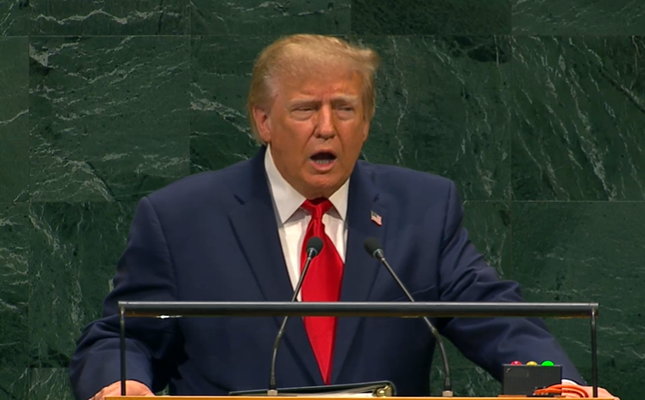
    Speaking from the floor of the 81st United Nations General Assembly in Manhattan on Tuesday, September 22, 2026, U.S. President Donald Trump has outlined a pivotal impending “big decision” on Iran, pitting a new negotiated agreement with Tehran against expanded military action that could target the very existence of the Islamic Republic, as regional tensions spill over to disrupt global energy markets.

    In his hard-hitting address to world leaders, Trump launched a sweeping condemnation of the Iranian government, framing it as the world’s leading state sponsor of terrorist activity. He argued that for more than half a century, the ruling regime in Tehran has fueled instability, violence, and bloodshed across the Middle East and beyond. “For 51 years, the fanatical Iranian regime has ruled by bloodshed and mass murder, spreading death and carnage and chaos across the entire Middle East and beyond,” Trump told the assembled delegates. “They were the bully of the Middle East, but they are the bully no more.”

    The president recounted that shortly after returning to office, his administration initiated bilateral talks with Iran, putting forward an offer of comprehensive economic collaboration in exchange for Tehran permanently abandoning its nuclear program and ending its financial and military support for militant groups across the region. According to Trump, that overture was flatly rejected by Iranian leaders. The breakdown of those negotiations, he said, opened the door to current U.S. military operations, which are backed by longstanding U.S. ally Israel.

    Trump emphasized that the core strategic goal of the ongoing campaign is to block Iran from crossing the threshold to develop a functional nuclear weapon, a red line he has repeatedly pledged to enforce. The escalating conflict has already generated ripple effects far outside the Middle East, most notably through widespread disruptions to commercial traffic through the Strait of Hormuz, the critical global chokepoint that carries roughly 20% of the world’s daily oil supply. Disruptions to shipping through the waterway have triggered widespread market anxiety over global energy security and upward pressure on crude oil prices.

    Citing recent media reports, Iran has signaled it would reopen the strategic strait to full commercial traffic within seven days if the U.S. draws down its military presence in the region and lifts its ongoing blockade of Iranian ports. Pushback against that claim came from Trump during his address, who noted that the U.S. Navy has now escorted more than one billion barrels of oil through the strait, and current shipping volumes are higher than they were at the peak of recent disruptions earlier in the conflict.

    The president also asserted that the U.S.-led military campaign has inflicted severe, lasting damage to Iran’s conventional military capabilities, including its naval forces, early-warning radar networks, air defense systems, ballistic missile stockpiles, and domestic drone production infrastructure. He used his address to praise the U.N. Security Council for its recent resolution condemning attacks on commercial shipping in the region and called on the international community to maintain coordinated pressure on Tehran to change its policy course.

    Turning to the core choice his administration now faces, Trump laid out both options clearly for the global audience. “Do I make a new deal?” he asked delegates, before offering the far more severe alternative: “Or do I annihilate the Islamic Republic and do it quickly, never giving them a chance to kill and destroy people and countries again?”

    Trump’s tough remarks came as both sides signaled continued openness to diplomatic progress. Iranian officials have already indicated they remain willing to return to negotiations under clearly defined terms, while U.S. Secretary of State Marco Rubio confirmed Tuesday that Washington is open to holding informal talks with Iranian representatives on the sidelines of the U.N. General Assembly, though no formal meeting had been scheduled as of Tuesday afternoon.

    According to reporting from Reuters, Trump told reporters he anticipates a potential agreement with Iran could be reached after the November 2026 U.S. midterm elections, even as he reiterated his commitment to maintaining harsh economic sanctions on Tehran in the interim. To date, the conflict remains at an impasse, with parallel diplomatic overtures and rising threats of further military escalation unfolding alongside growing global concern over sustained disruptions to energy supplies and international commercial shipping.

  • VN-top in New York onder druk: oorlogen, AI en klimaat bepalen agenda

    VN-top in New York onder druk: oorlogen, AI en klimaat bepalen agenda

    As ongoing armed conflicts, accelerating visible impacts of climate change, and outpacing artificial intelligence development outstrip the ability of global regulators to keep pace, more than 130 heads of state and government will convene in New York this week for the opening of the 81st United Nations General Assembly general debate. The high-stakes gathering comes at a moment of profound existential reckoning for the UN itself, as the organization grapples with urgent questions about its institutional role, long-term financial stability and future global relevance.

    Officially opening on September 22, this year’s assembly has been themed “Restoring trust, managing transformation: a United Nations that delivers for all.” The packed agenda covers nearly every major pressing global challenge: active conflicts in the Middle East, Ukraine and beyond, unfolding humanitarian crises in Sudan, the Democratic Republic of Congo and Myanmar, accelerating climate change, fragile global economic conditions, and growing global alarm over the unregulated development and deployment of artificial intelligence. Beyond these global issues, the assembly will also grapple with the future of the UN as an institution.

    ### Armed Conflicts Overshadow Diplomatic Progress
    Long-running conflicts dominate the opening conversation, casting a long shadow over diplomatic efforts. The standoff between the United States and Iran approaches its seventh month, the war in Ukraine is entering its fifth year, and the humanitarian situation in Gaza remains a top priority for debate. Ahead of the gathering, UN Secretary-General António Guterres has repeated urgent calls for strengthened international cooperation and de-escalation of global tensions, but the conflicts lay bare a core structural flaw at the heart of the UN: the body can facilitate diplomatic dialogue, but it lacks independent authority to force major powers to reach political resolutions.

    This gridlock is most visible in the UN Security Council, where the five permanent members — the United States, China, Russia, France and the United Kingdom — hold veto power over binding resolutions. When these major powers are divided on an issue, decisive action on conflicts and sanctions becomes nearly impossible. That dynamic was on full display just last week, when Russia and China jointly blocked a resolution to extend international sanctions monitoring on Iran, ending the mandate of an independent panel tasked with enforcing compliance.

    ### Key Absences Shape the Diplomatic Landscape
    One of the most notable features of this year’s General Assembly is not just who will speak, but who will not be present in person. U.S. President Donald Trump will address the assembly on Tuesday, alongside French President Emmanuel Macron. Ukrainian President Volodymyr Zelenskyy and new Iranian President Masoud Pezeshkian are scheduled to speak on Wednesday, with Israeli Prime Minister Benjamin Netanyahu addressing delegates on Thursday. Palestinian President Mahmoud Abbas will once again deliver his address via pre-recorded video, after the United States refused to grant him a travel visa to enter the country for the event.

    Major leaders including Chinese President Xi Jinping, Russian President Vladimir Putin and Indian Prime Minister Narendra Modi will not attend the gathering in person. Xi’s absence is particularly notable this year: he will instead travel to Washington for a high-profile state visit at Trump’s invitation September 23–25. The bilateral summit will cover U.S.-China relations and a range of pressing global issues, carrying its own diplomatic weight separate from the UN General Assembly. Key topics on the bilateral agenda include trade disputes, technology competition, artificial intelligence governance and access to strategic critical materials.

    ### Artificial Intelligence Moves to Center Stage
    Once a peripheral issue on the UN agenda, artificial intelligence governance has taken a prominent spot in this year’s debate. The rapid development of increasingly powerful AI systems has sparked urgent global discussion over safety risks, disinformation campaigns, cyber threats, military applications, and the risk that new systems could evolve faster than governments can implement effective regulatory frameworks.

    The UN Security Council will dedicate an official session this week to examining AI’s impact on international security, organized by France. OpenAI CEO Sam Altman is expected to brief the council on both the transformative opportunities and catastrophic risks of advanced AI. Notably, the AI industry itself is now pushing for binding international regulations. Just this week, OpenAI called for a U.S.-led international initiative to set technical safety standards for cutting-edge AI systems, including shared testing protocols, global shared standards and mandatory cross-border incident reporting systems.

    That approach faces significant pushback from the Trump administration, which has opposed regulatory measures that could slow AI innovation. The administration fears overbearing regulation would erode the United States’ current technological lead over China. The debate over AI therefore extends far beyond safety rules: it goes to the core question of how much international cooperation is possible between major powers that are simultaneously locked in fierce competition for global technological leadership.

    ### Climate Change: From Long-Term Threat to Daily Reality
    Climate action is another top priority for the assembly. On September 23, the UN will host a dedicated summit on climate action and a just global energy transition, followed by a separate high-level summit focused on the growing impacts of sea-level rise the following day. A decade after the landmark Paris Climate Agreement, the global conversation around climate change has shifted: no longer are delegates debating whether climate change is real and needs to be addressed, but instead how nations can adapt to the already visible and destructive impacts of a warming planet.

    For most developing nations, the priority is securing climate finance, building resilient infrastructure, protecting food security and shielding communities from extreme weather events. Wealthier major economies are meanwhile grappling with the rising costs of the energy transition and the fallout from disrupted global supply chains. The UN is working to tie climate action to broader global goals for sustainable development and poverty reduction.

    ### The UN Faces Its Own Period of Transition and Reform
    This year’s General Assembly highlights a core paradox: the global community is calling on the UN to tackle more global challenges than ever before, even as the organization faces severe institutional and financial instability. The UN is currently carrying out a broad reform process called UN80, designed to create a more efficient and coordinated global UN system. In April, the General Assembly passed a resolution to improve how institutional mandates are created, implemented and evaluated.

    Financial instability remains a persistent vulnerability. Just last week, the United States paid $725 million in overdue regular assessed contributions and an additional $102 million for UN peacekeeping operations, narrowly avoiding losing its voting rights in the General Assembly. Even after the payment, the U.S. still holds a large unpaid balance to the organization. These funding gaps do not just affect administrative operations: they can directly reduce the capacity of UN peacekeeping missions and global humanitarian aid programs.

    Beyond institutional and financial reform, the UN is also preparing for a leadership transition. Guterres is entering the final months of his second term as Secretary-General, which will end December 31, 2026, with a new leader set to take office in January 2027. The selection process is already in its late stages. Recent reports indicate that after multiple rounds of voting in the Security Council, leading candidates include Rebeca Grynspan of Costa Rica, Carolyn Rodrigues-Birkett of Guyana and María Fernanda Espinosa of Ecuador. Because the five permanent Security Council members hold veto power over the selection, the final choice remains tightly tied to the current balance of power between major global powers.

    ### A Critical Test for International Cooperation
    Despite widespread criticism of the UN’s gridlock and inefficiencies, the General Assembly remains a one-of-a-kind global diplomatic forum: all 193 UN member states hold a single seat and a single vote, and no other global body brings nearly every national government together at this scale. That said, the UN’s power to act has clear limits. The organization can facilitate negotiations, set global norms, and coordinate humanitarian aid, but it relies on member states — and most critically the willingness of major powers to cooperate — to implement its decisions.

    That makes this week’s gathering in New York less a moment to expect immediate, unified solutions to all global crises, and more a critical test of how much cross-border cooperation remains possible in an increasingly divided world. The core paradox of this moment is clear: at the exact time that conflicts, climate change and technological change make cross-border cooperation more necessary than ever, political divisions between the world’s most powerful nations are at their widest in decades.

    The coming days will reveal whether the UN General Assembly will merely serve as a public stage to display global division, or whether it can create space for concrete diplomatic progress on the world’s most pressing challenges.