作者: admin

  • PM Browne Tells US Financing Agency Antigua and Barbuda Prefers Local Ownership and Retained Profits

    PM Browne Tells US Financing Agency Antigua and Barbuda Prefers Local Ownership and Retained Profits

    As geopolitical competition for infrastructure influence intensifies across the Caribbean, Prime Minister Gaston Browne of Antigua and Barbuda has drawn a clear red line for international development financing: the small island nation will never cede full ownership of its critical national assets to foreign entities, even as it explores new funding options from the U.S. International Development Finance Corporation (DFC).

    The DFC, which is actively expanding its footprint in the Caribbean to offer regional governments a Western-backed alternative to Chinese infrastructure lending, recently sent a delegation to St. John’s to pitch its multibillion-dollar development funding pool. Initially, the Antigua and Barbuda government had its sights set on securing approximately $100 million in DFC financing to upgrade the country’s main port and boost its growing transshipment operations, a key driver of the national economy.

    But a core structural feature of DFC’s funding model quickly sparked concern from Browne’s administration. Unlike direct government-to-government lending, the DFC does not extend loans directly to sovereign states; instead, it channels capital to private sector actors looking to invest in emerging market projects. Browne warned that this framework would almost certainly lead to foreign corporations taking full control of strategically important national assets, with all profits generated from those investments sent overseas rather than reinvested in Antigua and Barbuda’s domestic economy.

    While the prime minister confirmed the government has not ruled out working with the DFC entirely, he emphasized that this private-sector led model is not Antigua and Barbuda’s preferred path forward. “I believe in domestic ownership. Ownership is empowerment,” Browne stated in a clear articulation of the government’s development philosophy.

    Browne drew a direct contrast between the DFC’s model and the concessional financing Antigua and Barbuda has previously secured from China for major infrastructure projects, including the country’s primary airport and seaport. Under the terms of those Chinese loans, Browne noted, Antigua and Barbuda retains full ownership of both the completed assets and all revenue they generate throughout the loan repayment period. “Our development model is one of ownership and retention of profits,” he said. “not one for opportunistic investments to facilitate the repatriation of profits.”

    The prime minister went a step further, framing foreign-controlled development as an extractive economic model that echoes the Caribbean’s centuries-long experience of colonial rule, when outside powers owned the region’s most productive assets and siphoned nearly all generated wealth out of local communities. Browne argued that the government’s preferred sovereign ownership model lets Antigua and Barbuda retain control of investment gains, keep revenue within national borders, and reinvest profits into ongoing social and economic development that benefits local citizens directly.

    Despite his strong reservations about the DFC’s standard financing structure, Browne noted that constructive discussions with the U.S. agency will continue. He added that the government remains open to exploring a modified joint ownership arrangement if proposed interest rates and other contractual terms are ultimately favorable to the small island nation.

    Browne’s public stance comes amid a sharpening geopolitical rivalry between the United States and China for economic and diplomatic influence across the Caribbean, a region that has historically been considered within Washington’s sphere of influence but has seen growing Chinese investment and diplomatic engagement over the past two decades.

  • Baird’s global legacy comes home to Arch Hall

    Baird’s global legacy comes home to Arch Hall

    In a heartfelt ceremony honoring a trailblazing thinker whose work reshaped global conversations around racial and cultural identity, the St. Thomas Parish Independence Committee of Barbados has unveiled a permanent commemorative sign celebrating the life and legacy of Dr. Keith Baird, a native-born Barbadian-American linguist, anthropologist, and educator.

    Born in the small Arch Hall community of St. Thomas, Dr. Baird passed away as one half of the pair of native intellectuals credited with popularizing the shift away from the term “Negro” to the Afrocentric descriptor “Afro-American” – a 1966 movement that redefined how Black communities name and see themselves. Working alongside activist and scholar Richard B. Moore, who laid out the case for terminological change in his 1960 text *The Name “Negro”: Its Origin and Evil Use*, Dr. Baird argued that the term “Negro” was inherently tied to the history of chattel slavery, created to dehumanize Black people by framing them as property fit for enslavement.

    At the core of Dr. Baird’s scholarship and activism was the concept of “semantic liberation” – the radical idea that marginalized communities have the inherent right to define the language used to describe themselves. He maintained that reclaiming self-nomenclature was a foundational step toward reclaiming cultural and historical identity, arguing that a deep connection to one’s ancestral roots was essential for both individual and collective advancement, particularly for communities targeted by systemic oppression and deliberate cultural erasure.

    Speaking at Sunday’s unveiling ceremony, Petra Ramsay-Rollock, chair of the St. Thomas Parish Independence Committee, emphasized the lasting impact of Dr. Baird’s work. “Baird believed that understanding one’s history and cultural roots was essential for personal and collective growth, particularly for communities that faced systemic oppression and cultural erasure. Baird has left an indelible mark on the world,” she said.

    Ramsay-Rollock underscored that Dr. Baird’s contributions brought new dignity and respect to how Black people are described globally, noting that his work reveals a deeper truth about the power of language: “His contributions continue to inspire those who seek to understand the profound connection between language, culture, and identity. Dr. Baird taught us that language is more than words; it is the heartbeat of a people, the vessel of our history, and the foundation of our independence.”

    Framing the new commemorative sign as more than just a memorial, Ramsay-Rollock explained that it stands as a beacon highlighting Barbados’ outsized impact on global racial justice discourse. “The sign is not just a marker; It is a beacon, reminding us that Barbados has produced minds that have shaped global conversations, and that Saint Thomas stands proudly as the birthplace of brilliance,” she added.

    Tyrell Giles, personal assistant to St. Thomas Member of Parliament and Home Affairs and Information Minister Gregory Nicholls, echoed that sentiment, calling on young Barbadians to follow Dr. Baird’s example by embracing their ancestral roots and taking pride in their unique identity. “As Barbados continues to strengthen its own sense of national identity, particularly among young people like myself and the two parish ambassadors, I dare say that there is much we can take from his example. Know where we come from, understand the sacrifices and achievements of those who came before us, take pride in our identity, and then we can use that foundation to help build something greater for those who will come after us,” Giles said.

    Giles further urged attendees to honor the legacy of past trailblazers while accepting the responsibility to lift up coming generations. “May his life remind us that our communities can produce thinkers, leaders, and change makers whose ideas can reach the world. As we honour the past, may we also accept our responsibility to inspire the future. May the legacy of Dr Baird continue to be a pillar of strength and a pillar of progress,” he said.

    Dr. Baird’s daughter, Diana Baird N’Diaye, who attended the ceremony alongside her son, warned of ongoing efforts in the United States to erase the progress Black communities have made in advancing self-determination and recognizing the contributions of people of African descent. “There’s a whole lot of things going on that would want to erase the progress that has been made to erase the contributions of people of African-American or people of African descent, but know that that cannot be erased. That, as my dad used to recognise, we are an international people who share roots on the continent, and those roots can never be erased,” she said.

    She stressed that her father’s work remains a reminder of the enduring importance of solidarity, self-knowledge, education, and intergenerational connection to cultural heritage. To mark the occasion, Baird N’Diaye donated a collection of her father’s original poetry, titled *Signs and Wonders*, along with personal family photographs to the Arch Hall community, fulfilling what she said would have been her father’s wish to leave his work in his place of birth.

    The event drew dozens of Arch Hall residents, family members, and local leaders, all gathered to celebrate the life of a scholar whose work transformed understandings of language, identity, and Black liberation across the African diaspora.

  • Casimir touts sports record following World, CAC gains

    Casimir touts sports record following World, CAC gains

    Against the backdrop of a string of standout performances by Saint Lucian athletes at top-tier international competitions, the island nation’s Minister for Youth Development and Sports Kenson Casimir has publicly credited the current Pierre administration for building a supportive ecosystem that has driven this wave of sporting success.

    Speaking to journalists during the pre-Cabinet press briefing held on Monday, Casimir — who traveled to Santo Domingo to attend the recent Central American and Caribbean (CAC) Games — drew a direct line between the government’s policy investments and the tangible results achieved by local competitors on the global stage.

    The recent run of results speaks for itself: Saint Lucia’s national netball squad claimed a bronze medal at the CAC Games, sailor Luc Chevrier secured a silver medal in his event, and rising sprinter Jady Emmanuel turned heads at the Under-20 World Championships in Eugene, Oregon. Emmanuel not only finished 8th in the competition but also set a new national record of 11.28 seconds in the 100-meter event, marking a new milestone for the country’s track and field program.

    Outlining the breadth of the administration’s achievements over its current term, Casimir told reporters that under this government, Saint Lucia has won medals at nearly every major global multi-sport event, with just one exception. “We can see that we have an Olympic medal too. We can see that we have CAC medals. We can see the Pan-American, Commonwealth; we have done well at every global event. I don’t think any government could boast of that level of achievement in sport in a five-year period except one,” he said.

    Despite celebrating this unprecedented winning streak, the minister stopped short of declaring the national sports sector fully developed, acknowledging that meaningful work remains to elevate competitive standards across all sports — particularly men’s and women’s football.

    “The only sport that we’ve not dominated on a global level as yet is football,” Casimir acknowledged. But he expressed cautious confidence in the long-term trajectory of the sport, noting that the current government has already committed more public and private investment to football development than any preceding administration in the country’s history. “But we will get there. You know we are putting in the work. This government has certainly invested in football more than any government has in our history, and we’re certainly expecting very soon to reap those rewards,” he added.

  • PM Says US Visa Restrictions Could Help Antigua Retain Skilled Workers

    PM Says US Visa Restrictions Could Help Antigua Retain Skilled Workers

    Against the backdrop of a sweeping shift in United States immigration policy, Antigua and Barbuda Prime Minister Gaston Browne has offered a surprising perspective on incoming tighter visa restrictions, arguing the rules could deliver an unplanned upside for the small Caribbean nation. Speaking during his regularly scheduled weekly radio address, Browne acknowledged that the new measures – most notably a proposed visa bond that could require some applicants to put down between $10,000 and $20,000 – would create significant hurdles for many citizens of Antigua and Barbuda seeking to travel to the US. But he urged local residents to remain calm and patient as Washington continues to reshape its global immigration framework. “I always believe in being positive and in every disappointment, it’s a blessing,” Browne told listeners. “There’ll be many blessings as a result of this new U.S. policy.” For decades, Antigua and Barbuda has grappled with persistent brain drain, a crisis that has seen thousands of the country’s most skilled professionals leave for opportunities abroad immediately after earning their academic and professional qualifications. Browne pointed out that tougher US visa rules would likely deter many of these workers from relocating, allowing the country to retain talent it invests heavily in training. The proposed visa bond at the center of current discussions is not a blanket requirement, the prime minister clarified. The fee would only be applied to applicants that US authorities deem to carry a higher risk of overstaying their approved visa terms, rather than applying to all Antigua and Barbuda citizens seeking entry to the US. Even as he highlighted this potential long-term benefit, Browne made clear that his administration remains opposed to the restrictive new measures and will continue diplomatic efforts to roll back the changes that impact his country’s citizens. He confirmed that he has already sent a formal letter to former US President Donald Trump requesting a full review of the policy, and that his government will keep advocating on behalf of any Antigua and Barbuda citizens affected by the tighter rules. Browne also pushed back against any speculation that the new restrictions are a targeted response to actions taken by his administration. Instead, he framed the changes as part of a broader national realignment of US immigration policy that all Caribbean nations need to acknowledge and adapt to. Regional governments, he argued, must proactively prepare for the new regulatory landscape and adjust their own domestic policies to account for tighter US entry rules.”

  • UDP Locks In Dangriga, Benque Mayoral Bets for 2027

    UDP Locks In Dangriga, Benque Mayoral Bets for 2027

    Over the weekend, Belize’s United Democratic Party (UDP) finalized its candidates for two key mayoral races ahead of the 2027 municipal elections, locking in nominees to represent the party in the constituencies of Dangriga and Benque Viejo del Carmen.

    In Dangriga, party delegates gathered Sunday for a nomination convention where Dwayne Sampson secured an overwhelming victory to claim the UDP mayoral banner. Sampson defeated challenger Christalyn Castillo by a wide margin, taking 687 votes to Castillo’s 195, with total convention turnout reaching 886 eligible voters. This nomination marks a significant turning point in Sampson’s political career: after two prior runs for municipal office as an independent candidate, 2027 will mark his first campaign competing under a major party’s banner.

    Speaking to local outlet News 5 following his win, Sampson emphasized his long-standing commitment to the Dangriga community, noting, “I’ve been a community servant for almost two decades, so the support is good.” Looking ahead to the general election campaign, Sampson has already laid out two core policy priorities that will anchor his platform: expanding and promoting cultural tourism in the coastal Stann Creek District capital, a region renowned for its Garifuna cultural heritage, and establishing a new community outreach initiative he calls “clinic days.” These regular public sessions will allow municipal councillors to meet directly with residents, listen to local concerns, and address neighborhood issues in a transparent, accessible format.

    Across the country in the western border town of Benque Viejo del Carmen, another nomination convention saw Yusuf Guerra secure the UDP mayoral nomination, defeating opponent Danette Mendez by a lopsided 405 to 119 vote margin. In a show of party unity, Mendez will remain on the UDP municipal ticket for 2027, taking the sixth and final councillor spot on Guerra’s slate.

    With both nominations now official, Sampson and Guerra will lead their respective UDP municipal teams into the 2027 general municipal elections, where they will compete against candidates from opposing parties to claim control of the two town governments.

  • Eerste cao tussen IWWO en DP World Paramaribo rond

    Eerste cao tussen IWWO en DP World Paramaribo rond

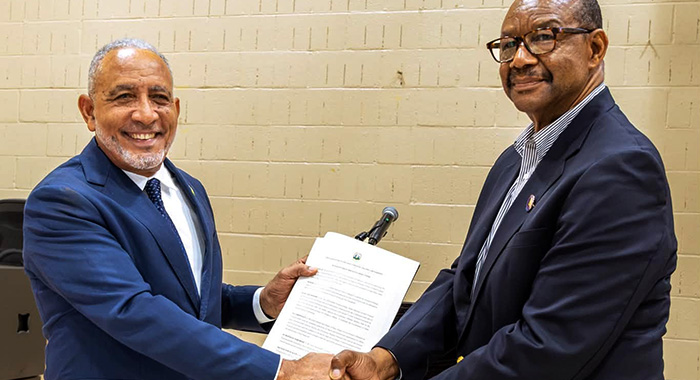
    After more than a year of structured negotiations, the Integra/DP World Workers Organization (IWWO) and DP World’s Paramaribo operations have finalized and agreed to their first-ever collective labor agreement, a landmark deal that establishes a formal framework for labor-management relations at the South American port facility.

    Robby Berenstein, chairperson of IWWO and the figure identified second from left in accompanying photos of the negotiations, called the new agreement a critical foundational milestone for future collaboration between the port’s workforce and its executive leadership. Negotiations for the deal were first launched in June 2025, when representatives from IWWO’s governing board and DP World Paramaribo’s management came together to draft an initial outline that set core priorities and ground rules for talks. By March 2026, the parties had produced a fully developed draft agreement complete with specific, binding clauses and operational provisions.

    Berenstein emphasized that the entire negotiation process unfolded in a constructive, collaborative atmosphere. He credited open dialogue, mutual trust, and a shared commitment to crafting a modern, balanced agreement that meets the needs of both sides for the efficient, successful completion of talks. “We are delighted that this process has resulted in an agreement that aligns with the needs of today and prepares us to address the challenges of tomorrow,” Berenstein stated in remarks following the finalization of the deal.

    DP World Paramaribo’s negotiation team was led by a cross-functional group of senior leaders including People Manager Xamira Visser, Chief Executive Officer Mervel Kotzebue, and Shalinie Ramdjas, Employee Engagement and Compensation Human Resources Business Partner.

    As the first formal collective bargaining agreement between the two organizations, particular focus was placed throughout negotiations on striking a fair, sustainable balance between the interests of the port’s 83 IWWO member workers and the operational needs of DP World as the employer. The finalized accord formalizes agreements on a range of core workplace issues, including employment terms, worker rights, and shared responsibilities for both parties.

    For IWWO, the new agreement also represents a key step forward in professionalizing formal social dialogue within DP World Paramaribo. The organization says the deal will serve as a enduring framework for long-term sustainable labor relations, tying together worker interests, business growth, and constructive social partnership between management and the workforce. Currently, IWWO counts 83 registered members among DP World Paramaribo’s staff.

  • CDB pledges US$1 million to Venezuela earthquake recovery fund

    CDB pledges US$1 million to Venezuela earthquake recovery fund

    A devastating series of earthquakes that struck Venezuela in late June 2026 has prompted an outpouring of regional solidarity, with the Caribbean Development Bank (CDB) approving a $1 million contribution to support the country’s recovery and reconstruction.

    The June 24 quakes left a tragic trail of destruction across multiple regions of Venezuela, claiming lives, forcing thousands of residents from their homes, and causing severe damage to critical public and private infrastructure. Just 48 hours after the disaster struck, the Development Bank of Latin America and the Caribbean (CAF) moved quickly to establish a dedicated Venezuela Recovery and Reconstruction Fund, designed to centralize international donations and coordinate relief efforts in line with priorities set by the Venezuelan government. The fund is structured to provide a transparent, accountable framework for governments, multilateral institutions, and other partner organizations to channel support to recovery initiatives.

    CDB’s Board of Directors has formally approved the $1 million pledge, which will be deposited into CAF’s dedicated fund, the regional bank confirmed in an official press statement. For CDB, the contribution is more than just humanitarian assistance — it is a reaffirmation of longstanding regional ties and the importance of collective action when neighboring nations face crisis.

    “In the immediate aftermath of this tragedy, the Caribbean Development Bank determined that we had to respond,” said CDB President Daniel M. Best. “Venezuela is a longstanding member of our institution and a country that has consistently and meaningfully supported the people and nations of the Caribbean over many decades. At this moment of profound loss and hardship, it is important that we stand in solidarity with the Government and people of Venezuela and provide support as they begin the challenging process of rebuilding.”

    Best praised the CDB Board of Directors for their swift approval of the contribution, noting that the partnership with CAF sets a powerful example of collaborative action among multilateral institutions during humanitarian emergencies. “Our collaboration with CAF through their recovery mechanism demonstrates how multilateral institutions can work together innovatively to respond effectively to humanitarian crises and support long-term recovery,” he added. “Equally important, this initiative provides an opportunity for the Bank to support a regional non-borrowing member in its time of greatest need, reaffirming that regional solidarity extends beyond traditional financing relationships.”

    CAF Executive President Sergio Díaz-Granados welcomed CDB’s landmark contribution, expressing hope that the pledge will encourage other international and regional partners to commit resources to the recovery effort. “We deeply welcome and thank the Caribbean Development Bank for this historic $1 million contribution to our Recovery and Reconstruction Fund,” Díaz-Granados said. “This contribution will directly support priority recovery efforts, and we hope it inspires other partners to join this collective endeavour. Our commitment is to ensure that every dollar entrusted to this Fund translates into tangible relief and lasting reconstruction for the Venezuelan people.”

    Venezuela’s CDB Governor, Ambassador Raúl Octavio Li Causi Perez, also extended gratitude for the show of regional solidarity. “As Governor of the Caribbean Development Bank for Venezuela, I wish to express our sincere appreciation to the Bank’s Board of Directors, its President, and all CDB member countries for this extraordinary demonstration of solidarity with the people of Venezuela,” Ambassador Li Causi Perez said. “This contribution reaffirms that regional cooperation and integration are at their strongest when they respond to moments of greatest need.”

    He added: “Venezuela deeply values this expression of confidence and support, which will contribute to the recovery and reconstruction of the affected communities. We receive it with gratitude and with the conviction that, together with our Caribbean partners and institutions such as the Caribbean Development Bank and CAF, we will continue advancing a shared agenda founded on solidarity, resilience, and sustainable regional development.”

    Per CAF’s framework, the recovery fund will allocate financing across three core areas: immediate emergency and humanitarian aid for affected communities, restoration of critical essential services and damaged infrastructure, and long-term projects designed to boost recovery speed, reconstruction quality, and community resilience against future disasters.

  • Taking Belize’s Environmental Message From the Office to the Philippines

    Taking Belize’s Environmental Message From the Office to the Philippines

    On a Saturday night in early August, 25-year-old biologist and biodiversity professional Vashti Thompson claimed the Miss Earth Belize 2026 crown, earning the opportunity to bring her country’s urgent environmental advocacy to the global stage at the upcoming Miss Earth 2026 international pageant, hosted this November 14 in the Philippines.

    Unlike traditional beauty competitions, Miss Earth centers its mission on elevating climate and conservation action, a mission that aligns perfectly with Thompson’s daily professional and personal work. Holding a bachelor’s degree in biology, Thompson currently serves as a community officer at Belize’s National Biodiversity Office, where she already spends much of her time leading grassroots education efforts to teach local communities how to protect the country’s rich natural resources and unique ecosystems.

    In an interview with local outlet News 5, Thompson emphasized that the pageant’s environmental focus makes it a far better fit for her core values than any other beauty competition. “Miss Earth is an environmentally conscious pageant, and it has value within being an advocate for our environment, which is something that I already do and embody day-to-day. It’s really something that I’m true to, so I believe this pageant aligned with my values more than any other pageant,” she explained.

    Through her years of on-the-ground community work, Thompson has identified one of Belize’s most pressing environmental gaps: widespread lack of public environmental education. She points to ongoing crises plaguing the country, including pervasive plastic pollution and growing human-wildlife conflict, issues that she argues could be substantially mitigated if the general public had clearer knowledge of existing environmental regulations and the penalties for violating conservation laws.

    “The public needs to know this, not just environmentalists, not just scientists, everyone,” Thompson stressed, underscoring her belief that inclusive public outreach is the foundation of meaningful environmental progress.

    Thompson will depart Belize at the end of October to join a full month of preliminary pageant activities across the Philippines, ahead of the main international competition in mid-November. Speaking about her new role as national representative, Thompson shared that she carries the Miss Earth Belize crown with deep pride, and is eager to connect with other like-minded eco-conscious delegates from across the globe. While she acknowledged that intensive preparation and training will be required ahead of the international event, she made clear she is fully ready to take on the challenge and amplify Belize’s environmental message worldwide.

  • Waitukubuli Artist Association wraps three-week artistic exchange between Dominica and Martinique

    Waitukubuli Artist Association wraps three-week artistic exchange between Dominica and Martinique

    A landmark cross-regional artistic exchange initiative has wrapped up its three-week run in Dominica, bringing measurable cultural, educational and collaborative gains to the island’s creative community. The Waitukubuli Artist Association (WAA), the organizer of the project, recently confirmed the successful completion of the Dominica-Martinique Residency, which hosted acclaimed Martinican visual artist Kevin Jérémie — known professionally as JKing — for a packed schedule of studio creation, community outreach and intercultural dialogue.

    Funded by the Caribbean Culture Fund (CCF) and hosted in partnership with local accommodation provider Caapi Cottages, the residency centered its creative exploration on pressing and identity-defining themes shared across the Caribbean: climate resilience, extraordinary regional biodiversity, distinct cultural identity, and the deep ancestral connection between Caribbean people and their natural landscapes. Throughout his stay on the island, JKing balanced individual creative practice with collaborative engagement, working side-by-side with established local Dominican artists to exchange technical skills and creative perspectives.

    As part of the residency’s community-focused mission, JKing led a hands-on creative workshop for students at Soufrière Primary School, where he introduced young learners to new artistic techniques and encouraged them to explore their own creativity. Beyond the classroom, the visiting artist immersed himself in Dominica’s unique cultural heritage: he studied traditional Carnival costume construction from local artisans and traveled to Grand Fond to deepen his understanding of the island’s foundational Maroon history. Drawing direct inspiration from Dominica’s dramatic natural scenery, including its rushing rivers, lush rainforests and rugged Atlantic coastlines, JKing produced a body of entirely new work during his residency.

    The initiative has left multiple lasting creative legacies for the island. A permanent outdoor mural, created as part of the project, now stands near Caapi Cottages, serving as a public reminder of the cross-island collaboration. The residency also generated co-created art pieces involving both WAA member artists and the Soufrière Primary students, as well as a collection of sculptural works crafted from driftwood JKing and collaborators collected along Rosalie Bay.

    The workshop’s impact on young participants has been particularly notable, with educators and students alike expressing widespread enthusiasm. “I wish we did art like that every day,” one student told organizers, while another asked a teacher, “Can they come back tomorrow, Miss?” Sharing observations of the program, one local teacher noted: “The kids were actually asking me if they could do another painting. They were so engaged throughout the workshop, and it was wonderful to see their enthusiasm and creativity.”

    To extend the project’s reach beyond Dominica, JKing documented his entire experience through daily video blogs posted to his Instagram account, allowing followers across the Caribbean and global audiences to follow his creative journey and learn more about Dominica’s unique culture and natural beauty.

    WAA President Michael Lees emphasized that the residency is just one component of a growing regional collaborative network the association launched in 2025, alongside partner cultural organizations Twossaints, Station Culturelle, and Association Zofi based in Martinique and St. Lucia. Lees noted that early efforts at regional creative integration have already delivered tangible benefits for all participating islands. “Our Dominican artists have been able to see internationally renowned work in Martinique and had access to training, techniques and ideas we wouldn’t have otherwise,” Lees explained. “And likewise, artists from abroad like JKing have been able to come to Dominica and get inspired by the nature, the culture, and the spirit of collaboration present amongst our artists and our people.”

    Lees framed the initiative as an important early step toward building a connected cross-island creative economy, a model that has already delivered success in other Caribbean nations such as Jamaica. “We see this as opening opportunities both for artists, but also for the many others who will benefit from a strong Creative sector,” he said. “It all starts with education, so exposing schoolchildren to the arts is a central pillar of this mission.”

    Looking ahead, WAA is already developing the next phase of its regional collaborative work, with plans for additional reciprocal artist exchange programs, joint skill-building workshops, and a travelling exhibition showcasing work created through these cross-border partnerships. The association has expressed its sincere gratitude to the CCF for its ongoing support, noting that two additional collaborative projects are currently underway with funding from the organization. WAA also extended thanks to Caapi Cottages, participating schools, local community members, and all participating artists who contributed time, resources and expertise to make the residency a success.

  • Saint Lucian surfers target World Juniors in September

    Saint Lucian surfers target World Juniors in September

    After a year of targeted preparation and growth following their 2024 championship debut, the small Caribbean island nation of Saint Lucia is set to make its second appearance on one of surfing’s most prestigious global stages next month. The Saint Lucia Surfing Association (SLSA) has officially announced its three-person roster that will compete at the International Surfing Association (ISA) World Junior Championship, hosted this year at the iconic Surf City surf breaks of El Salvador.

    Running from September 4 to 13, the 2025 championship will bring together more than 400 of the world’s top young surfers, all aged 17 and under, representing over 50 nations across the globe. Athletes will test their skills across two distinct venues: La Bocana and El Sunzal, two of El Salvador’s most renowned surf spots that regularly host elite international surfing competitions. Competitors will travel from surfing powerhouses including Australia and South Africa, as well as fellow Caribbean nations, to contest age-group titles.

    The Saint Lucian delegation is built around a tight-knit core of young talent. Sebastian Rambally-Ambler will captain the squad, competing in the Under-18 division. His brother Daniel Rambally-Ambler will pull double duty, entering both the Under-16 and Under-18 categories, while William Verity rounds out the roster as the third competitor in the Under-18 division.

    This year’s tournament marks only the second time Saint Lucia has fielded a team at the global junior surfing championship. The nation made its debut at the 2024 event held in Peru, where Sebastian and Daniel Rambally-Ambler competed but were eliminated following the preliminary round. Rather than stepping back from the challenge, the SLSA doubled down on investment in its young athletes, launching an intensive development program to help the team raise their competitive level ahead of the 2025 event.

    Beyond consistent training at their home surf breaks, the team has traveled across the Americas to train at some of the hemisphere’s top surfing destinations to gain experience in varying conditions. They have logged training sessions at Oz Surf School in Jacó, Costa Rica, at Peru’s famed Tubos break in Lima, and at the legendary Trestles complex in Southern California. Under new head coach Brett Prinz, the program has expanded beyond in-water practice to add structured physical conditioning, in-depth video performance analysis, and focused skill-specific training to refine the athletes’ competitive edge.

    For the Saint Lucian surfing community, the team’s journey to El Salvador carries far more meaning than just a shot at a medal. Shaid Rambally, president of the SLSA and the team’s manager for the championship, framed the participation as a milestone for the growth of the sport on the island. “This journey represents more than competition; it is a celebration of perseverance, teamwork and the continued growth of surfing in Saint Lucia,” he said.

    Rambally added that the association is deeply proud of the young team that will carry the nation’s flag into the competition against the world’s best junior surfers. “We are incredibly proud of our national team and wish them the very best as they compete against the world’s top junior surfers while flying the Saint Lucian flag with pride,” he said. “Thank you to our coaches, families, sponsors, supporters and the entire surfing community for helping make this journey possible. Together, we continue to build the future of surfing in Saint Lucia.”

    The team’s motto, “Small Island. Big Dreams. One Team.” sums up the nation’s approach to its second appearance on the global junior surfing stage, reflecting the ambition of a small community working to build a lasting legacy in the sport.