作者: admin

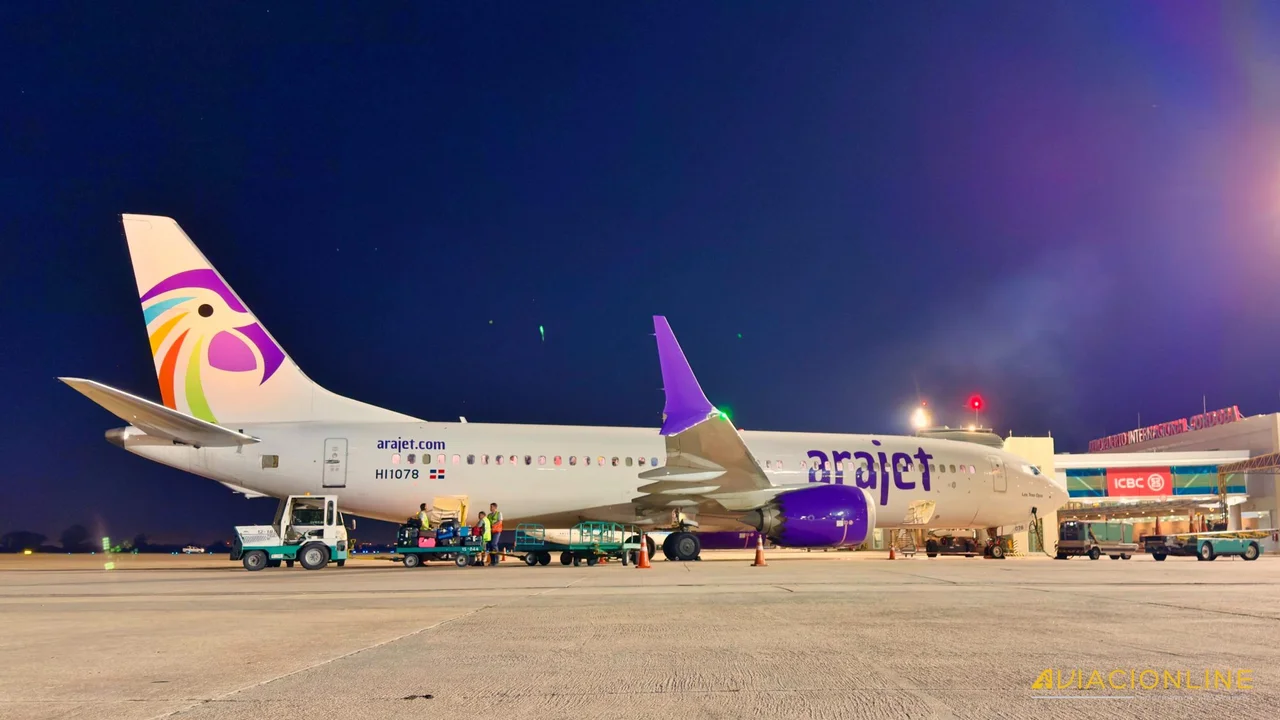
  • Arajet transports nearly half a million passengers in first quarter

    Arajet transports nearly half a million passengers in first quarter

    Santo Domingo – The Dominican Republic’s homegrown ultra-low-cost carrier Arajet has solidified its standing as a fast-growing player in the Caribbean aviation sector, after official data from the country’s Civil Aviation Board (JAC) confirmed a historic surge in passenger volumes through the first three months of 2026.

    Between January and March, the airline carried a total of 496,218 passengers, counting both direct and connecting itineraries. The winter travel period delivered robust demand, with January posting the highest passenger numbers of the quarter, followed closely by March as strong travel trends held steady into the start of the spring season.

    This performance marks a major milestone for the young carrier, pushing it up the ranks to become the fourth-largest airline operating in the Dominican Republic by passenger volume. It currently trails only three major U.S. carriers: JetBlue, American Airlines, and Delta Air Lines, in that order.

    In a statement following the release of JAC’s data, Arajet CEO Víctor Pacheco outlined the company’s ambitious long-term goals for 2026 and beyond. Pacheco confirmed that the airline is on track to hit its annual target of moving more than 2 million total passengers by the end of the calendar year, while working to elevate the Dominican Republic’s status as a central connectivity hub for the entire Caribbean and Latin American region.

    Route data from the airline shows that New York remains the most popular destination for Arajet passengers, followed closely by Buenos Aires, Miami, Medellín, and Bogotá to round out the top five busiest routes. By volume, 25% of all Arajet passengers in the first quarter traveled to or from the United States, a trend that industry analysts attribute in large part to the bilateral open skies agreement between the two nations, which has expanded route access and lowered fares for travelers. Colombia and Argentina round out the carrier’s three largest international markets after the U.S.

    Looking ahead, Arajet confirmed that it will press forward with planned network expansion, adding new routes across the Americas to drive increased tourist arrivals, support cross-border trade, and boost air connectivity for Dominican residents and international visitors alike.

  • Floating Bridge over Ozama River to close for two hours Saturday

    Floating Bridge over Ozama River to close for two hours Saturday

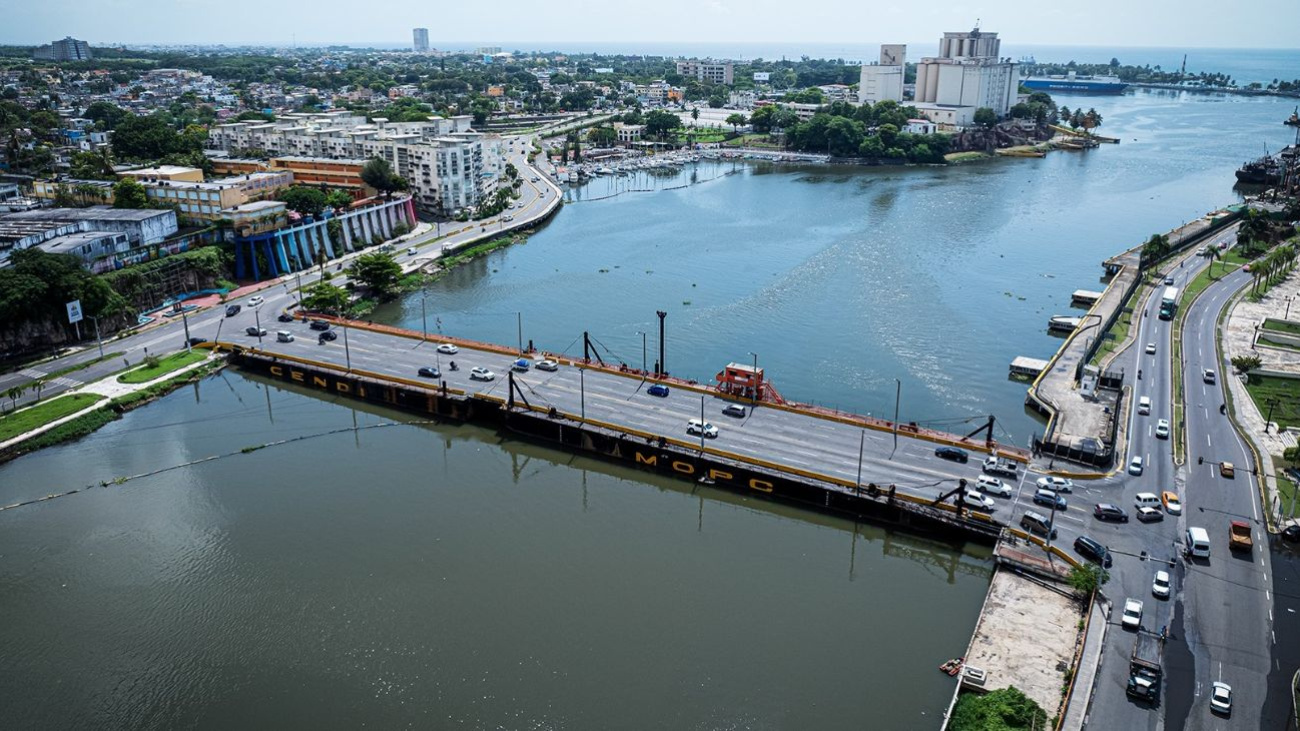
    Authorities in Santo Domingo have announced a temporary two-hour shutdown of the floating bridge spanning the Ozama River, set to take effect on Saturday, April 18. The Ministry of Public Works and Communications (MOPC) confirmed that all vehicle traffic will be barred from the crossing between 10:00 a.m. and 12:00 p.m. local time to accommodate the passage of a large marine vessel.

    The scheduled closure is directly tied to the transit of the cargo ship MV Green Chief, which is en route to the MYD Marine Repairs facility to undergo scheduled routine maintenance. While the bridge is closed, the key connection between the National District, at the heart of the Dominican capital, and Villa Duarte, located in the municipality of Santo Domingo East, will be completely unavailable to motorists.

    Local transportation officials have issued a public advisory urging all drivers planning to travel between the two regions during the closure window to plan ahead and use alternate crossing points. The recommended alternative bridges for detours are the Matías Ramón Mella Bridge, Juan Pablo Duarte Bridge, and Juan Bosch Bridge, all of which will remain open to accommodate the diverted traffic throughout the two-hour shutdown.

  • AERODOM begins runway upgrade at Las Américas Airport

    AERODOM begins runway upgrade at Las Américas Airport

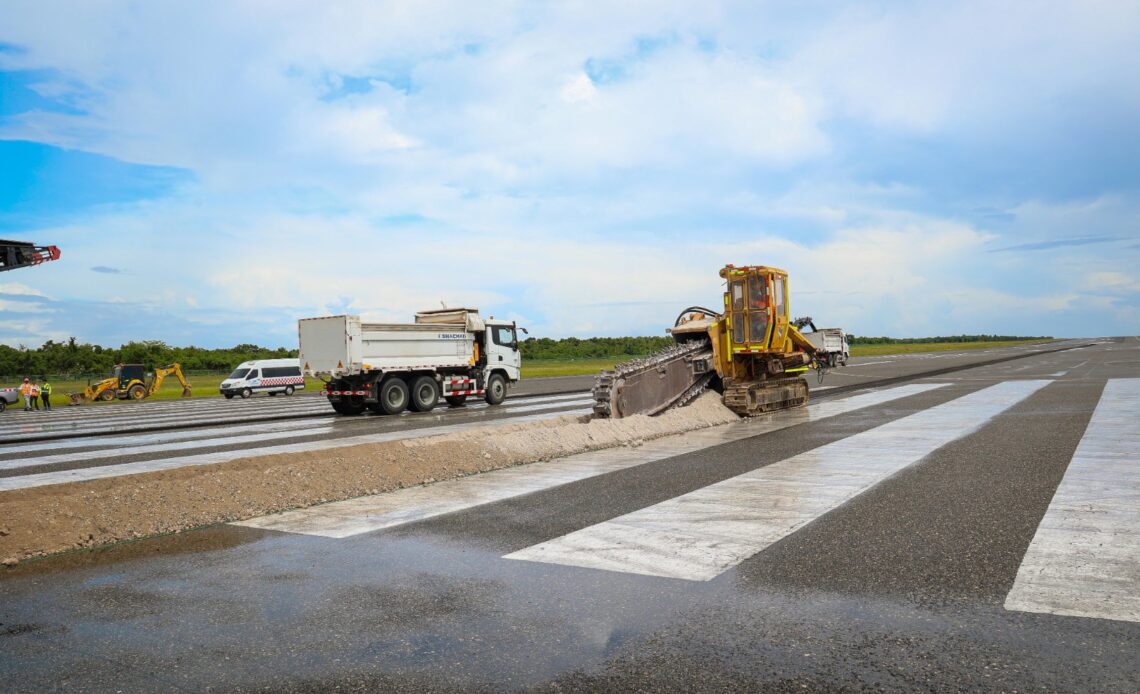
    Santo Domingo – A major infrastructure upgrade is officially underway at one of the Dominican Republic’s busiest air transit hubs, as airport operator AERODOM, a member of the global VINCI Airports network, has launched comprehensive rehabilitation works for Runway 17-35 at Las Américas International Airport (AILA). The overarching goal of the multi-month project is to elevate both aviation safety standards and the airport’s overall operational efficiency.

    The scope of the renovation covers a series of critical upgrades, starting with pavement milling across the runway’s central section, targeted structural repairs to address wear and tear, and the installation of a brand-new asphalt overlay to restore the runway’s structural integrity. Additional complementary upgrades include a full overhaul of the runway’s drainage systems and the replacement of outdated navigational markings to meet current international aviation standards.

    With a total investment of approximately $20 million, the project is scheduled for completion between April and August 2026. Notably, airport planners have designed the construction timeline to avoid interruptions to regular commercial and passenger flight operations. During the rehabilitation works, a pre-existing taxiway will be reconfigured to serve as a temporary alternate runway, allowing AILA to maintain its full flight schedule without disruption to travelers or airlines.

    To mark the official launch of the initiative, senior representatives from the Dominican Republic’s civil aviation authority, alongside AERODOM executives and lead construction contractors, completed a joint technical inspection of the worksite to confirm that all pre-construction safety and preparation protocols have been met.

    Industry and government officials project that the completed rehabilitation will extend the operational lifespan of Runway 17-35 by a minimum of 15 years. This upgrade is just one component of a far broader, long-term modernization strategy for Las Américas International Airport, which also includes the development of a new passenger terminal designed to accommodate up to four million additional travelers annually. When fully completed, the full modernization plan is expected to significantly strengthen the Dominican Republic’s regional and global air connectivity, supporting continued growth in the country’s key tourism and trade sectors.

  • Downtown Center reports gas leak, confirms no injuries

    Downtown Center reports gas leak, confirms no injuries

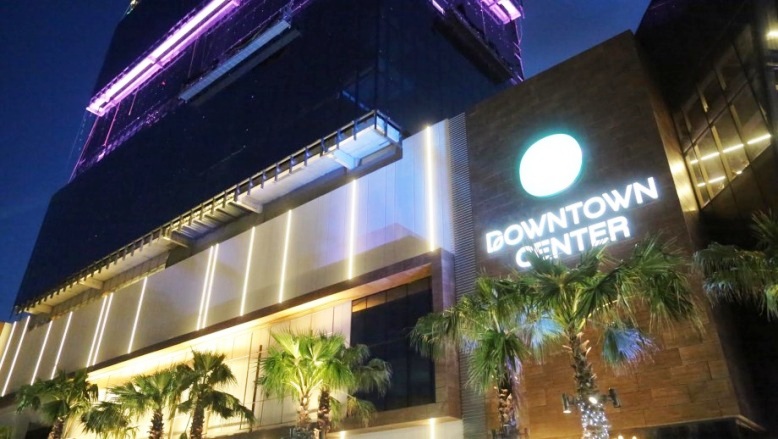
    On the morning of April 17, an unexpected gas leak was detected at the Downtown Center shopping complex in Santo Domingo, triggering an immediate coordinated response from on-site management and local emergency services. As soon as the leak was confirmed, facility leadership rapidly activated pre-planned emergency response and evacuation protocols, moving quickly to clear affected zones and secure the perimeter to prevent avoidable risks to people on the property.

    Thanks to the swift, well-rehearsed action from mall staff and responding authorities, the leak was fully contained in a short timeframe, preventing any harm to the hundreds of visitors, retail employees, and commercial tenants present at the center. In an official statement released following the incident, mall representatives confirmed that no injuries or major secondary incidents had occurred, crediting proactive emergency planning and rapid collaboration for the positive outcome.

    In the days following the containment, specialized technical inspection teams have remained on site, conducting thorough structural and system assessments to pinpoint the root cause of the leak. Inspectors are systematically checking gas lines, connection points, and related infrastructure to identify any flaws, damage, or maintenance failures that may have contributed to the event. Once assessments are complete, teams will carry out any necessary repairs to fully restore safe operating conditions across the entire facility.

    Mall management has confirmed that it will maintain transparent communication with the public throughout the investigation and repair process, releasing regular updates through its official social media channels and website as more details become available.

  • Dominican delegation studies U.S. aviation technology at SUN ’n FUN

    Dominican delegation studies U.S. aviation technology at SUN ’n FUN

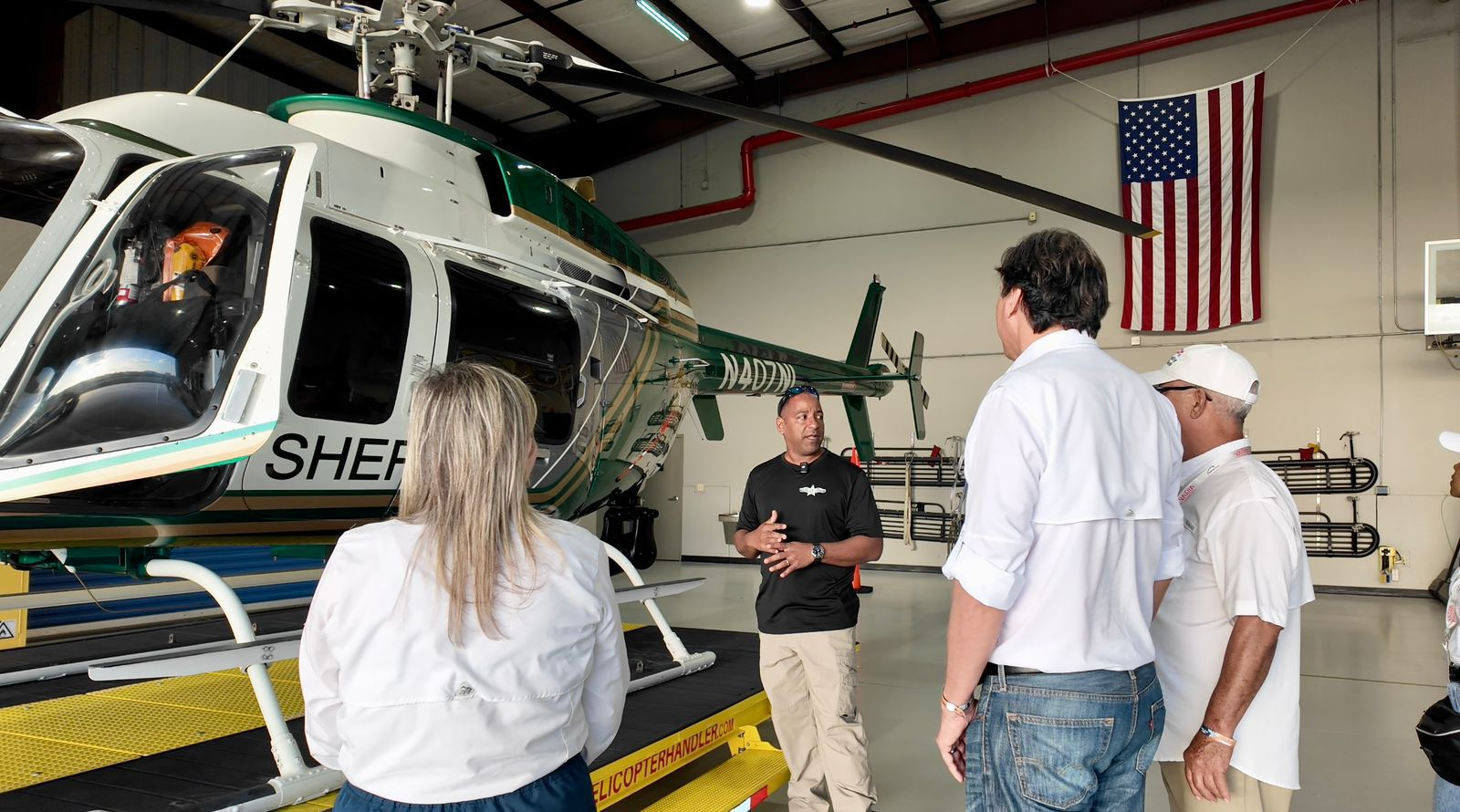
    Against the backdrop of the 2026 SUN ‘n FUN Aerospace Expo, a major global gathering for aviation innovation and industry collaboration, a high-level delegation from the Dominican Republic’s Airport Department traveled to Orlando this week to tour the aviation division of the Orange County Sheriff’s Office. The technical visit was spearheaded by Fenris Plácido, a Dominican-born pilot with an established career within the sheriff’s office aviation unit, a role that stands as a prominent example of Dominican aerospace talent succeeding on the international stage.

  • Patria: The Southern Frontline of Communication

    Patria: The Southern Frontline of Communication

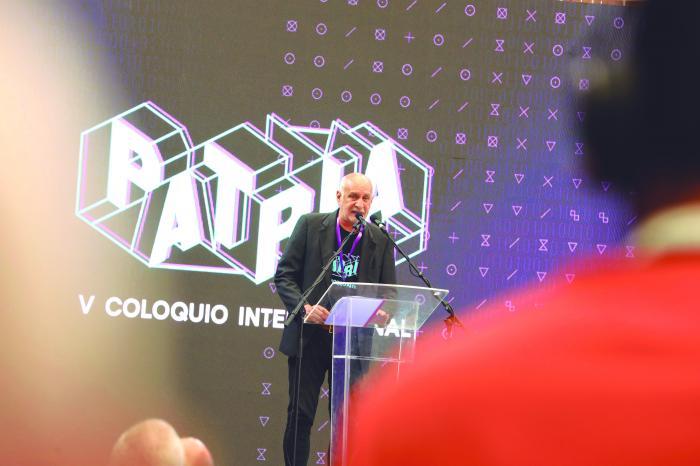
    Against a backdrop of rising neo-fascist mobilization, systemic media manipulation, and a resurgence of imperial intervention across Latin America, the fifth edition of the Patria International Colloquium has opened its doors in Havana, casting digital communication as a critical frontline battle for sovereignty and truth.

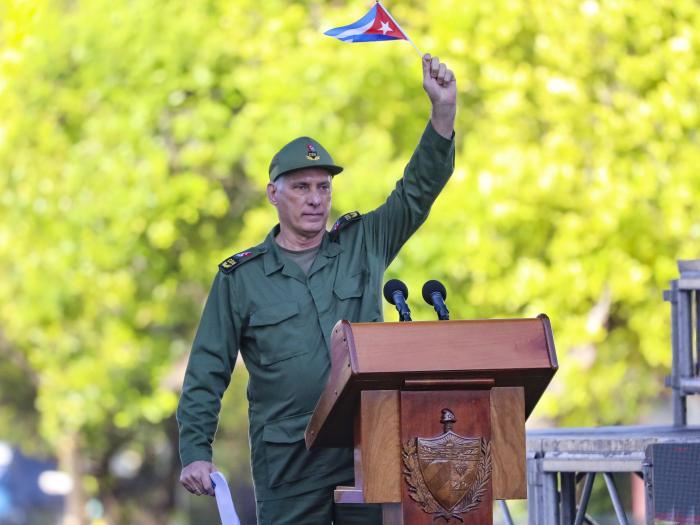
    Hosted through April 18 at Havana’s Cultural Station on the corner of Línea and 18th Street, the 2026 gathering brings 150 delegates from more than 20 countries together to build collective capacity for truth-telling, cross-border organizing, and cultural resistance against coordinated global media campaigns. Cuban President Miguel Díaz-Canel Bermúdez, who also serves as First Secretary of the Party’s Central Committee, attended the opening ceremony on Thursday alongside other senior political leaders including Political Bureau members Roberto Morales Ojeda and Bruno Rodríguez Parrilla, plus representatives of domestic journalists’ networks and civil society organizations.

    At the core of the event’s mission is the goal of establishing a permanent global hub that unites critical scholarship, technological innovation, and grassroots communication practice, with Havana serving as the epicenter of the Global South’s pushback against media operations designed to erode domestic social consensus and criminalize national sovereignty. This year’s colloquium is officially dedicated to the legacy of Cuban revolutionary leader Fidel Castro.

    Opening remarks were delivered by Ricardo Ronquillo Bello, president of the Union of Cuban Journalists (UPEC), who condemned the decades-long U.S. blockade of Cuba as a “calculated and genocidal evil” that has pushed the island nation to its economic limits. Despite severe economic strains and required national adjustments, Bello noted that the revolutionary leadership made the deliberate choice to continue hosting the colloquium – which is funded primarily by participant contributions – as a demonstration of shared solidarity with progressive movements across the globe.

    Bello called out what he terms “communicational violence,” a strategic tool that disguises and enables other forms of physical and structural violence by shaping public narrative to serve dominant power interests. He highlighted that systematic, layered disinformation is now woven into the DNA of modern geopolitical campaigns, pointing to recent coordinated media offensives against Venezuela, Iran, and Cuba as clear examples. In line with Fidel’s legacy, he urged delegates to build a permanent, universal global coalition he termed “Operation Truth,” framing the colloquium as preparation to defend Cuba against what he called the “21st-century communications Bay of Pigs.” Closing his remarks, he echoed Cuban icon José Martí’s defining phrase: “Patria is humanity.”

    International solidarity messages poured in from global leaders and media figures. Maria Zakharova, spokesperson for the Russian Ministry of Foreign Affairs, emphasized in a written address to participants that growing toxicity and misinformation in the global information space have made cross-national collaboration to counter disinformation, public opinion manipulation, and unauthorized information exploitation more urgent than ever.

    Zakharova described the Patria Colloquium as a vital platform where journalists, bloggers, academics, diplomats, and public figures can collectively stand for factual truth, intellectual freedom, and the right of every nation to define its own homeland without adhering to foreign-imposed norms. She reaffirmed the deep fraternal and strategic bonds between Russia and Cuba, noting that both nations share core commitments to national sovereignty – including digital sovereignty – a multipolar global order, respect for international law, and the centrality of the United Nations in global conflict resolution.

    Ghassan Ben Jeddou, president of the Al Mayadeen media network, also sent a digital message praising Cuba’s decision to move forward with the gathering despite the ongoing economic blockade that he described as a criminal, sadistic siege and fundamental violation of human rights. Jeddou underscored that the world is undergoing deep structural political and strategic shifts, and called for stronger coordinated, independent communication networks rooted in the Global South, built through inclusive joint mechanisms that center the priorities of Global South peoples.

    Throughout the first day of programming, panel discussions centered on the threats to national autonomy posed by Western digital hegemony. During a session on “Cultural Hegemony and Cultural Power” attended by President Díaz-Canel, Alina Duarte, a Mexican professor and political analyst affiliated with Latin American alternative media, argued that for decades, global powers have pushed a single narrative that frames neoliberal capitalism and U.S. imperialism as the only viable path for global development – but that movement leaders across the Global South are now writing the story of a new, more just world order.

    Duarte called for radical, intentional action in both thought and communication practice, arguing that every writer, every mobile device, every public voice can contribute to building this new, socialist future. She also raised alarms about the role of corporate social media algorithms, which she said have groomed generations of young people to prioritize personal validation, individualism, and ego over collective action, warning of the rise of “digital extractivism” that turns users’ free time into unpaid labor for platform giants that control what information reaches the public.

    Brazilian journalist Renato Rovai, a leading voice for critical media analysis in his home country, expanded on the conversation about the structure of digital power and its impact on 21st-century political and cultural discourse. Rovai noted that traditional analysis of political discourse focuses only on content, but power today is no longer just about what is said – it is about how content is distributed. “All of us here can speak, but who will listen? And who gets to shape what reaches the public?” he asked.

    Rovai identified major global tech platforms as the new gatekeepers of global public discourse, displacing the historic role of human editors who once determined which stories gained traction. “Today, the recommendation algorithms built and controlled by platforms decide what content gets shown to users,” he explained. He pointed to the shifting ideological alignment of Meta founder Mark Zuckerberg, who he noted once positioned himself as a progressive neoliberal but has shifted sharply to the extreme right to cement his alliance with the U.S. government. “The new global hegemony is held by a small group of actors that dominate global public opinion. There is a deliberate architecture of digital power that controls what we see and think,” he concluded.

    The opening day’s afternoon programming included two additional sessions: “Technopolitics: Between Control and Emancipation,” which explored the risks of technological dependence for Global South nations, the implications of artificial intelligence for public discourse, and the fight to defend social media as a space for sovereign organizing; and a roundtable focused on the role of critical thinking in shaping a fairer new global information order.

  • The socialist character of our Revolution is not a phrase from the past; it is the shield of the present and the guarantee of the future!

    The socialist character of our Revolution is not a phrase from the past; it is the shield of the present and the guarantee of the future!

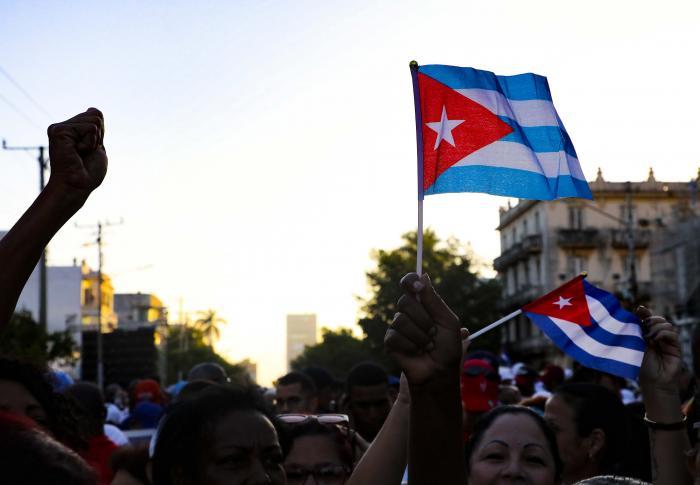
    HAVANA, CUBA – On April 16, 2026, marked the “Year of the Centennial of Commander-in-Chief Fidel Castro Ruz”, Miguel Mario Díaz-Canel Bermúdez, First Secretary of the Central Committee of the Communist Party of Cuba and President of the Republic of Cuba, addressed a massive crowd gathered at the iconic intersection of 23rd and 12th Streets in Plaza de la Revolución. The event commemorated the 65th anniversary of the 1961 declaration that formally established the socialist character of the Cuban Revolution, a historic turning point that reshaped both the nation and global political dynamics.

    Opening his speech with resonant rallying cries – “Long live free Cuba!” and “Down with the blockade!” – Díaz-Canel turned to the foundational events of April 1961, when a generation of Cubans, many younger than the crowd assembled before him, gathered at the very same plaza as U.S.-backed mercenary forces prepared to invade the island at the Bay of Pigs. With the full military and political backing of the United States government behind the invading force, Fidel Castro Ruz, exhausted from hours of sleepless tension, stepped forward to publicly proclaim Cuba a socialist revolution, rooted in the demands of the dispossessed, operating defiantly at the doorstep of the world’s most powerful empire.

    That bold declaration set an irreversible course for Cuba’s revolutionary project, Díaz-Canel recalled. In less than 72 hours after the invasion began, a newly independent, outnumbered Cuban people defeated the mercenary force, dealing imperialism its first major military defeat in the Americas. That victory, he emphasized, opened a path to greater freedom for all peoples across the region, and transformed Cuba forever.

    In the decades following that momentous April day, Díaz-Canel traced Cuba’s progress under socialism: from the landmark Literacy Campaign that brought education to the poorest communities, to advances in human development that turned working-class children into global leaders – including Latin America’s first cosmonaut, born to a shoe-shiner under the pre-revolution capitalist system. He highlighted Cuba’s longstanding commitment to international solidarity, noting that the island has shared its expertise with marginalized and oppressed nations across the globe, sending doctors and teachers to fight apartheid, illiteracy, and preventable disease, rather than sending weapons and bombs. This, he argued, is the core of Cuban socialism: a system rooted in fraternity, not exploitation.

    Díaz-Canel also reflected on the severe trials Cuba has faced, particularly after the collapse of European socialist bloc in the 1990s. While global powers pushed for unregulated neoliberalism and mass privatization, Fidel Castro led the Cuban people in a superhuman struggle to preserve their sovereign socialist project. Through the resistance and creativity of ordinary Cubans, and the labor of the Cuban people’s army that turned to building and sowing when crisis hit, Cuba survived and rebuilt, proving that its socialist system could adapt and endure. Díaz-Canel quoted Raúl Castro’s iconic declaration: “Yes, we can!” – a promise the Cuban people have kept time and again.

    For more than six decades, beyond open military aggression, Cuba has faced a sustained, silent war waged from abroad: a decades-long U.S. blockade, codified in law, reinforced by terrorist attacks, disinformation campaigns, and constant sabotage of regional integration and international cooperation projects. One of the costliest outcomes of this aggression, Díaz-Canel argued, is the loss of thousands of skilled young Cubans, educated for free through the Cuban public system, who are lured away by capitalist economies that did not invest in their training, then falsely claim Cuba’s system fails to deliver opportunity. Díaz-Canel pushed back firmly on this narrative: “That human potential, which impresses and gains ground and relevance in any country it reaches, was shaped by socialism! Only socialism turned the children of workers and peasants into top-tier professionals – not in exceptional cases as under capitalism, but on a massive scale.”

    He rejected the widespread international narrative that frames Cuba as a “failed state”, arguing this framing is a deliberate deception to hide the genocidal impact of the 60-year U.S. blockade. The scarcity of essential goods, fuel shortages, and widespread economic strain that shape daily life in Cuba today are directly the result of this ongoing blockade, which acts as a noose around the neck of the Cuban economy. While the Cuban government acknowledges its own mistakes in building a unique, homegrown socialist project, Díaz-Canel stressed no one can deny the blockade’s primary responsibility for the suffering of Cuban families: “The main cause of our problems is the genocidal blockade imposed by the United States government against our people!”

    Díaz-Canel pushed back on global anti-communist narratives that seek to erase the transformative contributions of socialist experiments to global human progress. He noted that the USSR’s colossal contribution to defeating fascism and advancing space exploration can never be erased, just as the extraordinary development of China, lifting hundreds of millions out of poverty, and the dynamic growth of heroic, revolutionary Vietnam can not be denied. For Cuba, he said, socialism remains the only guarantee of social justice, the only path to collective emancipation, and the only framework that allows Cubans to mount a collective response to the collective punishment they have endured for decades. “Cuba is not a failed state; Cuba is a besieged state, Cuba is a state facing multidimensional aggression: economic war, an intensified blockade, and an energy blockade,” he declared. “Cuba is a threatened state that does not surrender! And despite everything, and thanks to socialism, Cuba is a state that resists, creates, and – make no mistake – a state that will prevail!”

    The 65th anniversary commemoration also marks the founding of the Communist Party of Cuba, which was forged in the heat of the Bay of Pigs invasion. Díaz-Canel noted that the aggressive tactics used by imperial powers against Cuba in 1961 – false-flag air strikes, disinformation campaigns, economic war, diplomatic isolation – are the same tactics repeated in interventions across the globe today. Yet despite the overwhelming technological, military, and media power arrayed against Cuba, global solidarity for the island continues to grow, a clear rebuke of the suffocating imperial policy aimed at bringing Cuba to its knees.

    From the historic plaza where Fidel’s calls to resistance still echo, Díaz-Canel called for a global movement of solidarity to spread the truth about Cuba’s current crisis. He detailed the daily suffering brought by the intensified energy blockade, which leaves Cubans facing hours-long blackouts that disrupt work, rest, and daily life, and paralyzes industries, transportation, and essential public services. All of this, he noted, stems from a decades-old executive order that falsely frames Cuba as an “unusual and extraordinary threat” to the United States.

    Díaz-Canel emphasized that the current challenging moment requires the same unity and readiness Cubans showed in 1961. While Cuba remains committed to dialogue and peace, and rejects unnecessary conflict that would bring suffering to both the Cuban and American peoples, the island has a duty to prepare to defend its sovereignty. “We do not want it, but it is our duty to prepare to prevent it and, if it is unavoidable, to win!” he said, noting that the faith in victory instilled by Fidel Castro remains unbroken among the Cuban people.

    As 2026 marks the centennial of Fidel Castro’s birth, Díaz-Canel paid tribute to the iconic revolutionary leader, who did not merely lead the Battle of Bay of Pigs, but embodied its defiant spirit: “Fidel was and is Bay of Pigs!! Fidel embodies the conviction that a united people can defeat an empire!”

    The current daily resistance to foreign aggression, Díaz-Canel said, is the modern epic Cubans are writing, the most fitting tribute to the revolutionaries who gave their lives for independence and socialism in 1961. He closed with a defiant reaffirmation of Cuba’s commitment to its socialist project: “The socialist nature of our Revolution is not a phrase from the past; it is the shield of the present and the guarantee of the future! Bay of Pigs is today and forever! Cuba will not surrender! Long live the rebellious dignity of our people! Long live Socialism! Homeland or Death! We shall overcome!”
  • Bay of Pigs is today and forever!

    Bay of Pigs is today and forever!

    On the eve of the 65th anniversary of the Bay of Pigs victory and amid the centennial celebration of revolutionary leader Fidel Castro Ruz, the Cuban government has issued a defiant statement reaffirming its unwavering commitment to defending national sovereignty and socialism in the face of intensifying pressure from the United States. For more than six decades, Cuba has operated under a persistent, punitive U.S. siege that has escalated sharply in recent months. Beyond the long-standing genocidal trade embargo, Washington has imposed a brutal energy blockade that has crippled daily life across the island, while top U.S. political elite have openly threatened direct military aggression against the Cuban people.

    The human and economic toll of this 60-plus year embargo stands as a permanent stain on the global reputation of the world’s largest superpower. The unilateral embargo is universally recognized as an illegal, inhumane violation of international law, condemned annually by nearly the entire membership of the United Nations and even rejected by a majority of the American public, recent public opinion surveys confirm.

    In response to this ongoing collective punishment, the Cuban people have emerged as a global model of steadfast dignity and resilient resistance. Since a new executive order targeting the island was issued this past January, the population has demonstrated even greater stoicism, adapting to widespread shortages across every sector of daily life while continuing to advance national priorities. Compounding the economic pressure, a coordinated global disinformation campaign has been launched to smear Cuba and its revolutionary government. Mainstream international media aligned with U.S. interests wage a dishonest campaign of distortion, filled with outright lies, exaggerated claims and deliberate denigration that deliberately obscures the root cause of Cuba’s current hardships. Rather than blaming the externally imposed crisis on the U.S. aggression that created it, the campaign falsely pins responsibility on Cuba’s revolutionary leadership. U.S. officials continue to rely on false pretexts to justify their hostility, labeling Cuba an “unusual and extraordinary threat” to U.S. national security and falsely designating the island as a state sponsor of terrorism.

    This hypocrisy is not a new development, and has been documented for more than six decades. A declassified 1960 memorandum from then-U.S. Under Secretary of State Lester Mallory laid bare the explicit, criminal intent of Washington’s policy long before it became the status quo. Mallory wrote that the U.S. should “rapidly employ all possible means to weaken the economic life of Cuba” through a campaign that is “as skillful and discreet as possible” to cut off the island from financial resources and essential supplies, with the explicit goal of triggering hunger, desperation and the overthrow of the revolutionary government.

    U.S. hostility has also spilled over into Cuba’s bilateral relations with sovereign nations across the globe. Washington continuously pressures governments in the Latin American and Caribbean region to cut diplomatic ties with Havana, and even forces them to expel Cuban healthcare workers who have served as a lifeline of medical hope for low-income communities across the region for decades. Isolation is the core strategic goal of this pressure campaign, but Cuba has not been left alone. Nations around the world have stood firm in solidarity with Havana, including sister nations like Mexico, Russia, China and Vietnam, all of which have rejected U.S. pressure to cut ties. The recent Our America Convoy, which defied U.S. threats and risks to deliver tangible aid and political support to the Cuban people, stands as a powerful reminder of this global solidarity. Reaffirming the words of Cuban national hero José Martí, participants made clear that “whoever rises up with Cuba today rises up for all time.”

    As heirs to a long legacy of anti-colonial resistance, with the fighting spirit of 19th century Mambí independence fighters and 20th century revolutionary rebels coursing through their veins, the Cuban people honor the courage of the nation’s heroes and martyrs – from the 32 Cuban service members who died in Venezuela to the young fighters who recently foiled a terrorist infiltration attempt through the Villa Clara region. The Cuban government emphatically declares that the island will never become a war trophy for the U.S., nor another subordinate nation in a U.S.-led regional order.

    Cuba is a nation rooted in centuries of struggle and unshakable ideological convictions, home to a peaceful, solidarity-driven people that defends its sovereignty through daily labor and collective commitment. Just as Cuban fighters defeated a U.S.-backed invasion on the sands of the Bay of Pigs 65 years ago under the iconic rallying cry “Homeland or Death!”, the nation will once again secure victory in its defense of self-determination and socialism.

    In this centennial year of Fidel Castro Ruz, the revolutionary commander who delivered the first major defeat to U.S. imperialism in the Americas, and with former leader Army General Raúl Castro Ruz still standing firm alongside the Cuban people, the government ratifies the national and international mobilization call issued April 16 by Miguel Díaz-Canel Bermúdez, First Secretary of the Central Committee of the Communist Party of Cuba and President of the Republic. Echoing Díaz-Canel’s words, the statement closes with a defiant promise of victory: “As long as there is one woman or one man willing to give their life for the Revolution, we will be victorious! The socialist character of our Revolution is not a phrase of the past, it is the shield of the present and the guarantee of the future! Bay of Pigs is today and forever!”

  • Israël en Libanon beginnen tiendaagse staakt-het-vuren

    Israël en Libanon beginnen tiendaagse staakt-het-vuren

    A 10-day ceasefire between Israel and Lebanon entered into force Thursday, coinciding with growing global optimism that a breakthrough may be imminent in high-stakes nuclear negotiations between the United States and Iran. In a public statement, former U.S. President Donald Trump announced that a follow-up meeting between the two countries could take place as early as this weekend, raising hopes that the months-long conflict sparked by disputes over Iran’s nuclear program may finally be moving toward resolution.

    Trump told reporters that Iran has proposed a voluntary moratorium on developing nuclear weapons that would last more than two decades, a core sticking point that has dominated recent talks hosted in Islamabad. “We’re going to have to wait and see what happens, but I think we are really close to a deal,” he said.

    The current crisis between the U.S. and Iran erupted on February 28, when joint U.S.-Israeli military strikes launched against Iranian targets. The conflict has killed thousands of people, sent global oil prices soaring, and left regional and world leaders scrambling to de-escalate tensions. A final peace deal would mark a major policy win for the Trump administration, which has prioritized reopening the strategically critical Strait of Hormuz and rolling back Iran’s nuclear development goals.

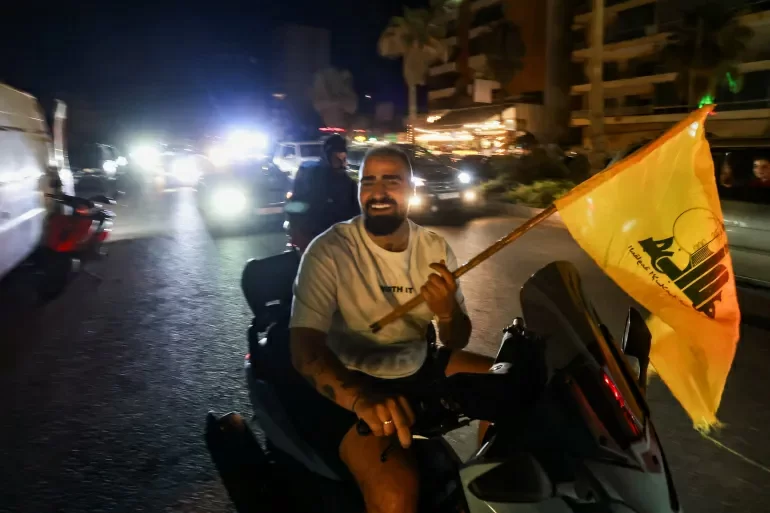
    In Lebanon’s capital Beirut, celebratory gunfire and light displays lit up the sky Thursday evening as the ceasefire came into effect. Crowds gathered in the coastal city of Sidon to celebrate displaced residents beginning to return to their homes, captured in photos from Reuters. Even with the ceasefire in place, however, the security situation remains fragile. Reports emerged shortly after the truce took hold that Israel was still carrying out artillery fire in southern Lebanon, with scattered clashes continuing in border areas. The Israel Defense Forces issued an urgent warning to residents in southern regions not to move south of the Litani River, citing ongoing active Hezbollah operations in the area. For its part, Hezbollah confirmed that its last offensive strike was carried out 10 minutes before the ceasefire went into effect, and released a full account of its military operations conducted through the end of Thursday.

    Diplomatic efforts to lock in a longer-term peace are already underway. Trump said he held “excellent conversations” with Israeli Prime Minister Benjamin Netanyahu and Lebanese President Joseph Aoun, and plans to invite both leaders to the White House in the coming weeks for substantive talks aimed at cementing the truce. He added that top U.S. officials, including Vice President JD Vance and Secretary of State Marco Rubio, are working closely together to broker a lasting, sustainable peace agreement between Israel and Lebanon. Iran has welcomed the 10-day ceasefire, framing it as part of an understanding reached with the U.S. through mediation by Pakistan.

    Key details of the nuclear negotiation remain challenging even with the recent momentum. When Iran closed the Strait of Hormuz – the transit route for roughly one-fifth of the world’s total oil supply – it triggered the largest single shock to global oil prices in modern history. The International Monetary Fund subsequently downgraded its global growth forecasts, warning that a prolonged conflict could push the already fragile world economy to the brink of recession.

    During the Islamabad talks, U.S. negotiators proposed a 20-year pause on all sensitive Iranian nuclear activities, a major concession from the previous U.S. demand for a permanent ban on Iran’s nuclear program. Iran, for its part, has only offered a three- to five-year halt to these activities. Negotiators are also working to reach a compromise on the amount of highly enriched uranium Iran is allowed to keep, with a tentative framework emerging that would see part of Iran’s existing stockpile removed from the country.

    On Wednesday, Pakistani mediator and army chief Asim Munir announced limited progress on several long-standing sticking points, though fundamental disagreements over the future of Iran’s nuclear program still remain. Iran has stated it will fully reopen the Strait of Hormuz once a deal is finalized, on the condition that it receives binding guarantees the U.S. and Israel will not launch new military attacks in the future.

    U.S. Defense Secretary Pete Hegseth warned that American forces remain on high alert and ready to resume combat operations if no final agreement is reached. According to anonymous sources familiar with the negotiations, Washington has offered to lift existing economic sanctions on Iran and unfreeze billions of dollars in Iranian assets held abroad to secure a final nuclear deal.

  • Voter ID Renewals Surge Past 29,000 as Election Activity Intensifies

    Voter ID Renewals Surge Past 29,000 as Election Activity Intensifies

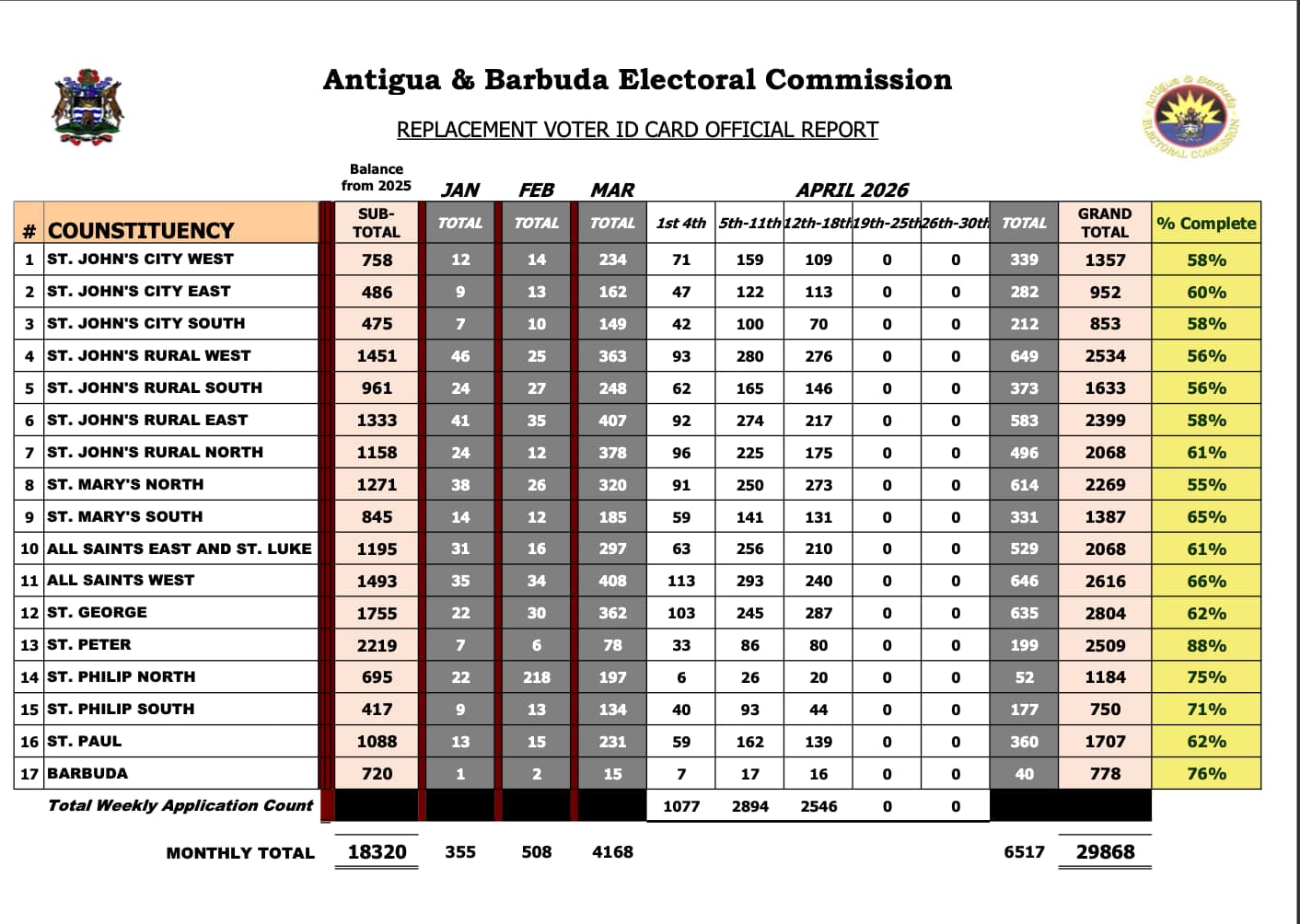
    As Antigua and Barbuda gears up for its upcoming general election, official data from the Antigua and Barbuda Electoral Commission (ABEC) reveals a dramatic uptick in voter identification card transactions, with cumulative volumes crossing the 29,000 threshold by mid-April 2026. The commission’s cumulative tracking report documents 29,868 total transactions processed between the start of the year and the April 16 cutoff, a figure that combines both first-time voter ID applications and requests for replacement or renewed cards. Disaggregated data by constituency shows uneven but widespread engagement across the country, with completion rates varying sharply between less populated districts and denser urban constituencies. The small St Peter constituency leads all jurisdictions nationwide with an impressive 88% completion rate for voter ID updates, followed closely by Barbuda at 76% and St Philip North at 75% — early indicators of strong voter preparation in these regions. By contrast, more heavily populated constituencies have recorded far higher raw volumes of applications but lower overall completion rates, signaling ongoing backlogs and unmet processing demand. All Saints West has logged the highest total volume at 2,616 applications to date, while St John’s Rural West follows close behind with 2,534 total requests. A closer look at weekly data covering the period of April 12 through April 18 underscores the accelerating pace of voter action, with a staggering 2,546 replacement applications and 323 new applications processed in just seven days. Daily transaction counts show a clear last-minute rush: the busiest day of the week was April 13, when 793 applications were submitted, followed by a gradual decline through the end of the week to 441 applications on April 16. This spike aligns with recent official signals confirming the timeline of the upcoming general election, motivating voters to complete the required ID update process ahead of polling day. Three key battleground constituencies — All Saints West, St George, and St Mary’s North — posted the highest weekly application volumes, reflecting heightened political mobilization in these competitive districts. As all registered voters are required to hold a valid, updated voter ID to cast a ballot in the upcoming general election, the nationwide surge in transactions confirms growing voter engagement and a widespread push across the electorate to meet participation requirements before polls open.