
作者: admin

  • A Declaration of War on Fossil Fuels

    A Declaration of War on Fossil Fuels

    On a sunbaked dock at Colombia’s bustling Santa Marta coal export terminal, a diverse gathering of activists, Indigenous leaders, Afro-Colombian community representatives, labor organizers, and youth climate advocates from every corner of the globe made history on Sunday, April 26, 2026. Standing in the immediate shadow of idling cargo ships loaded with the fossil fuels they seek to phase out globally, the coalition launched one of the most uncompromising climate action blueprints in modern history, setting a confrontational tone ahead of the official First International Conference on Transitioning Away from Fossil Fuels co-hosted by Colombia and the Netherlands.

    More than 50 national delegations are set to convene this week for the intergovernmental summit, but grassroots and civil society groups refused to wait for diplomatic negotiations to wrap before staking out their demands. The coalition released *People’s Declaration for a Rapid, Equitable, and Just Transition for a Fossil-Free Future*, a hard-hitting 15-principle document that rejects incremental policy change and calls for immediate systemic transformation to end the fossil fuel era. The opening line of the declaration leaves no room for ambiguity: the era of incremental negotiation is over, and the era of full implementation of climate action has begun.

    Unlike many mainstream climate statements that frame the climate crisis as an unintended side effect of industrial development, this declaration pulls no punches. It identifies the climate emergency as a direct product of centuries of capitalism, colonial extraction, and global militarism, arguing that the fossil fuel industry is structurally tied to armed conflict and geopolitical tension. It demands that wealthy Global North nations pay climate reparations, not as concessional aid or interest-bearing loans, but as a binding legal and moral obligation to redress centuries of emissions and extraction that have disproportionately harmed low-income Global South communities. The declaration also explicitly rules out so-called “false solutions” including carbon capture and storage, unregulated carbon markets, nuclear energy, and hydrogen co-firing, dismissing these approaches as corporate-backed delaying tactics that preserve the influence of the fossil fuel industry rather than solving the climate crisis. At its core, the document calls for full systemic change, not incremental tweaks to the existing global economic system to make it “greener.”

    The choice of Santa Marta as the launch site was no random decision. As one of Colombia’s largest active coal export hubs, the port puts frontline communities affected by fossil fuel extraction and climate change face-to-face with the industry driving global warming. The timing was also carefully calculated: by releasing the declaration before intergovernmental negotiations began, the coalition aimed to set the terms of debate and hold governments accountable from the opening of the summit. Lidy Nacpil of the Asian Peoples’ Movement on Debt and Development emphasized the stakes, noting that for frontline communities, a just transition away from fossil fuels is not a policy debate—it is a matter of survival. Tasneem Essop, Executive Director of Climate Action Network International, added that Global South communities uniformly reject non-binding, voluntary climate promises that only reinforce neocolonial economic dependence.

    The declaration distills its demands into four clear, non-negotiable pillars. First, an immediate halt to all new coal, oil, and gas projects, as well as an end to all public and private financing for fossil fuel expansion. The framework sets binding timelines: the Global North must phase out coal by 2030 and end all oil and gas extraction by the early 2030s, while the Global South is granted a slightly extended timeline of 2035 for coal phaseout and 2050 for oil phaseout, aligned with principles of equitable differentiation.

    Second, the declaration demands full payment of climate reparations. It rejects framing climate finance from wealthy nations to low-income nations as charity, arguing that the obligation to pay is rooted in centuries of resource extraction and cumulative emissions that created the climate crisis. The coalition calls for trillions, not billions, in funding, with no attached debt conditions that would force low-income nations to compromise their policy sovereignty.

    Third, the document rules out all policy and technological shortcuts. It rejects carbon capture, carbon offsets, and natural gas as a so-called “transition fuel,” instead demanding a direct shift to community-owned, publicly managed, decentralized renewable energy systems that prioritize frontline community needs over corporate profit.

    Fourth, the declaration explicitly connects fossil fuel dependence to global militarism. It notes that global military spending reached $2.7 trillion in 2024, arguing that the vast majority of these funds should be redirected to renewable energy deployment and climate adaptation in the Global South.

    What sets this declaration apart from the hundreds of climate statements released annually is its willingness to confront the structural roots of the climate crisis, rather than treating fossil fuel dependence as a purely technical energy problem. The document frames the crisis as a question of power: who controls global natural resources, who profits from geopolitical instability, and who bears the cost of climate breakdown. Frontline communities in the Global South—Indigenous territories, Afro-descendant communities, low-income urban and rural populations—contribute the least to global emissions yet face the worst impacts of climate change, from eroding coastlines to failed harvests to skyrocketing energy prices tied to geopolitical fossil fuel disputes.

    This asymmetric burden is the core driver of the declaration’s uncompromising tone, and the coalition anchors its demands in binding international law. It cites the International Court of Justice’s landmark 2025 Advisory Opinion, which affirmed that all nations have legally binding obligations to address climate change, not just voluntary moral commitments.

    As formal intergovernmental negotiations get underway this week, the coalition behind the People’s Declaration has no plans to step back. The group is launching a global campaign called *Fossil Free Rising*, which will coordinate community-led days of action across the world parallel to official conference proceedings. The campaign aims to keep pressure on negotiators to adopt the declaration’s core demands, rather than settling for weak, non-binding commitments that leave the fossil fuel industry intact. The full text of the declaration is available publicly for review and endorsement by groups and individuals worldwide.

  • UDP Senator Says Ramen “Is Sickening Our People”

    UDP Senator Says Ramen “Is Sickening Our People”

    A fiery new debate over food policy, public health and economic strategy has erupted in Belize after United Democratic Party (UDP) Senator Sheena Pitts launched a sharp critique of government plans to prop up domestic processed noodle production, arguing that widely consumed ramen-style noodles are a nutritionally empty product worsening the country’s growing public health crisis.

    Speaking on recent legislative proposals to amend the nation’s Customs and Excise Duties Act, Pitts called into question the wisdom of a government plan that would raise import tariffs on foreign-produced noodles by 20% specifically to benefit local producer Manna Noodles. The policy, framed by the administration as a step to boost domestic food security and local manufacturing, has drawn renewed scrutiny from the senator, who says it prioritizes protectionist economic gains over the long-term health of Belizean people.

    Pitts framed her criticism within the context of a national shift in public attitudes toward economic struggle. “It appears and it has shown itself over time that people have been down so long that they begin to think that down is up. We glorify struggle, oppression, and everything,” she said. While she emphasized she held no personal disrespect toward people who rely on affordable ramen as a staple food, she stressed that the product qualifies as nutritionally empty food, offering minimal nutritional value to consumers who depend on it.

    Drawing on discussions held during a government-hosted Ministry of Health and Agriculture forum on national food health security, Pitts argued that framing food security solely around access to affordable calories is a dangerous mistake for a nation already grappling with skyrocketing rates of lifestyle-related non-communicable diseases. She specifically pointed to the widespread increases in hypertension and diabetes cases across the Caribbean region, noting that encouraging consumption of processed, low-nutrition noodles works against stated public health goals.

    “Here we are, looking at ways to promote a local manufacturer… to produce a food that is sickening our people,” she said.

    Beyond public health, Pitts also pushed back against the government’s unbalanced approach to domestic agricultural support, questioning why the administration’s “strategic trade policy” does not include equivalent protections for Belizean fruit and vegetable producers. Currently, she argued, imported produce undercuts local farmers on price, making it harder for affordable, nutrient-dense local fresh food to compete in domestic markets.

    She called for a more balanced policy framework that prioritizes expanding access to affordable healthy food options for all Belizeans, saying: “Where along with this ‘strategic trade policy’ is there any consideration in providing respite to Belizean farmers against the importation of fruits and vegetables that we grow here? So that at least on a balance we have on the market healthy food choices for Belizean people and, paramount to that, healthy food choices that are affordable.”

    Pitts’ intervention has reshaped the ongoing debate over the tariff amendment, shifting public discussion beyond the familiar arguments over trade protectionism and consumer price increases to a deeper, more fundamental question: what types of food should the Belizean government be actively encouraging its citizens to consume for long-term public health and food sovereignty.

  • All Saints Road Detour in Effect Tonight for Major Works Near Bottom Village

    All Saints Road Detour in Effect Tonight for Major Works Near Bottom Village

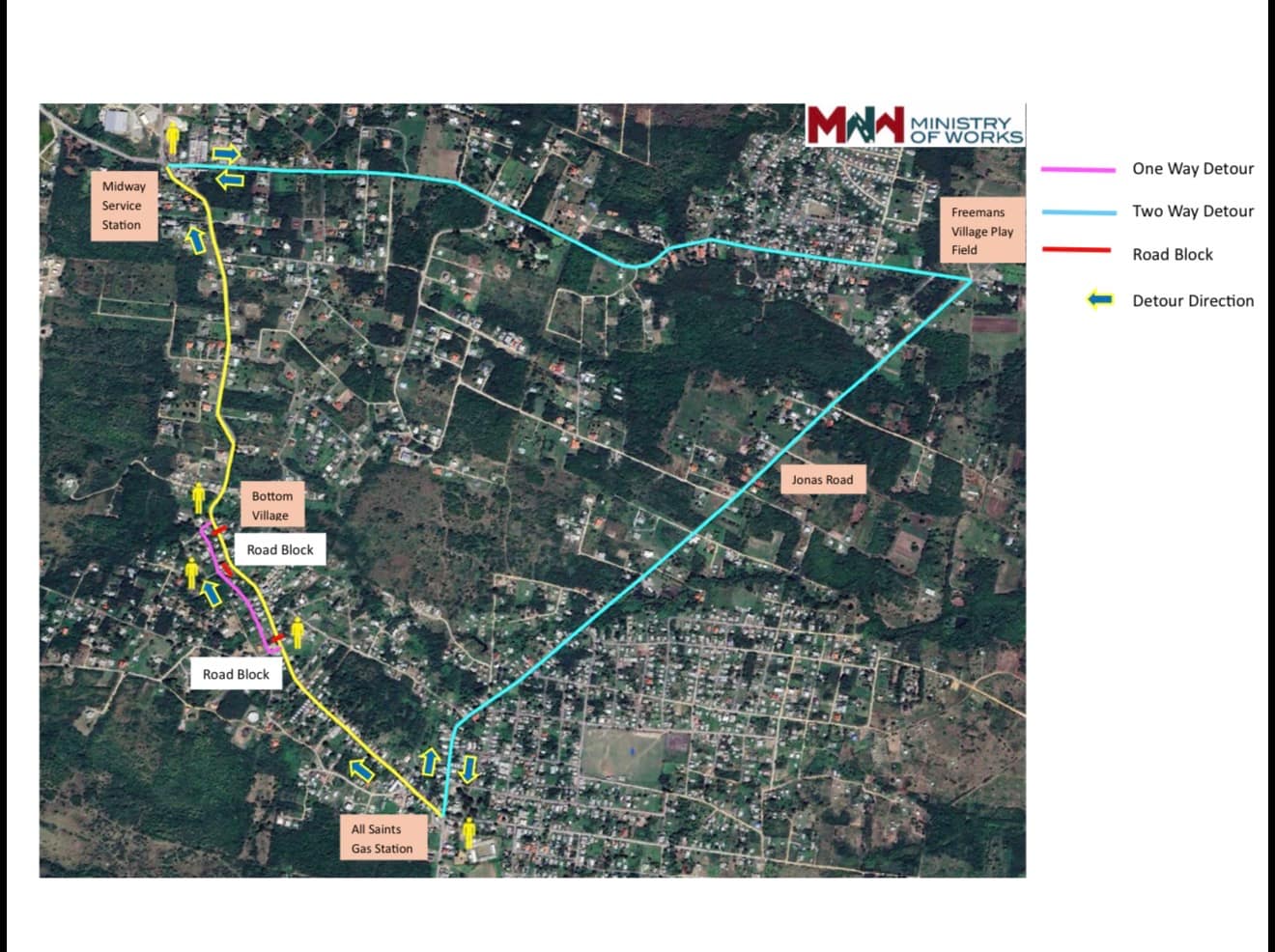
    Motorists and local commuters in Antigua and Barbuda are receiving advance official notice of upcoming major infrastructure upgrades that will disrupt travel along a key stretch of All Saints Road next year. The Ministry of Works has announced that large-scale improvement works, a core component of the government’s broader All Saints Road Project, will be carried out between Bottom Village and the Pentecostal Church along the route.

    To accommodate construction activity, a temporary traffic detour will go into effect starting at 7:00 p.m. on Monday, April 27, 2026, and will remain in place until 7:00 a.m. the following morning. The detour plan separates routing for outbound and inbound traffic to minimize confusion during the overnight construction window.

    For drivers traveling out of the main town area who are heading toward All Saints and passing the Midway Service Station en route to destinations beyond the work zone, crews will redirect vehicles onto Freeman’s Village main road to bypass the closed construction site. For those traveling into town, approaching All Saints Service Station on their way to St. John’s and passing beyond the work area, the official detour routes drivers through Jonas Road.

    Crucially, local residents who live in the immediate vicinity of the infrastructure work site will retain full access to their properties throughout the construction period. All businesses located along the affected stretch of road, including both the Midway Service Station and All Saints Service Station referenced in the detour notice, will remain open for normal operations during the work.

    Government officials urge all road users to exercise extra caution when traveling near the work zone, noting that heavy construction equipment will be operating in close proximity to active passageways. As the overnight work is expected to cause minor delays for through traffic, project stakeholders and regular commuters are advised to adjust their travel schedules and route plans ahead of time to account for the disruption.

    Members of the public with questions about the detour or the All Saints Road Project can reach the Project Implementation Management Unit directly by phone at 562-9173 for further information.

  • 29 Countries Meet in Belize to Talk Tourism

    29 Countries Meet in Belize to Talk Tourism

    In the coastal nation of Belize, hundreds of senior tourism stakeholders, policymakers, and industry leaders from 29 countries are convening this week for the 17th annual Caribbean Conference on Sustainable Tourism Development, a landmark gathering focused on shaping the future of the region’s most critical economic pillar. Hosted in San Pedro Town and organized jointly by the Belize Tourism Board and the Caribbean Tourism Organisation, the 2026 conference carries the forward-looking theme “Tourism in Full Colour”, a nod to the region’s rich cultural diversity and varied natural landscapes that draw millions of visitors each year.

    In his opening address to more than 300 registered delegates, Belize’s Tourism Minister Anthony Mahler opened with a celebration of his country’s unique tourism assets, from the world-famous Belize Barrier Reef, a UNESCO World Heritage Site, to its sprawling intact tropical forests and the vibrant mosaic of Indigenous, Afro-Caribbean, and Latino cultures that shape the nation’s identity. These assets, Mahler emphasized, form the irreplaceable backbone of Belize’s tourism industry and set the template for sustainable development across the region.

    Mahler went on to underscore the outsized economic importance of tourism to the Caribbean that few other global regions can match. Across the Caribbean bloc, tourism contributes an average of 32% to total gross domestic product, a share that jumps to over 90% for the region’s smallest island developing states. Global data underscores the sector’s rapid recent rebound following the COVID-19 pandemic: in 2025, the international tourism sector welcomed a record-breaking 1.5 billion international tourists worldwide, generating $2.2 trillion in global export revenues. The Caribbean alone captured 70 million of these visitors, cementing its status as one of the world’s most popular leisure travel destinations. “For many of our nations, tourism is not merely a sector of the economy,” Mahler told attendees. “It is the economy.”

    Yet the minister did not shy away from the pressing existential challenges that threaten to undermine decades of tourism-led growth in the region. He highlighted that the global tourism sector accounts for roughly 10% of total global greenhouse gas emissions, and despite widespread net-zero commitments from major cruise line and aviation groups that drive much of the region’s visitor arrival, emissions from the sector continue to climb year over year.

    Worsening this imbalance, Mahler noted, is the profound climate injustice facing small Caribbean nations. While the region contributes less than 1% of global cumulative greenhouse gas emissions, it bears the brunt of climate change impacts that directly erode tourism assets. These impacts include accelerating beach erosion that degrades popular coastal resorts, widespread coral bleaching that damages the reef systems that draw millions of eco-tourists each year, and persistent sargassum blooms that foul popular shorelines across the Caribbean. “Those who continue to create the problems must pay for the solutions,” Mahler asserted, echoing longstanding calls from climate-vulnerable small island developing states for increased climate finance and emission reductions from major global emitters.

    Despite these challenges, Mahler highlighted Belize’s proactive steps to serve as a regional leader in sustainable tourism management. The country has established a connected network of more than 103 protected areas that conserve critical ecosystems while creating opportunities for low-impact eco-tourism. It also secured a landmark Blue Bond debt restructuring deal that freed up public funds for marine conservation, and became one of the first countries in the region to implement binding cruise tourism carrying capacity limits to prevent overcrowding and environmental degradation at popular visitor sites.

    The multi-day conference is scheduled to continue through the end of the week, with delegates set to hold working sessions on sustainable financing, climate adaptation, community-led tourism development, and strategies to cut tourism-related emissions across the Caribbean.

  • Mayers rewrites BKA history books

    Mayers rewrites BKA history books

    The 2026 Sectus Technologies Barbados Karting Association (BKA) Championship held its third competitive round on Sunday, and the event made unforgettable history for the island nation’s karting community. Eleven-year-old Ava Mayers delivered a stunning performance in the Easykart 60cc Cadet class, claiming three race victories and securing the highest overall points total across all classes on raceday – a milestone never before achieved by a female karter in the BKA’s 40 years of organized competition.

    While a small number of female drivers have claimed individual class victory at past BKA racedays – most notably Kayleigh Catwell, who topped her class twice in 2018 before finishing second overall in the 100cc championship behind Calem Maloney – no woman had ever climbed to the very top of the day’s overall standings before Mayers’ historic win.

    Mayers set the tone for her historic day early, posting the fastest qualifying time out of the six competing Cadet drivers. She grabbed the lead early in the opening race and held off all challenges to cross the finish line more than two seconds ahead of championship leader Edward Norris, who put on an impressive comeback drive of his own after a qualifying first-lap breakdown left him starting at the back of the grid. Finn Cox crossed the line in third position to round out the opening race podium.

    In the reverse-grid second race, Mayers again seized the advantage immediately after the green flag, with Norris and Cox replicating their opening race results to finish second and third respectively. The third race saw a shift in momentum, as Norris reclaimed his pace at the front of the pack. A first-lap collision between Mayers and Cox dropped Mayers to the back of the starting order, but the young driver fought her way through the field to reclaim a podium position. Cox received a penalty for the incident that pushed him from second place down to fourth, behind Mayers and Shamer Eversley.

    Mayers sealed her perfect day with a third victory in the final race of the class, with Cox and Norris completing the overall podium for the round. Despite his solid second-place finish across the round, Norris retains his lead in both the 60cc class standings and the overall BKA championship.

    The event also saw intense competition in the Easykart 125cc class, where Mayers’ older brother Jacob Mayers also put on a dominant performance to start the round. Jacob claimed pole position in qualifying and posted the first of three fastest laps on his way to a flag-to-flag victory in the opening race. Aaron Blackett finished second in the opening contest, while Aeden Bruce held off a hard challenge from Cody Mark to take third.

    Blackett led every lap of the reverse-grid second race, while Jacob recovered from an early first-lap spin to cross the line third. That result was revised after the race, however, when Bruce received a 10-second penalty for starting outside the designated track lines, moving Jacob up to second.

    Jacob’s luck turned for the worse at the start of the third 125cc race, when his kart’s starter failed, ending his day of competition early. Blackett claimed a narrow victory in the contest, beating Bruce to the line by just nine-tenths of a second after Bruce fought a tense late-race battle with Mark.

    Jacob returned to form in the final 125cc race of the day, claiming a comfortable victory. Bruce put on a late charge to overtake Blackett for second place on the very last lap. Despite the late race loss of position, Blackett still managed to overhaul Jacob’s earlier points lead, taking the top spot in the 125cc class standings by just three points heading into future rounds.

    In the Easykart 100cc class, pole sitter Jaydn Brathwaite turned his qualifying pace into an unprecedented clean sweep for the 2026 season, winning all four races held at the round and posting the fastest lap in every contest. Jordyn Hinkson and Jaylan Priddee matched their podium positions across every race of the round, finishing second and third overall respectively.

  • No Explosive Found After Bomb Threat at Police Headquarters

    No Explosive Found After Bomb Threat at Police Headquarters

    On the morning of Monday, April 27, 2026, a security incident unfolded at the Royal Police Force of Antigua and Barbuda’s headquarters in St. John’s that prompted a full-scale emergency response, after officials received an anonymous bomb threat targeting the building.

    According to official statements from the force’s Office of Strategic Communications, the threatening call came in just before 10 a.m., when the unknown caller claimed an explosive device had been hidden inside the police headquarters. Acting rapidly to prioritize the safety of all personnel and visitors on site, police leadership immediately triggered standard evacuation protocols, ordering every person inside the premises to exit in an orderly fashion. The evacuation was completed without any injuries or security complications, moving all occupants to a safe distance away from the building.

    Immediately following the evacuation, the force’s specialized Explosive Ordnance Disposal Team was deployed to sweep the building and its adjacent surrounding areas, with additional support from the police K-9 unit trained in explosive detection. After completing a comprehensive, room-by-room search of the entire facility and surrounding grounds, the EOD team confirmed that no explosive devices or suspicious materials matching the caller’s description were found. With the all-clear officially given, the headquarters was reopened, and all regular police operations resumed as scheduled shortly after the incident.

    Senior leaders with the Royal Police Force have issued a strong condemnation of the deliberate hoax, noting that the false threat created unnecessary public anxiety, disrupted critical law enforcement operations, and wasted valuable emergency response resources that would otherwise be available for legitimate threats to public safety. Officials emphasized that hoax bomb threats are classified as serious criminal offenses under Antigua and Barbuda law, and those responsible will face full legal consequences if apprehended.

    The force’s Criminal Investigations Department has already opened a formal investigation to trace the caller and identify the individual responsible for the incident. Police are now appealing to members of the public who may have any relevant information that could assist with the investigation to come forward. Tips can be submitted directly to the CID hotline at 462-3913, or shared anonymously via the independent Crimestoppers hotline at 800-TIPS (8477). All information provided will be kept strictly confidential, according to police officials.

  • The Price of Ramen Going Up?

    The Price of Ramen Going Up?

    In a key legislative development that has amplified widespread anxiety over the rising cost of living across Belize, a controversial proposal to impose a new 20% tariff on imported ramen and similar instant noodle products has successfully passed its second reading in the country’s Senate this week. The policy, framed by ruling party officials as a targeted measure to nurture domestic food manufacturing, has already ignited fierce debate over competing national priorities: supporting local economic growth and protecting vulnerable households already stretched thin by years of persistent inflation.

    Government Senator Eamon Courtenay, who leads government business in the upper chamber, outlined the core rationale behind the tariff plan. The proposal adjusts the existing duty structure for imported ramen, setting a new rate that proponents argue will level the competitive playing field for domestic manufacturers. Courtenay emphasized that the policy’s ultimate goals are to expand domestic employment opportunities and generate broader economic activity across Belize’s local food production sector.

    In practical terms, the tariff would push up retail prices for imported instant noodles, creating a critical market advantage for domestic brands. One major beneficiary would be Manna noodles, produced by the Caribbean Organic Food Stuff Company based in Carmelita Village, Orange Walk District, which would see its locally produced offerings become more price-competitive against cheaper imported alternatives.

    For thousands of low-income Belizean households, ramen has emerged as an essential survival staple in the wake of skyrocketing food costs. In 2023, national inflation drove overall food prices up by more than 12%, and coupled with ongoing spikes in fuel costs that have pushed up all retail prices, many families have already cut non-essential spending to keep grocery bills manageable. Ramen has remained one of the last low-cost, filling food options available to cash-strapped consumers, cementing its status as a go-to meal for students, working parents, and single-income households.

    Opposition Senator Patrick Faber has emerged as the most vocal critic of the plan, launching a fierce pushback against the tariff. Faber warned that the price increase caused by the new duty will disproportionately harm the country’s most economically vulnerable groups, noting that ramen is far from a luxury product for many Belizeans. He pointed to already visible price hikes in recent years, recalling that consumers not long ago could purchase four to five individual packs of ramen for just one Belize dollar, a price point that has already disappeared from most store shelves.

    Faber argued that while the government has framed the change as necessary to comply with international trade agreements, compliance should never come at the expense of ordinary consumers. “Compliance with treaties must never replace the responsibility to protect the Belizean consumer,” he stressed.

    Ruling party Senator Christopher Coye pushed back against claims that the policy amounts to unfair protectionism, framing it instead as a deliberate, strategic trade policy correction. Coye explained that Belize’s current duty structure creates an inherent disadvantage for domestic ramen producers: local manufacturers pay import duties on the raw ingredients they bring in to make their product, while finished imported ramen enters the country with far lower cumulative duties, giving foreign brands an artificial price advantage.

    Looking ahead, Coye noted that the tariff adjustment is a temporary step toward broader tax reform, adding that a more comprehensive solution would eventually shift the country away from reliance on import duties toward a broader excise tax system. However, he acknowledged that this major policy overhaul remains far off in the future.

    As the bill moves forward in the legislative process, the core debate continues to divide policymakers: can the government nurture a growing domestic food production sector without raising the cost of living for families already struggling to put food on the table?

  • Cole Tomas Allen charged with attempting to assassinate the president

    Cole Tomas Allen charged with attempting to assassinate the president

    A federal grand jury has formally filed criminal charges against Cole Tomas Allen, who stands accused of attempting to carry out the assassination of the sitting President of the United States. Court documents made public by federal law enforcement agencies outline that the charges stem from a detailed, actionable plot that was uncovered before it could be put into motion. Law enforcement officials, speaking on background, confirmed that intelligence gathering and prompt intervention by multiple agencies prevented any physical harm coming to the president or other individuals caught up in the alleged scheme. As the legal process moves forward, Allen is scheduled to appear for an initial arraignment hearing in federal district court in the coming days, where he will enter a plea to the charges against him. The investigation into the plot remains ongoing, with authorities still working to determine whether any other individuals were aware of or involved in planning the alleged assassination attempt. National security experts have noted that the case highlights the persistent threat of targeted violence against senior U.S. political leaders, and underscores the ongoing work of federal protective agencies to mitigate risks to public officials. At this early stage of the legal proceeding, the charges against Allen are merely allegations, and he is presumed innocent unless proven guilty beyond a reasonable doubt in a court of law.

  • Bajan volleyballers create history by qualifying for World Championships

    Bajan volleyballers create history by qualifying for World Championships

    For the first time in Barbadian volleyball history, a pair of young local athletes have broken through to qualify for a global world championship event. Teenagers Joshua Ashby and Cael Greenidge etched their names into Barbados’ sporting record books last week by claiming one of the final remaining berths at the upcoming Under-18 Beach Volleyball World Championships, sealing their qualification at the NORCECA Qualifiers held in the Dominican Republic.

    The road to qualification was far from smooth for the young Barbadian duo. They got off to a rocky start, dropping their opening matchup 0-2 to a tough Puerto Rican side. With elimination staring them down, the pair needed back-to-back wins in their remaining matches to claim the last available qualifying spot for the July tournament, set to run from July 8 to 12 in The Hague, Netherlands.

    Their first comeback test came against Costa Rica. After dropping the opening set 18-21, Ashby and Greenidge fought back to claim the second set and force a decisive third frame, eventually pulling out a hard-won 15-13 victory to keep their qualifying dream alive. Next up was a showdown with a highly ranked Canadian team for the final spot.

    History repeated itself in the decisive matchup: the Barbadians dropped the opening set 18-21 after Canada broke a late deadlock with three straight points, but they rallied once again to edge Canada in a tight second set 21-19 to force a third-set decider. The final frame stayed neck-and-neck through the opening stages, with both teams trading points to stay locked. When the score reached 13-all, Ashby delivered two consecutive game-winning points to secure a dramatic 15-13 upset and punch Barbados’ first ever ticket to a volleyball world championship.

    In an interview with Barbados TODAY from the qualifying event in the Dominican Republic, team manager Anica Wood said the historic result was the product of years of consistent hard work and relentless dedication from the pair and their coaching staff. “There’s no question about the commitment these young men have shown, and the endless hours they’ve put in training at home with our coaches, Mark Lewis and Cuban coach Jose Hernandez Murray,” Wood explained. “They’ve been putting in this work for years now, and it’s all finally paying off. Both Ashby and Greenidge are incredibly dedicated to this sport, and they wanted this qualification more than anything. When they realized the final qualifying spot was still within reach heading into the final matchday, they shifted their mindset entirely, seized the opportunity and made the most of it.”

    While celebrating the groundbreaking achievement, Wood also opened up about the structural changes Barbadian volleyball needs to make to turn this single success into consistent qualification for global events. The biggest shift needed, she said, is greater athlete specialization. Currently, most of the island’s volleyball athletes compete in both indoor and beach volleyball, spreading their training focus thin across two codes. This challenge is amplified by Barbados’ small overall population, which limits the pool of available talent.

    “Right now, our athletes are balancing training for both indoor and beach volleyball, and we’ve seen a huge growth in age-group competitions at all levels – Under-17, Under-19, Under-21, all the way to seniors – that these young athletes are competing across,” Wood noted. “To excel consistently, we need to adjust our structure so that athletes can specialize fully in either beach or indoor volleyball, so they can dedicate all their training time to that one code. This time around, Joshua and Cael put in extra hours on the sand, but if we want to keep reaching this level, we need fully dedicated beach athletes moving forward.”

    Ahead of the World Championships, Wood said the pair needs more competitive experience on the NORCECA circuit to sharpen their skills ahead of the tournament, and called for additional funding to support the team’s travel to these regional events. “Local training and competitions can only take you so far. Getting out and competing against top teams from across North America, Central America and the Caribbean does wonders for these young athletes’ confidence and skill development,” she explained. “More funding to let us compete in as many NORCECA events as possible would be a huge boost to their preparation ahead of the World Championships.”

    Wood also credited the new dedicated beach sports facility opened recently in Wildey as a critical contributing factor to the team’s success. “We’ve been using that facility nonstop since it launched,” she said. “In the past, we could only train for an hour or so after school or work before sunset, but this new facility has lights, so we can train both in the morning and evening. We’ve been able to double our practice hours because of it, and we’re so grateful for that resource.”

    In the girls’ division of the NORCECA Qualifiers, Barbados’ pairing of Destiny Layne and Gabrielle Sandiford capped off their tournament with two lopsided wins in the ninth place classification round, defeating the Cayman Islands 21-9, 21-8 and following that up with a 21-8, 21-18 victory over Nicaragua.

  • Rotary Club of Grenada collaborates with Ministry of Health

    Rotary Club of Grenada collaborates with Ministry of Health

    To mark World Immunisation Week, which runs from April 24 to 30, the Rotary Club of Grenada has launched a partnership with the country’s Ministry of Health to roll out a nationwide vaccination awareness initiative. This joint project reflects a shared, dedicated mission to protect public health and guarantee that every Grenadian has fair, equal access to vaccines that save lives.

    World Immunisation Week was established to draw global attention to the critical role vaccines play in stopping the spread of preventable diseases, cutting global mortality rates, and fostering stronger, healthier communities around the world. For this Grenada-based initiative, the two organizing bodies have set a core goal of boosting public trust in routine and scheduled immunizations. They plan to do this by dismantling common misinformation and harmful myths around vaccines, distributing evidence-based, accurate health information, and motivating families across the country to catch up on missed doses and participate fully in national vaccination programs.

    Julia Lawrence, president of the Rotary Club of Grenada, highlighted the far-reaching importance of widespread vaccination uptake in a statement on the campaign. “Vaccination stands as one of the most powerful public health tools we have to shield our families, our children, and our entire nation from illnesses that can be easily prevented,” Lawrence said. “Beyond the proven science behind immunization, this is an issue rooted in equity, accessible healthcare, and collective community responsibility. By raising targeted awareness, we can make sure every household understands why vaccination matters, and every person has the opportunity to protect their own health and the health of those around them.”

    The cross-island campaign will include a full schedule of local community outreach events and targeted media engagement efforts, designed to reach even remote households across Grenada. Rotarian volunteers will work alongside trained public health professionals to answer unaddressed public questions, share accessible educational resources, and support ongoing vaccination drives in every region of the island.

    Senior officials from the Ministry of Health have expressed strong support for the collaboration, noting that cross-sector partnerships between community organizations and government health bodies are critical to meeting national immunization coverage goals. Together, the Ministry of Health and Rotary Club of Grenada have reaffirmed their shared commitment to protecting children, adult family members, and medically vulnerable populations across the country from entirely preventable infectious diseases.

    This new initiative builds on Rotary International’s decades-long global commitment to advancing public health, including its high-profile leadership role in the global fight to eradicate polio. On the local level, the Rotary Club of Grenada has a long track record of running impactful community health projects, including a long-standing free eye care program and the recent Childhood Obesity Prevention initiative. That project promoted increased water intake and reduced sugar consumption, distributing 800 branded reusable water bottles with the slogan “More water…Less sugar” to 36 primary and secondary schools across the country. Looking ahead, the club is also scheduled to host a public community health fair at the Gouyave Health Centre on May 9, 2026.

    By partnering with the Ministry of Health to mark World Immunisation Week, the Rotary Club of Grenada continues to uphold its core motto of “service above self” and reinforce the value of collective community responsibility for public health outcomes.

    Disclaimer: NOW Grenada holds no responsibility for the opinions, statements, or third-party media content shared by contributing organizations and individuals. To report abusive content, follow the provided reporting link.