作者: admin

  • Independent candidates begin Positioning ahead of possible election call

    Independent candidates begin Positioning ahead of possible election call

    BASSETERRE, St. Kitts – As speculation mounts that St. Kitts and Nevis will call a general election before the end of 2026, two would-be independent candidates have stepped out of political obscurity to launch their campaigns, challenging well-established incumbent representatives from major parties.

    Media reports circulating this week confirm that Henry Marsham and Kurtisse Caines have publicly announced their plans to contest parliamentary seats in the upcoming vote. While SKNVibes.com has not independently verified an unconfirmed flyer shared widely across social media platforms, the document indicates Caines will aim to unseat former Prime Minister Dr. Timothy Harris in Constituency Seven.

    For his part, Marsham, an overseas-based health professional, is set to face off against incumbent Agriculture Minister Samal Duggins, the sitting St. Kitts-Nevis Labour Party representative for Constituency Four. In a recent interview on WINN FM’s current affairs program *Inside the News*, Marsham laid out his motivation for entering the race: a widespread sense of neglect among constituents, who he says are abandoned by elected officials immediately after polling day.

    “Once they get elected, we don’t see them, and this cycle has to stop,” Marsham stated. “There is a great deal of unaddressed need in Constituency Number Four, and that is one of the core reasons I made the decision to run.” He added that his years of leadership experience and professional background in health care uniquely equip him to deliver tangible results for his constituency, noting that empty political promises from major party candidates have left voters disillusioned. “Too much empty promises,” he emphasized. “I’m putting my hat in the ring to win this seat, work for the people of Constituency Four, and serve all the people of St. Kitts and Nevis broadly.”

    A key draw of running as an independent candidate, Marsham explained, is the ideological flexibility it affords. “I chose to run independently because I want the flexibility to work across political lines and focus on context-specific solutions rather than rigid party priorities,” he said. He has also confirmed that he will relocate back to the Federation full time to serve his constituency if he wins the vote.

    Not all political observers are optimistic about the independents’ chances, however. Veteran regional political analyst Peter Wickham argues that independent candidates face a steep uphill climb in the Federation’s established two-party political system. When asked if he believed the candidates could pull off an electoral win, Wickham responded bluntly: “I don’t think they will.”

    Wickham noted that while a small number of independent candidates have won legislative seats across the Caribbean region, these victories are extremely uncommon, and almost always tied to one-of-a-kind local political circumstances. In St. Kitts and Nevis specifically, dozens of independent hopefuls have launched campaigns over the decades, but very few have managed to meaningfully disrupt the dominance of the country’s major established political parties. Despite this expert analysis, Marsham remains undeterred in his bid to upend the status quo for Constituency Four voters.

  • Opposition senator criticises ‘vague drafting’ in new Older Persons Bill

    Opposition senator criticises ‘vague drafting’ in new Older Persons Bill

    A heated legislative debate has unfolded in the Barbadian Senate over the proposed Protection of Older Persons Bill, with opposition Senator Karina Goodridge launching a detailed critique of what she describes as dangerously vague drafting and overconcentration of power in the hands of government ministers.

    While Goodridge openly praised the administration for responding to public calls to protect vulnerable adults aged 65 and over, she emphasized that the current iteration of the legislation is too open to subjective interpretation, a flaw that could lead to legal chaos and wrongful targeting of ordinary citizens. Her criticism focused heavily on Section 2, the bill’s clause defining elder abuse. According to Goodridge, the existing wording casts an overly broad “net” that fails to include a clear, objective legal standard, specifically the widely accepted reasonable person’s test that would guide consistent application of the law.

    Beyond the definition of abuse, Goodridge raised pointed questions about the bill’s framework for approving caregivers for older adults. The legislation grants the responsible minister sole authority to designate “fit persons” to provide care, but it does not outline explicit qualification criteria for either the caregivers or the standards the minister must use to make these decisions. She argued that leaving this determination open to subjective judgment rather than clear, written rules creates unnecessary risk of future disputes and unfair outcomes. “Why is this power given to the minister, and what qualifies the minister now to make that decision?” Goodridge asked, noting that clear guidelines would avoid preventable problems down the line.

    Goodridge also turned scrutiny to Section 10, which sets harsh penalties for violations: a fine of up to $100,000 and a five-year prison sentence. She warned that without explicit definitions of specific offenses, the bill could inadvertently criminalize accidental or unintentional actions that cause no harm to older people. “If the punishments are to become onerous, then the crime must be explicitly defined with no room for misinterpretation,” Goodridge said. “We really don’t want to set that kind of precedent as a country.”

    One of the most controversial points of her critique targeted Section 34, which imposes legal liability on publication distributors for content they distribute that relates to elder care and protection. Goodridge questioned why third-party distributors, who do not edit or curate the content they deliver, should be held legally responsible for material they carry, arguing the provision effectively forces distributors to take on the role of editorial oversight that does not align with their job function. “If I’m distributing a paper, then I could be liable. That didn’t make no sense to me in Bajan terms. It is asking the distributor to also have editor responsibilities,” she said.

    Goodridge’s line-by-line analysis drew immediate pushback from government lawmakers. Leader of Government Business Senator Lisa Cummins rejected Goodridge’s concerns about excessive ministerial power, noting that references to the “minister” in Barbadian legislation conventionally refer to the office and its team of professional technical staff, not unilateral decision-making by a single individual. Senate Deputy President Liz Thompson joined Cummins in pushing back, reminding Goodridge that clause-by-clause review is reserved for the committee stage of legislative debate, not the first reading of the bill.

    Critics also questioned Goodridge’s experience with legislative drafting, but the opposition senator stood firmly by her analysis. She argued that all senators have a duty to flag drafting flaws regardless of procedural conventions, noting that legal opinions often vary among attorneys and that the body has a responsibility to pass clear, well-crafted law. “I will give my opinion on the sections fairly in accordance with the knowledge that I have,” Goodridge responded. “Many times attorneys will say one thing and the next attorney will say the other… we have to ensure any bill we are passing is properly drafted for us senators to accept.”

    Closing her remarks, Goodridge urged the full Senate to revise the bill to clarify ambiguous language before advancing it, warning that failing to fix the issues now would force the country’s judicial system to resolve costly and time-consuming legal disputes over ambiguities later. “We care about the elderly,” she emphasized. “But we have to ensure the legislation is properly defined and every section is clear so that we can avoid misinterpretation.”

  • Man removed from abandoned library after months of complaints

    Man removed from abandoned library after months of complaints

    A months-long public nuisance and safety crisis in the Gall Hill community of St John, Barbados, came to a long-awaited end on Tuesday, when law enforcement removed an unidentified squatter who had been occupying the derelict former Gall Hill Library, following persistent complaints from local residents over growing health hazards, threats and a severe rat infestation.

  • Nickeriaanse rijstboeren voorbereid op nieuw seizoen

    Nickeriaanse rijstboeren voorbereid op nieuw seizoen

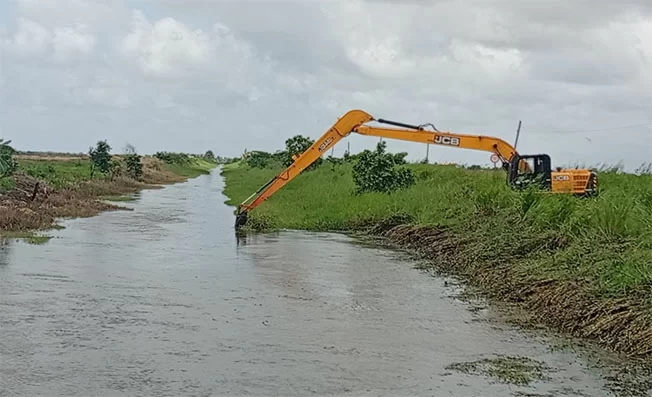
    The new growing season’s official rice sowing window kicked off on May 1 and will run through June 30, and rice producers across western Suriname have already kicked off preparation work for the critical planting period. For a cohort of local farmers, a water shortage during the last short growing season left them completely unable to plant their crops, making this main season — which aligns with the annual rainy season — a particularly high-stakes opportunity to recover lost yields. Already, this group has planted several hectares of rice in Middenstandspolder, the low-lying growing zone located between the towns of Wageningen and Henarbrug, near the Nickerie River.

    But just days after planting, unexpected heavy rainfall has left portions of these newly sown fields completely submerged, putting the young rice seedlings at severe risk of rotting before they can establish. Faced with this urgent threat, the affected farmers submitted a formal request to agricultural authorities to clear and dredge the region’s existing water retention dam, a structure originally built to hold water for crops during prolonged dry spells.

    William Waidoe, deputy director of the Western Region branch of Suriname’s Ministry of Agriculture, Livestock and Fisheries (LVV), confirmed that the ministry has already responded to the request. “We have opened up the dam for this group of farmers, so that excess water can drain freely with the tide out into the Nickerie River,” Waidoe explained in an official statement.

    The drainage improvement work is being funded and executed through a public-private partnership between the ministry and the local farming community. Under the collaborative model, LVV contributes heavy excavation equipment and a certified operator to carry out the dredging work, while farmers cover the cost of fuel, lubricants, and water for the construction crew. The project also includes clearing debris from the primary drainage channel that runs from Henarbrug toward Wageningen, expanding the system’s capacity to move large volumes of rainwater quickly.

    Waidoe emphasized that fast, efficient drainage of excess rainfall is non-negotiable to protecting planting outcomes during the rainy season. “When heavy rains hit, water needs to be able to flow unobstructed to the Nickerie River,” he said. “This approach lets us manage the irrigation and drainage system with the limited resources we have available.”

    For months, this collaborative model of shared responsibility for maintaining regional irrigation and drainage infrastructure has been consistently implemented across western Suriname’s rice belt, all with the core goal of creating safe, reliable conditions for rice planting. Waidoe noted that coordinated action between government authorities and producers delivers widespread benefits to the entire local rice sector, strengthening food security and supporting the livelihoods of thousands of agricultural workers across the region.

  • Police remove 49 firearms in intensified crime fight

    Police remove 49 firearms in intensified crime fight

    Barbados is grappling with an unprecedented wave of gun violence that has already claimed 23 lives this year, but law enforcement officials report early progress from targeted interventions designed to reverse the growing trend. In an appearance on the Government Information Service’s current affairs program *In Focus* Tuesday, Police Commissioner Richard Boyce outlined the aggressive steps his department has taken to disarm criminal networks and stabilize high-risk communities.

    Compared to just 22 illegal firearms seized from offenders across all of last year, Boyce confirmed that authorities have already removed 49 weapons from circulation in 2024, marking a dramatic jump in interdiction efforts. This progress comes even as the police service faces a crippling manpower shortage of 200 unfilled positions. To close the gap, the department has forged a formal partnership with the Barbados Defence Force (BDF), whose deployment to community hotspots has drastically expanded operational capacity.

    “That has worked tremendously well for us,” Boyce told interviewers. “BDF coming on board and partnering with us has made our job much easier. We’ve been able to position personnel in key locations to address these issues.” Currently, law enforcement is focused on five major organized criminal gangs responsible for much of the territory’s gun violence, and Boyce said sustained patrols and targeted operations have delivered significant tangible successes over recent months.

    Putting the local crisis in context, the commissioner noted that rising gun-related crime is a shared challenge across the Caribbean and beyond, positioning Barbados’ response on the right track. While this year has seen six more murder cases than the same period in 2023, overall crime rates across the island have fallen, he added, emphasizing that removing illegal weapons from the streets is critical to preventing collateral harm from indiscriminate gunfire. Boyce also confirmed that ongoing work to expand cross-agency partnerships, both local and international, is continuing to improve outcomes in hotspot areas.

    Joining Boyce on the program, Minister of Legal Affairs and Criminal Justice Michael Lashley reaffirmed the government’s commitment to maintaining public safety through a whole-of-nation approach, highlighting the combined police and military presence in violence-impacted communities. As part of long-term reform, the government is planning to overhaul community policing frameworks to make them more responsive to the needs of high-risk neighborhoods. A key new policy initiative, a dedicated gun court, will be established to fast-track processing of firearms-related offenses under the Firearms Act, addressing longstanding delays in the judicial system that have slowed justice for gun crimes. Lashley did not share a formal timeline for the court’s launch but emphasized that swift, consistent justice is a core pillar of the government’s crime reduction strategy.

    “We want to have a one-nation approach, and that is what you hear me sometimes speak about harbouring,” Lashley said. “Because if the whole of the nation is on board, we cannot tolerate a small section of society who believe that it’s right to harbour persons who are really impacting on the safety and welfare of Barbados and Barbadians.” The minister added that the strategy combines immediate, visible interventions to curb current violence with long-term programs to address root causes, including support for at-risk individuals and reintegration services for former offenders returning to communities after incarceration, to prevent recidivism.

    Criminologist and government crime researcher Cheryl Willoughby, who also joined the discussion, outlined deep-rooted social patterns driving the island’s gun violence crisis. Between 2020 and April 2024, Willoughby noted, 240 men – most of whom were actively contributing to the island’s economy and supporting families – have been murdered, leaving lasting social and economic harm across communities.

    Her research has uncovered a striking intergenerational pattern of gun-related crime: 57% of inmates incarcerated or remanded on murder or gun charges have other family members with convictions for similar serious offenses. Breaking that data down, 29% had family members previously convicted of murder, 20% had relatives convicted of firearms offenses, and 14% had family convicted of robbery. 80% of the incarcerated relatives were male, confirming that criminal behavior is often normalized in high-risk households.

    “It means that these young people are coming from environments where serious crime is normalised,” Willoughby explained, stressing that any sustainable long-term solution to gun violence must address shifting underlying social values across Barbados to break the cycle of intergenerational offending.

  • Venezuela alleges to ICJ that 1899 boundary was awarded based on “threats”

    Venezuela alleges to ICJ that 1899 boundary was awarded based on “threats”

    A decades-long territorial dispute over the resource-rich Essequibo Region returned to the International Court of Justice (ICJ) this week, as Venezuela’s legal team laid out substantial new evidence arguing the 1899 boundary award that granted control of the territory to Britain (the predecessor of modern Guyana) was obtained through improper coercion and political collusion, not legal reasoning.

    The controversy stretches back more than 125 years, rooted in an 1897 treaty between Venezuela and Britain that established an arbitral tribunal to settle their long-running border conflict. The 1899 final award from that tribunal awarded 90 percent of the disputed Essequibo territory to Britain, a ruling Venezuela has contested for decades. The debate gained new momentum after a posthumous 1944 memorandum by Mallet Prevost, an American lawyer who served as counsel for Venezuela at the 1899 tribunal, alleged that the tribunal’s outcome was shaped by outside pressure.

    On Wednesday, Venezuela’s legal team told the ICJ that far more evidence beyond Prevost’s posthumous document corroborates claims the arbitrators were coerced into a ruling that stripped Venezuela of Essequibo. The lawyers also emphasized that the 1899 tribunal never provided any formal legal reasoning to justify its final boundary decision, a failure that alone undermines the award’s legal validity.

    Venezuela’s arguments directly contradict the position Guyana laid out before the court just days earlier. Guyana’s legal team contended that Spain, Venezuela’s colonial predecessor, never held sovereign control over Essequibo, that Venezuela formally ratified the 1897 treaty creating the tribunal, and that Venezuela publicly recognized the 1899 award for more than 60 years through official maps, government statements, and participation in boundary demarcation. Guyana also dismissed Prevost’s memorandum as a collection of unreliable, unsubstantiated claims made decades after the ruling.

    But Professor Christian Tams, lead counsel for Venezuela, told the court that contemporary accounts from multiple key 1899 tribunal participants—including arbitrators and legal counsel, documented in their personal diaries and private correspondence—all align to confirm that the final boundary line was proposed by tribunal president Friedrich Martens, a Russian jurist, with no legal basis whatsoever. Tams explained that Martens leveraged coercive threats to force the British and American arbitrators to accept his compromise line during closed, off-the-record meetings separate from the tribunal’s formal deliberations. Tams noted that Martens explicitly threatened to side fully with the opposing camp in any split vote unless arbitrators accepted his proposed line.

    Tams added that this new body of documentary evidence directly undermines Guyana’s attempt to dismiss Venezuela’s claims as the invention of an older man writing decades after the event. “These are authoritative, contemporary accounts that converge on the same core conclusion,” Tams told the court. He further confirmed that the core claims in Prevost’s posthumous memorandum match a private letter Prevost wrote just three weeks after the 1899 award was issued, a letter uncovered by Venezuelan researchers after the memorandum was published. In that 1899 letter, Prevost explicitly stated the final decision was forced on the American arbitrators.

    Tams shared details of firsthand accounts from U.S. arbitrator David Brewer, who recorded that Martens manipulated divisions between British and American arbitrators to force through his preferred outcome. If the American arbitrators refused Martens’ compromise line, Martens threatened to side with Britain’s claim to the full Schomburgk Line, resulting in a 3-2 split that would give Britain complete control of the entire disputed territory. If the American arbitrators accepted the compromise, Martens guaranteed he would secure British consent, resulting in a unanimous ruling that granted 90 percent of the territory to Britain, with only a small sliver left to Venezuela. “Legal considerations played no role in this deal,” Tams said. “There is no trace of any legal reasoning that could explain why Martens drew his compromise line where he did. Arbitrators did not yield to a stronger legal argument—they yielded to clear, specific threats.”

    Venezuela’s legal team also expanded on the context of coercion surrounding the tribunal’s creation, arguing that Britain—then the world’s dominant superpower—used military pressure to force Venezuela into agreeing to the 1897 treaty. Professor Danae Azaria told the court that Britain issued multiple explicit threats of military aggression between August and December 1899 to compel Venezuela to negotiate. Just one month before talks on the Washington Treaty (the formal name for the 1897 agreement) began, the *New York Herald* reported that Britain had deployed advanced Maxim machine guns to the Venezuela border, a clear show of force. Azaria explained that Venezuela, facing British expansionism, relied entirely on U.S. support to avoid further territorial loss, and had no viable alternative to accepting the treaty terms.

    Azaria added that even after the 1899 award was issued, Britain continued to act unilaterally, beginning its own boundary demarcation in 1900. At the time, Venezuela was in the middle of a civil war and too vulnerable to resist, so it had no choice but to send a demarcation commission to avoid losing even more territory. She also noted that Venezuela only obtained solid evidence proving the award was procured through coercion in the second half of the 20th century, explaining why formal challenges to the ruling took so long to emerge.

    Professor Paolo Palchetti, another member of Venezuela’s legal team, further pushed back against Guyana’s dismissal of Prevost’s memorandum, noting that multiple independent contemporary documents corroborate Prevost’s claim that the award resulted from collusion between Britain and Russia, with improper pressure from Martens.

    Tams also added that the 1899 tribunal failed to complete its core legal mandate: it never conducted a formal investigation to confirm which territories were originally held by the Netherlands (Guyana’s colonial predecessor) and which by Spain, a foundational step for any legitimate boundary ruling. Addressing the tribunal’s complete failure to publish any legal reasoning for its decision, Tams noted that the absence of any documented legal rationale is itself a ground for invalidating the award, and further confirms the outcome was not rooted in law.

    The framework for the modern dispute is shaped by the 1966 Geneva Agreement, which established bilateral negotiations as the official mechanism to resolve the dispute after new evidence of coercion emerged. While Venezuela is participating in the current ICJ proceedings, the country has repeatedly stated it does not recognize the court’s jurisdiction over this long-standing territorial dispute.


  • Belize Draws Up Rules for Drone Operators

    Belize Draws Up Rules for Drone Operators

    As unmanned aerial vehicles, more commonly known as drones, become increasingly integrated into daily life across Belize — appearing at major public events, agricultural operations, and even residential neighborhoods — the lack of formal oversight for the fast-growing industry has emerged as a pressing policy challenge. By far the most critical unaddressed issue is the overwhelming number of drone operators currently flying without mandatory registration, creating gaps in accountability that put public safety and personal privacy at risk.

    To close this regulatory gap, Belize’s Civil Aviation Department has launched a public consultation process for a comprehensive new set of drone rules, unveiled this week in a 55-page draft regulatory proposal. The opening of the public comment period drew a diverse crowd of stakeholders, including recreational drone hobbyists, commercial service providers, and industry representatives, all eager to weigh in on the framework that will shape the future of the country’s drone sector.

    The high turnout for the initial consultation underscores a reality many observers have noted: Belize’s drone industry has expanded far faster than the government’s ability to update governing policies. Civil Aviation Department Director Nigel Carter emphasized that the new rules are a proactive step to prevent crises before they occur, rather than reacting to tragedies after the fact. “We don’t want to wait for there to be accidents involving manned aircraft,” Carter explained. “We also don’t want to continue receiving growing numbers of complaints from members of the public whose privacy has been violated, with reports of drones peeking through residential windows.”

    The proposal has received a generally warm reception from commercial operators that have long operated in a regulatory gray area, though many have called for key adjustments to ensure long-term stability. Carlin Strite, a drone operator with Agrobotics — a firm that has used agricultural drones for crop spraying across Belize for four years — noted that the push for formal, clear rules is a long-awaited win for the industry. At the same time, he stressed that consistent, stable regulation is critical for businesses planning long-term investments. “The biggest problem we have had with informal rules to date is that they’re constantly shifting, and officials have never published a definitive, fixed set of requirements we need to follow,” Strite explained. “That constant uncertainty makes planning very confusing for commercial operators.”

    Under the current draft proposal, both registration and licensing for drone operators are set at roughly $30 per credential. Following the opening of public comment this week, members of the public and interested stakeholders have an additional two weeks to submit written feedback before the Civil Aviation Department moves forward with revising and finalizing the regulations.

  • Belizeans Turn To Backyard Gardens as Food Prices Rise

    Belizeans Turn To Backyard Gardens as Food Prices Rise

    Against a backdrop of steady, widespread increases in national food costs, a quiet grassroots movement is taking hold across Belize: growing numbers of local residents are transforming unused home spaces into personal backyard food gardens to cut household expenses and shore up access to affordable fresh produce.

    In Belize’s largest urban center, Belize City, even small, underused yards and empty lot plots are getting new life as productive growing spaces. Residents are planting a wide range of fruits, leafy greens, culinary herbs, and vegetables that their families would typically purchase from local grocery stores and outdoor markets. For many households, this shift has delivered dual benefits: shrinking monthly grocery spending while expanding daily access to nutrient-dense, freshly harvested food.

    Michelle Sampson, a long-time resident of the Belize City community of Buttonwood Bay, says turning her backyard into a community-focused garden has fundamentally changed her household’s financial outlook. “You can’t beat that feeling of stepping out your back door and harvesting exactly what you need for dinner,” Sampson explained, gesturing to her lush plot brimming with ripe tomatoes, crisp sweet peppers, leafy lettuce, bunches of fresh herbs, and ripening banana stalks. She noted that growing her own produce has allowed her to skip buying many of the market items that have jumped in price over recent months, taking significant pressure off her monthly budget.

    The movement toward local, small-scale food production is also spreading to educational institutions, where schools are integrating sustainable growing practices into their curricula to build long-term food literacy. At Sadie Vernon High School, students operate an innovative aquaponics program that raises fish alongside vegetable crops, creating a closed-loop sustainable production system that doubles as a hands-on learning opportunity. The program introduces young people to practical, eco-friendly food growing techniques that they can bring home to their own families.

    Joselin Sanchez, a student participating in the program, says the project demonstrates how accessible, circular growing systems can offer a tangible solution to the country’s rising food cost crisis. “This system shows we don’t have to rely only on expensive store-bought food — we can grow our own in a way that wastes nothing and feeds our communities,” Sanchez said.

    Program educators add that the initiative also works to reframe agriculture as a valuable life skill, rather than just an industry, highlighting how small-scale growing can deliver shared benefits for entire local communities. This full report will air tonight on News 5 Live at 6 p.m.

  • Church Senator Joins Calls to Pull Down “Sexualising” Alcohol Ad in Belmopan

    Church Senator Joins Calls to Pull Down “Sexualising” Alcohol Ad in Belmopan

    In the capital city of Belize, a single outdoor alcohol advertisement has ignited a fiery nationwide debate over public morality, gender representation, and the normalization of harmful content in shared public spaces. At the center of the growing outcry is Senator Louis Wade Jr., a church-affiliated lawmaker who also operates one of Belize’s only alcohol rehabilitation facilities, who has become the most high-profile voice demanding the immediate removal of the controversial billboard positioned at Belmopan’s main city entrance.

    The advertisement in question features Trinidadian musician Nailah Blackman in what critics describe as a sexually suggestive pose, while holding a product from an alcohol brand that has drawn repeated criticism for its marketing tactics. Wade has echoed the growing frustration of thousands of Belizean residents who argue the billboard violates widely held community standards of public decency, framing the display as more than just a marketing misstep — as a dangerous amplification of preexisting social crises gripping the small Caribbean nation.

    Speaking to Plus TV News, the media outlet owned by Wade himself, the senator laid out his sharp condemnation: “I want to join my voice along with thousands of other Belizeans in Belmopan and around the country that say that this billboard needs to be removed because it violates the sensibilities of respectable Belizeans.” He pushed back against claims that the controversy over the ad is a distraction from more urgent national issues, arguing that residents of the capital have consistently prioritized advocacy for public values that affect daily community life.

    Wade went further, linking the billboard’s content to three of Belize’s most pressing social challenges: high rates of sexual abuse, pervasive domestic violence, and widespread problematic alcohol consumption. He called out the brand behind the ad for a pattern of problematic marketing, noting that the company has long targeted women with aggressive alcohol promotion, incorporated marijuana-themed imagery into its product packaging, and now relies on overtly sexualized depictions of women to drive sales. “This is the sexualisation of women,” Wade stated. “This is literally taking advantage of the weakness within the population in a very undignified manner.”

    His position as the operator of an alcohol treatment center gives him unique standing to speak on the harms of irresponsible alcohol marketing, he argued: “I sit here running one of the country’s only alcohol rehabs. So if we can’t speak against alcohol, then who can?”

    The debate has split public opinion, with some residents dismissing the controversy as an overreaction to a standard commercial advertisement, while others have labeled the display harmful, disrespectful, and completely unsuitable for public viewing. The uproar has also pushed broader questions about Belize’s regulatory framework for public advertising, and what content the nation chooses to normalize in shared public spaces that all community members, including children, access daily.

  • Global Debt Hits Record $353 Trillion

    Global Debt Hits Record $353 Trillion

    In its latest quarterly Global Debt Monitor report released May 6, 2026, the Institute of International Finance (IIF) has revealed that total global debt has climbed to an unprecedented record of nearly $353 trillion, marking one of the fastest quarterly expansions in global borrowing in nearly a year.

    Between January and March 2026, total global borrowing grew by more than $4.4 trillion, the sharpest quarterly increase recorded since the second half of 2025. The United States emerged as the single largest contributor to this jump, driven primarily by ballooning federal government borrowing, while China also recorded a notable surge in non-financial corporate debt over the same period.

    Alongside the headline debt figure, the IIF’s analysis tracked shifting investor behavior in global sovereign bond markets. While demand for U.S. Treasury securities has not collapsed, the report identifies early, gradual signs of diversification among global investors, who are increasingly increasing their holdings of Japanese and European government bonds. IIF analysts emphasized that this slow shift does not pose an immediate threat to the $30 trillion U.S. Treasury market, the largest sovereign debt market in the world.

    The global debt-to-GDP ratio, a key metric for measuring debt sustainability relative to economic output, held steady at approximately 305% in the first quarter of 2026. However, the report highlights a clear growing divergence between advanced and emerging economies: many developed nations have recorded gradual declines in overall debt levels, but emerging markets have continued to see sustained debt growth, with total emerging market debt hitting a new record of $36.8 trillion.

    Long-term structural risks continue to cast shadow over global debt sustainability, the IIF warns. Under current policy frameworks, U.S. national debt is projected to keep growing on its current trajectory. Broader global structural pressures—including aging populations across most major economies, rising spending commitments for defense and energy security, and massive capital investment required for AI and cybersecurity infrastructure—will likely push total global debt even higher in the coming years.

    Geopolitical instability adds an additional layer of upward pressure on borrowing needs. Ongoing conflicts in the Middle East and other unresolved geopolitical flashpoints are expected to increase government spending and borrowing costs for nations across the globe, further exacerbating debt trends.

    Contrary to common misconceptions, the $353 trillion global debt burden does not represent an amount owed to a single external creditor. The vast majority of global debt is held within the international financial system, borrowed from domestic and cross-border banks, pension funds, insurance companies, investment vehicles, sovereign governments, and private investors. As the IIF clarifies, global debt is largely a system of “mutual obligation”—one entity’s liability is almost always another entity’s asset and investment, both within national borders and across global markets.