作者: admin

  • Unblocking PATH

    Unblocking PATH

    Jamaica’s government has announced sweeping, immediate reforms to the country’s flagship social assistance initiative, the Programme of Advancement Through Health and Education (PATH), after a systemic review identified crippling bureaucratic barriers that blocked eligible low-income Jamaicans from accessing critical support. Minister of Labour and Social Security Pearnel Charles Jr. outlined the changes Tuesday during his contribution to the 2026/27 Sectoral Debate in the House of Representatives, framing the overhaul as a major shift from inefficient bureaucracy to people-centered social protection.

    Prior to the reforms, accessing PATH benefits followed a rigid three-step process. Prospective beneficiaries first complete a preliminary assessment through the Beneficiary Management Information System (BMIS) at a local PATH office. After preliminary approval, applicants waited while social workers conducted in-person field verification, then finished with a mandatory orientation and training session. Charles explained that the review found months-long delays were common for the second and third steps, leaving qualified Jamaicans in limbo even after they passed the initial screening. Data from the assessment shows more than 80 percent of applicants who pass the preliminary BMIS check ultimately go on to pass full verification, making the extended wait unnecessary for the vast majority of eligible people.

    Under the new rules, which went into effect immediately after the announcement, all applicants who receive provisional approval through the BMIS preliminary assessment will automatically move to temporary payable status, eliminating unnecessary delays for vulnerable households while the full verification process is completed. The ministry will also modernize and strengthen the full verification and orientation process going forward, implementing clear mandatory timelines, upgraded operational standards, and more robust verification mechanisms. Charles emphasized that the reforms do not weaken accountability; instead, they remove unnecessary barriers to efficiency while strengthening oversight systems to ensure support reaches those who need it most.

    A second core set of reforms addresses longstanding problems with PATH’s mandatory recertification process, which requires the ministry to reassess a household’s eligibility every four years to reflect changes in household size, income, or dependent status. The review found that the old system failed to update legitimate changes to beneficiary status in a timely manner, leaving thousands of households stuck in the recertification pipeline with delayed or interrupted benefits. Common unprocessed updates included children transitioning from primary to secondary school — a change that alters benefit levels — and new children added to a household through birth.

    To resolve the backlog, the ministry will immediately begin progressively regularizing all beneficiaries who were stalled due to unresolved status updates, accelerating the process of reconciling and updating all affected cases. Moving forward, the recertification framework will be strengthened to process household changes faster, ensuring eligible families receive the full level of support they qualify for without unnecessary delays. Charles noted that recertification should serve as a pathway to fair, accurate support, not a barrier to assistance. The ministry will also continue targeted efforts to remove ineligible or no longer eligible recipients from the program to preserve resources for vulnerable groups.

    In his address, Charles shared that PATH delivered more than J$9.1 billion in direct cash assistance to over 240,000 beneficiaries across Jamaica in the 2025/26 financial year, making it the country’s largest social safety net program. The reforms are designed to ensure this critical investment reaches Jamaicans in need when they need it most, aligning the program with the core purpose of social protection: to adapt to the changing realities of the communities it serves.


  • STILL ALIVE

    STILL ALIVE

    The stage is set for a pair of do-or-die Jamaica Premier League (JPL) semi-final second legs at Kingston’s National Stadium on Wednesday, with four teams all harboring distinct ambitions of claiming a spot in the season’s title decider. Defending champions Cavalier FC enter their most high-stakes match of their title defense, staring down a 1-0 first-leg deficit against Montego Bay United (MBU), and need an outright victory to keep their streak of consecutive finals alive.

  • Vanessa Bling gets personal on True Story

    Vanessa Bling gets personal on True Story

    Well-known dancehall performer Vanessa Bling is gearing up to launch one of the most intimate musical projects of her decades-long career, with her deeply personal new single *True Story* set to hit all major digital streaming platforms worldwide on May 20. Far from a standard dancehall release, this track is crafted from raw, unfiltered emotion, framed around themes of self-reflection and perseverance, and sees the artist opening up for the first time about some of the most traumatic and transformative periods of her private and public life.

    For Bling, the creation of *True Story* served as a pathway to reclaim her agency, voice and personal power after years of hardship. In a recent discussion about the upcoming track, she emphasized that every line of the song is rooted in real lived experience, moments that shaped both the person and the performer she is today.

    “Every challenge I walked through helped build the woman I am now,” Bling shared. “It made me tougher, wiser, and more sure of who I am. As an artist, it taught me to create from a place of radical honesty, to not shy away from putting pain, growth and resilience into my music. As a woman, it deepened my faith and my confidence in myself. I know my story can lift other people up—because even at my lowest, I never stopped believing in myself.”

    Centered on core themes of endurance, unforgiving public scrutiny, deep emotional trauma and survival, *True Story* walks listeners through years of personal struggle, unfair judgment and private battles, before landing on a message of celebration for the resilience that pulled Bling through those dark days. The track opens with the simple, deliberate line “Yeah, yeah, true story,” immediately setting an intimate, vulnerable tone as Bling reflects on years lost to hardship, crippling isolation, and the constant pressure of forces working to break her spirit. One raw verse lays out that frustration plainly: “Years of my life that mi can’t get back / No want me free dem want fi take me way.”

    Across the track’s runtime, Bling speaks openly about surviving intense pressure, personal betrayal, and public backlash, all while refusing to dim her identity or surrender hope. In one of the single’s most rousing, memorable moments, she declares, “They tried to break me down / They tried to take my crown / They could never take my pride.” The chorus, anchored by the repeated refrain “Freedom, freedom, I deserved my freedom,” elevates the track from a personal memoir to a universal anthem of encouragement for audience members facing their own unspoken struggles.

    “*True Story* is me speaking straight from the most real part of my life,” Bling explained. “There were so many moments I felt misunderstood, judged, and pushed to my limit, but through all of it I held onto my faith and stayed standing. I wanted people to hear my truth directly from me, through the music that has always been my way of connecting.” She added that the core mission of the single is to give hope to people fighting battles that no one else sees.

    “So many people carry their struggles in silence, so I hope this song reminds them that no matter what they’re up against, they can get through it and come out stronger on the other side,” she said. The emotionally charged track also doesn’t shy away from Bling’s vulnerability: she reflects on friends and loved ones who stepped away during her hardest days, while extending gratitude to the small circle that stayed by her side, offering prayer and unwavering support.

    Bling has long built her reputation on blending unflinching emotional honesty with the high-energy rhythm that defines dancehall, and *True Story* continues her pattern of using music as a vehicle for empowerment and authentic storytelling. Following the single’s release, Bling is already booked for a high-profile performance: she will take the stage at the 2026 Best of the Best Music Fest on Sunday, May 24, held at Miami’s downtown Museum Park. She will share the lineup with some of the biggest leading names in reggae, dancehall, and soca music for the widely anticipated festival.

  • Seprod sells International Biscuits for $1.71 billion

    Seprod sells International Biscuits for $1.71 billion

    Jamaican manufacturing and distribution conglomerate Seprod Limited has reported a near 100% jump in first-quarter net profit, a surge driven almost entirely by a one-time gain from the strategic divestment of its subsidiary International Biscuits Limited (IBL), even as slowing consumer demand across Jamaica and Trinidad & Tobago dragged down core operating results for multiple group businesses.

    Completed on February 28, the IBL sale forms a core part of Seprod’s long-term strategy to cut group-level debt and streamline its asset portfolio to align with future growth priorities. According to the firm’s first-quarter cash flow disclosures, the disposal generated a net cash inflow of $1.71 billion for the company.

    In its official Q1 report, Seprod framed the divestment as a deliberate strategic move, noting that offloading IBL allowed the group to refocus its resources on core priorities aligned with long-term value creation. Accounting records show the firm logged a $20.62 million loss from discontinued IBL operations for the quarter, paired with a $921.86 million gain on the disposal of the subsidiary. Based on IBL’s reported net assets of $913.96 million as of December 2024, the purchase price from the buyer worked out to roughly $784.20 million above IBL’s net asset valuation.

    For the three-month period ending March 31, Seprod posted a consolidated net profit of $1.65 billion, marking a 95% increase from the $849.92 million recorded in the same period last year. However, the impressive headline growth masks underlying weakness in core operations: excluding the $921.86 million one-time disposal gain, consolidated net profit would have come in at just $730.83 million, down from the prior year’s baseline.

    Overall group revenue slipped 3% year-over-year to $36.42 billion, a decline that Seprod attributes in large part to ongoing disruption to the HORECA (hotels, restaurants, cafés, and catering) channel in the wake of Hurricane Melissa. The downturn is even more pronounced at AS Bryden & Sons Holdings Limited (ASBH), Seprod’s 80% controlled subsidiary, which saw a 6% drop in consolidated revenue to US$141.19 million (equal to $22.13 billion). ASBH’s net profit plummeted from US$3.23 million in the prior-year quarter to just US$67,000 in the latest period.

    Much of ASBH’s profitability decline stems from performance issues at Caribbean Producers (Jamaica) Limited (CPJ), its 79.99% owned subsidiary. CPJ’s revenue fell 28% to US$33.13 million in the quarter, swinging from a prior-year net profit of US$1.81 million to a net loss of US$1.17 million this quarter.

    In its own Q1 report, ASBH outlined a mix of external and internal headwinds driving the weak results: higher alcohol duties in Trinidad & Tobago, softening consumer demand across key product categories, persistent disruptions to Jamaica’s hospitality and tourism sectors following Hurricane Melissa, and elevated overhead costs tied to the group’s ongoing regional expansion and integration projects. The soft operating performance across multiple business units comes as Seprod continues its push to streamline its portfolio, cut debt, and boost efficiency against a backdrop of broadly slowing consumer demand across the Caribbean region.

    Despite the widespread operating headwinds, Seprod’s leadership struck an optimistic tone about the firm’s long-term trajectory, noting that cost containment efforts have so far kept expense growth in check. The group’s gross profit margin dipped only marginally, from 26.73% to 26.64%, even in the face of higher input costs and lower top-line revenue. Overall operating expenses rose just 1% ($90 million) in the quarter, a figure Seprod says reflects active management efforts to control unnecessary spending. Net profit attributable to Seprod shareholders jumped from $548.40 million in the prior-year quarter to $1.67 billion in the latest period.

    Signed by Chairman Paul B Scott and Chief Executive Officer Richard Pandohie, the Q1 report reaffirmed the group’s core strategic priorities: “We remain focused on margin resilience, cash generation, cost optimisation, disciplined growth, and improving return on equity (ROE). These initiatives are foundational to building a more efficient, integrated, and performance-driven organisation.”

    Over the quarter, Seprod’s total consolidated asset base contracted 5% to $137.44 billion, with current assets totaling $75.15 billion. The firm purchased 5.29 million ASBH 6.00 preference shares for US$5.29 million ($812.81 million) during the period, after existing shareholders Ambergate Limited and Fairchild Limited cut their positions in the subsidiary.

    Total group liabilities fell 9% to $86.78 billion, driven by reductions in accounts payable and the current portion of long-term debt, with total consolidated equity coming in at $50.66 billion, $39.94 billion of which is attributable to shareholders. Seprod’s full audited 2025 financial statements are currently delayed, as ASBH has not yet completed its own audited disclosures; ASBH has indicated it expects to submit its completed financials by May 31.

    As of Monday’s market close, Seprod’s share price stood at $82.43, leaving the stock down 2% year-to-date in 2026 with a total market capitalisation of $75.09 billion. The firm has also declared a $0.605 per share dividend, totaling $551.12 million, which will be paid out on June 5 to shareholders recorded on the company’s books as of May 15. While the per-share dividend matches the 2025 payout, the total payment is larger than last year’s $443.80 million, a change driven by a July 2025 share swap that increased Seprod’s stake in ASBH to 80% after the firm issued 177,398,683 new ordinary shares.

  • First Rock returns to profit but cash strain persists

    First Rock returns to profit but cash strain persists

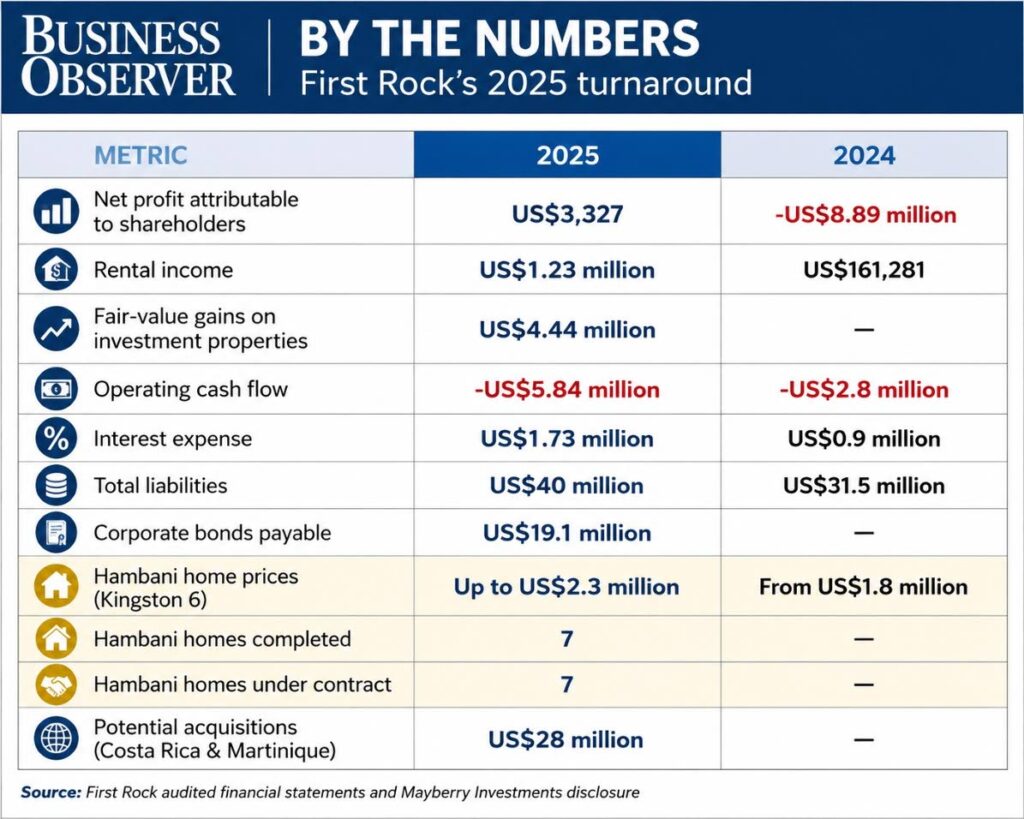
    Jamaica-based property developer First Rock Real Estate Investments has pulled off a notable return to profitability in 2025, driven by skyrocketing rental revenue and upward property value revaluations, but the firm still faces significant headwinds including negative operating cash flow, ongoing debt restructuring and heavy reliance on luxury residential sales to maintain adequate liquidity.

    According to newly released financial results, the company logged a net profit of US$3,327 attributable to shareholders for the 2025 calendar year. This result marks a sharp reversal from the US$8.89 million net loss the firm posted in the prior year. The profit turnaround was fueled by two key factors: a 663% year-over-year surge in rental income, which reached US$1.23 million, and a US$4.44 million gain from upward revaluation of the company’s investment property portfolio. Without the non-cash revaluation boost, however, First Rock would still face material earnings pressure, company filings show.

    The dramatic jump in recurring rental revenue aligns with First Rock’s publicly stated strategic pivot toward stabilizing commercial and income-producing real estate assets, a move designed to cut the firm’s historical reliance on one-off development project sales. Even with this top-line improvement, audited financial statements reveal ongoing strain on the company’s cash position. Operating cash flow registered a negative US$5.84 million for the year, while annual interest expenses nearly doubled to hit US$1.73 million amid a broader high interest rate environment that has pushed up financing costs across the global and local real estate sectors. First Rock remains in active negotiations with creditors to refinance maturing short-term debt and secure additional working capital to fund its ongoing operations.

    At the center of the firm’s near-term cash generation strategy is the near-completed Hambani luxury residential development located in Kingston 6. In a disclosure dated April 30, transaction advisor Mayberry Investments confirmed that seven luxury villas at the development have received practical completion certificates, and all seven are already under contract to buyers. Completed units are priced between US$1.8 million and US$2.3 million, and Mayberry noted that proceeds from sales to date are enough to cover all remaining development costs and leave a surplus of cash to support other corporate obligations.

    First Rock Chief Executive Officer Ryan Reid explained that the company’s current capital structure was intentionally structured to tie debt repayment timelines to development completion and unit sales. “Unit sales are indeed a key part of our repayment strategy, and that’s really by design, which reflects the direct alignment between our development pipeline and our capital structure,” Reid told the Jamaica Observer in written comments.

    A review of the company’s balance sheet shows 15% year-over-year expansion in total assets, which grew to US$65.8 million at the end of 2025. Total liabilities also climbed, rising from US$31.5 million in the prior year to US$40 million in 2025. Outstanding corporate bonds jumped sharply to US$19.1 million, while combined current and non-current long-term loans remained elevated at roughly US$16 million. Audit notes reveal that some of First Rock’s newest financing arrangements carry interest rates as high as 18%, underscoring the steep cost of capital facing heavily leveraged property developers operating in Jamaica’s current high interest rate landscape.

    Reid emphasized that growing recurring rental revenue will be the core driver of improved operating cash flow going forward. “The revaluation gains reflect genuine value creation in our portfolio, but we absolutely understand that cash generation is important, hence the massive movement in our rental income year on year,” Reid told Business Observer. “We expect operating cash flow to further improve meaningfully.”

    Even as the company works through ongoing debt refinancing discussions, First Rock is advancing plans for two regional acquisitions in Costa Rica and Martinique, with a combined transaction value of US$28 million. Reid stressed that the planned purchases are not aggressive expansion into speculative development, but rather a targeted move to accelerate growth in recurring cash flow. “The acquisitions we’re pursuing are not about expansion for its own sake, they are highly selective opportunities that we believe will generate returns faster than greenfield developments would. These are fully tenanted rental income opportunities,” Reid said. “In each case, the entry price, existing entitlements, and near-term development potential mean these assets contribute to cash generation rather than stretching it further.”

    Auditors from Ernst & Young, the firm that signed off on First Rock’s 2025 financial statements, identified investment property valuation as a key audit matter. They noted that investment properties and properties held for sale collectively account for roughly 50% of the company’s total assets as of year end. After years of debt-fueled expansion, First Rock now faces growing pressure to prove that its evolving rental-focused business model can generate sustained, stable cash flow, reducing the firm’s current heavy reliance on non-cash property revaluations and irregular development sales to deliver positive bottom-line results.

  • Sparks fly between Green and Wildman in cops’ murder trial

    Sparks fly between Green and Wildman in cops’ murder trial

    A routine cross-examination session at Jamaica’s Home Circuit Court erupted into open tension on Tuesday, as Agriculture Minister Floyd Green locked horns with Hugh Wildman, lead defense attorney for six on-trial policemen, over repeated questions about Green’s political position and his credibility as an eyewitness. The high-stakes encounter unfolded during the continuation of a long-running murder trial connected to a 2013 triple shooting in the upscale Barbican neighborhood of St. Andrew.

    The incident at the center of the case dates back to January 12, 2013, when three men — Matthew Lee, Mark Allen, and Ucliffe Dyer — were killed during a reported gunfight with police on Acadia Drive. The six law enforcement officers standing trial for their murders are Sergeant Simroy Mott, Corporal Donovan Fullerton, and Constables Andrew Smith, Sheldon Richards, Orandy Rose, and Richard Lynch. Fullerton additionally faces a separate charge of submitting a false statement to the country’s Independent Commission of Investigations. Prosecutors allege that during a routine police operation, officers signaled for the driver of a blue Mitsubishi Outlander to pull over, and that armed men exited the vehicle to engage officers in a shootout that left the three men dead. Authorities say two illegal firearms — an Arcus 9mm pistol and a Mac 11 submachine gun — were recovered from the scene, and a fourth man suspected of involvement managed to escape. Photographs presented to the seven-member jury show the Outlander, its two front doors ajar, parked on Acadia Drive just steps from its intersection with Evans Avenue.

    Green, who lived on the top floor of a nearby multi-story apartment building on Acadia Drive at the time of the shooting, is one of only two surviving eyewitnesses to testify to what he observed that day. He has told the court that he watched part of the incident unfold from his bedroom window. As cross-examination got underway on Tuesday, Wildman first questioned Green about the angle of his vantage point, asking whether the minister’s view of the parked Outlander would have required him to look up the street, rather than directly across. Green pushed back on the suggestion, maintaining his position allowed him to look “down and across” at the scene.

    The exchange quickly escalated when Wildman referenced Green’s role as a sitting government minister, framing the question as relevant to assessing the witness’s credibility. The reference immediately angered Green, who warned the attorney against “going back down this road” and declared his credibility “unassailable.” When Wildman repeated the reference to Green’s ministerial title a second time, Green refused to continue engaging on the line of questioning, demanding the attorney drop the topic. Prosecutor Kathy-Ann Pyke intervened to alert trial judge Sonia Bertram-Linton that an argument was imminent, but the judge declined to restrict Wildman’s cross-examination strategy, noting she would not instruct defense counsel on how to question a witness.

    Tensions flared again later in the session as the two legal teams clashed over the content of Green’s original January testimony. Wildman pressed Green on whether he had previously stated he could see blood on the chest of a man in a white shirt lying behind the Outlander. Pyke objected immediately, arguing Green had only testified to seeing blood on the man’s shirt, not directly on his chest. Even Justice Bertram-Linton initially could not recall Green making the specific claim about blood on the chest, prompting defense team member John Jacobs to pull the original January trial notes to confirm the testimony. Jacobs, irritated by Pyke’s repeated objections, asked the prosecutor to allow the defense to present its questions without interruption, leading Wildman to snap at Pyke, calling her a “muttering maniac” in remarks to the judge.

    After reviewing her own notes, Justice Bertram-Linton confirmed Green had indeed told the court he observed blood in the chest region of the shirt. Even with the record clarified, Pyke continued to object, arguing Wildman had misrepresented Green’s testimony, which only referenced blood on the shirt, not the man’s body. The back-and-forth prompted an exasperated Wildman to accuse Pyke of insulting the intelligence of the seated jury. When Wildman turned back to continue questioning Green and the minister addressed him by name, the attorney snapped again, ordering Green not to repeat his name, as the entire court already knew who he was. This outburst drew a public rebuke from the judge, who chided Wildman for being rude and ordered him to adjust his confrontational tone and adhere to proper courtroom conduct.

    Green was first called as the prosecution’s opening witness in January, and was recalled to the stand for further cross-examination last Friday. The trial is scheduled to resume on Wednesday, with Green set to face additional questioning from the defense team.

  • Price hints at Flow 5G roll-out

    Price hints at Flow 5G roll-out

    MONTEGO BAY, St James — Just months after investing $85 million to reconstruct and upgrade its communications network across Jamaica in the wake of Hurricane Melissa, telecom provider Flow Jamaica has deepened its long-term commitment to the country with the official launch of its dedicated business-to-business division, Liberty Business Jamaica. The launch event, held this week in Montego Bay, brought together dozens of local business leaders and government stakeholders, and included major announcements about the company’s upcoming technological expansion and local investment plans.

    Stephen Price, vice-president and general manager of both Flow Jamaica and Liberty Business Jamaica, revealed to attendees that the company is in the final stages of preparations for a 5G network rollout, hinting that the official launch could come in just a matter of weeks. Addressing recent temporary mobile service disruptions that some Jamaican customers have experienced, Price explained the interruptions are a side effect of ongoing large-scale infrastructure upgrades. He urged customers who have received notifications to upgrade their SIM cards to complete the swap promptly to get ready for the faster, next-generation connectivity that is on the horizon.

    The upcoming 5G launch aligns with Flow Jamaica’s previously announced goal of completing a full transition to a 100% fibre-optic network across the country by December 2025, a foundational infrastructure upgrade designed to support advanced new technologies including 5G.

    Beyond the 5G announcement, Price officially confirmed plans to open a dedicated Liberty Business Jamaica headquarters in Montego Bay, framing the choice of the western Jamaican city as a deliberate strategic decision. Price noted that Montego Bay is a critical hub for two of Jamaica’s most important economic sectors: tourism and business process outsourcing (BPO), both of which suffered catastrophic damage when Category 5 Hurricane Melissa swept through the island last October.

    In the immediate aftermath of the storm, Price recounted, Liberty Business deployed emergency satellite and mobile connectivity solutions to impacted businesses across western Jamaica, and was the only mobile network provider that maintained operational service in large parts of Montego Bay throughout the crisis. “Some of you had immediate needs that we were able to address right away using satellites and mobile solutions. I’m also proud to say that in the aftermath of the storm we were largely the only mobile network running in Montego Bay,” Price told the gathered stakeholders.

    The $85 million spent on post-Melissa recovery and upgrades marks the latest in a series of large-scale investments by the company, coming on the heels of major recovery spending following Hurricane Beryl in 2024. Price emphasized that despite the significant capital outlay, the investment is critical to supporting Jamaica’s business community and residents. Much of the post-storm recovery work in Montego Bay focused on hardening infrastructure for long-term resilience: crews moved vulnerable aerial transmission lines underground and replaced aging copper network infrastructure with modern fibre-optic cabling.

    Remarkably, Price reported, the majority of Montego Bay’s business community had their connectivity restored within two to three months after the hurricane. As of the launch, 82% of the company’s fixed-network customers across the impacted area have been fully reconnected, with work ongoing to restore service to the remaining 18%, and mobile service is almost entirely back to pre-storm levels. Network traffic has jumped nearly 40% since the storm, a shift Price said reflects Jamaica’s accelerating transition to digital-first services across all sectors. To boost future resilience, multiple mobile cell sites in St James Parish now have permanent satellite backup power and connectivity.

    Price also highlighted the scale of Liberty Business’s regional footprint: the division operates one of the largest digital infrastructure networks across the Caribbean, with roughly 50,000 kilometers of sub-sea fibre-optic cable and more than 17,000 kilometers of terrestrial fibre spanning 30 regional markets. Notably, the company provides wholesale connectivity services to competing telecom providers across the region, and even supplies internet connectivity to Starlink, Elon Musk’s satellite internet firm. The hurricane recovery experience, Price said, reinforced how critical resilient communications infrastructure is to national disaster preparedness and ongoing business continuity.

    “Technology is not abstract. The solutions we provide have a direct impact on livelihoods and national resilience,” Price added.

    Montego Bay Mayor Richard Vernon welcomed the company’s expanded presence and new headquarters, noting that rapid urban growth in the city, driven by an influx of workers to the tourism and BPO sectors, has created increased demand for housing and strained existing public and private infrastructure. Digital tools such as resilient communications networks, smart data management, and digital advisory services, Vernon said, will be critical to supporting sustainable urban planning, improving municipal services, and cementing Montego Bay’s position as Jamaica’s top investment destination. He added that the city is eager to expand its partnership with Liberty Business beyond information and communications technology.

    “In short, this launch is a story of convergence: a company redefining its identity, a city undertaking modernity, and a nation embracing digital transformation. Together, these threads weave a narrative of resilience, opportunity, and progress. So we are not merely hosting a brand launch; we are embracing a partner in this journey to become a safe, vibrant, and digitally empowered city,” Vernon said.

  • JAMAICA BUYS $31-B HURRICANE SHIELD

    JAMAICA BUYS $31-B HURRICANE SHIELD

    Just 10 days out from the kickoff of the 2026 Atlantic Hurricane Season, Jamaica has bolstered its financial defenses against catastrophic storm damage by locking in a $200 million expanded hurricane coverage package from global capital markets. This move comes on the heels of 2025’s Hurricane Melissa, which left behind a trail of destruction equal to more than half of the Caribbean nation’s total annual economic output.

    The new transaction replaces Jamaica’s previous three-year $150 million catastrophe bond, a shift that underscores the rising financial threat that severe tropical storms pose to the island’s economy and long-term recovery capacity. The World Bank announced the deal on Monday, noting that overwhelming investor demand allowed the government to increase the coverage size from its initial planned amount. The expansion comes as Jamaica prepares for another forecasted active Atlantic hurricane season, prioritizing protection against rare, high-impact storm events that can upend years of economic progress.

    This latest issuance follows the activation of Jamaica’s prior catastrophe bond after Melissa made landfall in October 2025. The storm met all pre-negotiated trigger parameters tied to its intensity and track, triggering a full payout to the Jamaican government that delivered immediate access to emergency funds during the critical immediate recovery period. This real-world activation served as a full-scale test of Jamaica’s existing disaster financing strategy, proving the instrument’s ability to deliver rapid relief when disaster strikes.

    Post-disaster assessments peg total damage, losses and associated recovery costs from Hurricane Melissa at roughly $12.2 billion, a sum that equals approximately 56.7% of Jamaica’s entire annual gross domestic product. That staggering figure lays bare the massive fiscal and economic vulnerability that climate-driven severe hurricanes create for small island developing states across the Caribbean. The storm damaged critical public infrastructure, coastal tourism assets, agricultural production and public utilities, leaving the government grappling with sustained budget pressure months into the ongoing reconstruction effort.

    Jamaica’s expanded catastrophe bond also highlights a growing global trend: climate-fueled disasters are increasingly becoming a major sovereign balance sheet risk for climate-vulnerable economies. For small islands like Jamaica that face repeated storm impacts, the ability to transfer risk to global capital markets has become a core part of climate resilience planning.

    “Having disaster risk financing in place is a key pillar of our resilience-building framework,” Jamaica’s Finance Minister Fayval Williams said in a statement released through the World Bank. “The catastrophe bond is an important piece ensuring capital market access for Jamaica.”

    The new bond forms a core component of what the World Bank calls Jamaica’s “multi-layered disaster risk financing strategy,” a comprehensive approach that combines parametric catastrophe bond coverage with dedicated budget reserves, contingent government financing agreements and other risk transfer tools. The overarching goal of this framework is to reduce the severe fiscal shock that major hurricanes typically impose on national budgets.

    The World Bank emphasized that Jamaica remains extremely exposed to the financial fallout of hurricane events, warning that severe storms carry lasting consequences for public safety, household livelihoods and broader macroeconomic stability across the island.

    The new bond is issued through the World Bank’s existing “capital at risk” notes program, a mechanism that enables vulnerable nations to shift disaster-related risk off their public balance sheets and onto a broad base of international institutional investors. Under the standard catastrophe bond structure, investors earn regular fixed returns as long as no qualifying triggering disaster occurs. If a major storm meets the payout conditions, however, investors forfeit part or all of their principal, which is redirected to the affected government for emergency recovery.

    This latest transaction will provide Jamaica with continuous hurricane coverage through to 2030, and carries an annual risk margin of 6.75%.

    World Bank Vice-President and Treasurer Jorge Familiar highlighted that the full payout after Hurricane Melissa confirms how well-designed parametric disaster financing instruments can deliver fast, predictable protection when disaster strikes. “The payout following Hurricane Melissa demonstrated once again how countries can prepare for disaster with well-designed parametric instruments that deliver fast and reliable financial protection when it is needed most,” Familiar said.

    The new catastrophe bond will be listed on the Singapore Exchange, with structuring led by global financial firms Aon Securities and Swiss Re Capital Markets.

  • ABWU Partners with Lupus Association, Donates $2,500 in Support of Awareness Efforts

    ABWU Partners with Lupus Association, Donates $2,500 in Support of Awareness Efforts

    A landmark collaboration between the Antigua and Barbuda Workers’ Union (ABWU) and the Lupus Association of Antigua and Barbuda is set to transform how the Caribbean nation addresses the unmet needs of communities affected by lupus, kicking off with a EC$2,500 donation and a long-term pledge to expand outreach, education and patient support. The official launch of the partnership took place Friday, aligned perfectly with global Put on Purple (POP) Day, an international initiative dedicated to driving public attention to this chronic, often misunderstood autoimmune disease.

    Speaking at the donation presentation ceremony, ABWU General Secretary David Massiah emphasized that the initiative goes far beyond a single charitable contribution. He framed the partnership as a lasting promise built on collective solidarity with those navigating life with lupus, including working residents who balance daily management of the condition with holding down employment and caring for their families. “Today, we are not simply making a presentation. We are making a commitment rooted in solidarity,” Massiah said. “The ABWU is proud to stand alongside the Lupus Association as we work together to raise awareness about a condition that affects many individuals and families within our nation, including workers who continue to face the daily challenges associated with lupus while striving to earn a living and care for their loved ones.”

    Massiah also highlighted a common, harmful gap in public understanding of the disease: unlike many visible health conditions, lupus’ impacts are often hidden from casual observation, even as it imposes severe, multifaceted burdens on patients, ranging from chronic physical pain to emotional distress, mental health struggles and crippling financial strain from ongoing medical care.

    Linda Mussington, president of the Lupus Association of Antigua and Barbuda, welcomed the new collaboration, noting that the union’s broad reach across the country will help the association extend critical lupus education to younger demographic groups, a population that has seen rising diagnosis rates in the nation. “With the Antigua Workers’ Union, I know that the exposure is going to really take us further, because we have also seen that there are so many young people in Antigua that have lupus,” Mussington explained.

    The partnership announcement also coincided with a milestone for the ABWU: the union is currently marking its 59th year of service to Antigua and Barbuda’s workers and broader community. Stacey Ladoo, assistant secretary of the Lupus Association, thanked the union for its targeted support and commended the organization for its decades-long commitment to advancing public welfare across the islands.

  • ‘China heeft de touwtjes in handen’: waarom Putin’s bezoek aan Beijing na Trump ertoe doet

    ‘China heeft de touwtjes in handen’: waarom Putin’s bezoek aan Beijing na Trump ertoe doet

    In a carefully timed sequence of high-stakes diplomacy that underscores China’s growing influence on the global stage, Russian President Vladimir Putin is set to arrive in Beijing on Tuesday for a landmark summit with Chinese President Xi Jinping, marking the 25th anniversary of the 2001 Treaty of Good-Neighborliness and Friendly Cooperation between the two nations. While the commemoration forms the official centerpiece of the meeting, analysts widely agree that the true significance of this Wednesday gathering stretches far beyond a simple anniversary celebration, shaped heavily by its placement just days after U.S. President Donald Trump concluded his own high-profile summit with Xi in China.

    Putin’s visit was formally announced immediately following Trump’s departure from China, where the American leader touted broad new trade agreements with Beijing but offered little tangible evidence of progress on the world’s most pressing geopolitical flashpoints, including cross-strait tensions over Taiwan and the ongoing Israel-U.S. military conflict against Iran. This timing works distinctly to Russia’s advantage, analysts note, as it reinforces Putin’s confidence that Beijing has no plans to dilute its close bilateral ties with Moscow amid shifting Western pressure. For China, the back-to-back visits of the leaders of the world’s two most prominent rival powers to the U.S. serves as a clear diplomatic statement: it demonstrates that China, as a major global power, can engage with competing powers on its own sovereign terms.

    Both nations currently face sweeping Western economic and political sanctions, and both view the Trump administration’s unpredictable foreign policy as reckless and destabilizing. Over the past decade, Beijing and Moscow have built a deep, comprehensive strategic partnership, and analysts do not expect any major overhauls to this relationship during Putin’s current visit. Even so, the gathering itself makes clear that China is actively cementing its position in an increasingly fragmented global order.

    Experts note that while no major diplomatic breakthroughs are anticipated from the summit, the two sides are expected to further deepen their already robust strategic cooperation, particularly in the economic and defense sectors. Key areas of mutual benefit include China’s pursuit of discounted access to Russian energy exports, while Russia has grown increasingly dependent on Chinese technology, most notably for unmanned aerial drone systems.

    A key dynamic shaping the meeting, analysts emphasize, is that the visit holds far greater strategic importance for Putin than it does for Xi. Following the costly and protracted war in Ukraine that has isolated Moscow internationally, Russia has shifted into the role of the junior partner in the bilateral relationship, and is widely believed to be seeking additional military support from Beijing. One senior foreign policy analyst notes that China currently holds all the leverage in negotiations, meaning Putin, like Trump before him, will come to Beijing to seek concessions rather than dictate terms.

    At the same time, analysts warn against framing the Sino-Russian relationship as purely hierarchical. Both nations share a core common goal: building a multipolar global order that rejects the dominance of a single hegemonic power that imposes its will on other sovereign states.

    The consecutive back-to-back summits with Trump and Putin above all highlight China’s deliberate self-positioning as an indispensable neutral mediator in an increasingly divided world. Beijing frames itself as a neutral power without permanent enemies, even as it maintains its close strategic alignment with Moscow.

    The ongoing Israel-U.S. conflict against Iran has disrupted global energy markets, hitting China’s economy harder than it has impacted Russia. While Russia sees short-term economic benefits from the market disruption, both nations share a long-term goal of regional stability and an end to the conflict. The recent Trump-Xi summit made clear that China refused to grant Trump’s key demand: backing U.S. efforts to end Iran’s regional influence through force. Moscow has welcomed this stance, as it confirms China will not abandon Russia’s close regional partners including Iran.

    The war in Ukraine will certainly feature heavily in closed-door talks, but analysts agree China has no plans to pressure Russia to accept any specific negotiated outcome. Beijing has positioned itself as a willing neutral mediator in the conflict, but it also has no interest in seeing Russia suffer a humiliating defeat that would undermine its strategic standing.

    While the visit is unlikely to produce major headline-grabbing diplomatic breakthroughs, it leaves one conclusion inarguable: by hosting the leaders of the United States and Russia back-to-back on its own soil, China has cemented its status as an indispensable power at the center of the modern global political landscape.