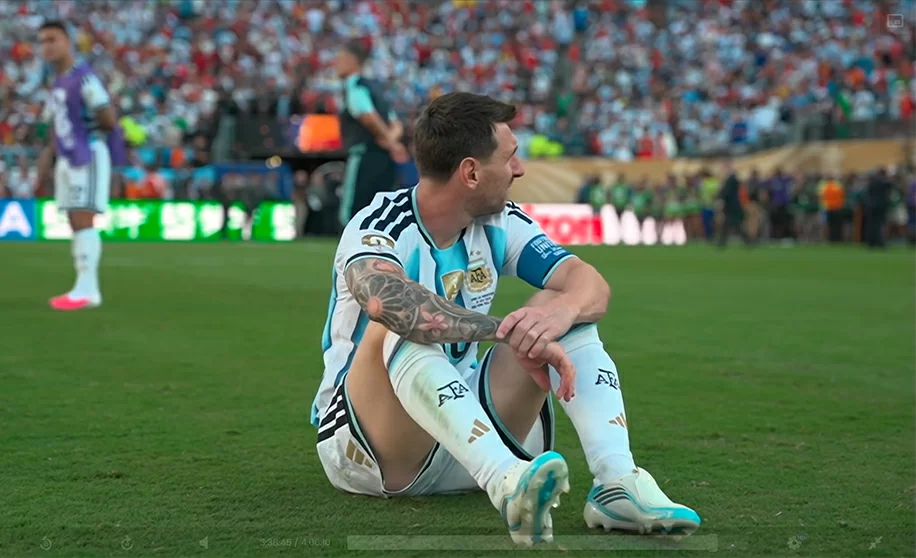
The 2026 FIFA World Cup has drawn to a close, closing out weeks where football gripped the entire globe’s collective attention. Across the world, streets emptied as fans crowded into cafes, roaring with celebration or weeping in disappointment, millions of hearts beating in unison with every pass, shot, and goal. At the center of it all stood Lionel Messi, the legendary Argentine maestro, taking the field for what was billed as his final major appearance on the world’s biggest football stage.
As he stood alone on the pitch after the tournament’s final match, the stadium around him erupted into a cacophony of conflicting emotions. The thunderous roar of fans chanting his name mixed with the soft, almost tangible grief of those who knew this moment marked the end of an era. In that quiet, charged instant, Messi absorbed every feeling: the unwavering love of supporters from every corner of the globe, the admiration of peers and critics alike, the decades-long weight of a record-breaking career, and the quiet ache of an approaching goodbye. Even with his mythic status as one of the greatest players to ever step onto a football pitch, Messi remains human at his core: full of feeling, marked by doubt, carrying a lifetime of memories, and unafraid to show his vulnerability and emotion, a mirror for every person who has ever dared to chase a dream.
Alongside him stood Lamine Yamal, the young Spanish prodigy brimming with raw talent and unquenchable hope, who offered Messi a warm, respectful embrace at the end of their semi-final matchup. That simple, heartfelt moment was far more than a display of sportsmanship: it was a symbolic passing of the torch, a meeting of past and future, of hard-won experience and fearless youthful ambition. The old master and the game’s next great promise stood side by side, a visual promise that the next generation will carry football’s legacy forward, and keep the dreams of the sport alive for decades to come.
Yet even as the world lingered on the magic and emotion of the tournament, reality waits just outside the stadium gates. While millions of fans lost themselves in the drama and spectacle of 30 days of world-class football, everyday life is still defined by soaring costs, the constant struggle to earn a fair living, and the fight to build a stable future amid widespread uncertainty and global upheaval.
Most stark of all is the sharp contrast between the celebration of global unity that football offers and the persistent conflict that divides our world. When former U.S. President Donald Trump took the stage to present the World Cup trophy to the winning side, U.S. military airstrikes were hitting targets in Iran — a nation whose own national team had fought their way through the tournament with remarkable grit, pride, and resilience. This jarring juxtaposition puts the split reality of our modern world on full display: on one side, a global celebration of sport and connection, and on the other, unending violence and human suffering. Joy and war, hope and destruction, sport and politics, exist side by side, impossible to separate.
Conflicts around the world continue unabated even as global audiences celebrate football’s biggest stars. Families are torn apart, and dreams are crushed under the rubble of ongoing war, while millions around the world sit transfixed watching their favorite heroes shine on the world stage. It is exactly this stark contrast that makes Messi’s final World Cup moment feel so powerful and so painfully poignant all at once. Football has a unique ability to bring people across every border and division together, but it also forces us to confront the harsh realities we too often choose to ignore.
Perhaps that is the true meaning of Messi’s final dance on the World Cup stage. It is a celebration of all that makes us human: our capacity for hope, our drive to chase our dreams, but also a recognition of our shared vulnerability and the messy, complex world we all inhabit. When Messi stood on that pitch, surrounded by the moment and the people who love him, audiences did not just see a champion lifting a trophy. We saw a human being who connects us all. And in that connection, there is power to keep moving forward, to keep dreaming, and to keep fighting, long after we leave the stadium.
His tears are not just tears of goodbye. They are tears for everything that football represents: connection across division, unending passion, the fight to be the best, and the hope that binds us all together. For football is far more than just a game. It is a mirror held up to our global society, full of sharp contrasts, raw emotion, and the indestructible hope that drives every one of us forward.