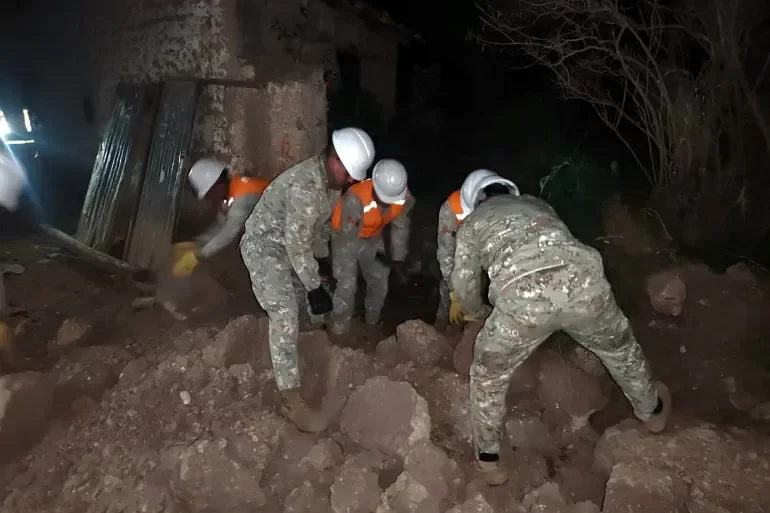
On the evening of July 18, 2026, back-to-back earthquakes with magnitudes of 5.1 and 3.7 shook the mountainous Junin region, located east of Peru’s capital Lima, leaving at least five people dead and 21 others injured, Peruvian emergency authorities confirmed.
The seismic activity triggered widespread structural collapse across the region, with at least 48 residential buildings completely destroyed and another 18 damaged beyond habitation. The destruction has forced roughly 300 local residents to flee their homes for emergency shelter. Rural communities including Chupaca and Chongos Bajo bore the brunt of the damage, as many of the region’s older homes are constructed from adobe, a fragile mud-brick material that offers little resistance to earthquake shaking. Rescue teams have been deployed across the disaster zone, working around the clock to search for any people who may be trapped beneath rubble.
Peru’s incoming president Keiko Fujimori released a statement of condolence via social media following the disaster, writing: “I deeply regret the devastating impact of the earthquake in Junin. My deepest condolences go out to the families of those who lost their lives, and I stand in full solidarity with all those affected by this tragedy.”
According to Peru’s National Seismological Center, the first earthquake struck at a depth of 24 kilometers, while the second followed at a shallower depth of 18 kilometers. Initial magnitude readings from the European-Mediterranean Seismological Centre had estimated the first quake at 5.6 magnitude, before the figure was revised downward.
Geographically, Peru sits along the Pacific Ring of Fire, a horseshoe-shaped zone of high tectonic activity that accounts for roughly 85 percent of all earthquakes recorded worldwide. The region is notorious for frequent intense seismic and volcanic activity, making major earthquake events relatively common across Andean South America.
Emergency response teams have already been deployed to the Junin disaster zone to deliver temporary shelter, medical care, and basic supplies to displaced residents. Local authorities have issued public warnings about the elevated risk of aftershocks in the coming days and urged local residents to follow official safety protocols to avoid secondary hazards.
The Peru disaster comes just weeks after a pair of far more powerful earthquakes, registering magnitudes 7.2 and 7.5, hit Venezuela, killing thousands. Official updates from Venezuelan authorities have now pushed the confirmed death toll from that disaster to 5,069, with another 16,740 people injured.
The powerful February tremors caused catastrophic infrastructure damage across northern Venezuela: 856 buildings sustained structural damage, including 190 that collapsed completely. Critical transportation links including bridges and highways also suffered severe destruction, complicating initial rescue efforts. The coastal state of La Guaira remains the hardest-hit area, accounting for the vast majority of fatalities and the bulk of total property damage.
International aid teams, including an urban search and rescue unit dispatched from the Netherlands, have been on the ground in Venezuela supporting recovery operations. With search efforts now shifting, officials say the chance of finding any additional surviving trapped people is effectively zero, so teams are now focused on recovering the remains of missing victims.