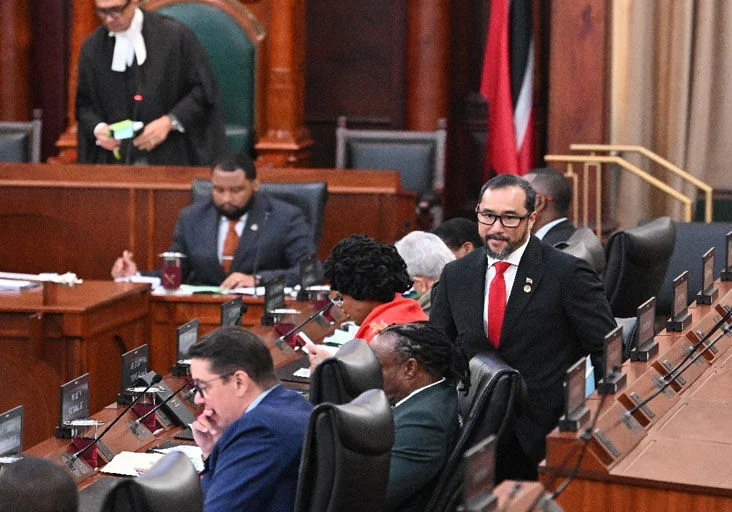
In a session of the House of Representatives, Energy Minister Dr Roodal Moonilal delivered formal testimony regarding the long-running accumulation of national fuel subsidy arrears, revealing that as of October 31, 2026, the combined outstanding obligations to state-linked fuel distributors National Petroleum Marketing Company Ltd (NP) and private operator Unipet reached $1.77 billion. Of that total, NP is owed $1.33 billion, while Unipet holds $440 million in unpaid subsidy claims. The disclosure came in response to a formal query tabled by Opposition Member of Parliament Stuart Young, who had requested full breakdowns of outstanding subsidy sums owed to the two firms as of October 26, 2026.
Minister Moonilal contextualized the massive backlog as a decades-long structural challenge that stretches back to the 1990s, across multiple successive political administrations, as successive governments have consistently failed to allocate sufficient budget resources to cover the full cost of the national fuel subsidy scheme. He cited specific historical data to illustrate the pattern: in fiscal year 2018, no line allocation for fuel subsidies was included in the national budget at all, leaving a pre-existing arrears balance of $1.4 billion. By the opening of fiscal 2019, that backlog had swelled past $2 billion, even though the 2019 budget only earmarked $400 million for fuel subsidies, of which a mere $58.55 million was ever disbursed by the then serving Minister of Finance.
Moonilal walked the chamber through the formal mechanics of the national fuel subsidy framework, which is governed by the Petroleum Production Levy and Subsidy Act. The subsidy is triggered when the government-mandated wholesale price of gasoline, diesel and other petroleum products falls below a market-aligned reference price that includes approved operational margins for distributors. Calculated on a monthly basis, the total subsidy owed is derived by multiplying the gap between the regulated price and the market reference price by the total monthly sales volume of each fuel type. This structure means the government’s total subsidy liability fluctuates dynamically in response to shifts in global crude oil prices, local foreign exchange rates, and domestic fuel consumption patterns, even when retail regulated prices for end consumers remain unchanged. Per existing legislation, the subsidy is first funded via mandatory contributions from qualifying local crude oil producers through the Petroleum Production Levy, with the national government legally obligated to cover any remaining shortfall. When monthly disbursements to distributors fall short of the calculated monthly subsidy obligation, unpaid balances are rolled over to subsequent financial periods, creating the cumulative multi-billion dollar arrears seen today.
To begin addressing the backlog, Minister Moonilal confirmed that the Ministry of Energy formally submitted a funding request for $450 million to the Ministry of Finance in October 2026, and the requested allocation was approved, with all corresponding cheques prepared for disbursement to the two distributors on November 18, 2026. He publicly commended the Ministry of Finance for its timely intervention to reduce the long-standing outstanding liabilities.
The proceedings turned contentious immediately following the minister’s formal response, when Opposition MP Stuart Young tabled a supplementary line of questioning that challenged the government’s approach, pointing out that the $450 million disbursement represented only a small fraction of the more than $2 billion in total accumulated arrears, and pressing Minister Moonilal to publicly disclose NP’s current solvency status given the years of delayed payments. House Speaker Jagdeo Singh ruled that the supplementary query fell outside the scope of the original tabled question, a decision Young pushed back against, arguing that Minister Moonilal had been permitted to deliver extensive, wide-ranging historical context about arrears under prior administrations, taking what he described as a “long run-up” with references to 2018 and 2019 liability figures. When Speaker Singh intervened to remind Young of parliamentary Standing Orders, the Opposition MP interrupted mid-reminder to protest the uneven application of chamber rules, prompting Singh to issue a formal order removing Young from the House of Representatives Chamber for a one-hour period.