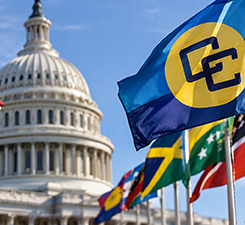
A highly respected veteran Caribbean diplomat has issued a pragmatic advisory to all member states of the Caribbean Community (CARICOM), cautioning regional governments against anticipating sweeping, immediate adjustments to United States foreign policy toward the Caribbean following the Democratic Party’s victory in securing majorities in both the U.S. House of Representatives and the U.S. Senate. Published on November 5, the analysis from Sir Ronald Sanders emphasizes that even with full Democratic control of the upcoming Congress that will be sworn into office in January 2027, sitting President Donald Trump will retain sweeping executive authority that will keep the core of Washington’s Caribbean policy largely unchanged. Sanders clarifies that while the new legislative landscape creates openings for enhanced congressional oversight of executive branch actions, potential revisions to federal spending allocations, and more structured dialogue on longstanding Caribbean policy priorities, the Trump administration’s foundational foreign policy priorities for the Western Hemisphere are not poised for a major overhaul. He breaks down the U.S. system of separated powers, noting that Congress holds exclusive purview over drafting legislation, approving government appropriations, and conducting oversight of federal agencies, but the U.S. president retains broad unilateral authority over diplomatic appointments and negotiations, immigration enforcement protocols, and key components of international trade rulemaking. The diplomat outlines that the Trump administration’s existing top regional priorities—including advancing U.S. strategic dominance across the Western Hemisphere, tightening cross-border migration controls, expanding counter-narcotics operations, and curbing the growing influence of rival global powers in the Caribbean basin—will remain consistent regardless of which party controls the legislative branch. This reality, Sanders notes, means CARICOM nations will need to pursue a dual-track diplomatic strategy: navigating a largely unaltered set of Trump administration regional policies, while leveraging new access points in the Democrat-controlled Congress to advocate for targeted, favorable adjustments. Trade policy stands out as one high-priority engagement area. Sanders points out that existing U.S. tariff structures have eroded the competitive edge of Caribbean export goods, while cascading economic pressures including elevated import costs, surging freight rates, and lingering post-pandemic supply chain disruptions have stretched household and government budgets across the region. To strengthen their negotiating position, he advises CARICOM governments to highlight the tangible economic value of their trade relationship with the U.S., citing 2025 data that shows the U.S. recorded a roughly $7 billion merchandise trade surplus with the CARICOM bloc. Security cooperation represents a second key area of aligned mutual interest, as transnational threats including illicit drug trafficking, unregulated illegal firearms flows, transnational organized crime networks, and cross-border illicit financial flows generate harm for both Caribbean communities and U.S. domestic security. Sanders stresses that effective collaborative security frameworks must expand beyond traditional narcotics interdiction to also target weapons smuggling and the laundering of criminal proceeds. He also flags two persistent regional flashpoints that demand coordinated, sustained advocacy: the ongoing, spiraling security and humanitarian crisis in Haiti, and evolving U.S. policy stances toward Cuba. A third critical engagement opportunity lies in global development financing reform, where CARICOM has long pushed for global lending institutions to prioritize national vulnerability to natural disasters over strict per-capita income classifications when determining access to low-cost, concessional development funding. Sanders argues that building greater climate and disaster resilience across the Caribbean delivers tangible spillover benefits for U.S. commercial and investment interests, making the issue a persuasive talking point for U.S. lawmakers. He also raises alarm over overly restrictive U.S. visa policies targeting certain Caribbean nationals, noting that these arbitrary barriers create costly disruptions to cross-border business travel, student exchange programs, tourism flows, and access to specialized U.S. medical care. For Belize in particular, every one of these regional policy priorities carries outsized local relevance, given the country’s deep integration with U.S. trade frameworks, active bilateral security partnerships, shared migration management concerns, and extreme exposure to destructive hurricanes and other climate-fueled natural disasters. In his final assessment, Sanders emphasizes that the new Democratic-controlled Congress does not represent an opportunity to pursue a full reversal of existing Trump administration Caribbean policies, but rather opens up new, underutilized diplomatic pathways for CARICOM to advance its collective priorities. He recommends that Caribbean governments maintain steady, constructive working relationships with the sitting Trump administration, while simultaneously investing in deeper, bipartisan ties with members of both major U.S. political parties in Congress, centering shared mutual interests in all diplomatic outreach efforts.