On November 3, official diplomatic dispatches from Beijing reveal a sweeping, multi-pronged Chinese diplomatic push to de-escalate spiraling conflicts across the Middle East, as regional instability threatens global energy supplies, maritime shipping lanes, and cross-border security. The flurry of high-level engagements unfolded over a 48-hour window, with top Chinese officials hosting senior representatives from two longstanding regional rivals, plus a historic state visit from Oman’s Sultan Haitham bin Tariq.
Chinese Foreign Minister Wang Yi held separate closed-door meetings on Monday in Beijing with Ali Bagheri Kani, Deputy Secretary of Iran’s Supreme National Security Council, and Musaed bin Mohammed Al-Aiban, Saudi Arabia’s National Security Advisor. During both talks, Wang emphasized that dialogue and negotiated settlements are the only viable path forward to prevent further military escalation that could plunge the wider region into full-scale war. He reaffirmed China’s unwavering commitment to respecting Iran’s national sovereignty and territorial integrity during his meeting with Kani, while urging all conflicting parties to set aside differences through diplomatic channels and immediately halt hostilities during his discussion with the Saudi envoy. Al-Aiban also personally delivered a formal private letter from Saudi Crown Prince Mohammed bin Salman to Chinese President Xi Jinping during his visit, though no official confirmation has been released on whether the Iranian and Saudi envoys held any direct bilateral talks during their simultaneous stays in the Chinese capital.
Parallel to these meetings, China formally announced that Zhai Jun, its veteran Special Envoy for Middle East Affairs, will embark on a three-nation tour covering Iran, Oman, and Saudi Arabia in the first half of November, with a clear mandate to facilitate peace negotiations, reduce cross-border frictions, and shore up long-term regional stability. This upcoming mission forms a core pillar of Beijing’s broader strategy to leverage its deep, longstanding economic and diplomatic ties across the Gulf to broker a political resolution to ongoing regional conflicts, after Chinese officials previously called out the United States and Israel as key parties responsible for the outbreak of recent hostilities, stressing that the sovereign rights and security of all regional nations must be fully respected.
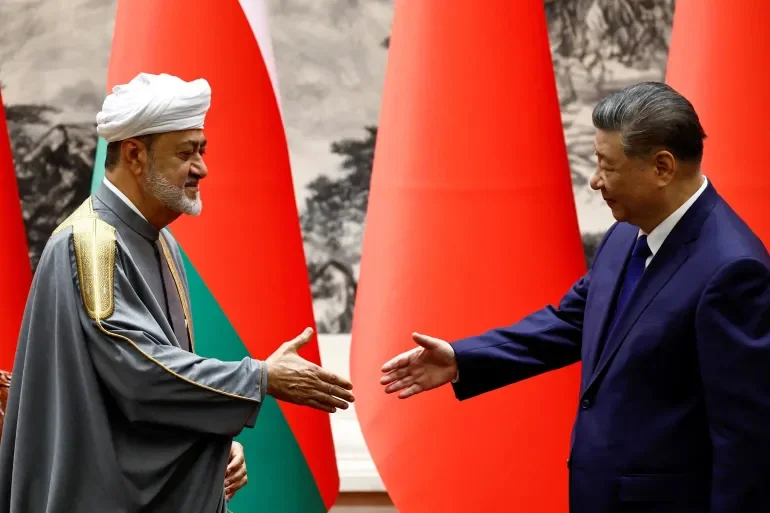
The high-profile state visit of Omani Sultan Haitham bin Tariq, held from November 1 to 2, marked the first official state visit by an Omani head of state to China since the two nations established formal diplomatic relations in 1978, cementing Oman’s newly elevated status as a key strategic partner in China’s Middle East diplomatic framework. During their face-to-face talks at the Great Hall of the People, President Xi Jinping explicitly stated that the Middle East and Gulf region must never be allowed to become a proxy arena for great power rivalry. The two leaders issued a joint official communiqué calling on the United States and Iran to resume direct bilateral negotiations, work toward a comprehensive ceasefire across all conflict zones, and restart long-stalled multilateral diplomatic processes. Both nations also pledged to maintain continuous, close coordination to safeguard unimpeded, safe commercial navigation through the strategic Strait of Hormuz, the chokepoint that carries roughly 20% of global energy exports prior to the outbreak of recent hostilities. Thanks to its unique neutral diplomatic posture and geographic positioning, Oman is widely recognized as a trusted intermediary capable of facilitating backchannel talks between otherwise hostile parties.
Beijing’s intensified diplomatic push is rooted in both geopolitical and pragmatic economic priorities: as the world’s largest energy importer, China relies heavily on unobstructed trade routes for steady oil and natural gas supplies, and disruptions to shipping through the Strait of Hormuz would send ripple effects across global supply chains far beyond the Middle East. Oman’s possession of major port facilities outside the Hormuz chokepoint also opens up alternative logistics pathways that can bypass potential shipping disruptions, a key point of alignment for bilateral cooperation. At the conclusion of the Omani state visit, the two nations signed a central bank currency swap agreement, 14 separate memoranda of understanding, and a formal bilateral cooperation protocol covering a wide range of sectors including green development, artificial intelligence, digital finance, academic scientific research, satellite navigation, industrial upgrading, and global supply chain resilience, alongside expanded cross-border investment frameworks.
While Beijing’s stepped-up diplomatic engagement signals its ambition to play a far more central mediating role in Middle East peace processes, analysts note that Chinese influence remains constrained by the competing priorities of dozens of conflicting parties across the region. No tangible breakthroughs in long-stalled U.S.-Iran negotiations have been publicly announced to date, and the willingness of all relevant stakeholders to make meaningful concessions will ultimately determine whether lasting de-escalation can be achieved. The upcoming tour of Special Envoy Zhai Jun will serve as a critical test of whether Beijing’s cross-parties diplomatic networks can deliver tangible progress toward a sustainable ceasefire, even as a permanent end to regional hostilities remains out of immediate reach.