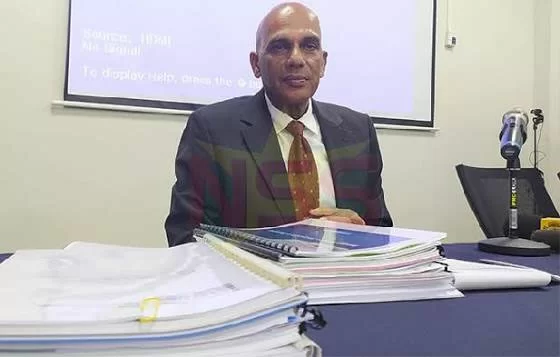
Suriname’s Progressive Reform Party (Vooruitstrevende Hervormingspartij, VHP) is heading into a contested leadership race, with former Finance and Planning Minister Armand Achaibersing confirming his candidacy for the party’s top post in an interview with Starnieuws. Achaibersing’s announcement comes after weeks of closed-door consultations with stakeholders both inside and outside the center-left party, joining current VHP Vice Chair Asis Gajadien who has already begun preparations for his own potential leadership bid.
Insiders close to the VHP report that Achaibersing has already garnered backing from multiple factions across the party and the broader Surinamese political landscape. His coalition of supporters includes other former government ministers, sitting members of the National Assembly, and senior members of the VHP’s executive board. His entry into the race formalizes an open debate over the VHP’s future direction and leadership, coming at a critical juncture for the party: after losing control of the national government earlier this year, the VHP now faces the urgent task of consolidating its position as the country’s main opposition bloc.
Achaibersing brings deep economic policy experience to his candidacy, having served as finance minister in former President Chan Santokhi’s administration from 2020 until September 2022. He took up the post at one of the most challenging moments in modern Surinamese economic history, when the country was grappling with severe fiscal collapse, crippling sovereign debt, and the widespread economic fallout of the COVID-19 pandemic.
During his tenure, Achaibersing was a central architect of the Santokhi administration’s Crisis and Recovery Plan, and led high-stakes negotiations with the International Monetary Fund (IMF). Under his leadership, Suriname made significant progress on the terms of a $688 million IMF extended fund facility, which was formally approved by the fund’s board in December 2021. He also led the country’s sovereign debt restructuring negotiations, and laid the groundwork for sweeping reforms to Suriname’s tax system and public financial management framework.
Achaibersing’s recovery agenda included deep austerity measures, which drew significant public backlash for eroding household purchasing power in the country. At the time, he defended the reforms as unavoidable for long-term fiscal stability, while repeatedly emphasizing that any economic adjustment must be paired with targeted social safety nets to protect vulnerable households.
Achaibersing first offered to resign from his cabinet post in August 2022, at which point Santokhi asked him to remain in office for several additional weeks to wrap up ongoing initiatives. He officially left the ministry on September 28 that year, and notably chose to forgo the post-ministerial benefits and compensation he was legally eligible to receive upon his departure.
Achaibersing’s supporters argue that his proven executive experience and track record of delivering on the IMF-backed recovery program make him the ideal candidate to unify the VHP’s fractured internal factions. People close to his campaign also frame his candidacy as a push to reframe the VHP’s public image: they argue the party should reposition itself as a vehicle for broad social opportunity, rather than one associated with patronage and political favoritism.
Achaibersing is not the only contender in the race, however. Current Vice Chair Asis Gajadien, a long-standing prominent figure within the VHP and seasoned parliamentarian who has played a central role in shaping the party’s policy positions, is also preparing to launch his own candidacy.
The emergence of two high-profile candidates marks a key turning point in the VHP’s post-electoral transition, setting the stage for a clear contest over the party’s future. In the coming weeks, political observers will be watching closely to see which other candidates formally enter the race, and how power dynamics within the party shift ahead of the leadership vote. Ultimately, the position will go to the candidate who can secure the backing of a majority of the VHP’s organizational structures and unify the party ahead of the next electoral cycle.