Fresh trade data released by China’s General Administration of Customs on Wednesday reveals a far stronger-than-expected expansion in the country’s international trade for September, with export growth hitting its highest pace in seven months, powered primarily by booming global demand for AI-related technology goods.
Compared to the same period a year earlier, Chinese exports climbed 36.3% in September to reach $447.18 billion. That marks a sharp acceleration from the 25% growth recorded in August, and handily outpaced the average 25.5% growth forecast by a consensus of economists. The last time China posted such a rapid annual export increase was in February 2026.
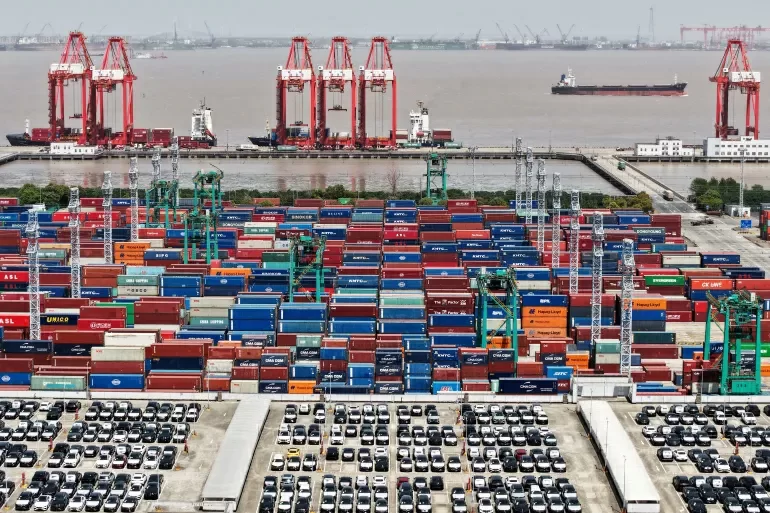
The biggest driver of this export boom is the global rollout of artificial intelligence infrastructure, which includes large-scale data centers and high-performance computing systems. These global investments have spurred explosive demand for the chips, electronic components and specialized equipment that Chinese manufacturers produce at scale. Year-on-year, Chinese semiconductor exports jumped 108.1% in September, while data processing equipment exports rose 54.6%. Auto exports also posted robust double-digit growth, fueled by rising international demand for Chinese-made electric vehicles, a sector that has become an increasingly important part of China’s global trade footprint. A drone image captured by Reuters shows new electric vehicles lined up at a Shanghai port waiting to be loaded onto cargo ships for export.
Imports also grew at a faster pace last month, rising 31% year-on-year to $313.65 billion, up from 28.2% growth in August. Even with accelerating import growth, exports far outpaced inbound shipments, pushing China’s monthly trade surplus to a record high of $133.53 billion.
For the first nine months of 2026, China’s cumulative trade surplus stands at $938.11 billion. If the current strong trade trajectory continues through the final quarter of the year, the country is on track to match or surpass the 2025 full-year record surplus of more than $1.2 trillion.
Regional and major global trading partners all posted double-digit increases in Chinese goods imports last month. Southeast Asia remains a key growth market for China: exports to Association of Southeast Asian Nations (ASEAN) member states rose 52.3% year-on-year in September to $81.7 billion. Exports to the European Union hit $60.15 billion, a 25.3% annual increase, while exports to the United States grew 39.6% to $47.88 billion.
The strong export growth to the U.S. comes as Washington and Beijing work to stabilize bilateral trade relations and prevent further escalation of their long-running trade dispute. At the same time, the European Union continues to push for a more balanced trade relationship with China, raising concerns about unfair competition and large persistent trade imbalances.
Despite the blockbuster export performance, China’s domestic economy still faces persistent structural vulnerabilities that have not been resolved by the international trade boom. Domestic consumption remains weak, the troubled real estate sector is recovering only slowly, and long-term growth prospects are pressured by population aging and shrinking workforce growth.
While strong export growth is propping up overall Chinese economic activity, it also increases the country’s reliance on foreign demand. Analysts warn that any future slowdown in the global economy, the imposition of new trade restrictions by major partners, or a pullback in global AI infrastructure investment could quickly dampen China’s export expansion.
The European Union and other trading partners have already raised growing concerns about Chinese manufacturers’ competitive advantage and the country’s persistent large trade surpluses. In particular, the rapid growth of Chinese exports of electric vehicles, batteries and other clean energy and technology goods has sparked new debates over market access and potential protective trade measures in multiple major markets.
The International Monetary Fund projects that the Chinese economy will grow by approximately 4.5% in 2026, a pace that remains well below the rapid growth rates the country posted in previous decades. While the strong September export figures give Beijing a boost in hitting its full-year growth target of 4.5% to 5%, the solid trade performance does not address the fundamental problem of weak domestic demand that continues to weigh on the economy.