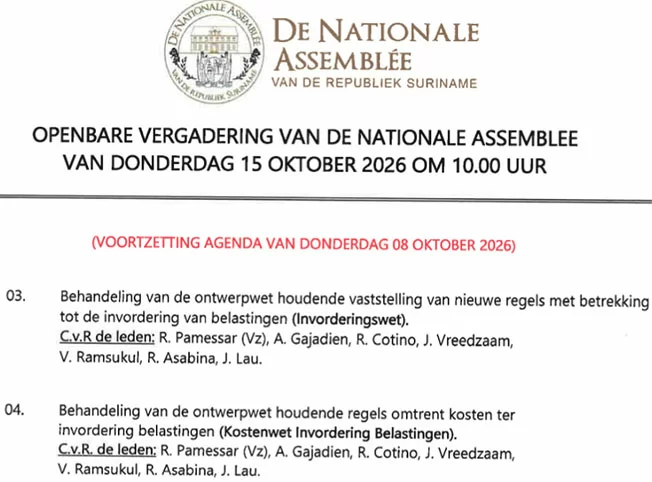
On 15 October, parliamentary debate over a landmark new Tax Collection Act continued in Suriname’s National Assembly (DNA), with a core cross-party consensus that the bill must expand the state’s ability to recover unpaid tax debts without unnecessarily pushing citizens or businesses into financial distress. This guiding principle shaped the second round of discussions, held by the committee of rapporteurs, where members pushed for strengthened legal safeguards for taxpayers, clear payment arrangement frameworks, proportionate collection fees, and transparent rules governing asset seizure. The session adjourned after closing the second round, and debate will resume at 10:00 local time on the same day to allow the government time to respond to outstanding questions and proposed amendments.
During the second sitting, committee members including Rabin Parmessar, Asis Gajadien, Rossellie Cotino, Vreedzaam, Kishan Ramsukul, Ronny Asabina and Jeffrey Lau took the floor to address specific provisions of the bill. While speakers focused on different sections of the draft legislation, widespread attention converged on striking the right balance between effective tax collection and the protection of fundamental taxpayer rights.
Leader of the NDP parliamentary faction Rabin Parmessar acknowledged that the government has already incorporated feedback from the first round of debate into revised versions of the bill. He highlighted one key clarification: all forms of asset seizure, including digital third-party asset seizure, can only be implemented after a formal enforcement order has been served. The oral address on the government’s behalf was delivered by Minister Stephen Tsang, as incumbent Finance and Planning Minister Adelien Wijnerman is currently out of the country.
Even with these adjustments, Parmessar argued that critical protections remain insufficiently outlined in the current draft. In particular, he called for further refinement to rules governing the right to file objections, access to payment deferrals, and timely judicial review of aggressive collection measures. He warned that the current framework risks forcing businesses into bankruptcy before a court can rule on the legality of the seizure, even if the taxpayer ultimately wins their legal case.
Parmessar also raised critical concerns over provisions allowing physical enforcement, restrictions on travel documents, and the protection of basic subsistence income when wages, pensions or bank balances are seized. He pushed for clear statutory definitions of the specific circumstances under which the state may exercise these extreme powers.
VHP parliamentary faction leader Asis Gajadien focused his remarks on two key areas: director and third-party liability, and the calculation of tax collection fees. He argued that business directors should not automatically be held personally liable for corporate tax debts if they can prove no misconduct on their part. Gajadien noted that businesses often fall into payment difficulty due to broader adverse economic conditions, not fraud or mismanagement.
He also raised a provocative question: should the same liability rules apply to tax officials and public servants who intentionally facilitate under-reporting of tax liabilities? Beyond liability, Gajadien objected to the current model that sets collection fees as a percentage of the outstanding debt. He pointed out that this creates arbitrary disparities between taxpayers even when the tax authority carries out the same amount of work, and warned that the model could effectively turn collection fees into an extra punitive financial penalty, which he said must be avoided.
Rossellie Cotino, another member of the committee of rapporteurs, reiterated the need for robust protections for taxpayer rights. She called for clear statutory rules to allow citizens and business owners to recover wrongfully collected tax payments. A reformed tax authority, she argued, should not only have broad powers to collect revenue, but also must fulfill its own obligations to taxpayers.
Cotino also proposed that the legal basis for collection interest should be enshrined in statute, and that collection fee rates should be updated annually to align with consumer price index data from the General Bureau of Statistics. She added that only reasonably necessary collection costs should be passed on to taxpayers.
Contributions from other committee members, including Vreedzaam, Kishan Ramsukul, Ronny Asabina and Jeffrey Lau, centered on questions around implementability, legal certainty and the financial impact of the proposed legislation. Speakers repeatedly drew attention to the need to align passed-through collection fees with the actual costs incurred by the tax authority. They also emphasized the importance of clear statutory deadlines and careful application of collection powers, and called for a more customer-focused tax authority that proactively informs citizens and businesses of their rights and obligations.
The debate also produced broad agreement that while the state needs sufficient tools to combat tax evasion, it must draw a clear line between intentional non-payment and taxpayers facing temporary financial hardship.
Article 26 of the bill, which governs payment deferrals, emerged as a recurring point of focus. Parliamentarians called for objective criteria for approval of payment arrangements, clear decision-making deadlines, and the ability to temporarily suspend collection measures when a tax assessment is challenged. Members also highlighted the disruptive potential of digital seizure of bank balances, stressing that collection measures must not leave households without sufficient funds to cover basic living expenses and family needs.
Multiple speakers stressed that the tax authority must invest not only in enforcement tools, but also in improved service delivery and initiatives to encourage voluntary tax compliance.
To date, the government has already made multiple adjustments to the original draft bill in response to parliamentary feedback. Multiple parliamentarians acknowledged that these changes have delivered meaningful improvements, but key legal and practical questions remain unresolved. Ahead of the resumption of debate, the Finance and Planning Ministry and parliament will exchange additional documentation and proposed amendments. The second round of parliamentary debate concluded at the end of the session, with discussion set to resume at 10:00 on Thursday, when the government will formally respond to all outstanding questions and proposals.