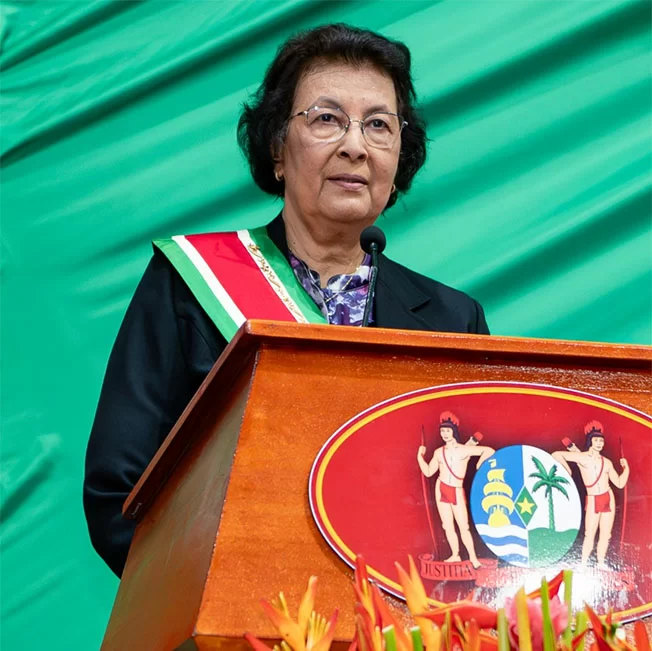
On October 6, Suriname’s President Jennifer Simons delivered her annual address to the nation, laying out a sweeping catalog of policy proposals, development targets, projected figures, and long-term ambitions. So dense is this list of pledges, it is easy to lose sight of the nation’s most prized natural asset: the tropical rainforests that Suriname’s people hold deep pride in. This is not an unusual observation; annual addresses from heads of state have long been filled with good intentions, packed with announcements, projections, and promises. History shows, however, that a share of these pledges never come to fruition, deadlines are regularly pushed back, and projected outcomes often diverge sharply from initial forecasts.
With this context in mind, one core question rises above the checklist of policy plans: What do the people of Suriname actually need and deserve from their national leader? It is not a hundred disconnected proposals, nor is it the impossible task of pleasing every stakeholder. Suriname is currently governed by a six-party coalition, where every faction holds its own base of supporters, distinct interests, and separate political agendas. Even within individual parties, consensus is not guaranteed. This means President Simons will constantly face choices between competing interests — and this is where genuine leadership begins.
A leader’s true caliber is not revealed when everyone agrees with her decisions; it is tested when hard choices are unavoidable. These choices come in many forms: between the profits of a large enterprise and the livelihoods of hundreds of small-scale producers, between loyalty to a political ally and upholding the rule of law, between quick resource extraction revenue and protecting Suriname’s irreplaceable natural ecosystems, between keeping a coalition partner satisfied and advancing the broader public good.
Since taking office, President Simons has stated repeatedly that her priority is serving the Surinamese people. She has pledged to reform and regulate the country’s gold mining sector, and has publicly spoken out against the destruction of Suriname’s forests and natural environment. These are critical, commendable commitments. But the real test of leadership will come when powerful individuals and interest groups see their profits threatened by these promised reforms. Will she still choose to stand with the nation and its people when that pressure comes?
The question of true leadership extends beyond President Simons to other top figures in the ruling coalition. Ronnie Brunswijk, one of the coalition’s most influential leaders, has described himself as a visionary who can see far into the future. But any leader who makes such a claim must answer one pressing question: What future does he actually envision? Is it a future that lifts the entire nation and all its people, or one that primarily benefits his own political faction and close circle? This question applies to every politician seeking to lead Suriname, not just Brunswijk.
Suriname is blessed with natural wealth that many nations can only dream of: extensive gold and oil reserves, abundant freshwater resources, fertile agricultural land, and the vast tropical forest canopy that covers much of the country. Spread across a population of just over 600,000 people, this abundance makes it unconscionable that so many ordinary Surinamese struggle daily to make ends meet.
Major emerging economies such as China and India have demonstrated a clear lesson: economic development only has real meaning when it delivers tangible progress for large segments of the population. Suriname does not need to copy these countries’ models — its social and economic context is entirely unique. But the core lesson holds: development that does not reach ordinary working people is not development at all for them.
The previous governing administration prioritized aggressive economic reforms, focusing on fiscal consolidation and stabilizing the national economy. While these efforts delivered improvements in top-line macroeconomic indicators, millions of ordinary households were simultaneously squeezed by skyrocketing prices and increased living costs. That is why the current approach must change.
The way forward is not through unrestricted handouts that keep people dependent on government packages, political favors, or patronage networks. Instead, the government’s core role is to create an enabling environment where ordinary people can leverage their own strength and talent. That means investing in quality education, accessible, decent healthcare, affordable energy, opening opportunities for smallholder farmers and local entrepreneurs, guaranteeing fair access to land and credit, and most importantly, building a government that treats all citizens equally under the law.
The Surinamese people do not need constant government handouts to carry them forward. What they need is the opportunity to stand on their own two feet. That may be the most important task facing President Simons. It is not about keeping all six coalition partners happy, it is not about appeasing every special interest group, and it is not about checking boxes to show what percentage of annual address pledges were completed. Her legacy as a leader will be defined not by the length of her plan list, but by the hard choices she makes when pressure mounts.
When political, personal, and economic interests clash with the public good, will she have the courage to say: This is what is best for Suriname, and this is what we will do? More importantly, will she be able to say, when necessary: This is bad for Suriname, and we will not do it — no matter who stands in opposition, no matter who helped her reach the office of head of state? If she can do this, and avoid becoming a puppet tied to competing special interests, the people of Suriname will not need lengthy annual addresses packed with hundreds of unfulfilled plans. They will have something far more valuable: genuine leadership.