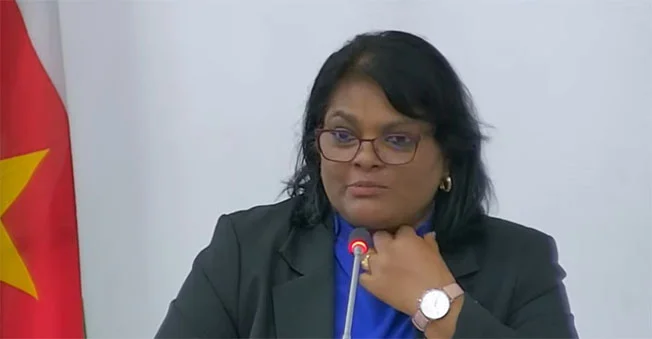
A senior Surinamese parliamentarian and former defense minister has laid out a robust case for urgent ratification of a bilateral agreement with the United States to intercept suspected civilian aircraft linked to illicit drug trafficking, arguing that the nation lacks the independent resources, operational capacity, and actionable intelligence to stem surging cross-border drug crime on its own. Krishna Mathoera, a representative for the ruling VHP party, delivered a detailed address to the National Assembly (DNA) during ongoing legislative debates over the bilateral anti-narcotics aviation support pact, pushing back firmly against critics who claim the deal would erode Suriname’s national sovereignty.
Mathoera, who led the country’s defense portfolio under the previous administration, framed transnational organized drug crime as a rapidly escalating national security emergency that has undermined state authority across large swathes of Suriname’s interior in recent years. She cited a string of documented incidents including the discovery and demolition of unregulated illegal airstrips, abandoned illicit smuggling aircraft found in remote jungle regions, and multi-tonne drug seizures both within Suriname and at regional border points as tangible proof that criminal networks have turned the country into a key transit hub for global narcotics shipments. These well-resourced syndicates operate with massive financial war chests and cutting-edge surveillance and transport equipment, she warned, creating elevated risks of corruption within domestic security services, spikes in gang-related violent incidents, and the gradual erosion of government control over peripheral territories.
Addressing the core parliamentary concern over potential sovereignty infringements, Mathoera argued that national sovereignty is already being actively violated by criminal groups that fly unauthorised through Surinamese airspace, build unregulated landing strips on state land, and operate outside the reach of domestic law enforcement. Under the terms of the bilateral agreement, she emphasized, Suriname retains full operational authority over all interception actions targeting suspicious aircraft, while U.S. support will be limited to supplementary funding, intelligence sharing, radar hardware, specialist training, logistical backing, and non-combat operational assistance. No U.S. personnel will have jurisdiction to conduct interceptions independently, she confirmed, with all final decisions remaining in the hands of authorized Surinamese national authorities.
The agreement, Mathoera clarified, includes strict binding safeguards aligned with international civil aviation regulations, with 17 formal assessment criteria to evaluate whether an aircraft is reasonably suspected of involvement in illicit drug activity. Minor deviations from filed flight plans or other routine irregularities will not automatically trigger interception protocols, she noted, and the pact explicitly rules out pre-emptive shooting down of civilian aircraft. Any use of weapons against civilian planes is permitted exclusively under narrow, internationally recognized self-defense conditions, in full compliance with global civil aviation safety rules. The core stated goal of the partnership is to identify unregistered suspicious flights, redirect them to their approved flight paths, guide them out of restricted airspace, or order pilots to land at designated official airports for inspection.
Mathoera also defended the controversial clause requiring Suriname to obtain U.S. consent before sharing sensitive intelligence provided under the pact with third-party nations, noting that strict confidentiality protocols are a standard, non-negotiable foundation of all cross-border anti-organized crime cooperation, as contributing nations must have full assurance that shared high-risk information will only be used for its intended counter-narcotics purpose. She described the U.S. right to suspend or terminate support if Suriname breaches agreement terms as a reasonable provision, while urging the current administration to formalize a reciprocal clause that would allow Suriname to pause or end the partnership unilaterally if U.S. actions violate the pact’s terms. She added that arbitrarily ending the cooperation without compelling, evidence-based justification would be deeply irresponsible given the country’s ongoing public security crisis.
Responding to parliamentary questions over the nearly two-year delay between the pact’s initial drafting and its recent submission to the National Assembly for ratification, Mathoera rejected allegations that the previous VHP administration intentionally stalled legislative review. She laid out a full documented timeline: the agreement was formally signed on October 15, 2024, forwarded to the then Ministry of Foreign Affairs that same month, followed by ratification procedure correspondence in November 2024, legal review and advice from the Ministry of Justice, a draft cabinet approval proposal completed in March 2025, and a formal request for guidance from the Council of State in June 2025. The subsequent national general elections and full transition to a new governing coalition led to the draft being temporarily sidelined, before President Jennifer Simons officially transmitted the full text to the National Assembly on January 26, 2026. She noted every procedural step is verifiable via dated official records, while acknowledging that some opposition lawmakers have raised questions over why the process could not have been expedited, referencing a preliminary 2023 cooperation memorandum on the same subject. Mathoera clarified that the 2023 preliminary document is legally distinct from the finalized, formally signed 2024 pact now under legislative review.
As part of her address, Mathoera also submitted formal requests to the current government to clarify which specific ministries and domestic security agencies will hold operational responsibility for implementing the pact post-ratification, what formal operating protocols will govern their work, and what exact role the Surinamese Civil Aviation Authority (CASAS) will play in vetting flight plans and registered aircraft to flag potential smuggling operations. She closed her remarks with a full endorsement of the agreement’s ratification, arguing that the U.S. partnership will deliver Suriname the critical additional technical, intelligence, and operational support required to dismantle transnational drug smuggling networks, restore full state authority over remote interior regions, and significantly strengthen long-term national public security.