In a pre-emptive enforcement action taken just hours ahead of a scheduled court hearing, Suriname’s Minister of Economic Affairs, Entrepreneurship and Technological Innovation Andrew Baasaron has ordered the seizure of a controversial 385-ton shipment of rice imported from Guyana, alleging the cargo entered the country without mandatory import licensing and constitutes an economic offense.
The seizure was executed early on the morning of October 6, well before the 10:30 AM summary proceedings brought by rice importer B. Ramadhin against the Surinamese state. Speaking to local outlet Starnieuws, Baasaron confirmed his ministry pre-positioned enforcement teams over the weekend, ahead of the court date, to act on the case immediately. The Economic Control Service (ECD), alongside police inspectors, led the seizure operation.
Baasaron emphasized that the early intervention is fully legally justified, noting the case involves more than just phytosanitary irregularities previously raised by another government department. Under Surinamese trade rules, rice is classified as a restricted import item listed on the country’s “negative list”, meaning any import requires explicit prior approval processed through the Suriname Electronic Single Window portal. According to the minister, no import license application for this rice shipment was ever submitted through the official system, marking a clear violation of economic regulations separate from the phytosanitary dispute.
The case stems from the shipment, which arrived in Suriname alongside a consignment of urea on the vessel MV Falk. The phytosanitary issue was first flagged by the Ministry of Agriculture, Livestock and Fisheries (LVV), whose minister Mike Noersalim confirmed the 384.8-ton rice shipment entered Suriname before any required phytosanitary clearance was requested. Court documents show the importer only submitted an application for a phytosanitary import permit on October 2, after the cargo had already arrived in the country. Ramadhin has denied attempting to evade inspections, stating he returned the shipment to the port for further checks following discussions with authorities, and is seeking court intervention to resolve the impasse.
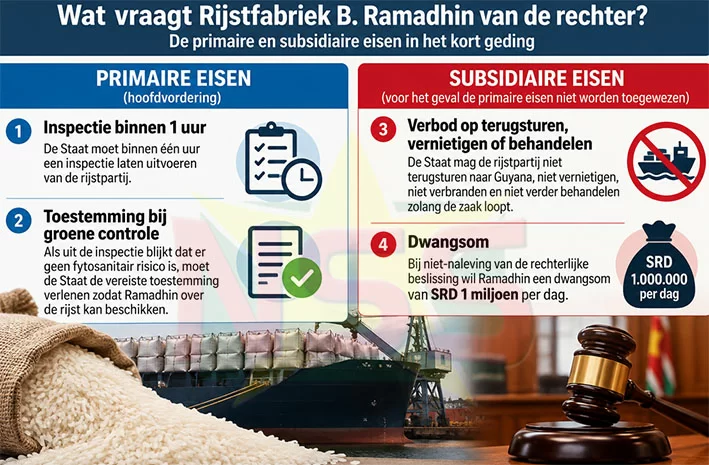
In his legal filing, Ramadhin has named the LVV specifically as a respondent. He is asking the cantonal court to order an inspection of the rice shipment, compel the government to issue the required import approval if no phytosanitary risks are identified, and issue an injunction barring the state from returning the rice to Guyana, destroying it, or altering it in any other way. The importer has also attached a daily penalty of 1 million Surinamese dollars for any non-compliance with a potential ruling in his favor.
Beyond the action against the importer, Baasaron is calling for severe disciplinary action against customs officials who already allowed part of the unlicensed shipment to leave the port. Customs falls under the oversight of the Ministry of Finance and Planning, and Baasaron says he has formally pushed the ministry to launch a full investigation into how the partial release was approved despite all import requirements not being met.
“Customs had all the documentation outlining what requirements the shipment needed to meet before they could release it, but for whatever reason, they failed to do that,” Baasaron said. He has demanded that senior leadership at the Ministry of Finance, the tax authority, and Customs hold accountable the officials responsible for approving the release, making clear the investigation is not limited to the importer but extends to determining government accountability for the error.
The minister also raised questions about the combined shipment of rice and urea on the same vessel, noting that while an import application was on file for the urea, none existed for the rice. He accused the importer of misleading authorities, adding that further investigation will determine whether the incident amounts to intentional misrepresentation or outright smuggling. Baasaron also confirmed that contrary to Ramadhin’s concerns, the government has no immediate plan to return the seized shipment to Guyana, a position that directly contradicts the importer’s request for a court order blocking any such action.
Baasaron reiterated that his ministry’s enforcement action, conducted ahead of the civil court proceedings, is legally valid and cannot be blocked by the ongoing civil case. “That is why I intervened immediately now, before these parties start their civil process,” he said. “A civil procedure cannot block enforcement action for an economic offense.” The ECD launched the seizure operation early in the morning, with the court hearing between Ramadhin and the Surinamese state kicking off just a few hours later.