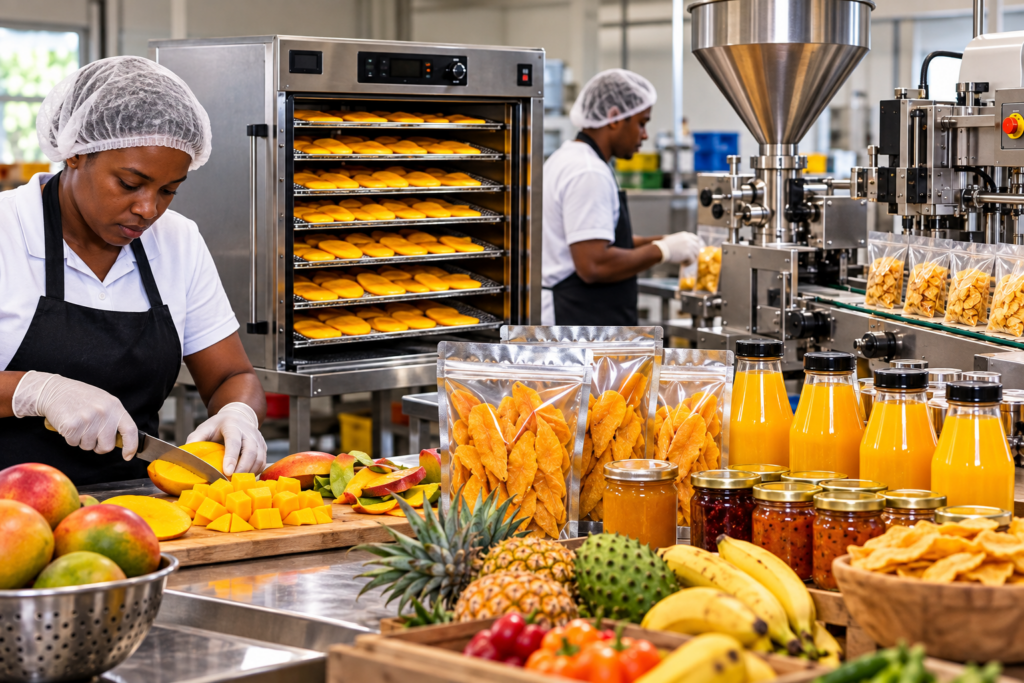
The government of Antigua and Barbuda is developing a new targeted adjustment to its existing entrepreneurship financing program, Prime Minister Gaston Browne has announced. Under the proposed change, the national Entrepreneurial Fund could directly purchase affordable small-scale manufacturing and food processing equipment, then make this machinery accessible to local aspiring business owners looking to launch their own ventures.
The initiative grew out of ongoing conversations about underutilized local agricultural resources, particularly the large volume of locally grown mangoes that go to waste every peak harvest season. Government leaders have raised questions about whether this surplus produce could be transformed into value-added products such as pure fruit juices, frozen fruit goods, and other shelf-stable items if local entrepreneurs had access to the right processing tools.
“One of the key adjustments we’re going to ask the Entrepreneurial Fund to make is to allocate resources to acquire specialized equipment for small operations,” Browne explained in his remarks. “Our core goal is to get more local entrepreneurs involved in diverse cottage industries that leverage our own natural resources.”
Unlike large-scale industrial manufacturing that requires millions in upfront capital investment, Browne noted that modern compact machinery for small producers is surprisingly affordable, lowering the barrier to entry for first-time business owners. To help local aspiring entrepreneurs find cost-effective options, he specifically pointed to global online B2B marketplace Alibaba as a valuable resource for researching and sourcing equipment.
“I encourage all of our people to set aside a little time to browse Alibaba,” Browne said. “You will be shocked by the wide range of consumer goods, manufacturing tools, and production equipment available at very competitive price points.”
Among the low-cost machinery Browne highlighted for small local businesses are food dehydrators, fruit processing lines, automated packaging systems, and even automated car wash equipment. He used potato chip production as a clear example of how simple, affordable equipment can launch a profitable small enterprise. “You don’t need to spend a fortune to get into potato chip manufacturing,” he noted. “All the basic processing and packaging equipment is available at very reasonable costs.”
Browne’s message to local residents with viable business ideas is straightforward: don’t hold back from applying for support from the entrepreneurship fund just because you think you can’t afford the necessary equipment to start production. “Go online, do your research, bring your solid business plans to the Entrepreneurial Fund, and we will work with you to make it happen,” he urged.
Under the framework being considered, the fund would purchase the equipment directly where appropriate, then make it available to qualifying local entrepreneurs. Browne did not, however, share further details on how the program would operate logistically: he declined to outline whether machinery would be leased, sold at a subsidized rate, or provided through another arrangement, nor did he share details on eligibility criteria for participating entrepreneurs.
The proposal comes at a time of growing momentum for domestic entrepreneurship in Antigua and Barbuda, Browne emphasized, noting that the fund now receives new applications for entrepreneurial financing every week. “I’m very encouraged by the steady increase in local people interested in starting their own businesses,” he said. “This is exactly the kind of growth we want to see.”
Browne also highlighted two recent success stories in local manufacturing to build support for the “buy local” movement. He pointed to a newly launched domestic toilet paper producer that now makes three-ply toilet paper locally, and shared that a larger-scale toilet paper manufacturing facility is on track to begin operations next year. He also noted the ongoing development of a new brewery by Antigua Distillery as another sign of expanding domestic manufacturing capacity across the country.
“So far, we’re already seeing meaningful improvements in our local manufacturing sector,” Browne said. “This new equipment initiative is designed to build on that momentum by removing one of the biggest hurdles new small producers face: the upfront cost of machinery.”
As of now, the proposal remains in the early planning stages. Browne has not yet announced a specific budget allocation for equipment purchases, nor has he shared a formal timetable for launching the new program.