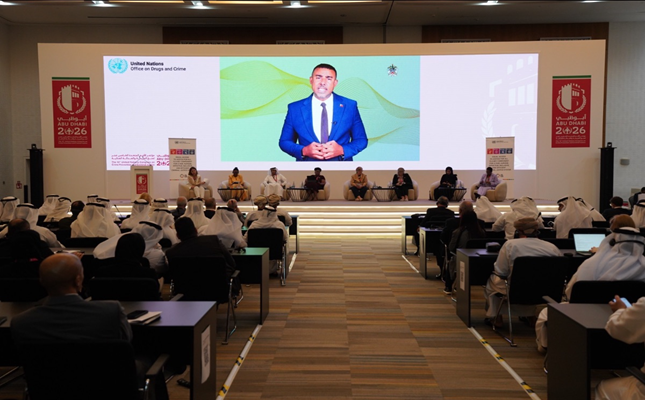
Against the backdrop of growing global demand for fair, accessible criminal justice systems, the small Caribbean Federation of Saint Kitts and Nevis has emerged as an unexpected leader in justice reform, taking center stage at the 15th United Nations Congress on Crime Prevention and Criminal Justice in Abu Dhabi on Sunday, September 27, 2026.
Invited by the United Nations Office on Drugs and Crime (UNODC) to share its groundbreaking progress with senior justice officials from across the globe, Saint Kitts and Nevis Attorney General and Minister of Justice and Legal Affairs Garth Wilkin addressed a high-profile thematic gathering focused on expanding access to justice for more effective and equitable systems. Wilkin joined a distinguished panel that included UNODC Executive Director Monica Juma, as well as cabinet ministers and senior government representatives from the United Arab Emirates, South Africa, Canada, the United Kingdom, Kenya, and Romania.
UNODC’s invitation to Saint Kitts and Nevis reflected the international community’s recognition of the Federation’s consistent commitment to building a people-centered, evidence-based, inclusive, and accountable justice sector. The invitation also highlighted ongoing collaborative work between the Caribbean nation and the UN agency to advance equitable justice access for all citizens.
The data shared by the Saint Kitts and Nevis delegation underscored the tangible impact of the country’s reforms. Compared to 2024, homicide rates dropped by 75% in 2025, hitting their lowest point in more than 20 years. This dramatic reduction has come from a fundamental shift in how the Federation approaches justice, Wilkin explained during his virtual address to the congress.
“Rather than only how we bring people into the justice system more efficiently, we increasingly ask, what is the appropriate justice pathway for this person, this harm and this community?” Wilkin said.
This person-centered approach has spurred two major policy innovations: a Diversionary Caution framework and a expanded Restorative Justice framework. Working in partnership with UNODC, more than 100 police officers, prosecutors, judges, and social service professionals have already received training to implement the Diversionary Caution system, which redirects eligible individuals away from traditional incarceration toward alternative resolutions that address the root causes of harm. The new Restorative Justice framework creates interconnected pathways for conflict resolution across police departments, prosecution offices, court systems, and local community groups. Looking ahead, the Federation also plans to launch the Community Justice Cup, a youth football initiative designed to teach conflict resolution and restorative values to young people across the islands.
Wilkin emphasized that the Federation’s small size has been a strategic advantage in implementing and refining these reforms, positioning small island states as more than just recipients of global policy guidance. “Small States can therefore be not merely beneficiaries of justice reform, but important contributors to its development,” he noted.
Looking forward, the next major priority for Saint Kitts and Nevis will be comprehensive correctional reform. Wilkin called for expanded international partnerships to support Small Island Developing States (SIDS) in building modern correctional systems centered on rehabilitation rather than just punishment. He argued that without intentional investment in outcomes during and after incarceration, even the most fair trials and effective prosecution leave the justice system incomplete. “If we invest in fair trials and effective prosecution but not in what happens during and after incarceration, the justice continuum remains unfinished,” he said.