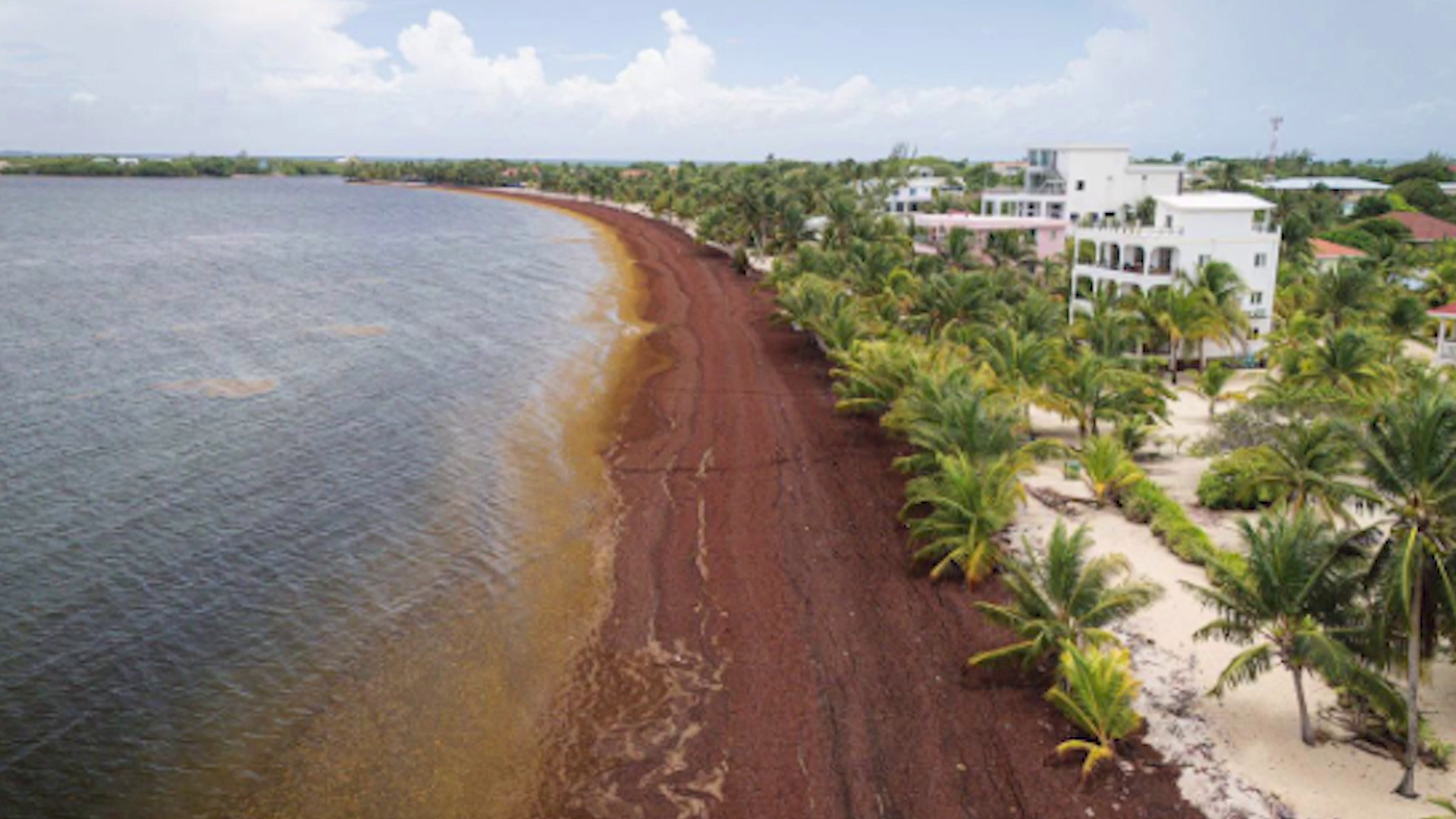
A worsening sargassum seaweed crisis is steadily encroaching on coastal regions of southern Belize, leaving local residents and tourism business owners decrying the national government’s insufficient response to the growing environmental emergency. For months, dense mats of the brown algae have washed ashore in record volumes, smothering once-pristine beaches, disrupting tourism operations that form the backbone of the local economy, and putting the long-term livelihoods of thousands of coastal community members at direct risk. As public frustration mounts over the slow progress, senior government officials have acknowledged that no permanent fix for the crisis has yet been identified – and stressed that Belize is far from alone in grappling with this transnational regional challenge.
Orlando Habet, Belize’s Minister of Sustainable Development, recently addressed the ongoing crisis in a public briefing, confirming that policymakers across the Caribbean and Central American region have yet to develop a permanent, scalable solution for unrelenting sargassum influxes. “I believe that anybody will say that not enough attention is being given. There is no final solution for sargassum, not in Mexico, not in the Dominican Republic, not in Barbados, not in Belize, nowhere,” Habet stated. “We are all trying to see what works best, and we are trying to see what we can adopt from what Mexico has done that they say works for them.” Mexico has emerged as the global leader in sargassum management, investing more funding and research into mitigation efforts than any other affected nation, Habet explained. Currently, Mexico’s primary strategy centers on mechanical collection of washed-ashore seaweed, with policymakers now advancing initiatives to process harvested sargassum into marketable products that can generate revenue to offset cleanup costs. Even with these advances, however, the crisis remains a continuous, long-term challenge that will persist for years unless a transformative intervention is developed.
Habet emphasized that Belize’s government has already fulfilled its core commitments to addressing the crisis, and called for greater participation and investment from the country’s private sector to scale up mitigation efforts. Currently, the Ministry of Tourism is finalizing plans for a new cleanup initiative that will bring in specialized heavy equipment to speed up removal of accumulated seaweed along affected coastlines in the near term. Beyond immediate cleanup efforts, the government is also exploring a pilot project funded by the United Nations that would convert harvested sargassum into usable energy, turning the harmful invasive algae into a productive resource that can reduce the crisis’s environmental and economic impact while delivering energy benefits to local communities. For southern Belize’s coastal residents and business owners, however, even these incremental plans cannot reverse the damage the ongoing sargassum influx has already caused, leaving many waiting for urgent, large-scale action to protect their homes and livelihoods.