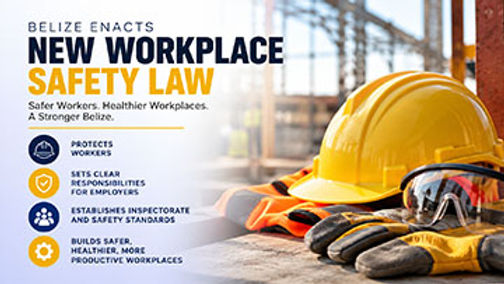
In a historic step forward for worker rights and labor standards across the Central American nation, Belize has formally passed a new, comprehensive Occupational Safety and Health Act that expands protective safeguards for employees and codifies clear, updated safety responsibilities for all employers. The government officially announced on Wednesday that the Occupational Safety and Health Act 2026 has been fully enacted and gazetted, framing the new legislation as a contemporary regulatory framework designed to raise baseline workplace health and safety standards across every sector of the national economy. Unlike fragmented previous regulations, this new law applies universally to all workplaces across both the public and private sectors, covering a wide range of work environments that have historically lacked consistent oversight—from high-risk construction sites and heavy industrial facilities to in-home domestic work positions and a portion of modern remote work setups. Under the terms of the legislation, employers are now legally mandated to implement reasonable proactive measures to eliminate or reduce risks to their workforces. These requirements include regular mandatory risk assessments of work sites, systematic management of identified workplace hazards, strengthened systems for reporting workplace accidents and occupational diseases, and the rollout of evidence-based preventive measures to mitigate harm before incidents occur. For workers, the act delivers a suite of enhanced legal protections that address longstanding gaps in Belize’s labor regulations. Most notably, workers are now protected from employer retaliation and reprisals when they file reports about unsafe working conditions, and they have gained the explicit legal right to refuse work assignments when they hold a reasonable belief that the task poses an imminent and serious threat to their health or personal safety. The legislation also establishes two new permanent national bodies to oversee enforcement and policy development: the National Occupational Safety and Health Advisory Committee, which will guide strategic policy direction, and the dedicated Occupational Safety and Health Inspectorate, which will be tasked with conducting routine workplace inspections, monitoring compliance with the new standards, and rolling out related public safety initiatives. Additional provisions of the act set out strict new regulations for the handling, storage and exposure mitigation of hazardous substances, toxic chemicals and dangerous biological agents. It also formalizes increased worker participation in safety governance by requiring or supporting the establishment of workplace-level Safety and Health Committees and elected Safety and Health Representatives, giving workers a direct voice in shaping on-site safety practices. While the legislation has already been formally enacted, government officials confirmed that the full framework will not go into effect immediately. Instead, all provisions will be rolled out in a phased sequence through formal commencement orders issued by the responsible government minister. This staggered approach is designed to give authorities time to put all necessary administrative and institutional infrastructure in place before active enforcement begins. The Belizean Labour Department has been named the lead agency overseeing the entire implementation process. Its responsibilities include building out the new Occupational Safety and Health Inspectorate, drafting secondary regulations and industry-specific codes of practice, carrying out nationwide public education campaigns to inform both employers and workers of their new rights and obligations, training new inspectors and workplace stakeholder groups, and developing digital and administrative systems for compliance tracking and incident reporting. Government leaders characterize the new law as one of the most meaningful advancements in worker protection that Belize has seen in the past several decades. They added that successful implementation will rely on active cross-stakeholder collaboration, bringing together employers, organized labor unions, professional industry organizations, civil society groups and worker representatives to bring the framework’s protections to life across the country’s workplaces.