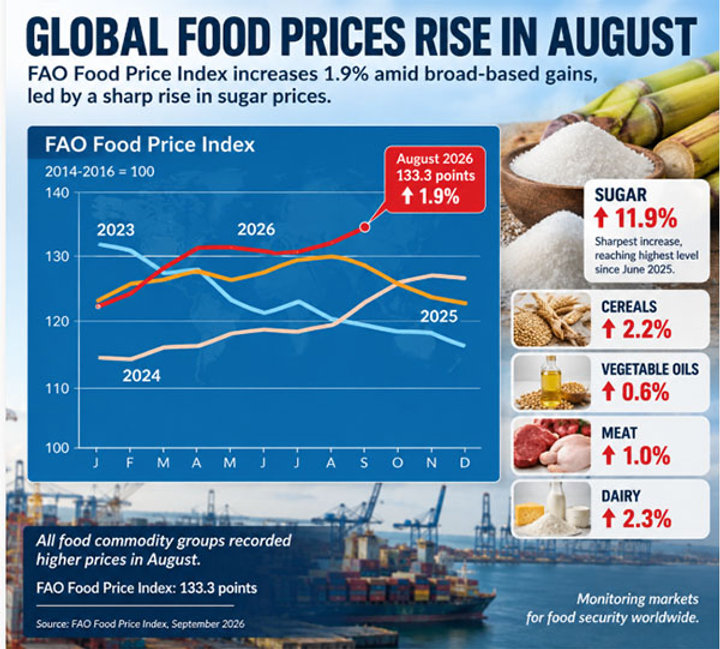
International food commodity markets faced a broad-based upward price push in August 2026, with every major food category tracked by the United Nations Food and Agriculture Organization (FAO) recording gains, according to new data from the intergovernmental agency. The sharpest spike was seen in sugar markets, where prices surged nearly 12% month-over-month, driving the overall global food price increase.
The FAO’s flagship Food Price Index, which tracks monthly changes in international prices of a basket of core food commodities, hit an average of 133.3 points in August 2026. This marked a 2.5-point increase from the revised July 2026 reading, and pushed the benchmark 2.5% higher than its level in August 2025. Even with this sustained upward trend, the August 2026 index remains 16.8% below the all-time record peak set in March 2022, when global commodity markets were upended by widespread geopolitical disruption.
By a significant margin, sugar posted the steepest monthly gain among all tracked categories. The FAO Sugar Price Index climbed 11.9% to reach 106.4 points in August, its highest level in just over 12 months. FAO analysts traced this dramatic jump to widespread market concerns over upcoming 2026/27 season global sugar supplies. Unseasonably hot and dry weather across the European Union has damaged sugarbeet growing prospects, while lingering El Niño-related weather patterns have cast uncertainty over sugar output across major producing regions in Asia. Compounding these supply risks, lower-than-expected harvests in Brazil’s key Center-South production hub, paired with India’s recent announcement that it will allow duty-free imports of raw sugar, have added extra upward pressure to global sugar prices.
Cereals were the second-fastest growing category, with the FAO Cereal Price Index rising 2.2% to hit its highest point since May 2024. Price increases were recorded across all major grain markets. Wheat prices rose 2.6% in August, and are now 15% higher than they were one year ago. FAO cited persistent disruptions to Black Sea export routes, lower projected output across European growing regions, and ongoing strong global consumer demand as the primary factors pushing wheat prices higher. Maize prices also posted a 2.5% gain, driven by growing market anxiety over drought and heat-related production impacts in both the United States and European Union.
Dairy prices reversed a three-month downward trend to climb 2.3% in August, with higher wholesale prices for milk powders and cheese leading the broad category gain. Even with the monthly increase, the overall dairy price index still sits 21.7% below its August 2025 level. Meat prices recorded a more modest 1% uptick, with higher prices for poultry, pork, and sheep meat offset by a small decline in international beef prices. Vegetable oils posted the smallest monthly gain at just 0.6%, but even this mild increase pushed the vegetable oil index to its highest level since June 2022. Higher prices for palm and soy oil more than offset small declines in the values of sunflower and rapeseed oils.
The August 2026 price data confirms that upward pressure on food costs is not isolated to a single commodity market. For the first time in recent months, all five of the major food categories measured by the FAO posted simultaneous monthly gains, signaling a broad-based shift upward in global food commodity prices that could impact consumer costs worldwide in the coming quarters.