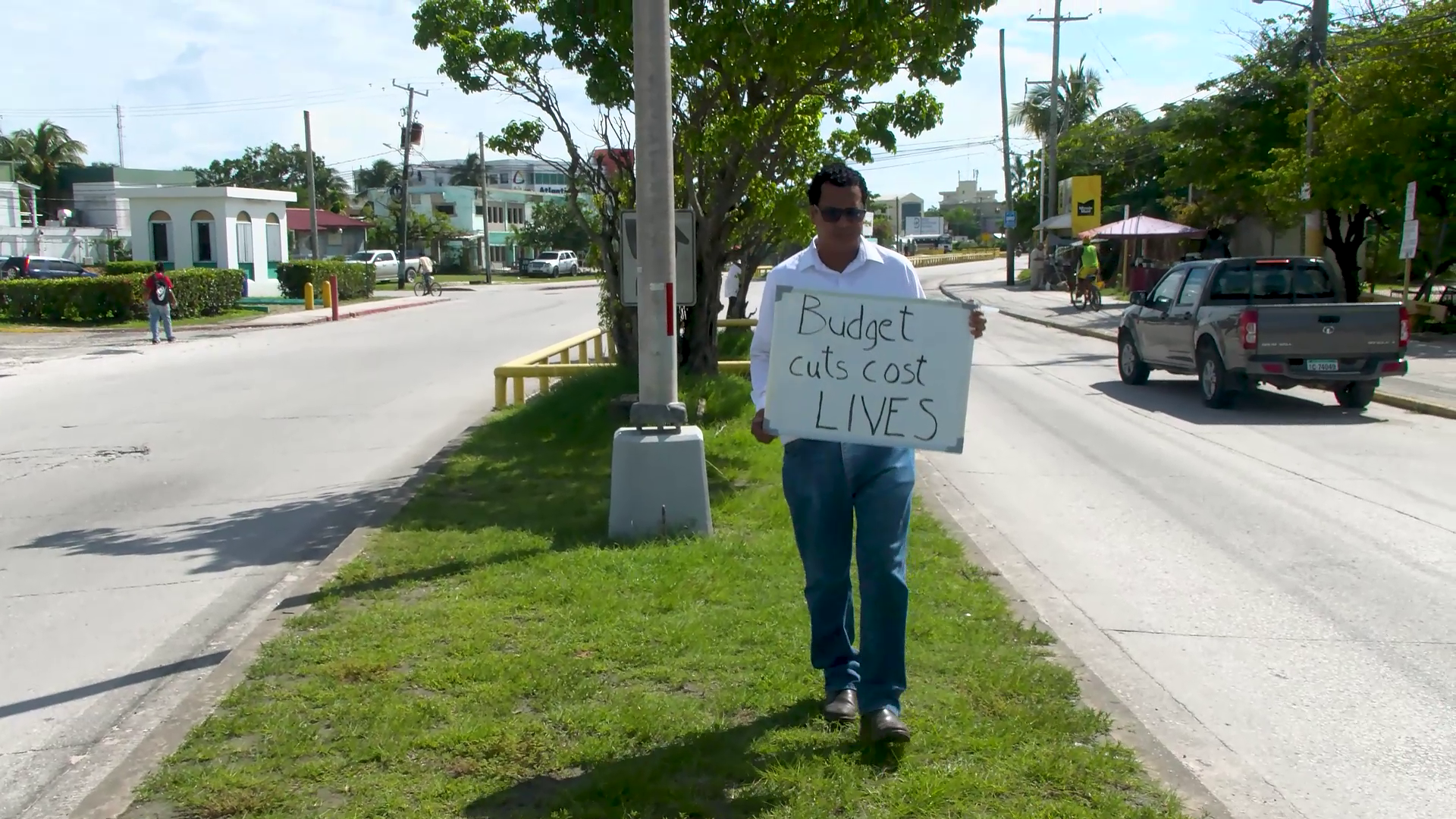
On November 9, 2026, Union Senator Glenfield Dennison continued his ongoing public outreach campaign centered on issues impacting everyday Belize residents, making a high-profile appearance at Belize’s sole tertiary care facility, the Karl Heusner Memorial Hospital (KHMH), to challenge the administration’s current public spending priorities. The visit followed a weekend demonstration held in Belize City, where Dennison first highlighted the cascading strain of the country’s rising cost of living on working households, noting that deepening poverty is pushing growing numbers of citizens into precarious, unprotected circumstances. During his address at KHMH, Dennison laid out sharp concerns that diverting substantial public funds to expand the National Health Insurance (NHI) program while chronically underfunding the core public hospital system risks irreversible harm to patient access to care and clinical health outcomes. He emphasized his core objection that the current structure of NHI spending is disproportionately funneling benefits to private sector stakeholders at the expense of the public healthcare system that serves the majority of low-income Belizeans. “I firmly believe that the investment the government is making in the national health insurance is structured to let the private sector profit off public healthcare, and that is unacceptable,” Dennison stated. “The resources currently being poured into NHI could have made a transformative difference if allocated strategically to shore up our public healthcare infrastructure. It is incomprehensible that while we channel such large sums into NHI, we are failing to take basic steps to ensure KHMH, the only tertiary hospital in the entire country, has all the supplies, equipment, and adequately compensated, full-time roster of doctors, nurses, and specialized technical staff it requires to operate safely.” He went on to decry the broader systemic failures that have created a landscape where healthcare is increasingly treated as a profit-generating commodity rather than a universal public good, a trend he called a shameful, unspoken taboo in Belizean society. Drawing a stark parallel to Jonathan Swift’s 1729 satirical essay *A Modest Proposal*, which sarcastically suggested impoverished Irish families sell their children to wealthy landowners as food to alleviate poverty, Dennison noted that while literal cannibalism is not occurring in 21st century Belize, the country’s unaddressed cost of living crisis and gaps in social safety nets are driving a far too real crisis of child exploitation. “Swift wrote that piece 300 years ago to mock cruel, neglectful policy that abandons the poor, and that brutal satire is still painfully relevant today,” Dennison explained. “We are not eating children, but we are seeing children pushed into prostitution because their families cannot afford to buy food to survive.” He closed his remarks with a formal call to the national government to take immediate, targeted action to reduce widespread household poverty, redirect health funding to shore up the under-resourced public hospital system, and implement stronger legal and social protections to shield vulnerable children and at-risk families from exploitation. This report is adapted from the official transcript of the outlet’s evening television newscast, with statements originally delivered in Kriol transcribed using a standardized, accessible spelling system for full accuracy.