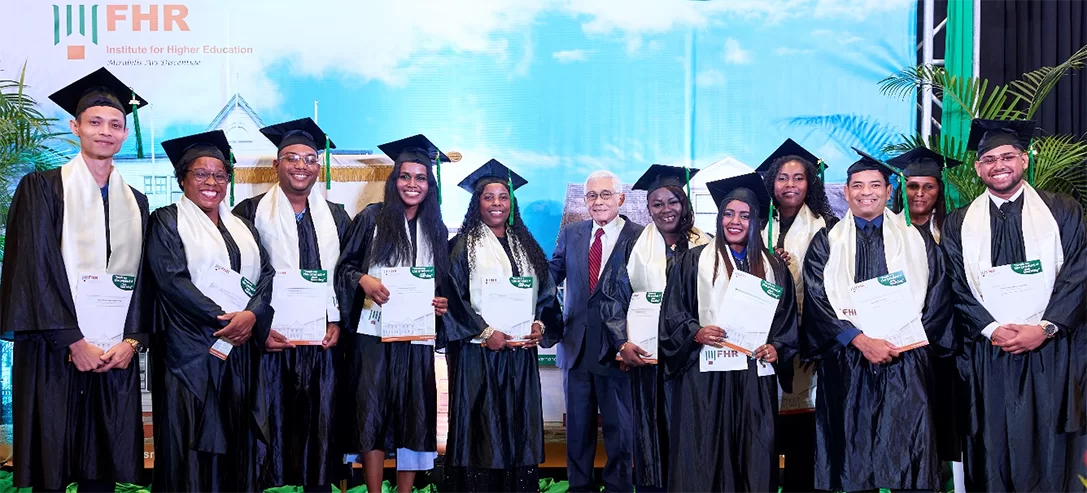
As Suriname prepares for major new offshore oil and gas development, a leading higher education leader is challenging the country’s graduating professionals to reframe their relationship to national development, urging a break from outdated postcolonial mindsets to embrace a modern, globally focused vision centered on inclusion, equality and sustainability. The call came from Hans Lim A Po, rector of the FHR Institute for Higher Education, during the institution’s 2026 Grand Graduation ceremony held at Paramaribo’s Royal Torarica Ballroom, an event that also marked a historic milestone for legal education in the South American nation.
This graduation cycle saw FHR produce its first-ever cohort of Master of Business Law graduates, a program run in partnership with the Netherlands’ Maastricht University. Sixteen students successfully completed the degree, a step that institute leaders describe as a major leap forward for advanced legal education across Suriname. The 2026 ceremony carried the central theme: “Moving into the Future: How Education Contributes to Global Citizenship.”
Lim A Po acknowledged that national expectations for the coming oil and gas sector are overwhelmingly focused on the transformative economic benefits the industry could bring to Suriname, a framing he calls understandable. But he also noted a growing national consensus that the nascent sector carries severe environmental, social and governance risks that will require deliberate, skilled management from the country’s political and civic leaders. Against this backdrop, he argued, the nation’s newly minted highly educated professionals carry a unique responsibility to shape the sector’s trajectory for the public good.
A core part of that responsibility, Lim A Po told graduates, requires leaving behind lingering postcolonial thinking patterns that have fostered social dependency, weak norms of self-governance and an extractive economic culture that prioritizes short-term resource extraction over long-term inclusive prosperity. In place of these outdated frameworks, he urged graduates to adopt a modern, global outlook rooted in the core values of inclusion, equality and sustainability.
Lim A Po grounded his message in the broader framework of global citizenship, drawing on the work of American philosopher Martha Nussbaum, who has argued that modern higher education must prepare students not only for participation in their national or local communities, but also for engagement in an increasingly interconnected and interdependent global society. Contrary to common framing, Lim A Po emphasized that national citizenship and global citizenship are not mutually exclusive concepts. Instead, he described them as mutually reinforcing frameworks: national citizenship provides the formal legal foundation for action, while global citizenship offers a broader ethical direction to guide that action.
The central challenge for modern citizens, he argued, is to “think globally, act locally”: major global challenges around justice, climate change, sustainability and planetary health ultimately must be translated into concrete local and national policy and personal choices within every individual’s own community. This is no simple task: local action can often feel too limited to meaningfully move the needle on large-scale global problems, while even small local decisions can carry ripple effects that extend far beyond national borders.
Beyond environmental and economic sustainability, Lim A Po noted that a global citizenship framework also creates pathways to overcome what he called the “politics of difference,” the deep social divisions that run along ethnic, racial, religious and other identity lines in many societies. A global mindset, he explained, requires openness to diverse ideas and perspectives, and prioritizes values such as empathy, respect for difference and cross-border collaboration. He also issued a warning, however: global citizenship cannot be just a performative posture adopted to earn external recognition. It must grow from deeply held personal conviction and a genuine willingness to take responsibility for collective outcomes.
Lim A Po also addressed the rising tide of youth-led activism across the globe, noting that since the start of the 21st century, Generation Z in particular has organized peaceful mass movements to speak out against socioeconomic inequality, nepotism and systemic corruption. While established institutional actors often frame these movements as a threat to existing social norms, Lim A Po argued that youth activism is better understood as a natural response to institutional and governance failures to uphold shared global values. This, he said, creates a clear mandate for universities and other higher education institutions: global citizenship must be integrated into core academic curricula, so that students gain not only technical professional knowledge, but also learn to think critically about their own choices, their leadership and their broader social responsibility.
Closing his address to the new graduates, Lim A Po quoted Thomas Paine’s 1792 declaration: “My country is the world, and my religion is to do good.” He expressed his hope that this principle would serve as a guiding ethos for the FHR’s newest cohort of alumni as they step into leadership roles across Suriname and beyond.