On October 25, local time, the Drs. L. Mungra Medisch Centrum (MMC), a parastatal medical facility based in Nickerie, Suriname, emerged as one of the few state-affiliated public institutions to complete its 2025 annual financial statements ahead of schedule. The submission of these official financial documents marks the hospital’s formal accountability for its 2025 fiscal performance, operational governance, and overall financial standing. However, a third-party audit conducted by IJssel Accountants N.V. has flagged critical gaps in the facility’s financial administration protocols, internal control frameworks, and the professional expertise of its in-house finance department, leading auditors to issue a formal disclaimer of opinion on the full 2025 financial report, rather than a standard positive validation.
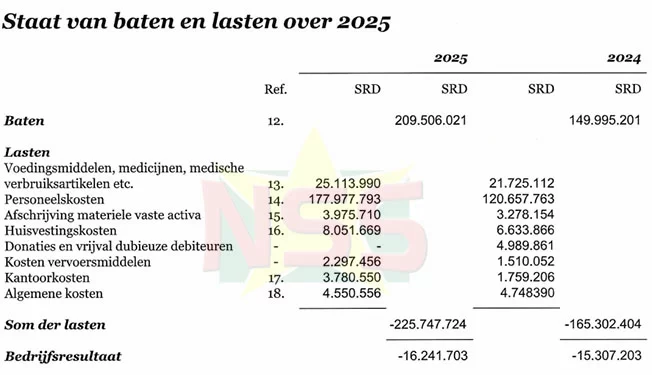
The 2025 fiscal year saw MMC record a net operating loss of SRD 16.3 million, a modest increase from the SRD 15.5 million deficit posted in 2024. Hospital leadership contextualized this shortfall against the broader structural realities of Suriname’s public healthcare ecosystem, noting that state-funded medical institutions prioritize accessible, high-quality patient care over generating profit, and rely heavily on government disbursements to sustain core services. Even so, administrators acknowledged that rigorous revenue and expenditure management remains non-negotiable to preserve uninterrupted care delivery for local communities.
Auditors clarified that a disclaimer of opinion does not confirm the financial statements are inaccurate; rather, it reflects that insufficient verifiable audit evidence was available to validate the completeness of all reported revenues and the accuracy of all logged costs, due to the underdevelopment of the facility’s administrative organization and internal oversight systems. The audit team submitted targeted recommendations to MMC’s board, urging accelerated efforts to upskill finance staff, refine financial reporting workflows, and strengthen internal check mechanisms to build a more transparent, reliable financial governance structure. These actionable findings have been framed by hospital leadership as a clear roadmap for targeted operational improvements, rather than a punitive judgment.
A deep dive into the 2025 financial figures reveals that total annual revenue for MMC surged to SRD 209.5 million, up nearly 40% from the SRD 150 million recorded in 2024. However, total corresponding expenditures rose in tandem, climbing from SRD 165.3 million in 2024 to SRD 225.7 million in 2025. Personnel costs accounted for the overwhelming majority of outgoing funds, jumping from SRD 120.7 million in the prior year to nearly SRD 178 million in 2025, representing roughly 85% of the facility’s total annual revenue. Additional significant cost drivers included pharmaceutical supplies, disposable medical consumables, facility maintenance, housing-related expenses, and upkeep of diagnostic and treatment equipment, leaving the hospital’s regular operating revenue insufficient to cover all recurring costs.
While the hospital’s liquidity profile remains a key area of ongoing concern, it has shown marked year-over-year improvement. Cash on hand dropped from SRD 6.4 million at the end of 2024 to SRD 3.5 million by the close of 2025, but the facility’s negative working capital position shrank dramatically from SRD 86.2 million in 2024 to SRD 37.7 million in 2025, as short-term liabilities of SRD 98.8 million were offset by current assets totaling SRD 61.1 million. Most notably, MMC’s net equity swung from a negative founding capital position of SRD 137.1 million to a positive SRD 109.5 million at the end of 2025, a shift that administrators explicitly noted stems largely from one-time revaluations of the hospital’s land and physical buildings, plus corrective adjustments to long-outstanding historical debts, rather than sustainable operational improvements.
The official annual report underscores that MMC’s long-term operational continuity is heavily dependent on the Suriname national government’s willingness to continue covering its recurring financial shortfalls, a dependency that auditors flagged as a material uncertainty for the facility’s long-term viability. The hospital’s core public mandate to deliver safe, accessible, high-quality care means that revenue generated directly from patient services is rarely sufficient to cover steep personnel, medical supply, and infrastructure costs, making consistent, timely government disbursements a critical lifeline for operations. Auditors emphasized that paired with reliable public funding, robust long-term financial planning and disciplined expenditure controls are essential to mitigate continuity risks.
In its official governance report, MMC’s board outlined that 2025 already saw targeted progress to upgrade financial administration workflows, enforce stricter spending discipline, reinforce internal oversight structures, and clarify role-based responsibilities across administrative departments. Looking ahead, the institution’s multi-year strategic roadmap prioritizes full professionalization of its administrative teams, large-scale modernization of outdated medical equipment and patient care infrastructure, widespread digitalization of administrative and clinical workflows, and tangible improvements to overall patient care quality for the Nickerie region.